Categories
COVID Archives

COVID analytical update – Thursday, May 28

I estimate that NY has less COVID than CA

Things continue on track — COVID is receding at a good pace. Everything is looking good, other than California and Virginia, but Virginia shows a decline today – just one day, but better than the alternative. Record tests were reported today – over 450,000! – 95% were reported negative, a very good number.

I continue to think that with COVID declining quickly, that these reports are no longer useful. However, the press hasn’t received the memo yet, and nearly all headlines are still inaccurate and overwhelmingly negative, so I’m determined to keep producing these until the news catches up with the facts.

As always, feel free to send me your questions about my assumptions, methodology, or modeling in general.

  • Likely date of active case peak (Chalke modeling): April 10
  • Likely date of peak deaths (IHME): April 15 (last revision on May 26)
  • Short term projection for active cases tomorrow: 143,000
  • Total Test Results reported today: 453,560 (record high)
  • Total Pending tests reported today: 1,906 (very low)
  • National reported case Growth Rate today: 1.36% (very low)

Shane Chalke Interviews

https://www.fredericksburg.com/opinion/editorial-unlock-demographically-not-geographically/article_a62e6e70-dccd-51cf-b7b2-16d77a90fd9c.html

Website

Groom Ventures has agreed to host a website that will archive my daily reports, and supplement with other commentary. John Groom worked at one of my companies back in the day, and is an excellent writer. The website is: www.howmuchrisk.com For those of you that post my daily report on Facebook, let me suggest you link to this site, as the direct Facebook posts don’t seem to copy the graphs.

Daily Analysis

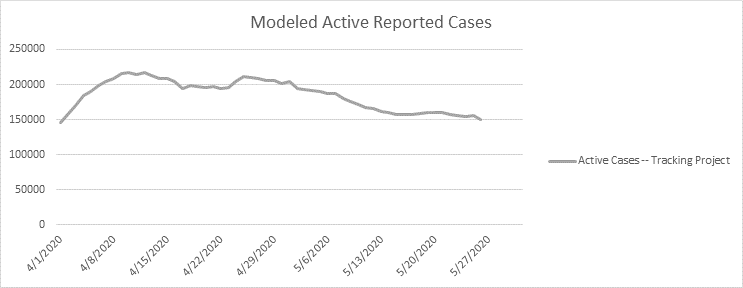
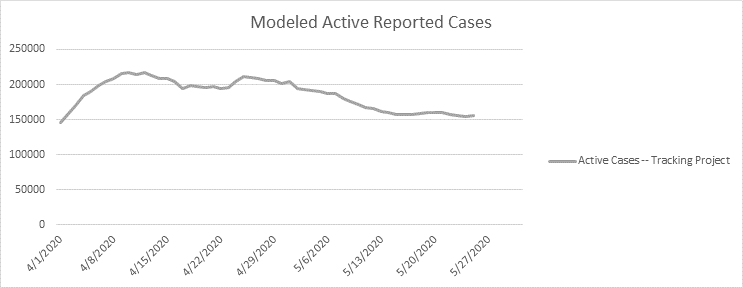
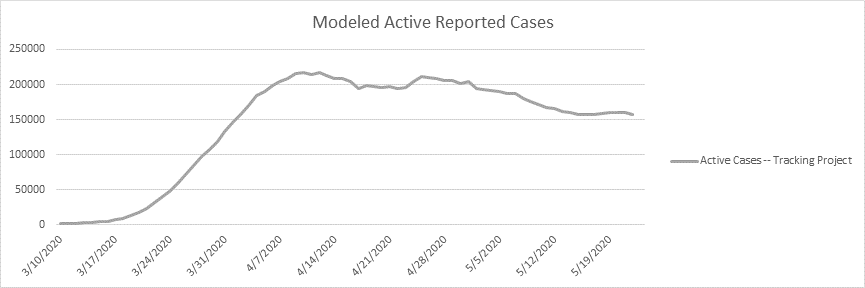
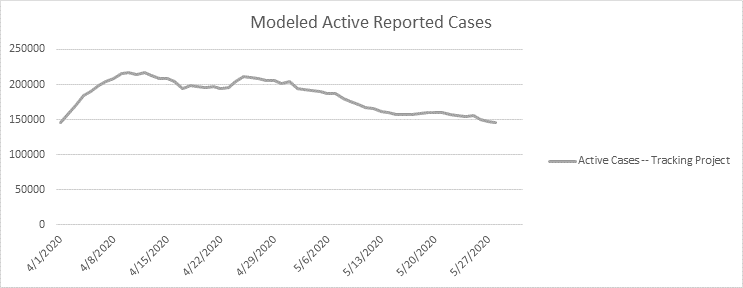
Here is the national picture of active cases – another decline today down to 145,000. We’re down 33% from the peak. I projected a few weeks ago that we’d be down 50% by the end of May. With the issues in CA and VA we might not make it, but we’re heading there. I now model known active cases at a tiny sliver of the U.S. population – about 0.043%.
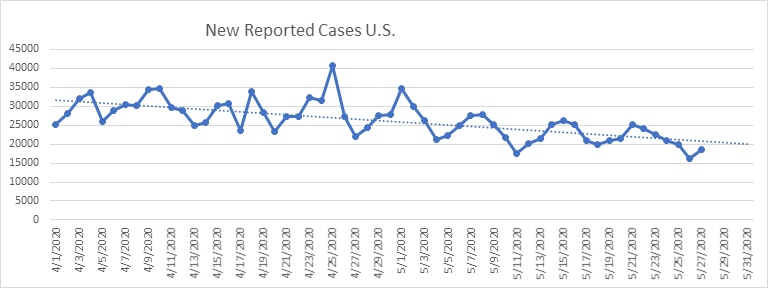
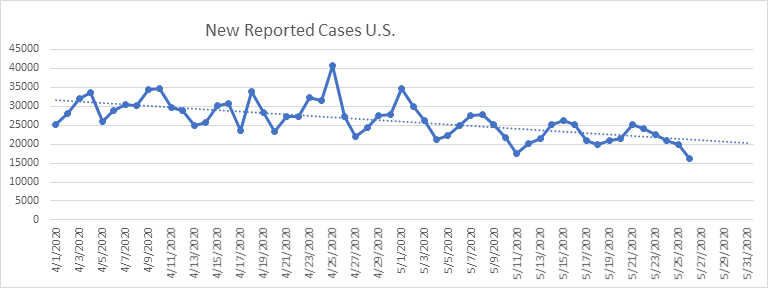
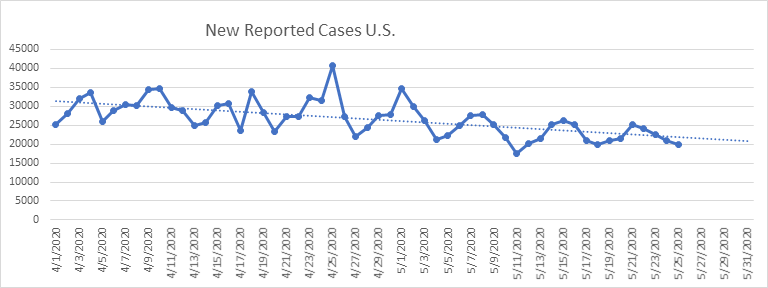
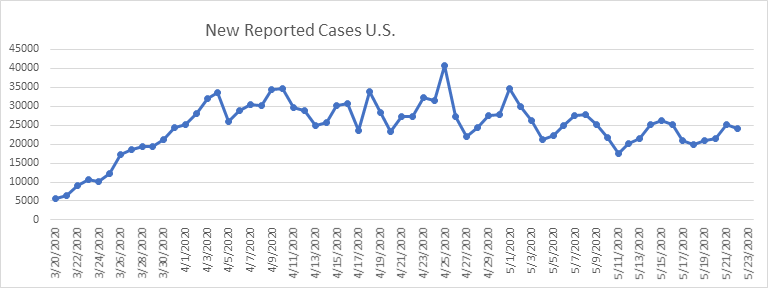
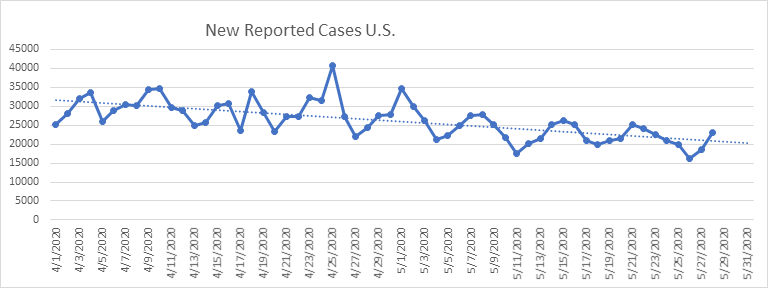
Here are the new reported cases nationally. All still tracking in the right direction. Thursday is usually a big day for reporting, so I think all is tracking well.
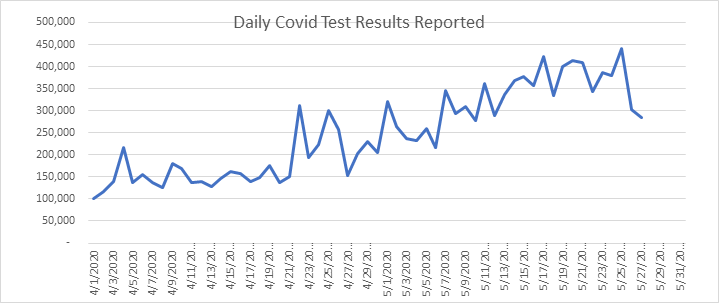
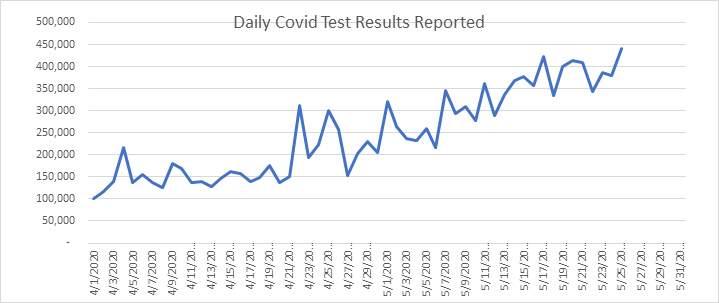
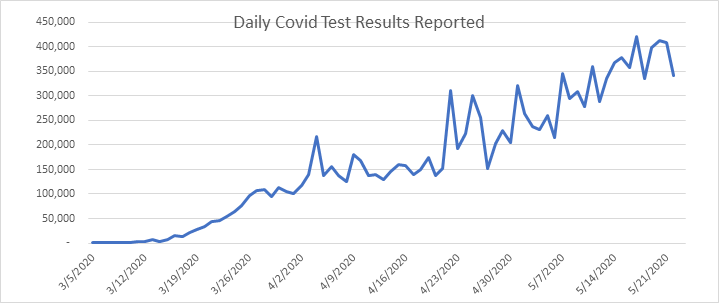
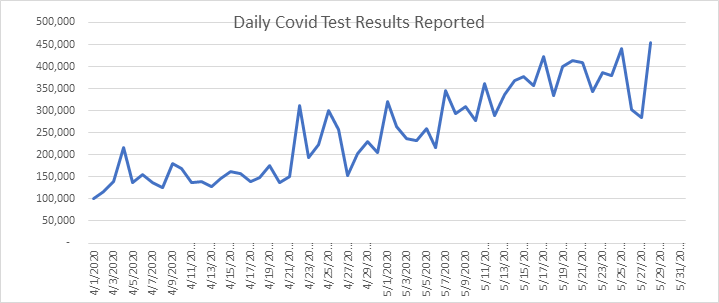
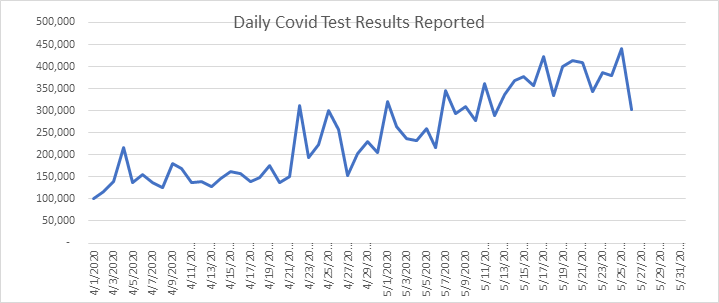
Here are the daily reported tests. A new record set today – we must be testing a lot of asymptomatic people now. It’s the only explanation. As a result, I think the number of undiscovered cases as a percentage of reported cases must be falling.
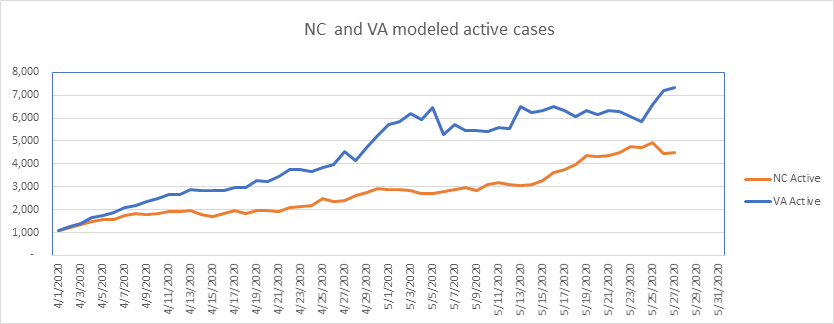
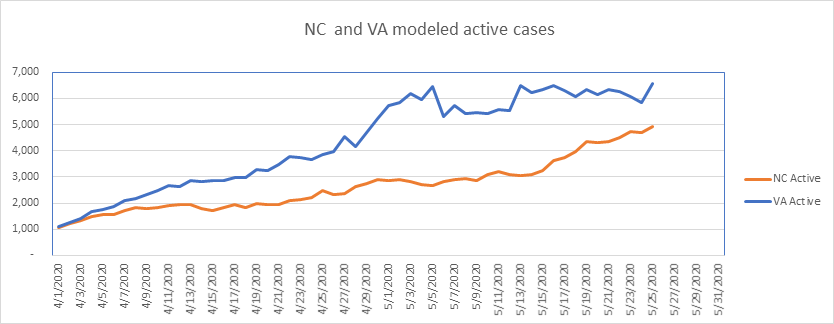
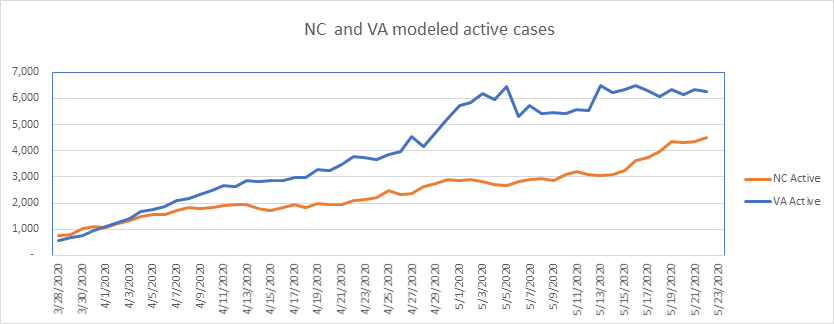
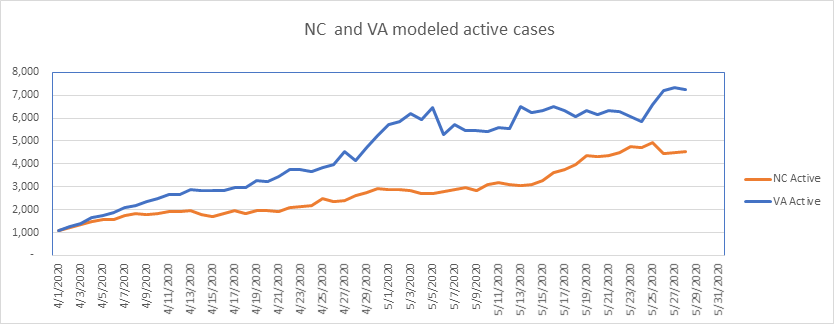
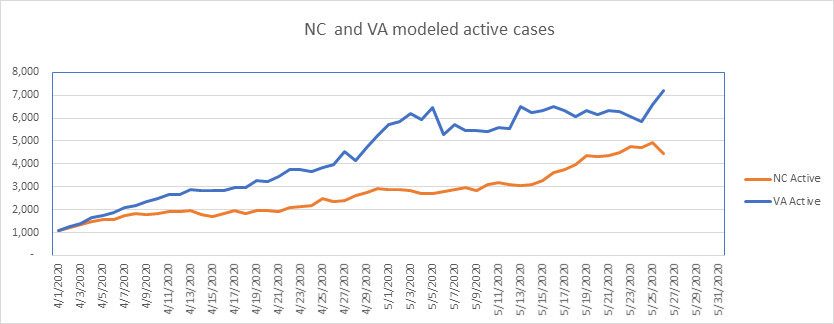
On to the states. VA and NC are diverging recently, even though NC is in Phase 2 and VA hasn’t substantially entered Phase 1 yet. We see a small drop in VA today, which is hopeful.
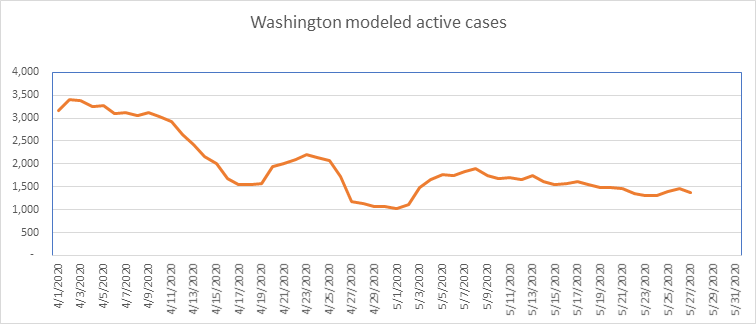
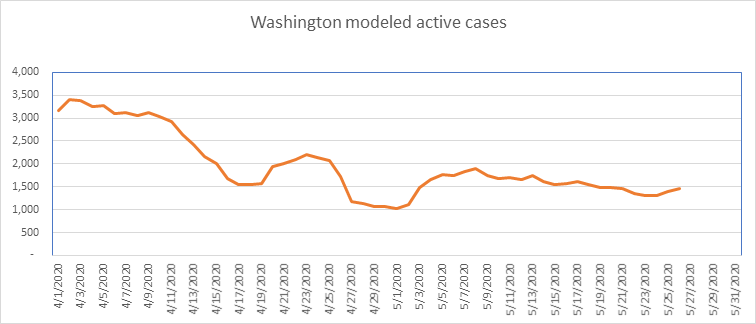
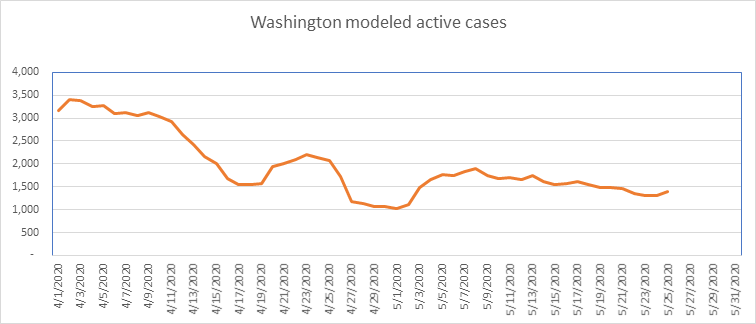
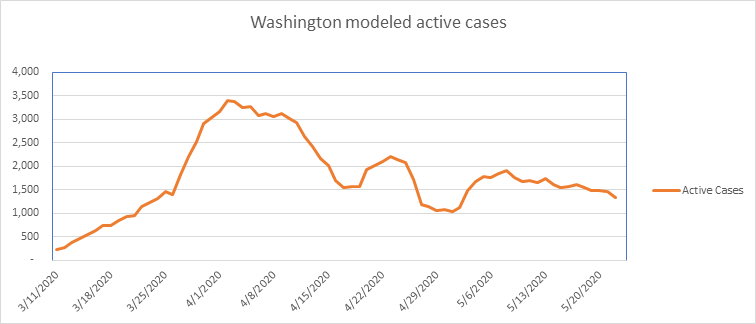
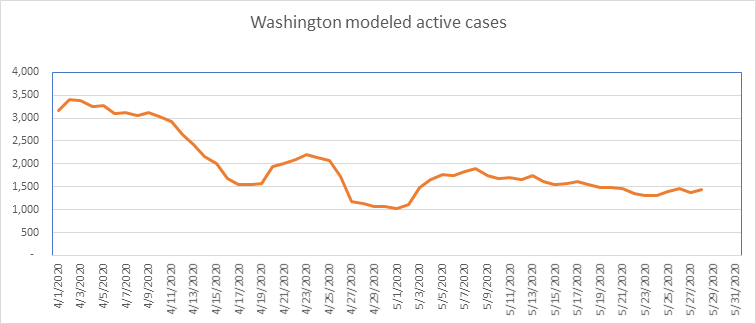
No surprises with Washington – long slow decline – total remaining cases are small – about 1400. It’s so small that it’s not really worth reporting on, but Washington was an early hot spot, so we’ll continue with it until the end.
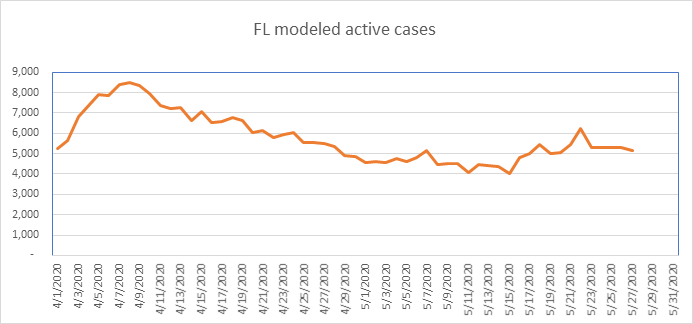
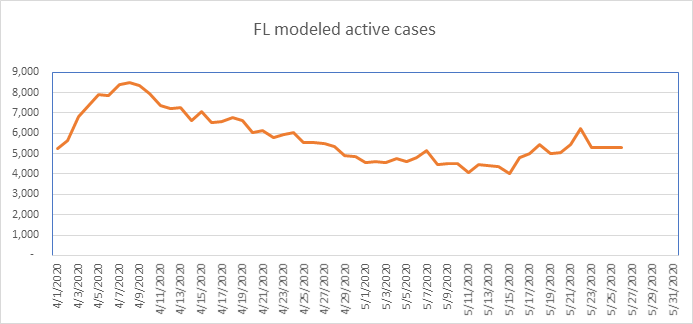
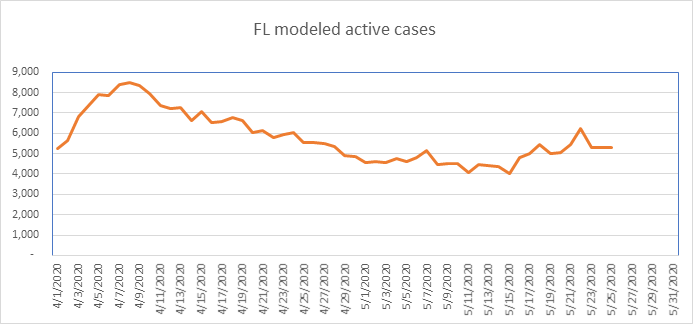
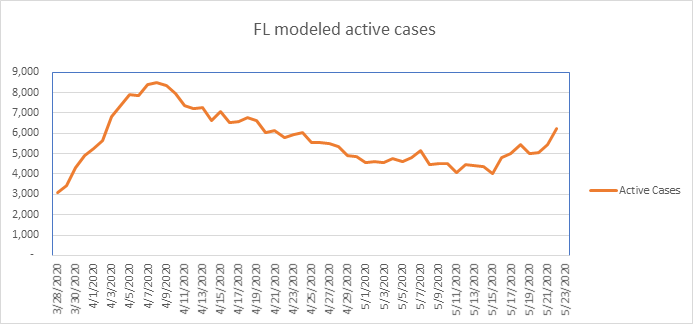
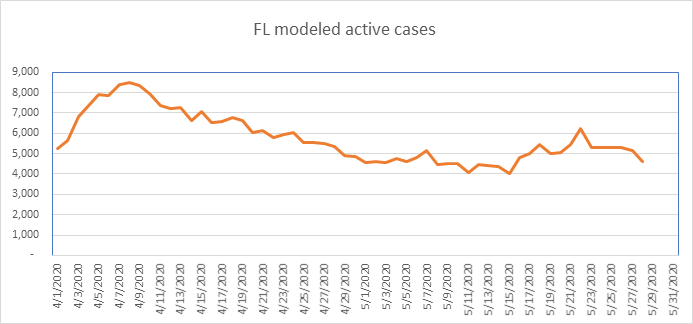
Significant drop in Florida today. Florida is now down 46% from the peak. The hot spot in Florida continues to be Miami. Other than in SE Florida, COVID presence is small.
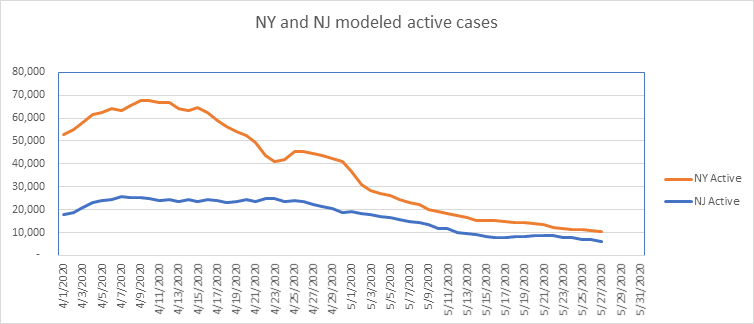
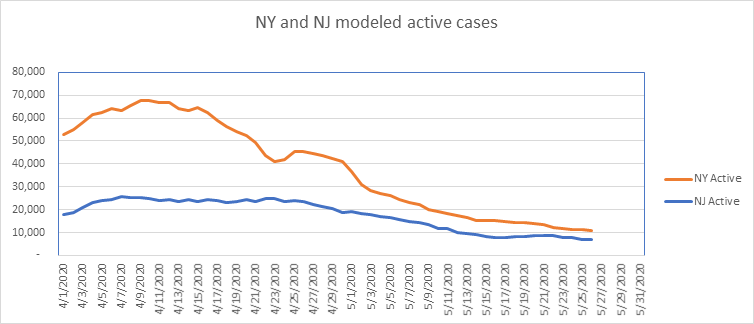
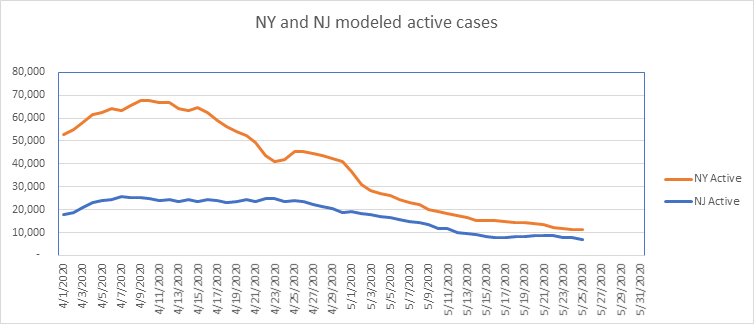
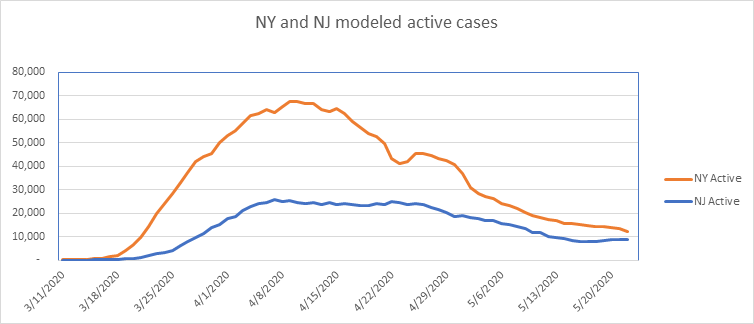
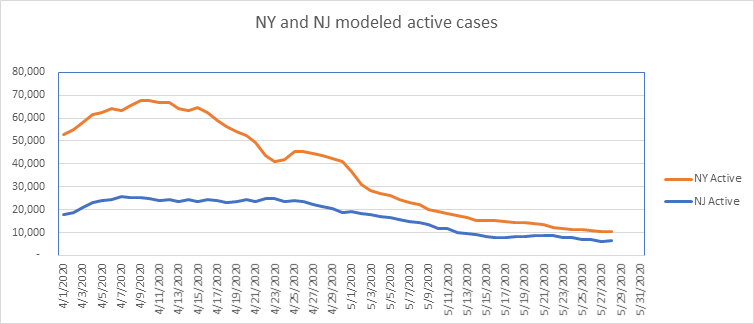
Here are NJ and NY. Both continue to decline. I estimate that NY now has only about 10,000 known cases left, which is less than the active known cases in California. NY is now down 85% from the peak, which is remarkable. Both states are recovering well. It’s commonly thought that NY will be one of the last states to open up, as they were hit so hard. But with only 15% left, I disagree with this.
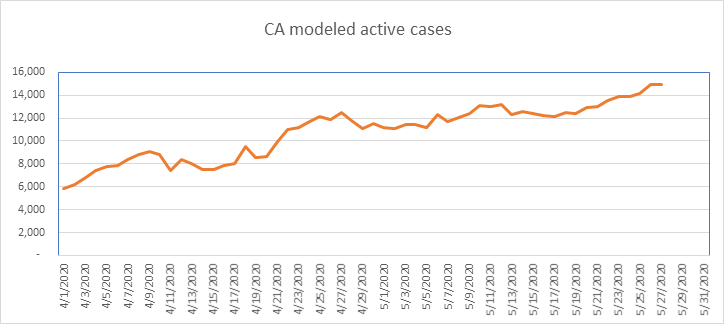
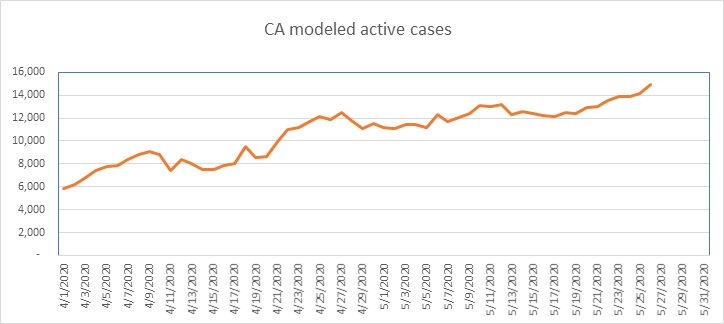
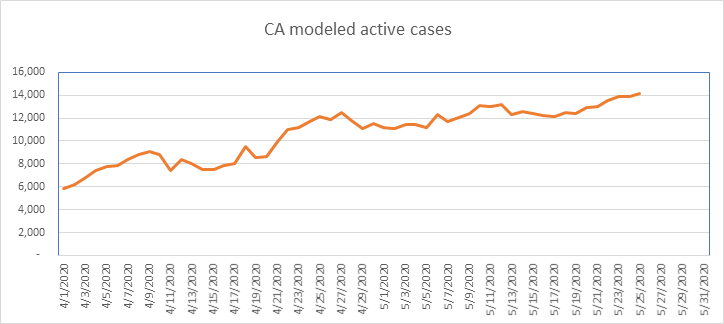
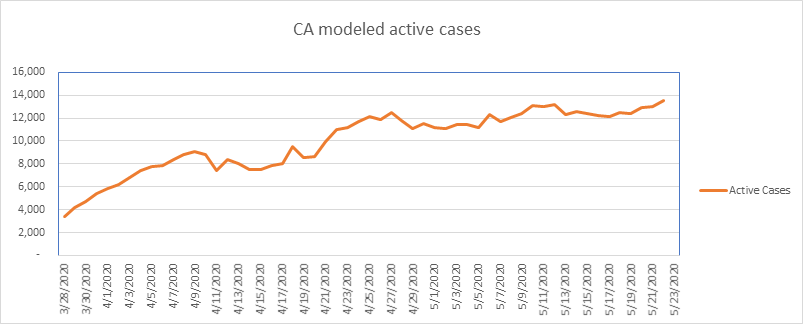
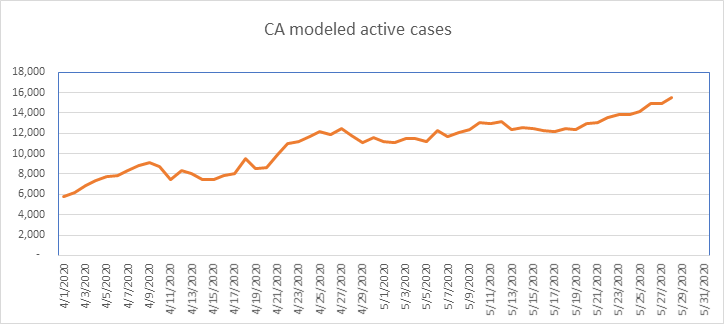
California has problems in Los Angeles, which is skewing the entire state’s numbers upwards. Overall, California continues to increase, but still smaller than NY on per capita basis.
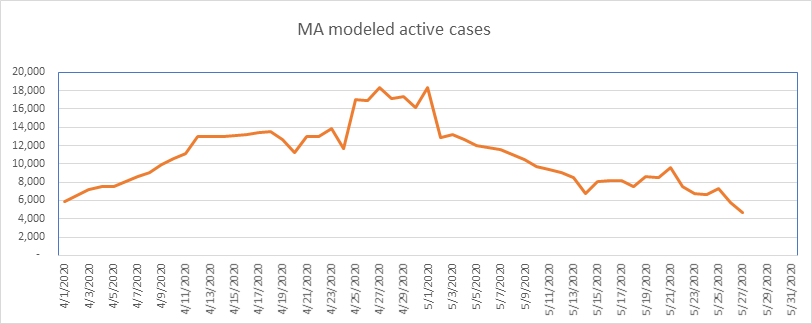
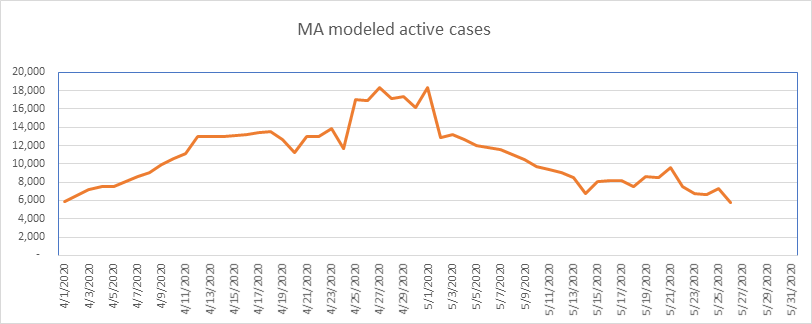
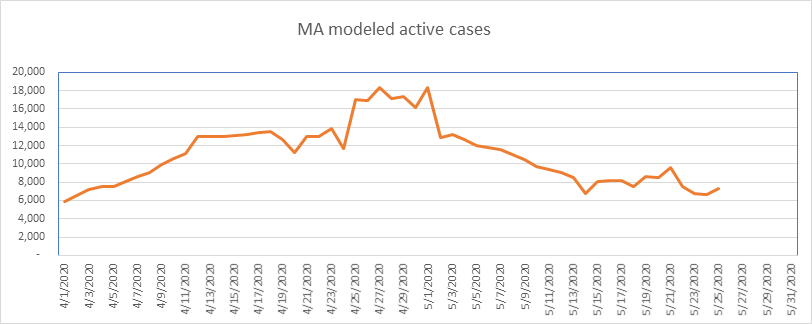
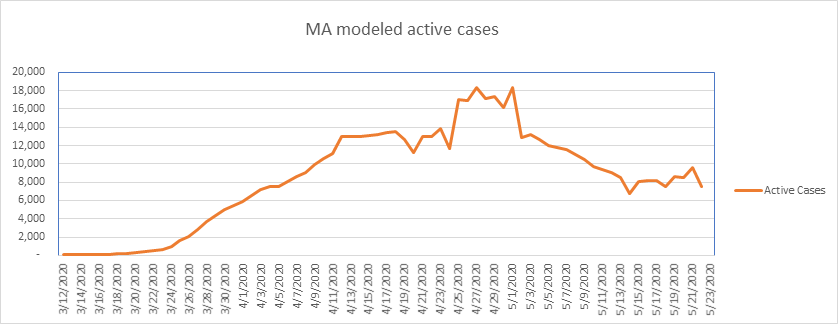
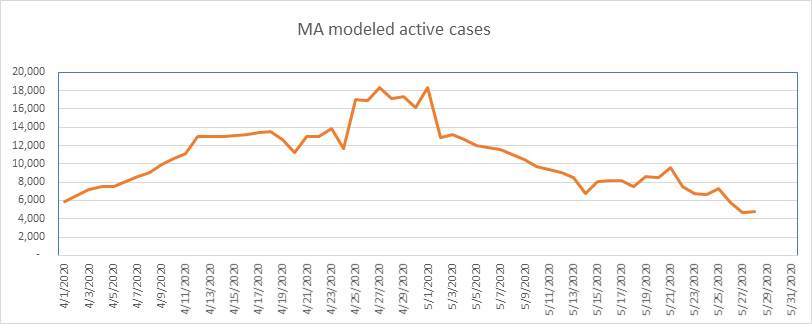
Massachusetts continues to do well, with a remarkably rapid recovery. MA is flat today, with 2 days of reporting – expect another drop tomorrow.
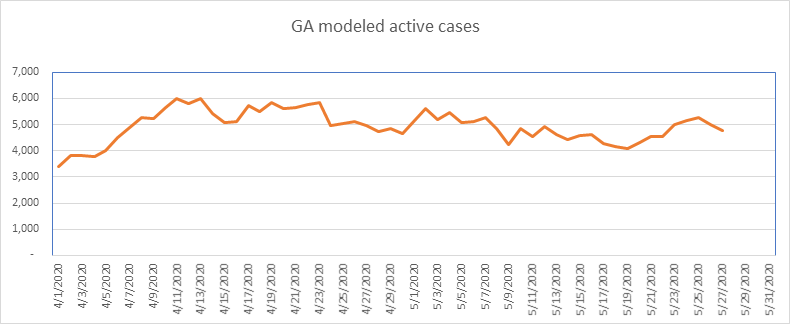
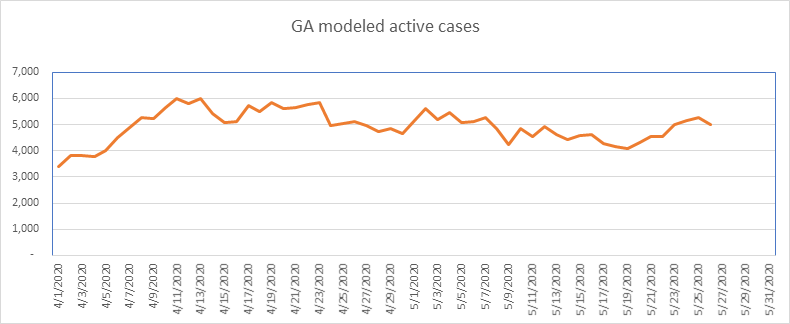
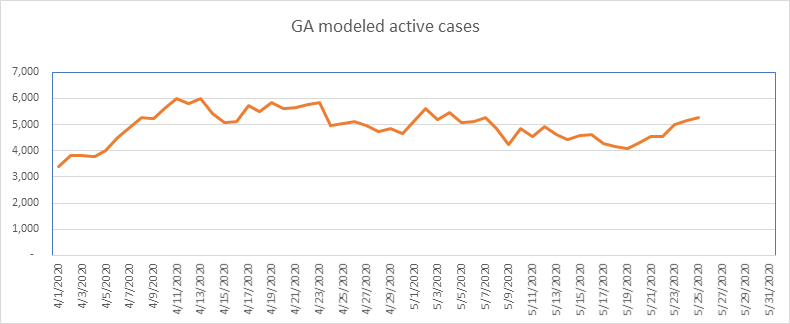
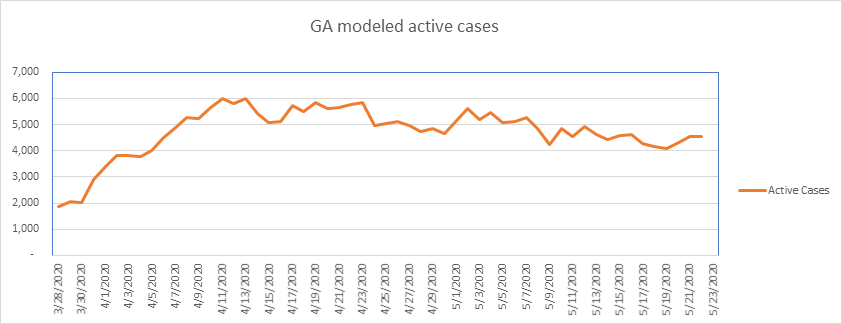
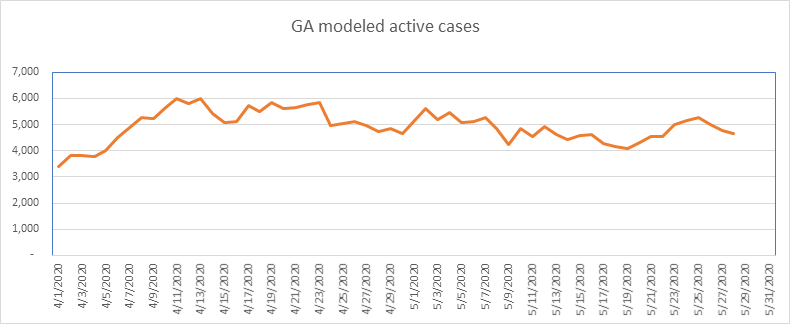
Georgia shows another decline today, now down 22% below the peak.
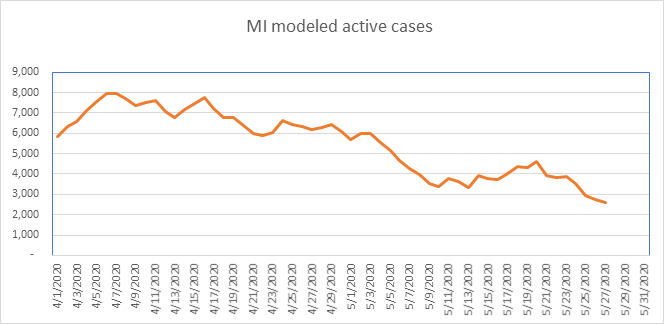
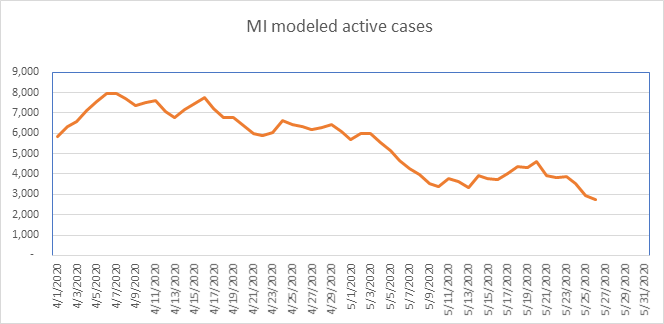
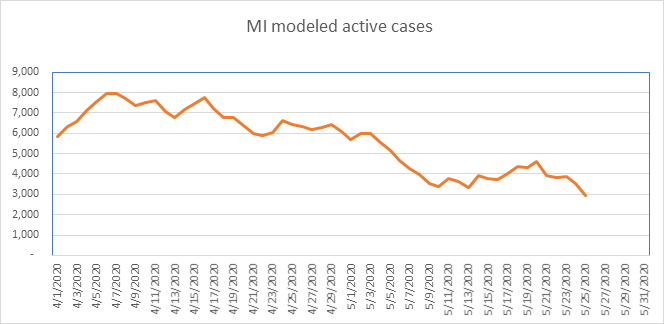
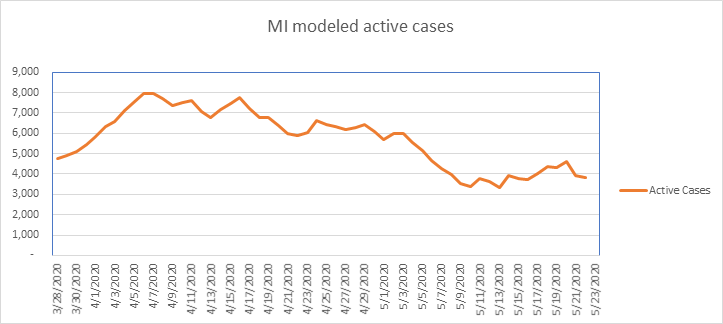
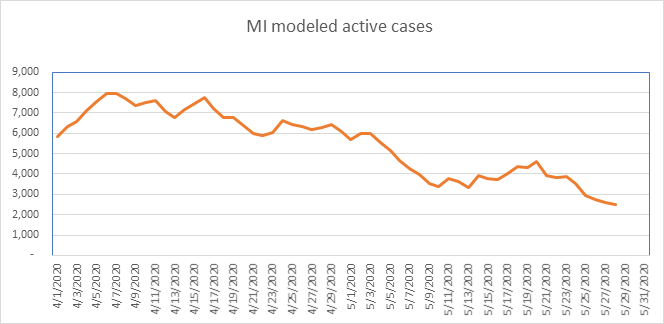
Another drop in Michigan today. Michigan is down 68% from the peak on April 6th.
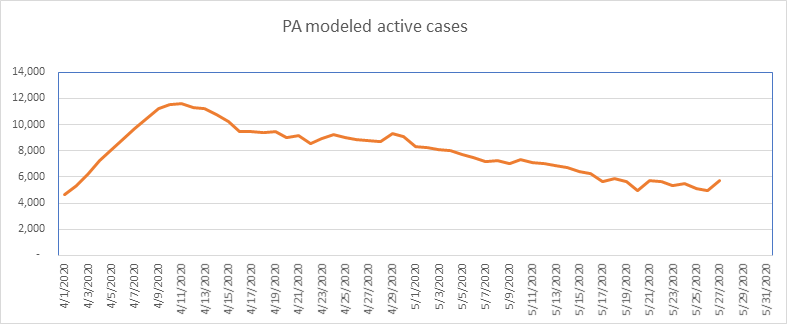
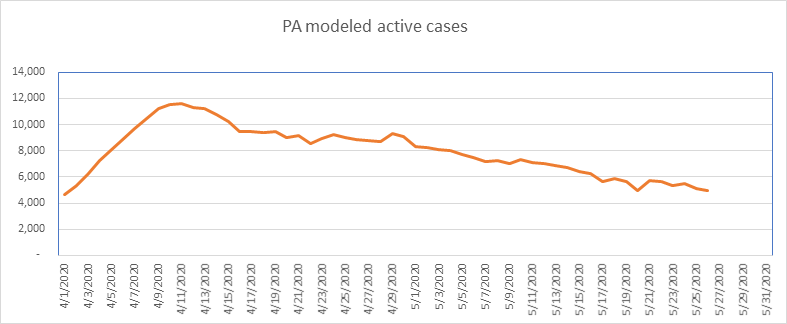
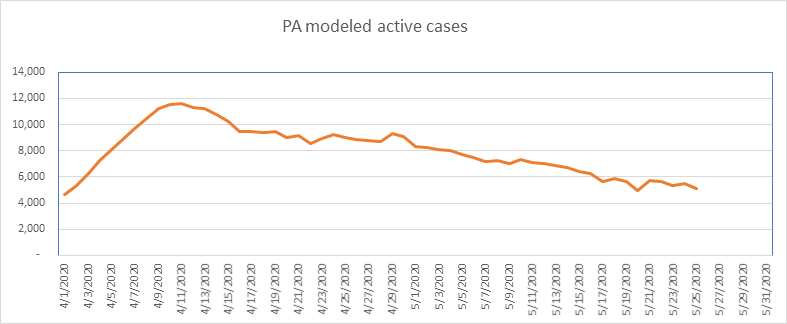
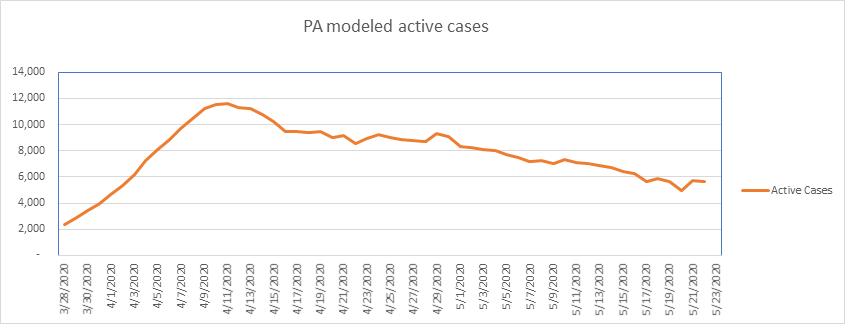
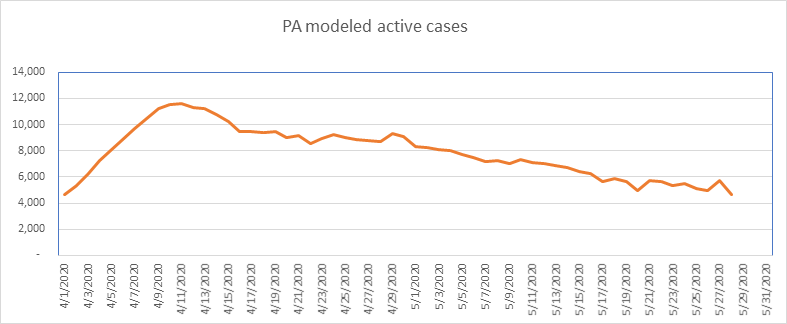
A drop in Pennsylvania today, now 60% below their peak.
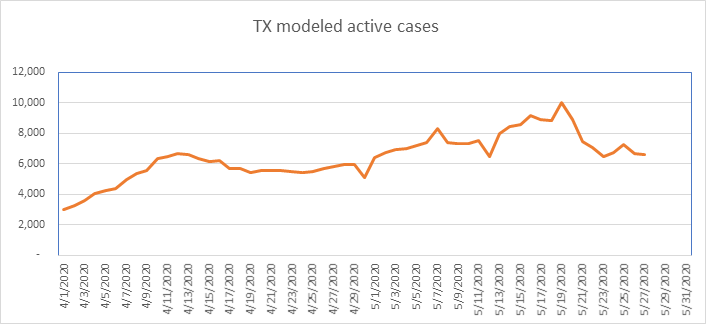
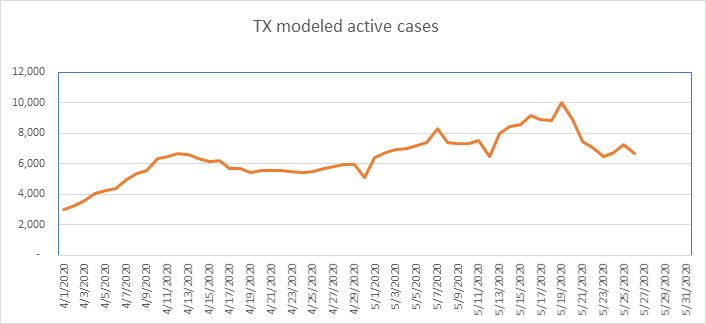
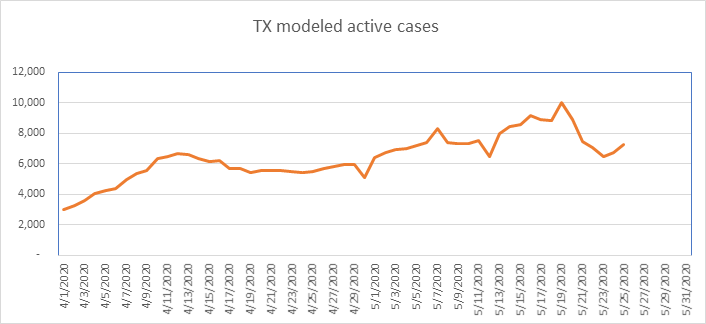
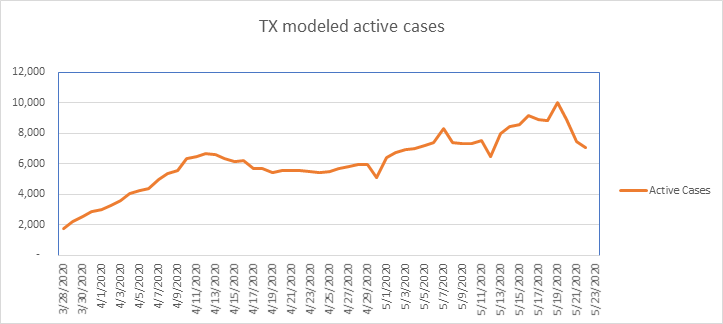
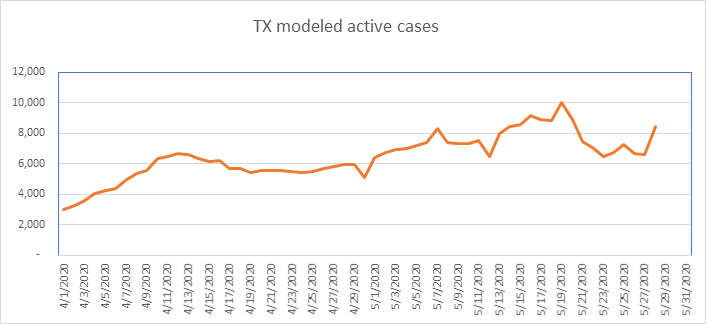
A significant increase in Texas today. I believe Texas peaked on May 19th. Texas has a small COVID presence per capita.
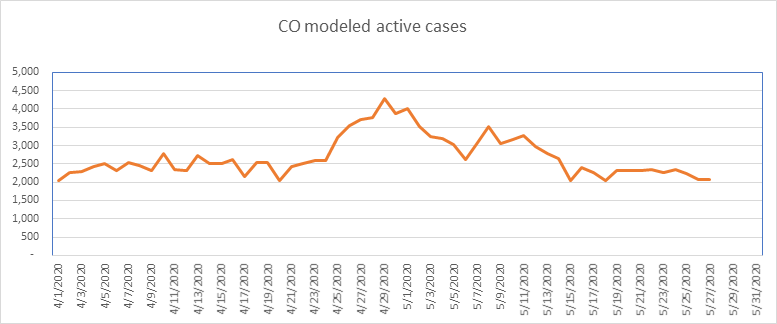
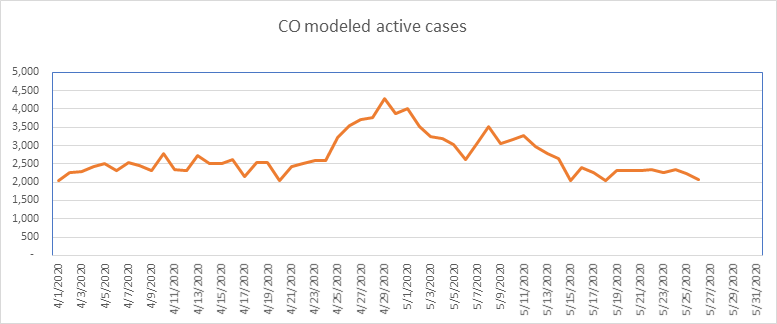
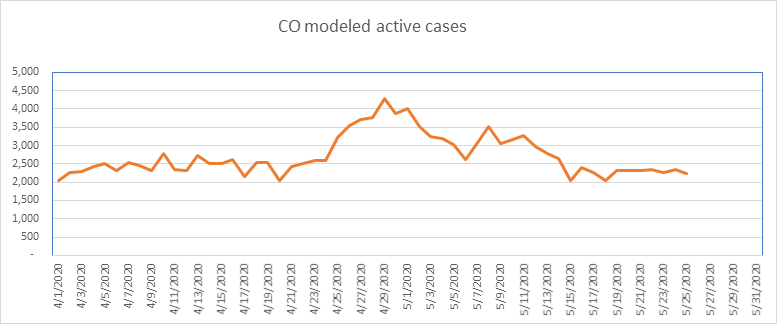
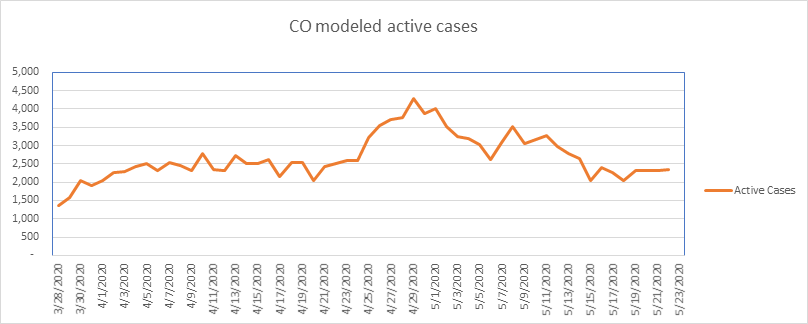
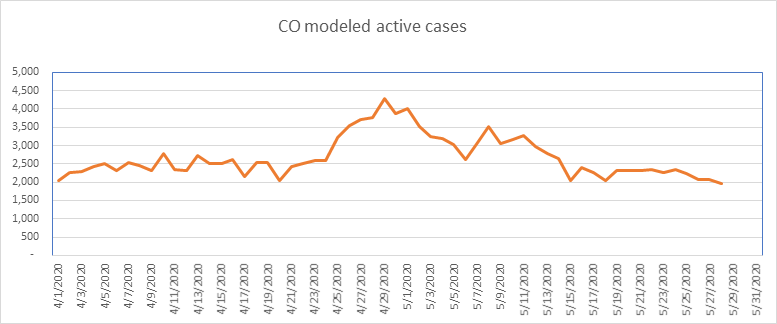
And finally, here is Colorado. Colorado is one of the states that has had aberrations in their data. In any event, it looks like Colorado is about 54% below the peak on April 29th.
So that’s it for today. The numbers are very small as a percentage of the population. Unless you’re in a high density area, your chances of contracting COVID are very small. However, even though the probability is very small, that doesn’t help if you’re the one catching it. Everyone please continue to be as cautious as circumstances dictate.

–Shane Chalke, FSA
Categories
COVID Archives

COVID analytical update – Wednesday, May 27

My first study on the effectiveness of lockdowns

COVID continues to recede at a good pace. Everything is looking good, other than California and Virginia, which continue to be problematic.

Over the past 2 days I’ve completed my first (of several, I hope) investigations into the effectiveness of lockdowns. Before I get into the mechanics and empirical results, here are my conclusions so far:

  • Does social distancing (being cautious) slow the progress of COVID? Probably.
  • Do lockdowns slow the progress of COVID? I don’t think so.

Now, on to why I come to these early conclusions. With the patchwork of states in various phases of social and business restriction, it is quite difficult to isolate experiments on which to base conclusions. The closest I can come to this is comparing Virginia to North Carolina. Both states have similar populations, climate, geography, nearly the same population density, and have had similar COVID growth rates. More importantly, both states imposed stay at home orders on the same day, March 30th. This makes for a reasonable set of observations on which to do some analysis.

From there, the paths differ. Although Virginia entered a modified Phase 1 on May 15th, it only applied to rural areas, and didn’t affect the majority of the population, which as of today is still under the stay at home order.

NC, on the other hand, moved into Phase 1 on May 8th, and on to Phase 2 on May 22nd.

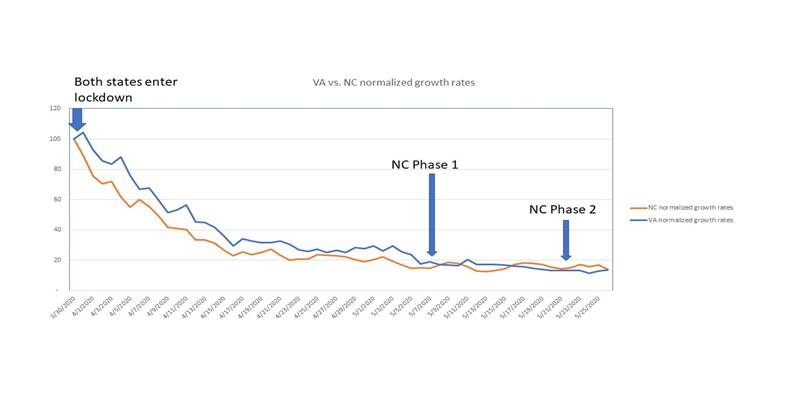
To make a reasonable comparison, I looked at COVID daily growth rates in reported cases from March 30 to May 26. Since both states have erratic daily data, I calculated the five-day moving average of daily growth rates for each state, and then normalized those growth rates on March 30th to a radix of 100. From this, I can show a graphical representation of the disease progression by state. It looks like this. Do you see any meaningful differences? I don’t either. Of course, it’s too early to notice any effect of NC Phase 2, but I’ll run this analysis again in a week to see what we see…

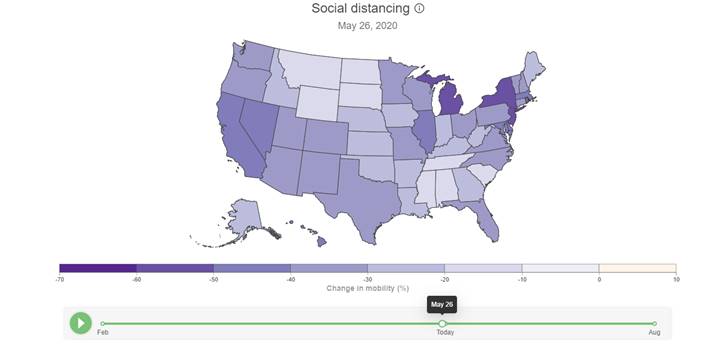
So why don’t we see the continued stay at home order in VA having an effect? From this point, I can only theorize. I believe it’s because societal behavior is not dependent on stay at home orders. People will be cautious as they see fit, regardless of executive orders. It is possible to estimate social mobility from credit card and mobile phone activity. This next picture is from the IHME site, showing social distancing as of yesterday.

Notice anything interesting? Virginia and North Carolina are in the same band of social mobility, even though NC is well into Phase 2 and the majority of Virginia is still subject to stay at home orders. I’m going to continue to study this, but my early conclusion is that stay at home orders don’t result in people staying at home any more than if there were no stay at home order. More to come…

As always, feel free to send me your questions about my assumptions, methodology, or modeling in general.

  • Likely date of active case peak (Chalke modeling): April 10
  • Likely date of peak deaths (IHME): April 15 (last revision on May 26)
  • Short term projection for active cases tomorrow: 145,000
  • Total Test Results reported today: 285,440 (high)
  • Total Pending tests reported today: 3,132 (low)
  • National reported case Growth Rate today: 1.1% (very low)

Shane Chalke Interviews

https://www.fredericksburg.com/opinion/editorial-unlock-demographically-not-geographically/article_a62e6e70-dccd-51cf-b7b2-16d77a90fd9c.html

Website

Groom Ventures has agreed to host a website that will archive my daily reports, and supplement with other commentary. John Groom worked at one of my companies back in the day, and is an excellent writer. The website is: www.howmuchrisk.com For those of you that post my daily report on Facebook, let me suggest you link to this site, as the direct Facebook posts don’t seem to copy the graphs.

Daily Analysis

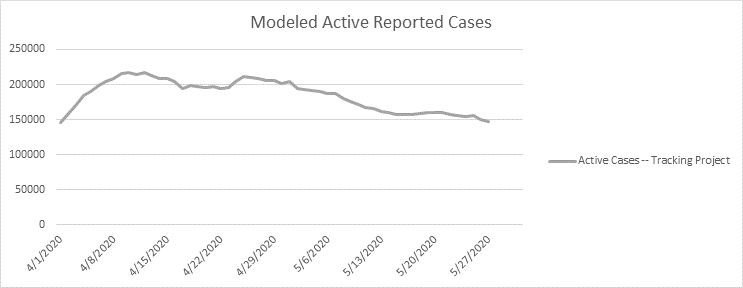
Here is the national picture of active cases – another decline today down to 147,000. We’re down 32% from the peak. I projected a few weeks ago that we’d be down 50% by the end of May. With the issues in CA and VA we might not make it, but we’re heading there. I now model known active cases at a tiny sliver of the U.S. population – about 0.043%.

Here are the new reported cases nationally. All still tracking in the right direction.

Here are the daily reported tests. Lower test reporting today, about where we were a week and half ago. It could be that a clump of tests reported two days ago when we saw a new record, and we’ll see another cluster soon, or that with such a low positive rate, we’re running out of people to test under the current protocol.

On to the states. VA and NC are diverging recently, even though NC is in Phase 2 and VA hasn’t substantially entered Phase 1 yet.

No surprises with Washington – long slow decline – total remaining cases are small – less than 1400.

Florida seems to be leveling off from their 2nd half of May bump. The hot spot in Florida continues to be Miami. Other than in SE Florida, COVID presence is small.

Here are NJ and NY. Both continue to decline. NJ is now down 76% from the peak, and is now tracking well with NY. NY is now down 84% from the peak, which is remarkable. Both states are recovering well.

California has problems in Los Angeles, which is skewing the entire state’s numbers upwards. This could be a function of California’s dramatic increase in testing – I don’t correct for this (I may at some point).

Another healthy drop in Massachusetts, now down 74% from the peak on April 27th. This is a remarkably rapid recovery. MA is expected to do 2 days of reporting tomorrow, so this will pop up a little then.

Georgia shows another decline today, now down 20% below the peak.

Another drop in Michigan today. Michigan is down 67% from the peak on April 6th.

An increase in Pennsylvania, but I expect the trend to continue. PA is a long way down from the top.

Here is Texas, flat today. I believe Texas peaked on May 19th, and is now down 34% from the top. Texas has a small COVID presence per capita.

And finally, here is Colorado. Colorado is one of the states that has aberrations in their data. In any event, it looks like Colorado is about 52% below the peak on April 29th.

So that’s it for today. The numbers are very small as a percentage of the population. Unless you’re in a high density area, your chances of contracting COVID are very small. However, even though the probability is very small, that doesn’t help if you’re the one catching it. Everyone please continue to be as cautious as circumstances dictate.

–Shane Chalke, FSA
Categories
COVID Archives

COVID analytical update for Tuesday, May 26

National growth rate reaches new low of less than 1.0% — Deaths continue decline

Everything is looking good today. The only states I track that still seem problematic are California and Virginia.

My current project is to analyze any correlation between the dates of relaxing restrictions and the disease progression. I’m normalizing each state for testing scope, and then analyzing the daily growth rates before and after opening. (spoiler alert – I see NO correlation so far). More to come.

Groom Ventures has agreed to host a website that will archive my daily reports, and supplement with other commentary. John Groom worked at one of my companies back in the day, and is an excellent writer. The website is: www.howmuchrisk.com For those of you that post my daily report on Facebook, let me suggest you link to this site, as the direct Facebook posts don’t seem to copy the graphs.

As always, feel free to send me your questions about my assumptions, methodology, or modeling in general.

  • Likely date of active case peak (Chalke modeling): April 10
  • Likely date of peak deaths (IHME): April 15 (last revision on May 25)
  • Short term projection for active cases tomorrow: 148,000
  • Total Test Results reported today: 302,099 (high)
  • Total Pending tests reported today: 1,549 (record low)
  • National reported case Growth Rate today: 0.98% (record low)

Shane Chalke Interviews

https://www.fredericksburg.com/opinion/editorial-unlock-demographically-not-geographically/article_a62e6e70-dccd-51cf-b7b2-16d77a90fd9c.html

First, the progress on daily deaths is looking good. I changed the graph so it begins with the IHME projection of peak daily deaths on April 15 so I can show a trend line from the peak. Why, you might ask, does my graph show the peak deaths on May 7th. The reason is that IHME adjusts the deaths to date of death, and I show the date of reporting. As many states went through the process of reclassifying historical deaths as COVID, they were reported in many cases well after the date of death. I don’t have the resources to do this, so I just report when they are reported. Clear as mud, right? The takeaway is that even with inconsistent reporting, we’re still showing a steady decline. Good news.

Here is the national picture of active cases – another decline today down to 150,000. We’re down 31% from the peak. I projected a few weeks ago that we’d be down 50% by the end of May. With the issues in CA and VA we might not make it, but we’re heading there. I now model known active cases at a tiny sliver of the U.S. population – about 0.044%.

Here are the new reported cases nationally. The long, slow decline continues. I’ve added the linear trend line so it’s easier to see the pattern.

Here are the daily reported tests. A drop in tests today, but still over 300,000, and the positive rate once again came in very low, at 5%. Total reported tests now stand at about 15 million.

On to the states. Both VA and NC are in some stage of reopening (all 50 states are now). North Carolina moved on to Phase 2 Friday, while VA maintains heavier restrictions. Looking at the 2 states side by side, you can see a lot more COVID in VA, even though VA has only 85% of the population of NC. On a population adjusted basis, VA has nearly double the COVID than NC. IHME updated their model today, and still project peak deaths in NC on June 6th, so NC should be ready for decline. VA shows a new peak today – It’s hard to interpret VA data, as they use “event date reporting” (I’ve discussed this several times). IHME now projects peak deaths in VA way back on May 2nd, so I expect this curve to fall in line at any time.

No surprises with Washington – long slow decline – total remaining cases are small – around 1500.

Florida seems to be leveling off from their 2nd half of May bump. The hot spot in Florida continues to be Miami. Other than in SE Florida, COVID presence is small.

Here are NJ and NY. Both continue to decline. NJ is now down 74% from the peak, and is now tracking well with NY. NY is now down 84% from the peak, which is remarkable. Both states are recovering well.

California has problems in Los Angeles, which is skewing the entire state’s numbers upwards. This could be a function of California’s dramatic increase in testing – I don’t correct for this (I may at some point).

Another healthy drop in Massachusetts, now down 69% from the peak on April 27th. This is a remarkably rapid recovery.

Georgia shows a decline today, after 6 days of increases. This is welcome news. Georgia is 17% below the peak.

Another drop in Michigan today. Michigan is down 65% from the peak on April 6th.

Pennsylvania continues on trend – steady declines since the peak on April 11. Pennsylvania is down 57% from their peak. (I reported 66% yesterday, but it was a typo – the correct number was 56%.)

Here is Texas, with a nice decline today. I believe Texas peaked on May 19th, and is now down 34% from the top. Texas has a small COVID presence per capita.

And finally, here is Colorado. Colorado is one of the states that has aberrations in their data. In any event, it looks like Colorado is about 52% below the peak on April 29th.

So that’s it for today. The numbers are very small as a percentage of the population. Unless you’re in a high density area, your chances of contracting COVID are very small. However, even though the probability is very small, that doesn’t help if you’re the one catching it. Everyone please continue to be as cautious as circumstances dictate.

–Shane Chalke, FSA
Categories
COVID Archives

COVID analytical update for Monday, May 25

Lowest daily death count since March 30

Happy Memorial Day, everyone –

I took a few days off for the weekend. The big news today – we have another record test reporting day today, with 441,027, an all time high. We also recorded a dramatically dropping death count over the weekend, with today’s reported deaths, 523, the lowest since March, quite early in the pandemic. Many states are also dropping dramatically, but we do have a few hot spots that are against the overall trend, most notably California (more on this below). The cumulative case growth rate came in at 1.2%, the lowest yet, and a snail’s pace compared to last month.

The IHME model updated today, and the projected peak daily deaths move up one day to last April 15th.

As always, feel free to send me your questions about my assumptions, methodology, or modeling in general.

  • Likely date of active case peak (Chalke modeling): April 10
  • Likely date of peak deaths (IHME): April 15 (last revision on May 25)
  • Short term projection for active cases tomorrow: 153,000
  • Total Test Results reported today: 441,027 (record high)
  • Total Pending tests reported today: 3,368 (very low)
  • National reported case Growth Rate today: 1.2% (record low)

Shane Chalke Interviews

https://www.fredericksburg.com/opinion/editorial-unlock-demographically-not-geographically/article_a62e6e70-dccd-51cf-b7b2-16d77a90fd9c.html

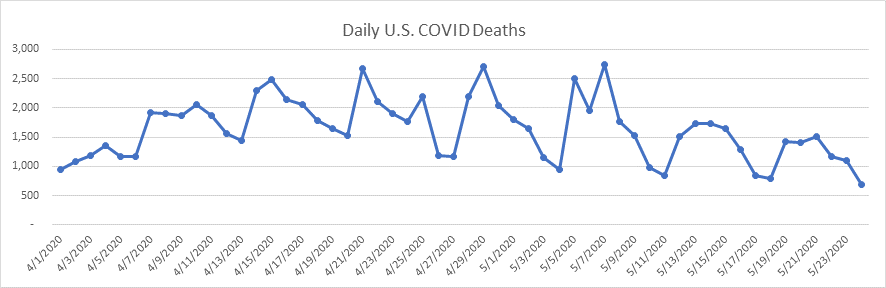
First, here is the big news. I show this graph once in while to keep you up to date, but I don’t model deaths – I concentrate on modeling active cases, which I continue to believe is the most important metric to gauge the slowdown (why does no one else model it?). Daily deaths are roughly half of what they were a bit over 2 weeks ago – and this, with many states expanding their definition of a COVID death.

Here is the national picture of active cases – small decline today but relatively flat for a week now. We’re down 29% from the peak. This is mixed bag of rapid declines in most areas, coupled with a few spots where the disease is still growing. Known and still active cases (the number of people that are currently sick) is a bit over 150,000. To add some perspective, this is a tiny sliver of the U.S. population – about 0.044%.

Here are the new reported cases nationally. The long, slow decline continues. I’ve added the linear trend line so it’s easier to see the pattern.

Here are the daily reported tests. As you can see, we had no slowdown in test results over the holiday weekend, and in fact set a new record today, at over 440,000. Total reported tests are now just under 15 million. More importantly, positive tests set a new record low, at only 4.5% of total reports.

On to the states. Both VA and NC are in some stage of reopening (all 50 states are now). North Carolina moved on to Phase 2 Friday, while VA maintains heavier restrictions. Looking at the 2 states side by side, you can see a lot more COVID in VA, even though VA has only 85% of the population of NC. On a population adjusted basis, VA has about 57% more COVID than NC. IHME updated their model today, and still project peak deaths in NC at June 6th. NC has dramatically increased testing, but I still expect NC to show declines soon. VA shows a new peak today – It’s hard to interpret VA data, as they use “event date reporting” (I’ve discussed this several times). IHME now projects peak deaths in VA way back on May 2nd, so I expect this curve to fall in line shortly as well.

No surprises with Washington – long slow decline – total remaining cases are small – around 1500.

Florida seems to be leveling off from their 2nd half of May bump. The hot spot in Florida continues to be Miami. Other than in SE Florida, COVID presence is small.

Here are NJ and NY. Hard to tell from the graph (it has the historical big NY numbers on it), but NJ has had quite a decline this weekend. NJ is now down 73% from the peak, and I’m now thinking active cases will stay below NY. NY is now down 83% from the peak, which is remarkable. Both states are recovering well.

California has problems in Los Angeles, which is skewing the entire state’s numbers upwards. IHME projects peak deaths in California back on May 13, but is modeling a long tail.

Massachusetts has had a very rapid recovery, now down 61% from the peak on April 27th. This is a remarkably rapid recovery.

Georgia has increased for 6 days now. Still well below the peak last month, but we’ll watch it closely.

Big drop in Michigan over the weekend. Michigan is down 63% from the peak on April 6th.

Pennsylvania continues on trend – steady declines since the peak on April 11. Pennsylvania is down 66% from their peak.

Here is Texas, with some increases the past 2 days, after some rapid drops. I believe Texas peaked on May 19th. Texas is another state with a small COVID presence per capita.

And finally, here is Colorado. Colorado is one of the states that has aberrations in their data. In any event, it looks like Colorado is about 48% below the peak on April 29th.

So that’s it for today. Please remember that although the number of active cases is declining, it’s declining slowly (some areas quite fast, though). We’re on the backside of the curve, in some states still near the top, where the probabilty of coming in contact with an infected person is relatively higher than it will be in another week or two. Everyone be careful.

–Shane Chalke, FSA
Categories
COVID Archives

COVID analytical update for Friday, May 22

How much double counting of cases is going on?

Several of the doctors on this list have told me that when a patient is hospitalized for COVID, they are generally tested multiple times for COVID during their stay, sometimes as many as 5 positive tests before testing negative. I was curious about this, so spent the day researching various states in an attempt to figure out if these multiple tests were reported as multiple cases (even though it’s only a single individual) or whether the reporting is sophisticated enough to de-duplicate these tests so we don’t exaggerate the number of cases.

First, I found out pretty quickly that it’s not easy to get this information. I did find at least 13 states that report positive tests, rather than positive people. My confidence in my findings ranges from around 75-100%, so don’t take this to the bank, but I think these states are double counting cases: AL, AR, CA, GA, ME, MD, MA, MI, OK, PR, TX, VA, and WY. There may be many others, but I can’t verify that. In addition, I found 4 states (AR, PR, TX, and VA) that report positive anti-body tests as cases. Texas doesn’t do this entirely, as the public labs in Texas attempt to de-dup, but the public labs represent a small percentage of tests.

I’m convinced now, that as the volume of testing grows, so does the double counting. We currently have at least 40,000 people hospitalized for COVID currently (we don’t know the actual number, as many states don’t report this, or report it based on surveys only). If the average number of positive tests is 4 (I’m guessing from anecdotal evidence here), then that could mean as many as 10,000 to 20,000 extra cases per week if all states are doing this. Since I’m currently modeling less than 160,000 active cases in the U.S., this is a big distortion.

Antibody test reporting could be even more problematic. These tests (often referred to as Serum tests) are intended to reveal who was infected with COVID in the past, but now recovered. When these positive tests are reported as new cases, the new case count data is corrupted. The media is very interested in showing that we undercount cases and deaths, but has no interest in the distortions that cause over counting, so you’ll likely not read much about this.

I don’t think any of this is planned or intentional, as it’s probably not easy to track individuals verses tests, and I don’t think many foresaw the multiple tests per individual when testing was scarce. However, I’m now thinking that my model of active reported cases is an upper bound, and the actual number is probably 5-10% lower.

In any event, I don’t try to correct for any of these data distortions, simply because I don’t have reliable data to do so. I think it is important that the CDC quickly develop and enforce consistent protocols for test reporting. It’s hard to know how the disease will progress in the future if we don’t even know what it is doing today. Public response relies on whether the disease is growing or declining, so I think solid data is critical. I’d give the CDC a mediocre grade at best on this issue.

As always, feel free to send me your questions about my assumptions, methodology, or modeling in general.

  • Likely date of active case peak (Chalke modeling): April 10
  • Likely date of peak deaths (IHME): April 16 (last revision on May 20)
  • Short term projection for active cases tomorrow: 154,000
  • Total Test Results reported today: 342,418 (high)
  • Total Pending tests reported today: 3,709 (very low)
  • National reported case Growth Rate today: 1.5% (very low)

Shane Chalke Interviews

https://www.fredericksburg.com/opinion/editorial-unlock-demographically-not-geographically/article_a62e6e70-dccd-51cf-b7b2-16d77a90fd9c.html

Here is the national picture of active cases – small decline today but relatively flat for a week now. We’re down 28% from the peak.

Here are the new reported cases nationally. Long, slow decline. No new news here. It could be lower – see discussion above.

Here are the daily reported tests. We’re reporting a million tests every 3 days.

On to the states. Both VA and NC are in some stage of reopening (actually all 50 states are now). North Carolina is moved on to Phase 2 today, while VA maintains heavier restrictions. Looking at the 2 states side by side, you can see about 50% more COVID in VA, even though VA has only 85% of the population of NC. IHME updated their model again yesterday, and projected peak deaths in NC is still June 6th. If that’s the case, then I expect peak active cases about 2 weeks earlier, or tomorrow.

No surprises with Washington, now down about 61% from their peak on April 3rd.

Florida is worth keeping an eye on. It has been rising for 7 days now, but still small for the size of the state.

I’ve added NJ and combined it with New York. NY is now down 82% from the peak, which is remarkable. NJ had a long plateau at the top, and is now down 66% from the peak. Surprisingly, I expect that NJ will have more COVID than NY in a week or so. The two states look to be converging.

California is drifting upwards, but they are one of the states that reports each positive test as a new case, so caveats here. Not much COVID presence in the state outside of Los Angeles.

Massachusetts has had a very rapid recovery, now down 59% from the peak on April 27th. The northeastern states were hit harder than most, but are recovering faster as well.

Georgia is flat today, still on a long, gradually decline.

Another drop in Michigan today. Michigan is down 52% from the peak on April 6th.

Pennsylvania continues on trend – steady declines since the peak on April 11.

Here is Texas, with another significant drop today. We may have hit the peak here on May 19th. Texas is already down 30% from that high point in just 3 days. Texas is another state with a small COVID presence per capita.

And finally, here is Colorado. Last Friday, Colorado reduced their cumulative death count by 24%. https://www.foxnews.com/us/colorado-lowers-coronavirus-death-count They were coding deaths as COVID where COVID was present, but where there was clearly another cause of death. They revised the COVID deaths downward, but then added another category called ”deaths among people with COVID-19”, and continue to report these as COVID deaths on their website. This was a red flag to me, so I thought it would be interesting to see how they are progressing, and if we see an unusual pattern it might be cause for further research. In any event, it looks like Colorado is about 52% below the peak on April 29th.

So that’s it for today. Please remember that although the number of active cases is declining, it’s declining slowly (some areas quite fast, though). We’re on the backside of the curve, in some states still near the top, where the probabilty of coming in contact with an infected person is relatively higher than it will be in another week or two. Everyone be careful.

–Shane Chalke, FSA
Categories
COVID Archives

COVID analytical update for Thursday, May 21

Some surprises about the seasonal flu

Pretty boring report this time, so I’ll talk about my little “flu project” today.

My goal today was to compare the so-called “Case Fatality Rate” of COVID with that of the seasonal flu. Well, it’s simply not possible. There is no national reporting system for the flu. More on that later…

First, I want to clear up confusion about Case Fatality Rate (CFR), Infection Fatality Rate (IFR), and Mortality Rate (the conditional probability of dying if you contract the disease). First, let me say that all of these terms are sometimes used interchangeably, and that adds to the confusion. Here is my best explanation from an actuarial viewpoint.

CASE FATALITY RATE (CFR): This is quoted as nothing more than the total number of recorded deaths divided by the number of confirmed cases. You can find it on sites like www.infection2020.com on the home page. It’s currently running about 6%. It is NOT a representation of the probability of dying if you have COVID, simply because the number of confirmed cases does not represent the number of people who have COVID in society – that number is much larger based on the several random testing studies done in the United States.

INFECTION FATALITY RATE (IFR): This is “usually” the number of recorded deaths divided by an estimate of the total number of people in society who have or have had COVID. This number is much lower, but rarely quoted. It is somewhat closer to a mortality rate, but until the disease has run its course, it will be less than the mortality rate, since deaths lag the case count.

MORTALITY RATE: Yes, this is the probability of dying if you catch COVID. The mortality rate is the number of recorded deaths divided by an estimated number of cases that the deaths originate from. It involves modeling the total COVID in society, and then matching that up with the deaths that result from that cohort of cases. This is more complicated to do, but that’s what actuaries are for (literally). My first (but not last) mortality calculation (described at the end of each day’s report) resulted in an overall mortality rate of 0.53%, but of course wildly different by age group.

Now, on to the flu. It turns out that no one actually counts flu cases or deaths – hey, I’m just a mathematician, so I was surprised by this. It’s easy to count flu tests and laboratory confirmed cases, but not deaths. I thought I would be clever and divide flu confirmed deaths from last year by positive flu tests and show that the CFR for flu is higher than COVID. However, the number that doesn’t exist is “confirmed flu deaths”.

[all flu data to follow from the CDC] Last season (2018/2019) we administered 1,454,484 flu tests in the U.S. 229,364 of these were positive – yes, that’s right – less than a quarter of a million confirmed flu cases. Yet, the CDC estimates that 36 million had the flu, and there were 34,000 deaths. How do they know this? Well, they don’t really. The confidence interval is very wide. They extrapolate from a survey of hospitals and medical providers in 13 geographical areas about respiratory illness visits to estimate the number of flu patients who sought medical care. Then they estimate the number that did not seek medical care from the 2010 Behavioral Risk Factor Surveillance Survey. From this, they model how many likely had the flu nationally. There is a similar methodology for deaths, since a minority of flu deaths show flu on the death certificate. The end result is that I couldn’t complete my little project, but you get the idea. Very likely more people died from the flu than the total number of confirmed cases… (if I were a reporter I’d probably conclude that the mortality rate for the seasonal flu was over 100%).

Sorry for the long diatribe, but sometimes when I look into things the answers floor me.

My next project is to work on a refined mortality model. My goal this time is to use all of the random testing studies to date, and gain better insight on the mortality rate by age and morbidity.

As always, feel free to send me your questions about my assumptions, methodology, or modeling in general.

  • Likely date of active case peak (Chalke modeling): April 10
  • Likely date of peak deaths (IHME): April 16 (last revision on May 20)
  • Short term projection for active cases tomorrow: 155,000
  • Total Test Results reported today: 408,415 (very high)
  • Total Pending tests reported today: 3,641 (very low)
  • National reported case Growth Rate today: 1.6% (very low)
Categories
COVID Archives

COVID analytical update for Wednesday, May 20

Today we see near record test reports and a near record high negative test ratio. That’s good.

I’ve added NJ to the mix of states I’m analyzing, and changed the presentation a bit to compare some states on the same graph. I think this helps understand the relative impact of COVID on neighboring states. So far, I’ve combined NJ and NY, and NC and VA.

Much has been made in the press of the Case Fatality Rate (or CFR). It is widely reported at about 6%. This is not an entirely useless statistic, but should not be confused with the mortality rate. The CFR is simply the number of reported deaths divided by the number of reported cases. To calculate a mortality rate (the probability of dying IF you have contracted COVID) it is necessary to model how many people have the disease at any one point in time (many more than the reported cases), and then determine the number of deaths emanating from that cohort. I did this last month, and calculated an overall mortality rate of about 0.5%, but much higher for senior citizens and near zero for younger people (see below). Just to satisfy my curiosity, tomorrow I’m going to calculate the Case Fatality Rate for the seasonal flu. I suspect it’s higher than that for COVID, but neither should be used as a proxy for the probability of death – standby…

I’m also working on a calculation for the mortality rate for those under 65 without existing morbidities. This will be an important number, as it will represent the probability of dying from COVID for the healthy population under 65. It’s obviously a very, very low number, but I’m seeking to quantify it.

As always, feel free to send me your questions about my assumptions, methodology, or modeling in general.

  • Likely date of active case peak (Chalke modeling): April 10
  • Likely date of peak deaths (IHME): April 16 (last revision on May 18)
  • Short term projection for active cases tomorrow: 155,000
  • Total Test Results reported today: 413,794 (very high)
  • Total Pending tests reported today: 2,973 (very low)
  • National reported case Growth Rate today: 1.4% (very low)
Categories
COVID Archives

COVID analytical update for Monday, May 18

Lowest daily deaths since March

The big news today is the U.S. recorded the lowest daily death count since March, with 786 deaths reported today. All the states I’m tracking are moving more or less as expected, except for NC and FL. NC continues to increase, and Florida shows a significant 3-day increase. Some of the rise in reported cases can be attributed to the fact that testing volume is increasing faster than the disease, and NC has nearly tripled testing over the past 3 weeks. However, there are other states with this level of testing increase that are not showing an increase in modeled active cases.

As always, feel free to send me your questions about my assumptions, methodology, or modeling in general.


  •  Likely date of active case peak (Chalke modeling): April 10
  • Likely date of peak deaths (IHME): April 16 (last revision on May 12)
  • Short term projection for active cases tomorrow: 159,000
  • Total Test Results reported today: 335,305
  • Total Pending tests reported today: 3,596 (very low)
  • National reported case Growth Rate today: 1.3% (record low)
Categories
COVID Archives

COVID analytical update for Sunday, May 17

Record testing, and continued declines

I’ve been doing interviews for radio and newsprint lately. Here are a couple of links:

This one has been airing this weekend on a number of radio stations in Virginia: https://www.youtube.com/watch?v=RBor5ZqiRag

Here is one published today in a Virginia newspaper: https://www.fredericksburg.com/opinion/editorial-unlock-demographically-not-geographically/article_a62e6e70-dccd-51cf-b7b2-16d77a90fd9c.html

I’ll keep posting links here as I get them.

The big news today is a record spike in tests reported – over 420,000, coupled with a decline in new reported cases. The fact that most states have relaxed restrictions doesn’t seem to be affecting the pattern of decline. Also, as expected, the daily death report continues to decline. All good news.

I may not report every day, since the pattern remains relatively stable. However, if something changes, I’ll report right away.

As always, feel free to send me your questions about my assumptions, methodology, or modeling in general.

  • Likely date of active case peak (Chalke modeling): April 10
  • Likely date of peak deaths (IHME): April 16 (last revision on May 12)
  • Short term projection for active cases tomorrow: 156,000
  • Total Test Results reported today: 422,024 (a new record high)
  • Total Pending tests reported today: 3,449 (very low)
  • National reported case Growth Rate today: 1.4% (very low)
Categories
COVID Archives

COVID analytical update for Friday, May 15

Slow, steady progress

Same as yesterday. Slow, but steady progress at the national level, with steady increases in testing. In fact, we saw record tests reported again today – 378,410. By the end of the month, I expect we’ll see the U.S. about ½ way down the back side of the curve. No news on the IHME front. They still estimate that we saw peak daily deaths about a month ago on April 16.

As of today, there are only 5 states left with comprehensive restrictions on business and travel — https://www.wsj.com/articles/a-state-by-state-guide-to-coronavirus-lockdowns-11584749351?mod=theme_coronavirus-ribbon. With the vast majority of states in various stages of the opening process, it now becomes very difficult to discern any patterns in active cases by lockdown status. If we see any flare-ups in any of the states that I’m tracking this month, you’ll be the first to know.

As always, feel free to send me your questions about my assumptions, methodology, or modeling in general.

  • Likely date of active case peak (Chalke modeling): April 10
  • Likely date of peak deaths (IHME): April 16 (last revision on May 12)
  • Short term projection for active cases tomorrow: 155,000
  • Total Test Results reported today: 378,410
  • Total Pending tests reported today: 2,457 (very low)
  • National reported case Growth Rate today: 1.9% (very low)
Site powered by   

Foundation for Sane Public Policy

Visit John F. Groom on Amazon and Groom Media Membership

Publicty