Categories
COVID Archives

Is New Jersey Really Deadly?

I wasn’t going to report until tomorrow, but when extraordinary things happen in the data, I feel compelled. So, I was doing my daily inspection of the numbers, and noticed that national deaths increased by 2,500. With daily deaths under 1,000 for 23 days in a row, this didn’t seem believable. I examined each of the states, and voila, there it was – NJ increased their death count today by 1,877. What? NJ only has about 2,000 active cases left, so how is this possible, I’m thinking! Well, today is the day that NJ began reporting “probable” deaths in addition to confirmed deaths. Today they reported just 23 confirmed deaths but 1,854 probable deaths. Of course, it’s impossible that 1,854 people probably died today from COVID. To report these numbers, department of health workers have been combing through data for weeks, going all the way back to late winter. I have no problem with this, but the new “probable” deaths are all reported today, and I guarantee that tomorrow you’ll see at least some headlines which say “largest daily death count in two months!”. Most states don’t even report probable deaths, but many do. In my analysis below, I’ve corrected for the 1,854 probably deaths in NJ. Eventually, the COVID Tracking Project will likely correct for these as well, as they have with some other states in the past.

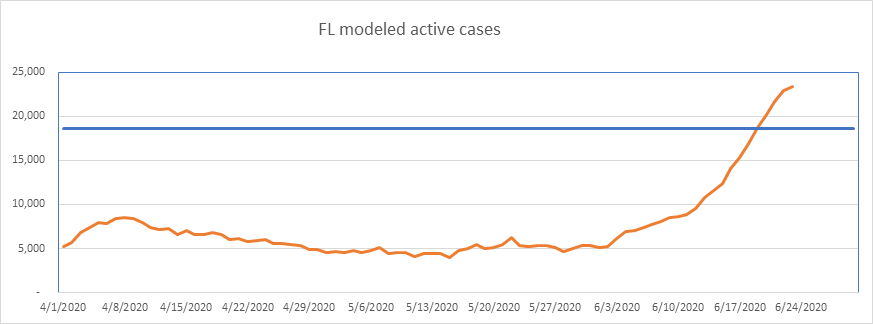
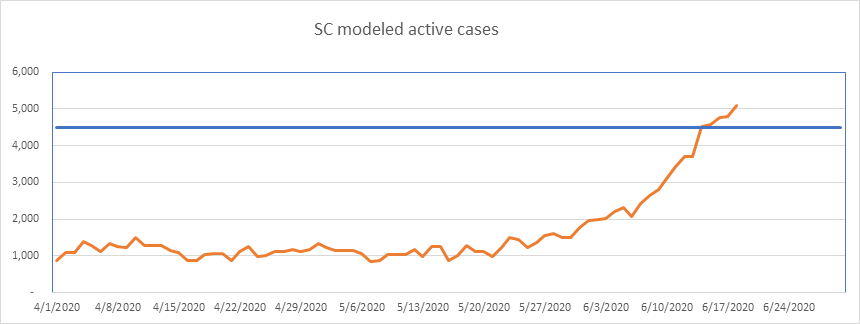
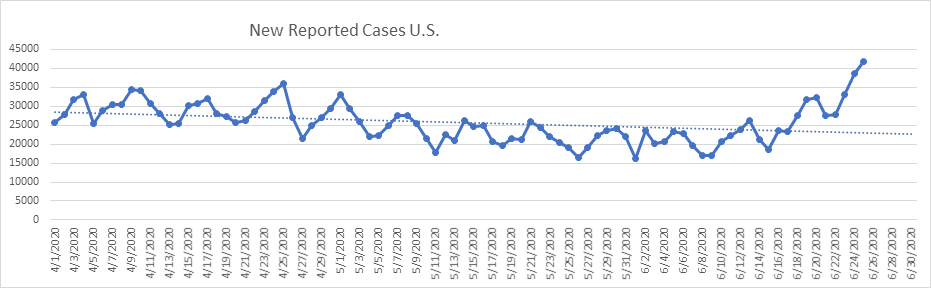
Today we set a record for new reported cases. Today’s new case count came in at 41,939. These numbers are pushed up almost entirely by 5 states: Arizona, California, Florida, South Carolina, and Texas. 20,530 new cases came from these 5 states alone today – 49% of all new cases. These are the states to watch. For the past two days, Arizona and California look marginally better. But I don’t like the looks of FL, SC, and TX. Also, if we don’t see a change in the next couple of days in GA, I’ll add that to the “problem” list.

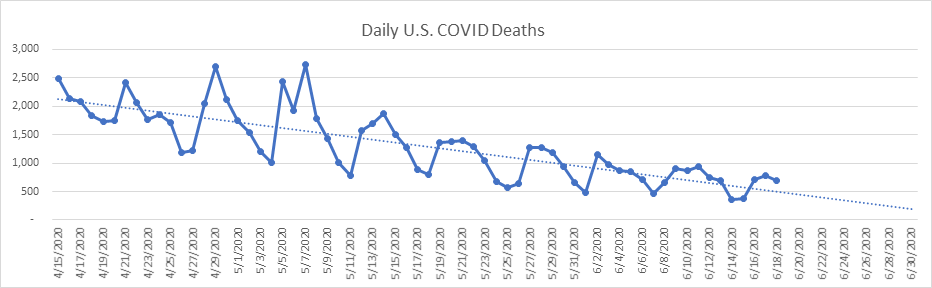
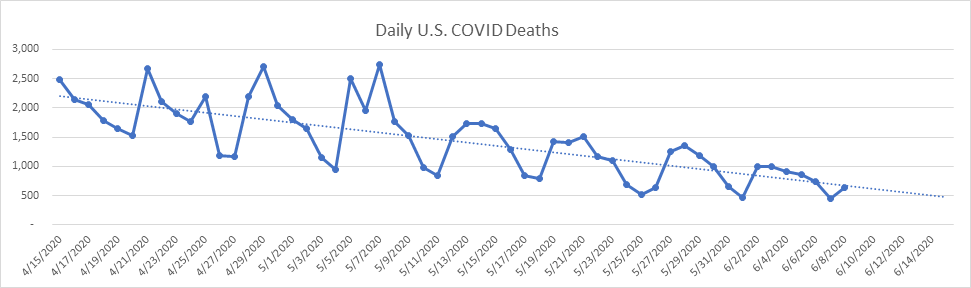
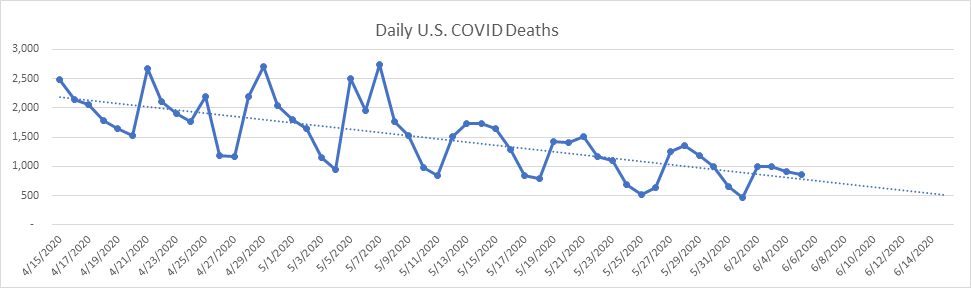
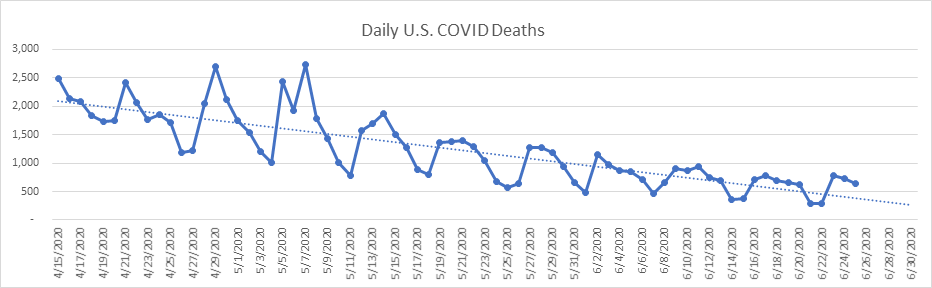
Deaths, on the other hand, continue their downward trend, with 646 deaths reported today (other than NJ’s historical probable deaths). National cases have been on the rise for 2 weeks now, yet we see no increasing trend in daily deaths. We may yet see real increases, but not so far. I’m now thinking that this divergence between reported cases and deaths is a result of:

  • We’re testing people who are less ill as the testing protocol widens
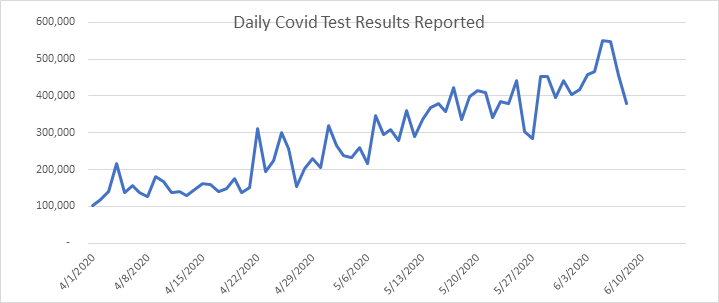
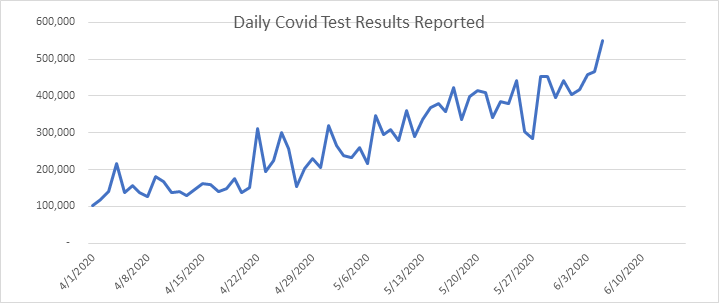
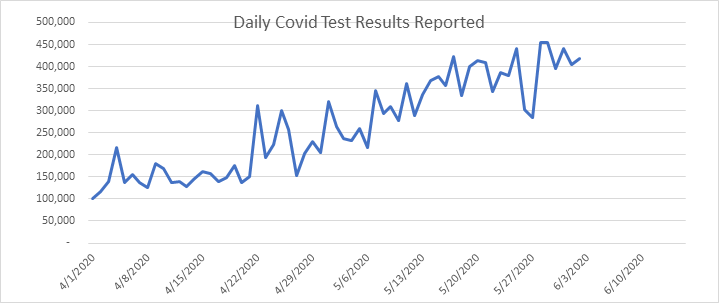
  • General expansion of testing (we hit a new national record today)
  • We’re testing a younger demographic, and younger people are becoming infected at a higher rate than previously (their mortality rate is close to nil)
  • Double counting of cases is increasing, including antigen and antibody tests, as well as PCR tests – we know that AZ, CA, TX, and SC double count cases

I’ll possibly report again tomorrow, or if no news, after the weekend…

As always, feel free to send me your questions about my assumptions, methodology, or modeling in general.

  • Likely date of active case peak (Chalke modeling): April 10
  • Likely date of peak deaths (IHME): April 16 (last revision on June 24)
  • Total Test Results reported today: 640,465 (a new record)
  • Total Pending tests reported today: 2,133 (extremely low)
  • National reported case Growth Rate today: 1.77% (low)

Shane Chalke Interviews

https://www.fredericksburg.com/opinion/editorial-unlock-demographically-not-geographically/article_a62e6e70-dccd-51cf-b7b2-16d77a90fd9c.html

Website

Groom Ventures has agreed to host a website that will archive my daily reports, and supplement with other commentary. John Groom worked at one of my companies back in the day, and is an excellent writer. The website is: www.howmuchrisk.com For those of you that post my daily report on Facebook, let me suggest you link to this site, as the direct Facebook posts don’t seem to copy the graphs.

Daily Analysis

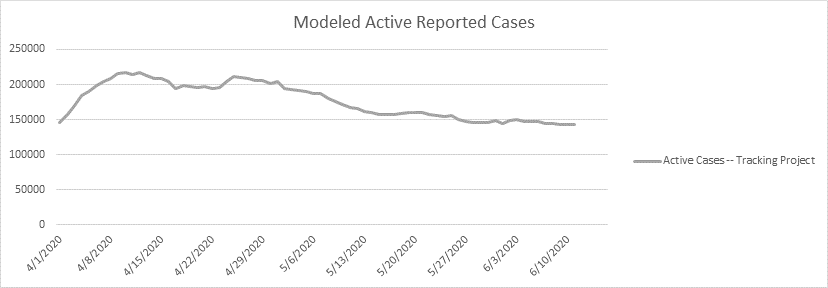
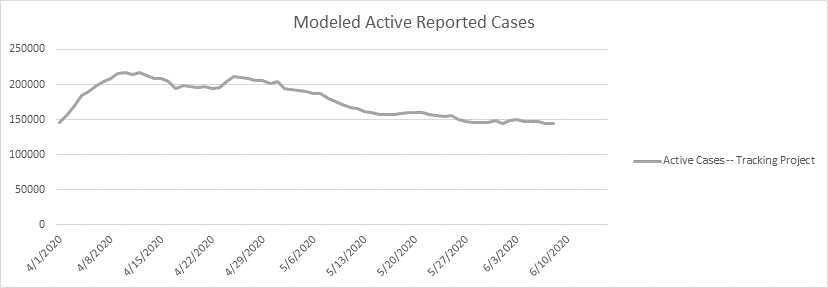
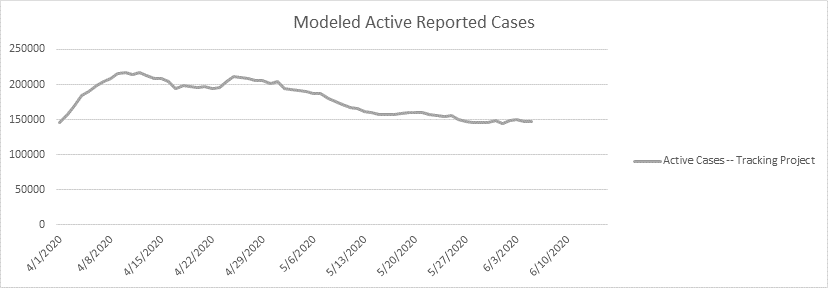
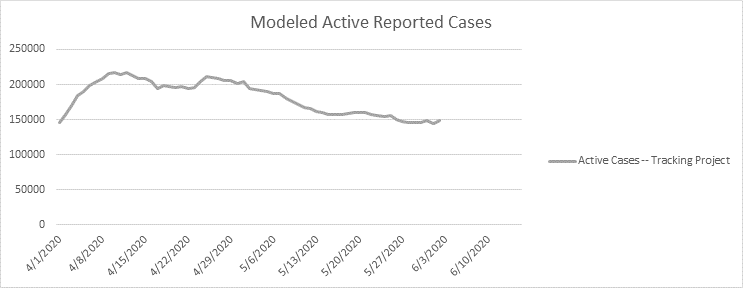
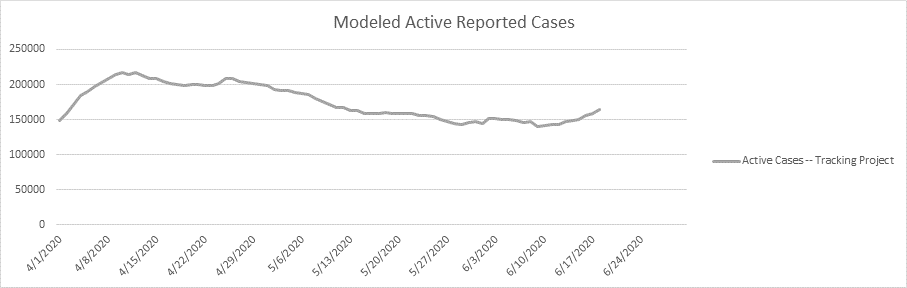
Here is the national picture of active cases – I’m modeling about 233,000 known active cases. Over half of the active cases I’m modeling come from the 5 problem states. Again, this number is high (I don’t know by how much), as many states routinely double count cases.
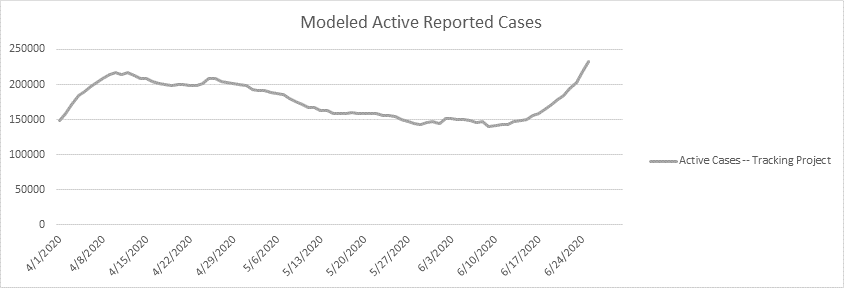
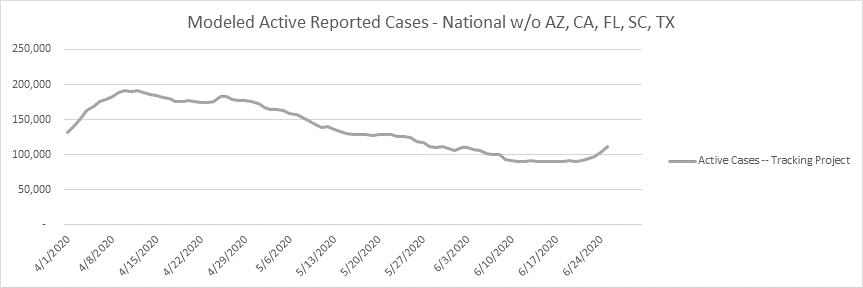
Here is the rest of the country without the 5 focus states. Not great, but a much better picture.
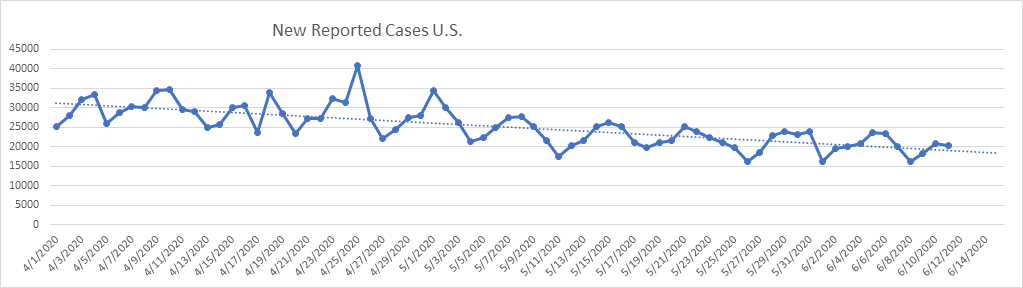
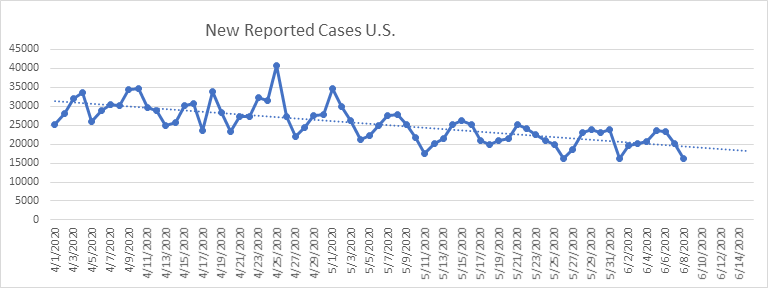
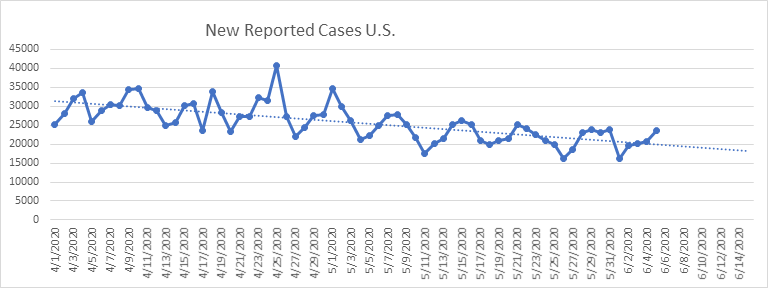
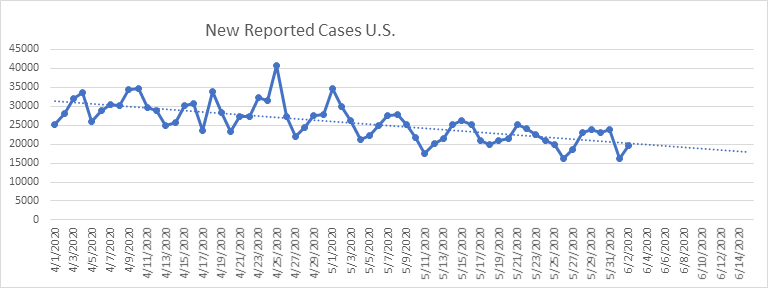
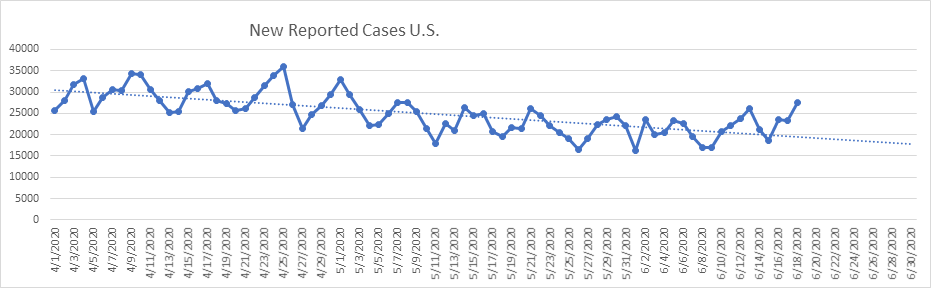
Here are the new reported cases nationally. Increasing for 10 days now – half of all new cases are in 5 states.
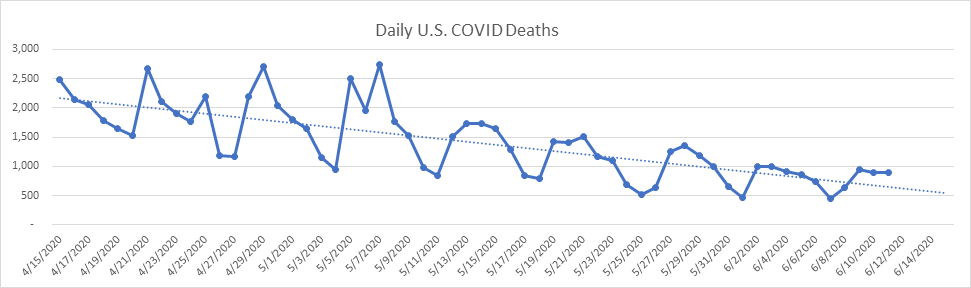
Here are the daily death reports. Deaths are running a small fraction of what the experts predicted for June. We’re definitely seeing a divergence of active cases vs. deaths.
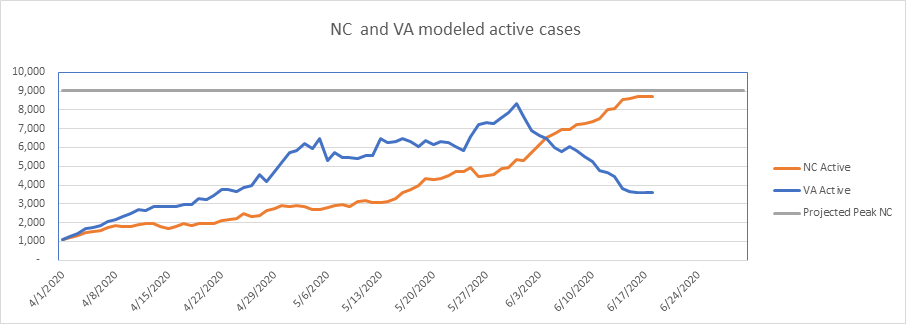
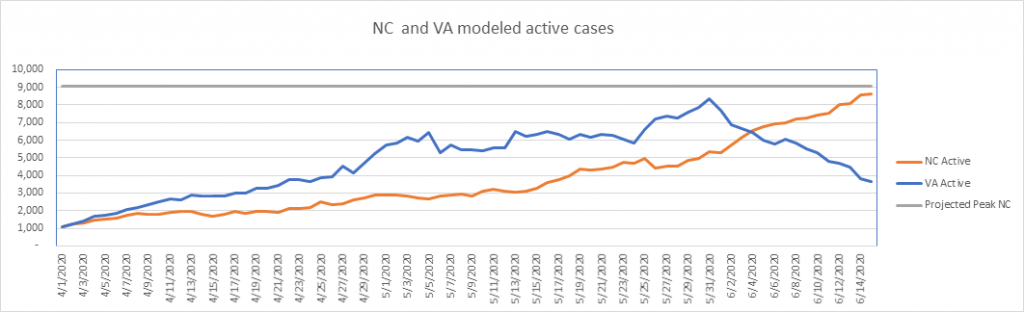
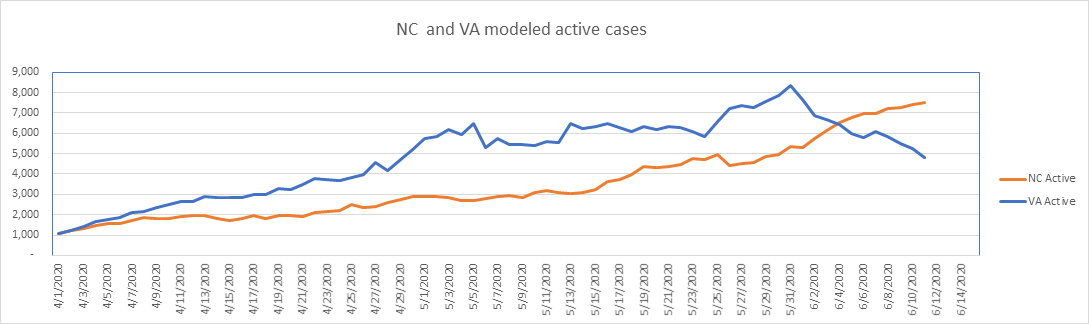
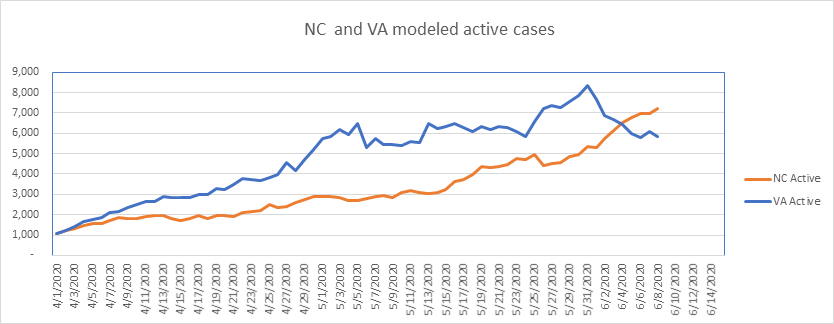
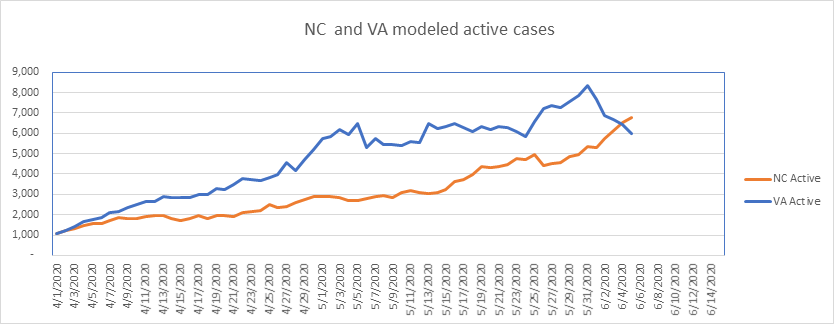
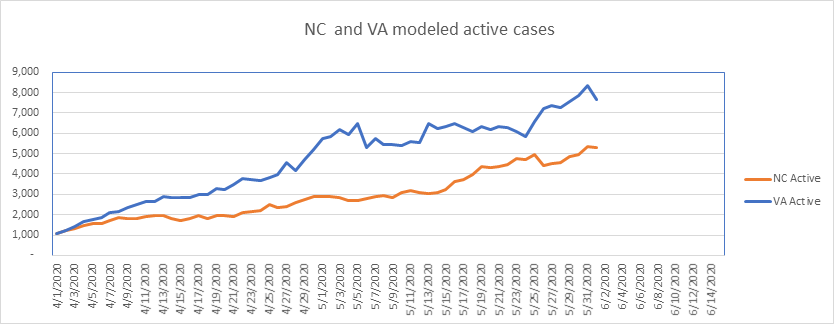
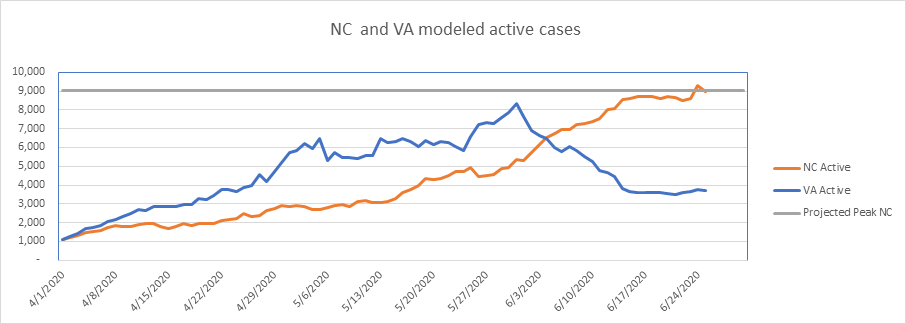
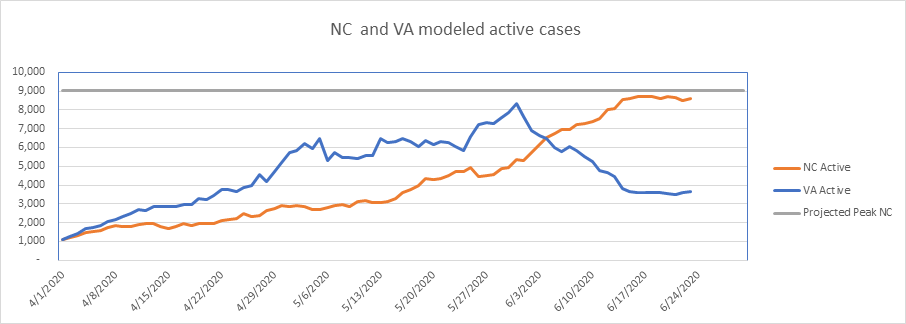
On to the states. NC has been roughly level for 11 days now – this is a significant improvement from the growth rate in the previous 2 weeks. It looks like it may be peaking right around the average as a percent of the population, and at a lower rate per capita than Virginia. Ironically, NC decided to stay in Phase 2 for another 3 weeks.
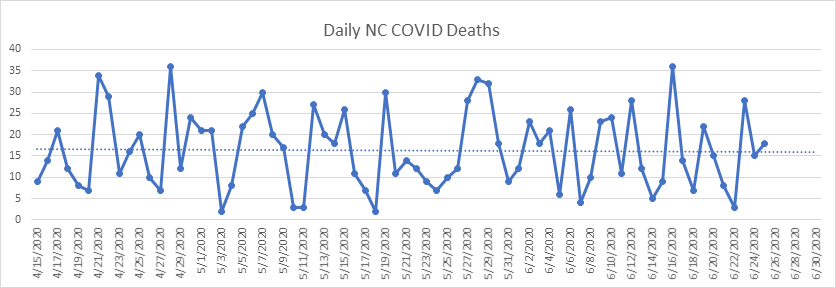
In addition to a fairly steady state with respect to cases in NC, daily deaths are flat as a pancake for weeks now. Look at that trend line…
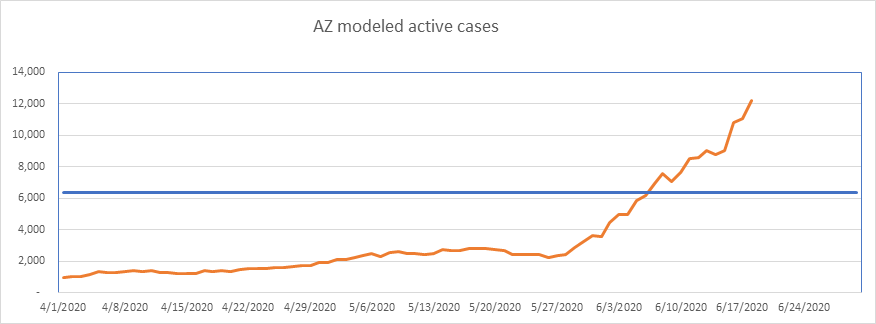
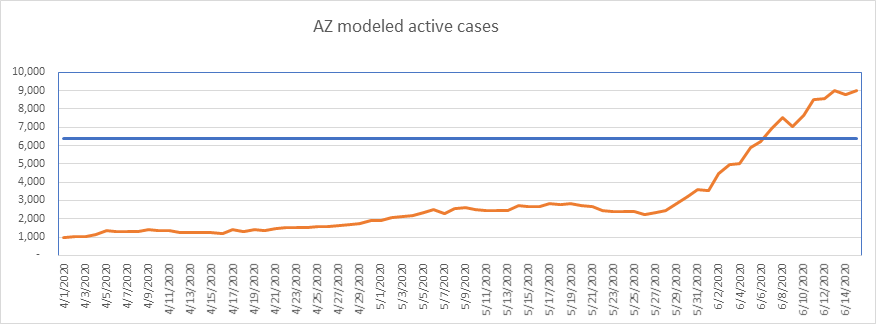
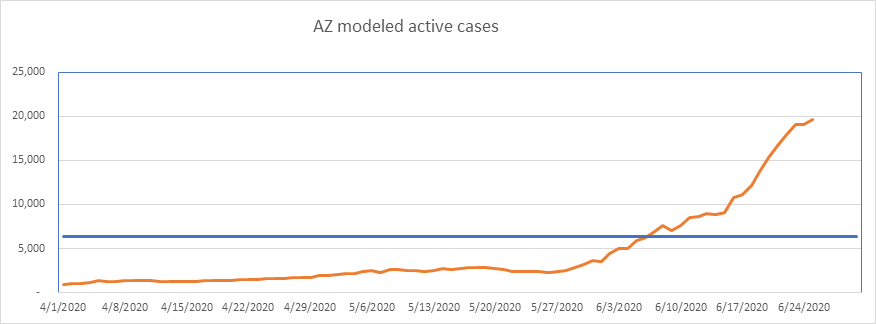
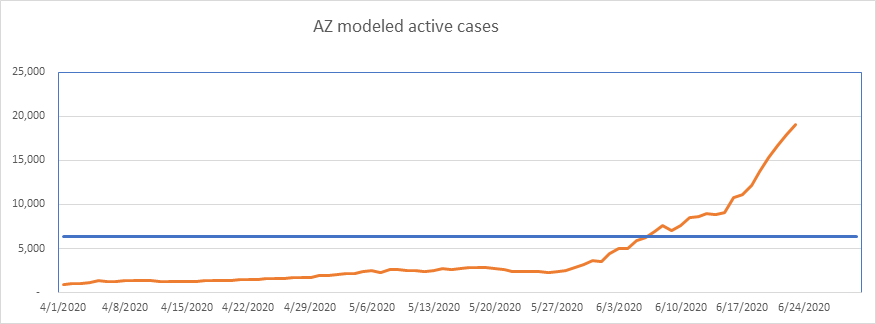
Arizona looks a bit better over the past 2 days, but it’s only 2 days. AZ is now at currently at 0.265% of the population, nearing NJ’s 0.29% at its peak. I need to point out every day that Arizona’s data is exaggerated, since they count specimens tested rather than people, and it’s not uncommon to get multiple tests if you’re sick – each time you’re tested you’d show up as a new case. Even worse, Arizona counts positive antibody tests as new cases.
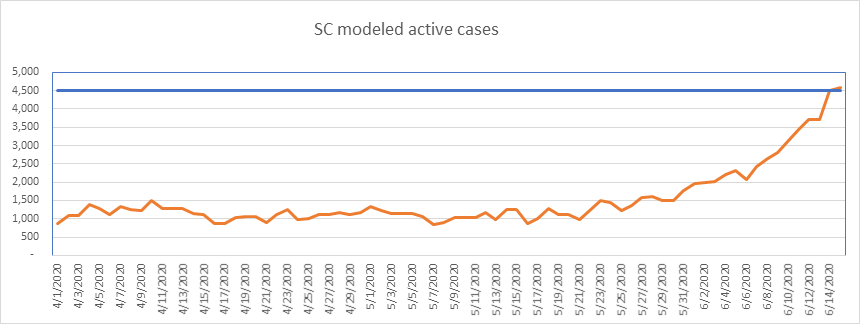
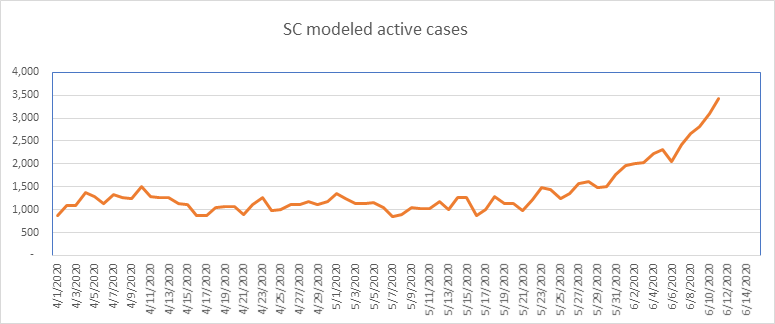
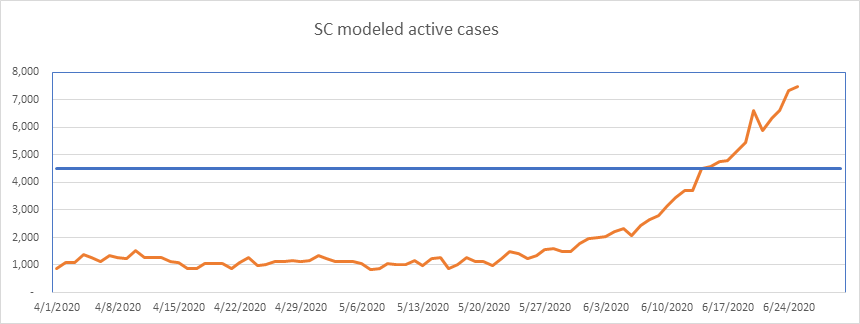
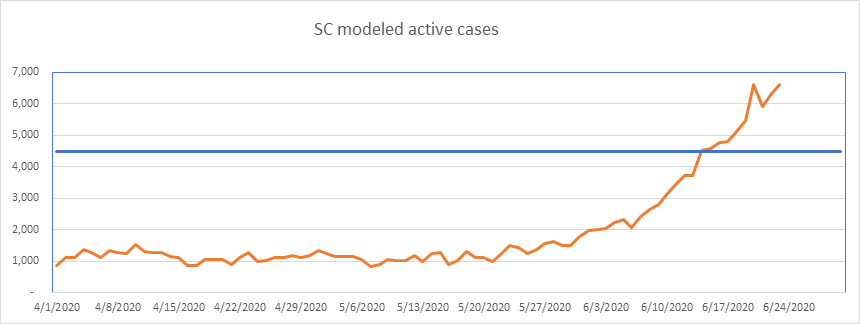
South Carolina added just about 130 new actives today, so isn’t skewing any national numbers, but we’ll keep watching it until it levels. South Carolina also double counts cases, as they treat each positive test as a new case. Worse still, until June 11th, SC counted positive antibody tests as new cases. If this keeps up I’ll take them off my “problem” list, and perhaps add GA.
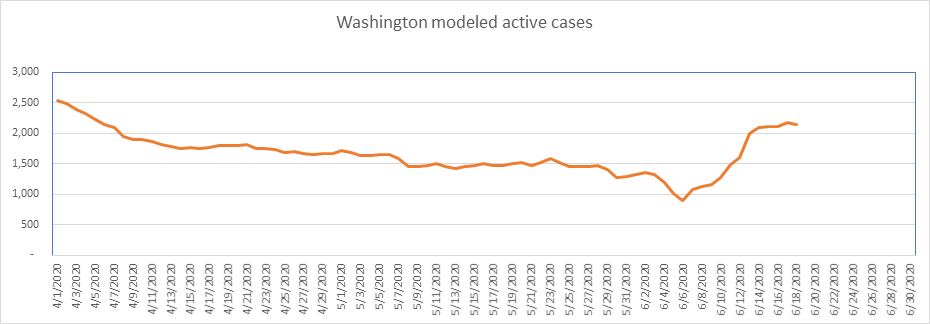
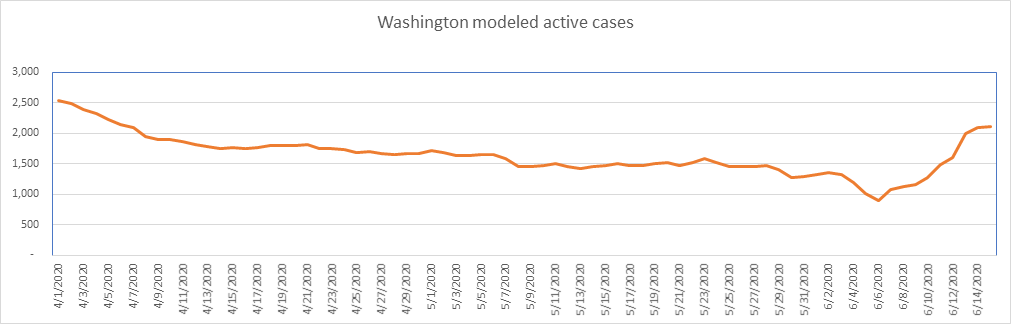
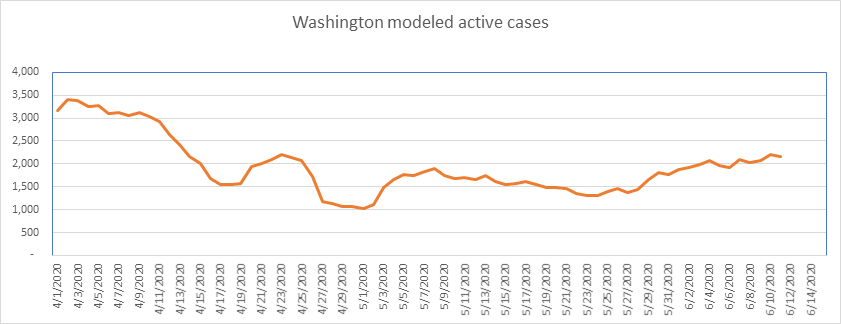
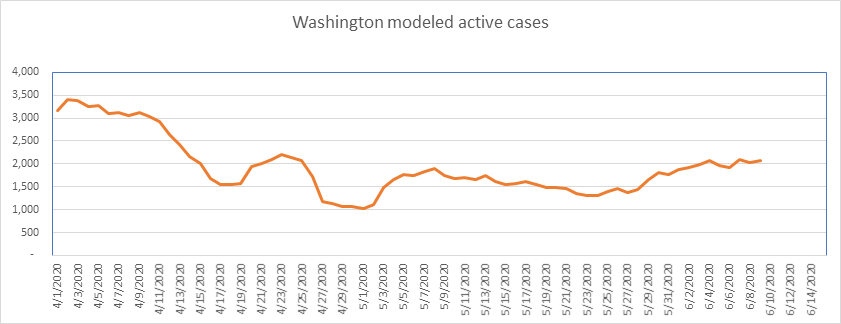
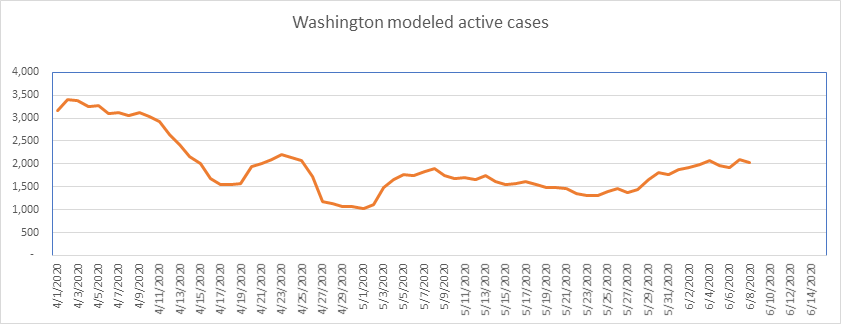
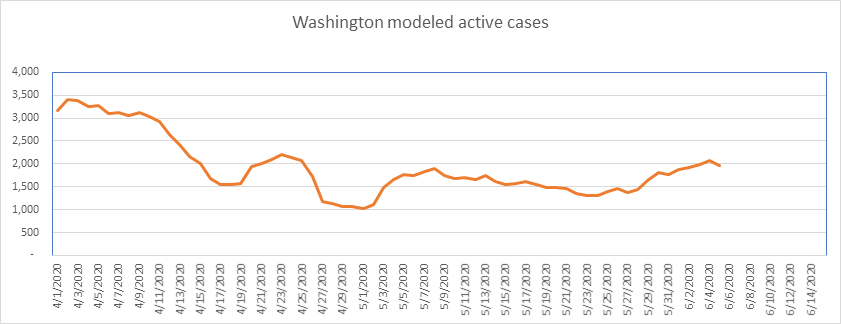
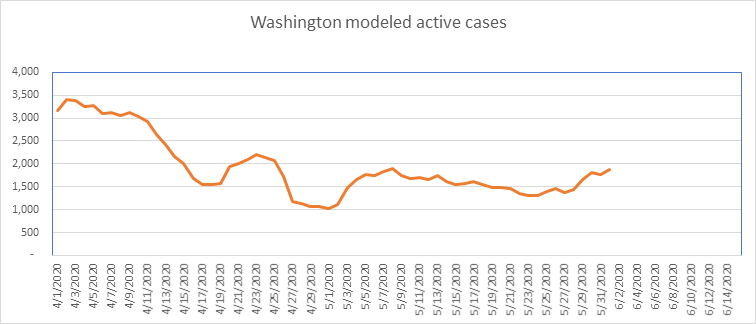
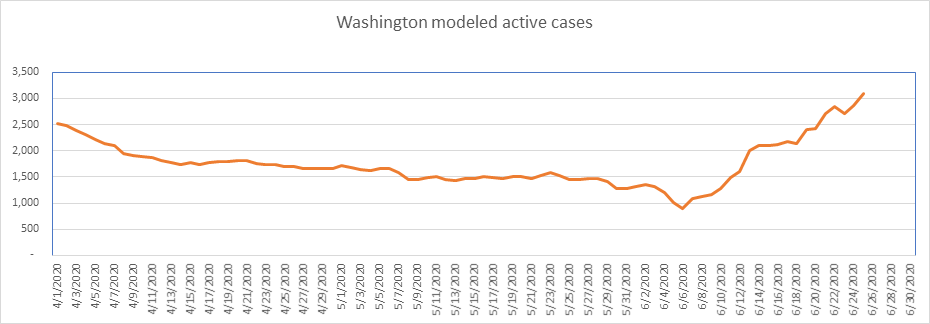
Washington reached a new peak, but is still at a low level per capita. I’d add them to the “problem” list, but the growth rate is low and the numbers are small – a couple of hundred cases a day – so they minimally impact the national numbers.
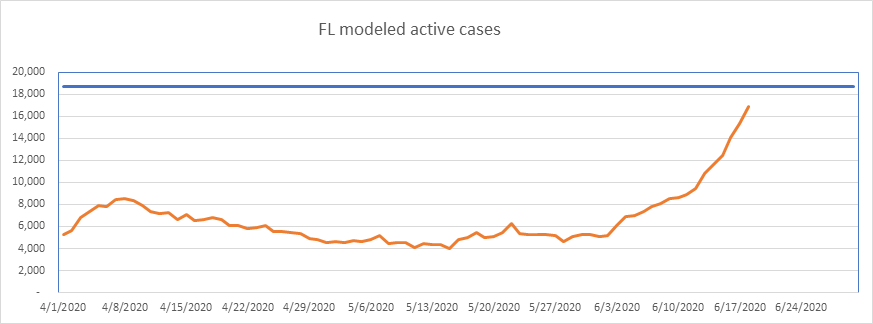
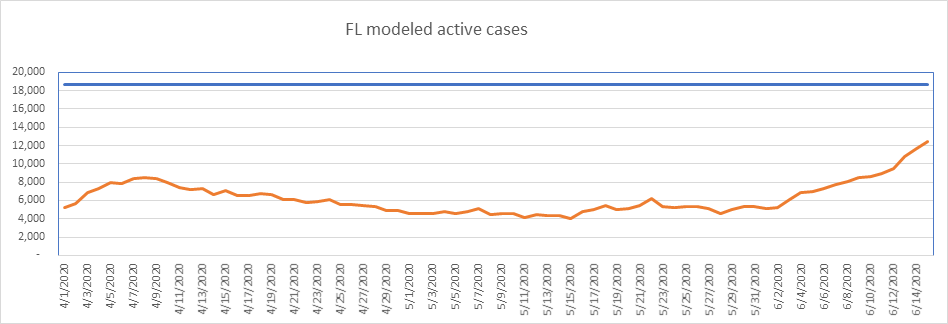
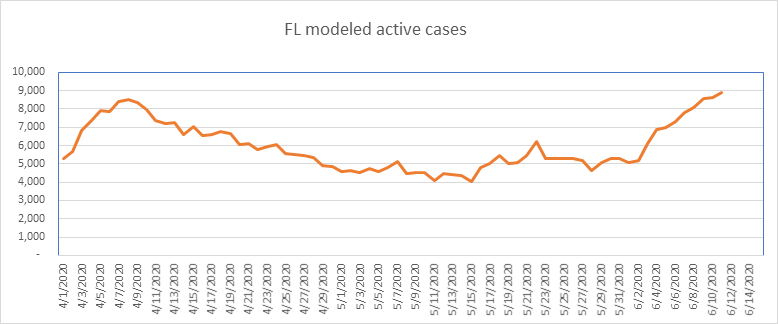
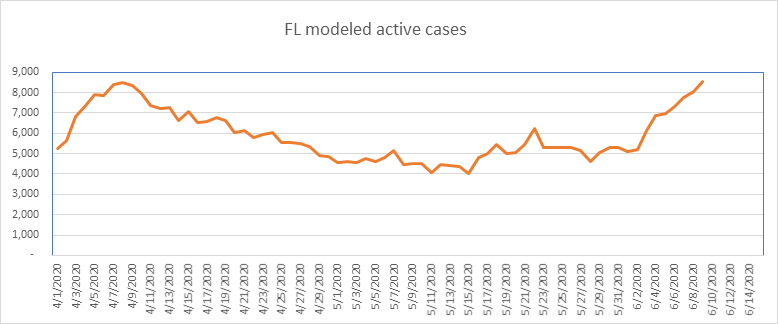
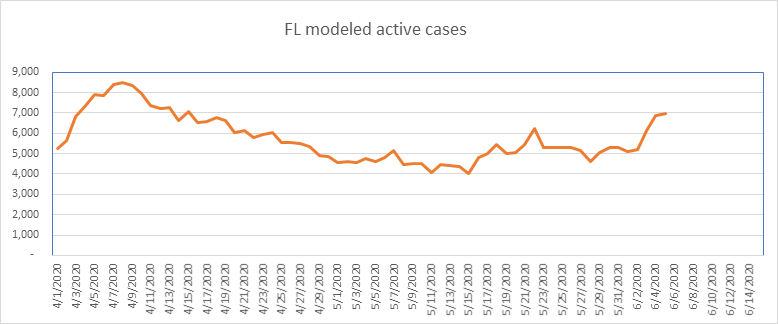
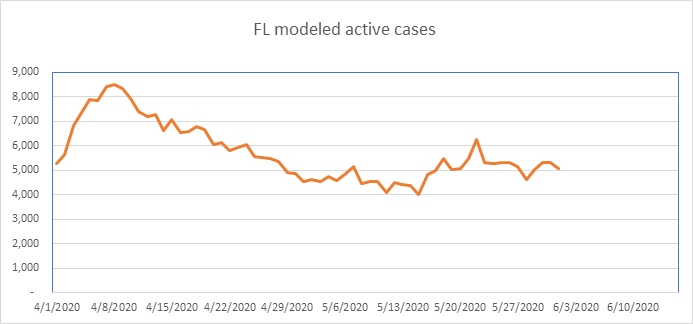
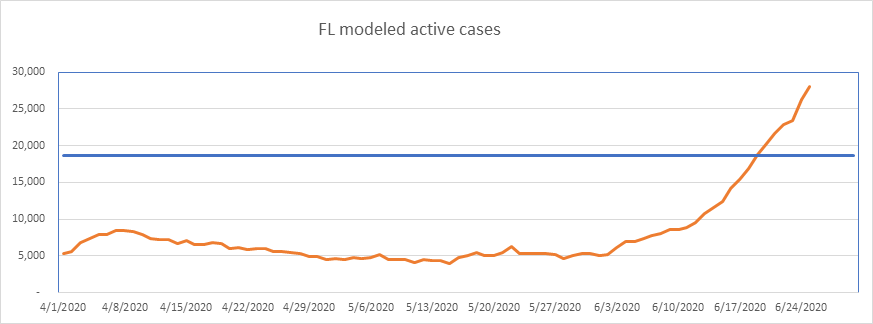
The Florida growth rate is increasing again, after a 4 day slowdown.
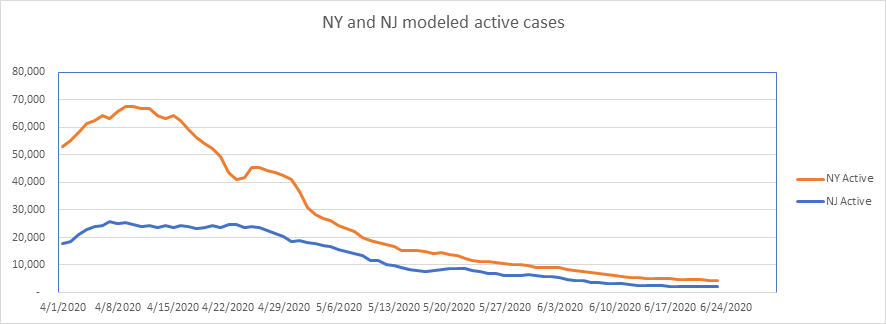
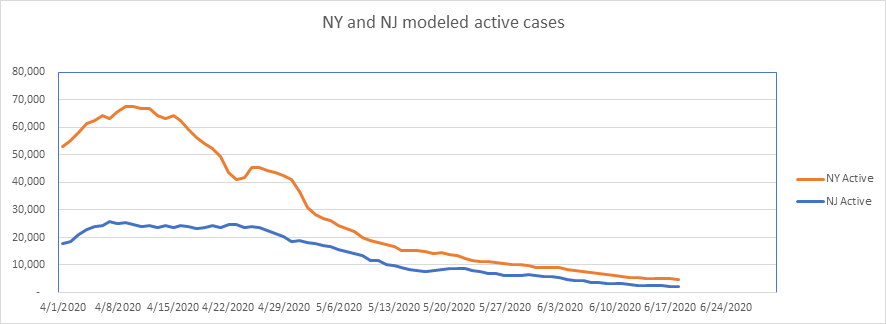
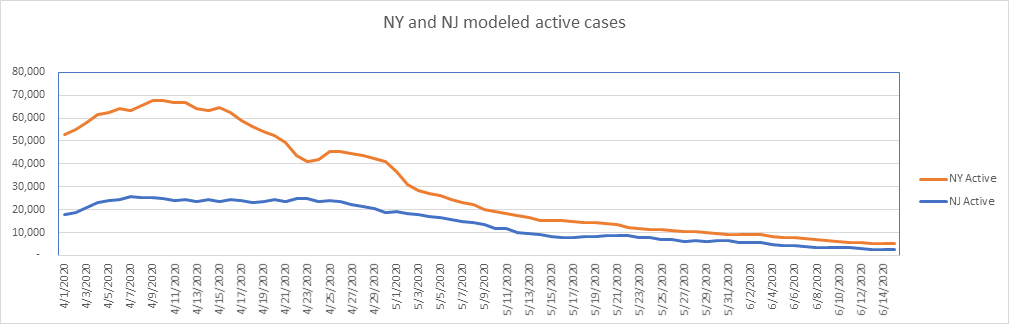
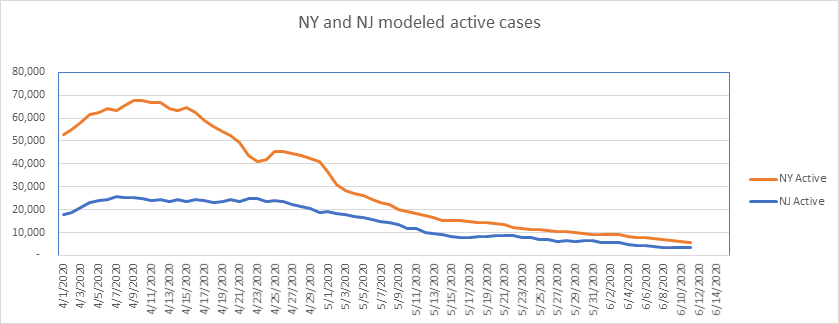
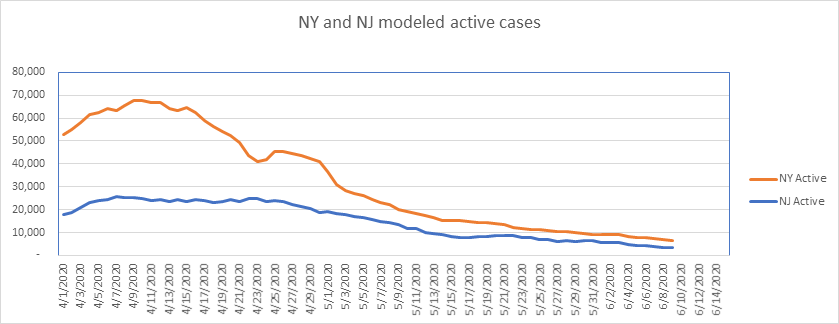
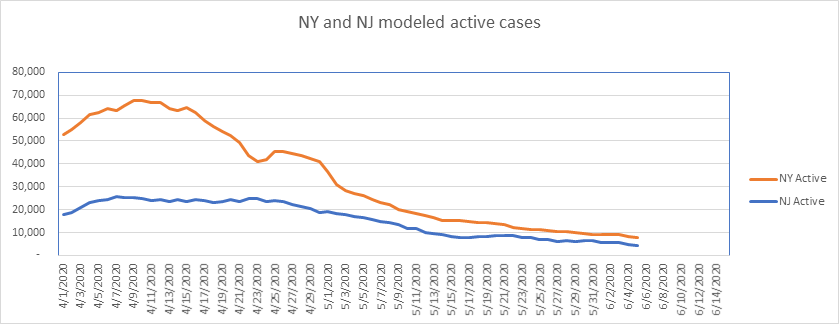
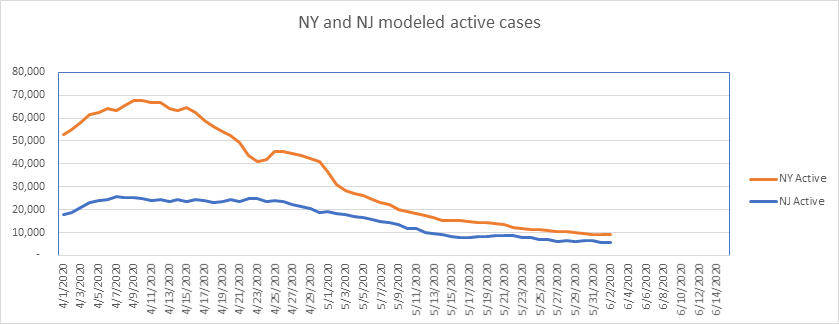
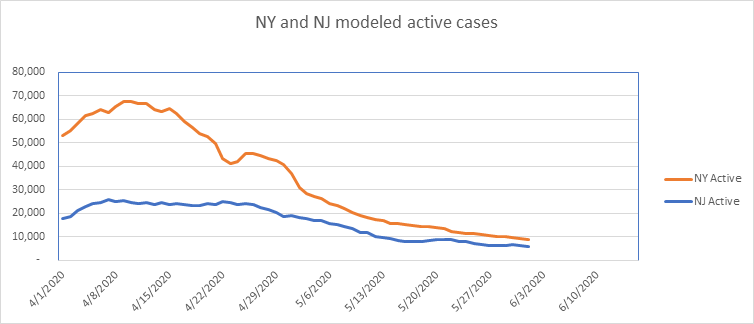
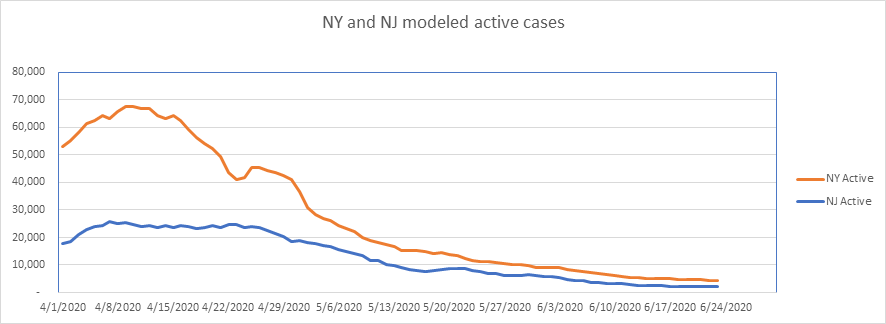
Both NY and NJ continue to be great recovery stories. I’ll keep reporting on these two states in case something happens out of pattern. It’s been a very long time since anything surprising has happened here, though. Interestingly, the new probable deaths didn’t show up in the case count in NJ. Oh, how I wish for consistent data…
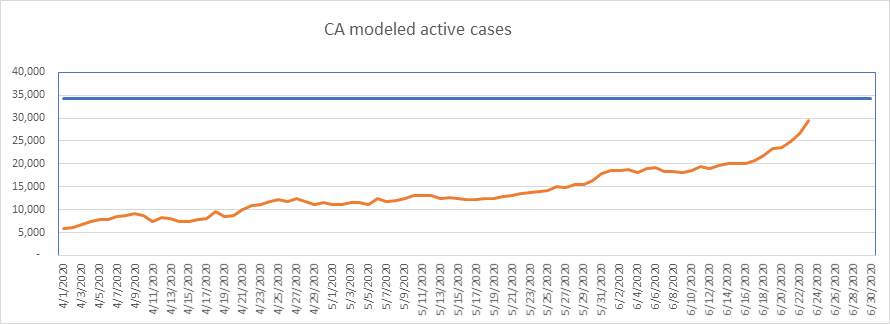
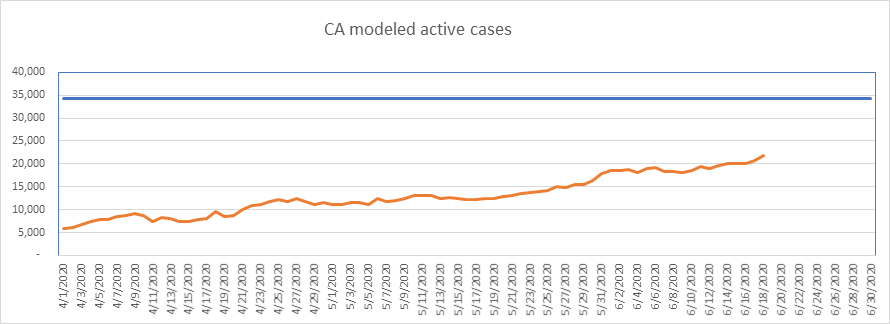
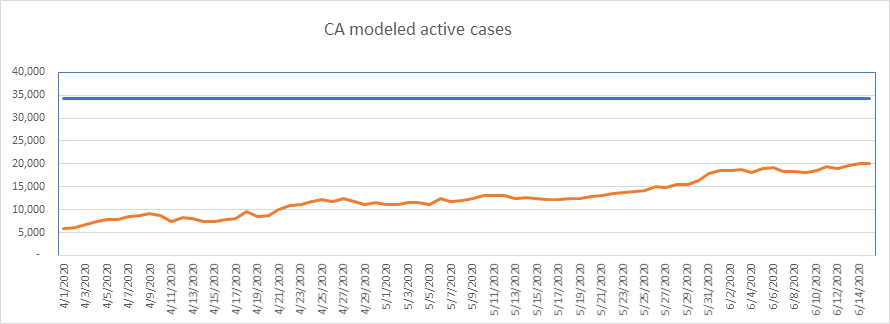
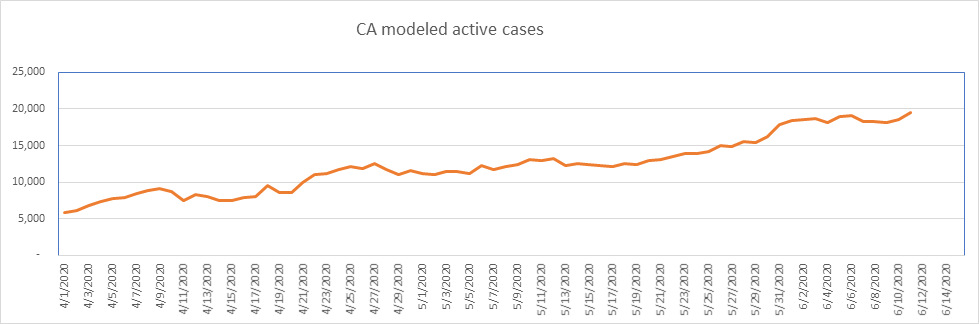
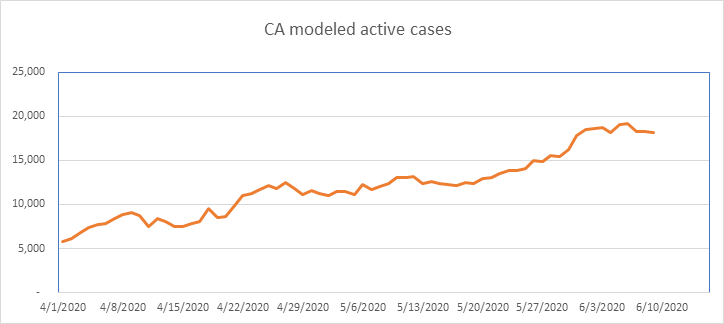
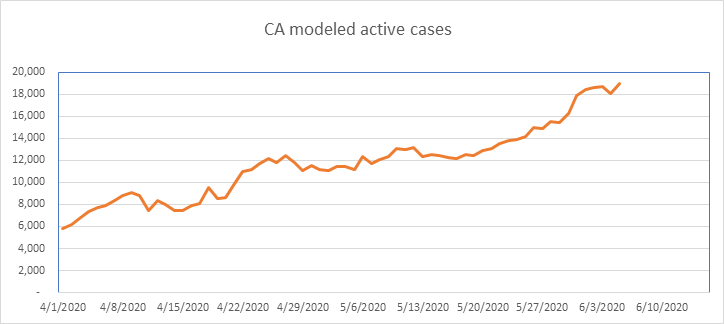
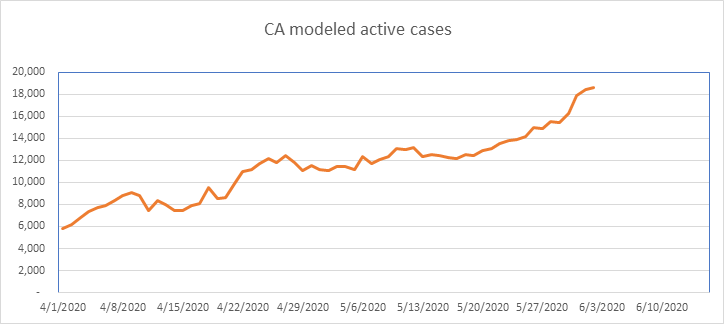
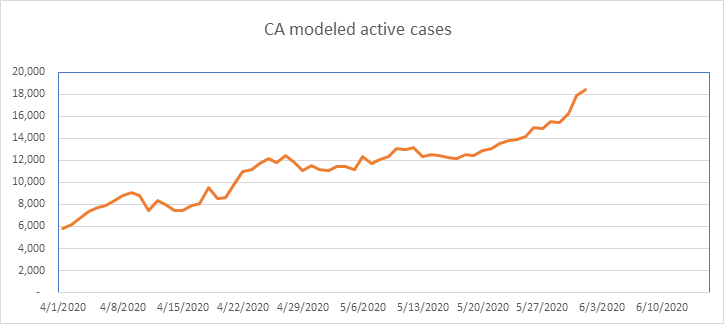
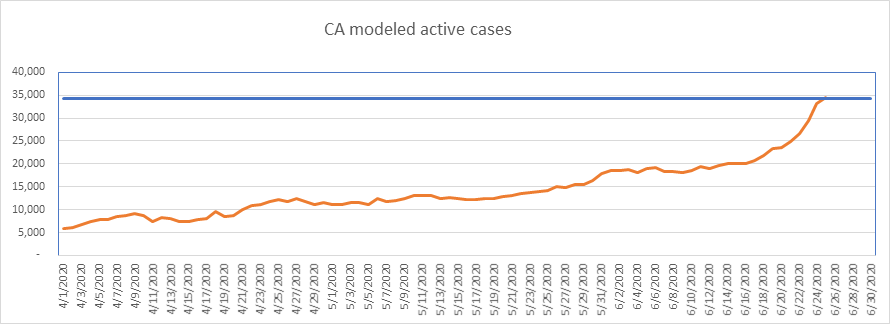
A little slowdown today in California – one day has little meaning, but I like to see it. As always, I need to report that California is one of the states that double counts cases. California is just now at the average peak, so if it begins leveling off now that would be very elegant mathematically.
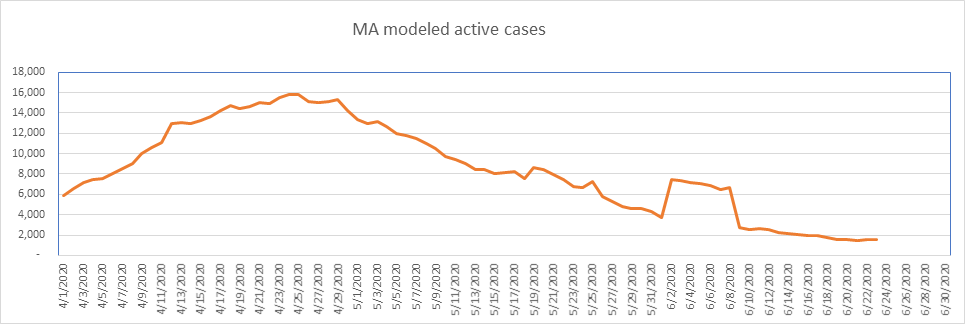
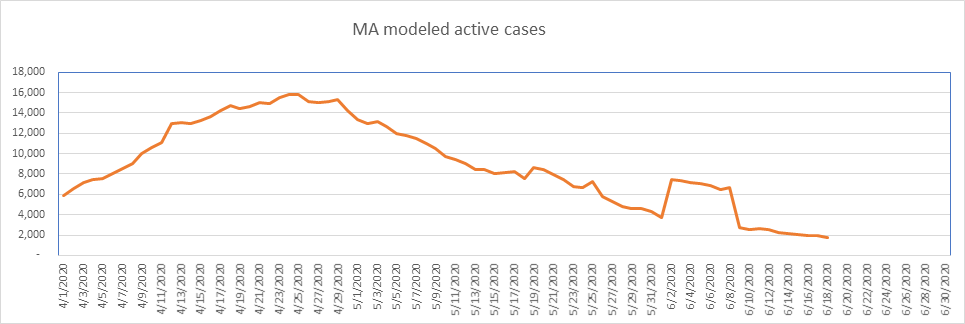
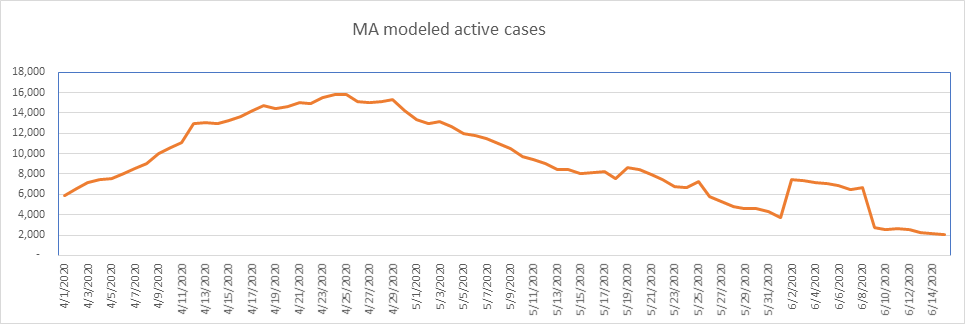
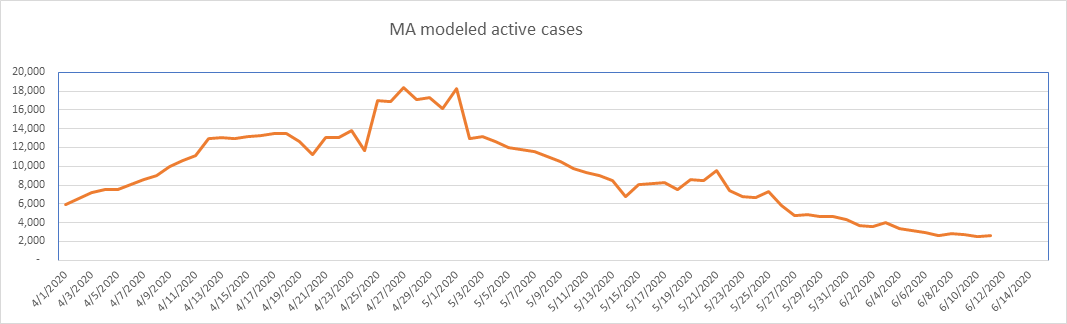
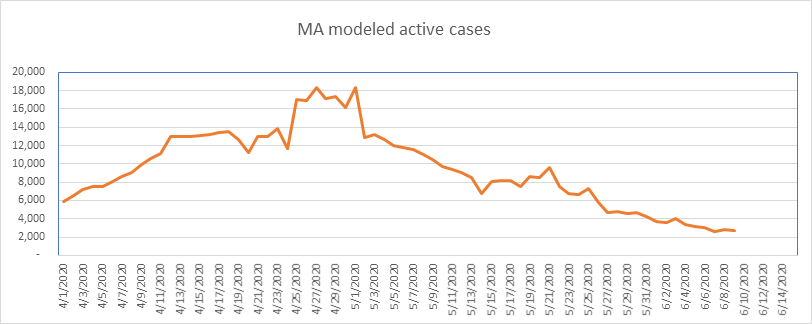
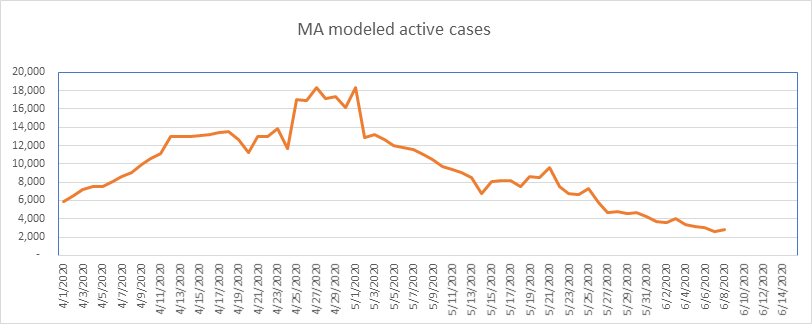
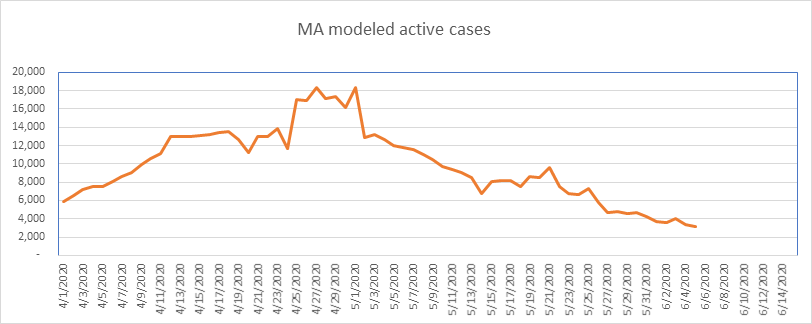
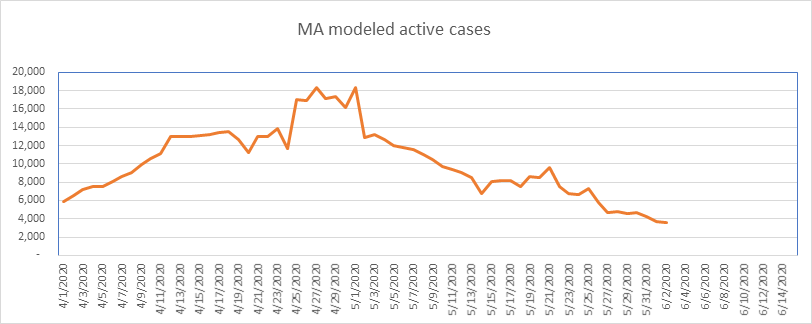
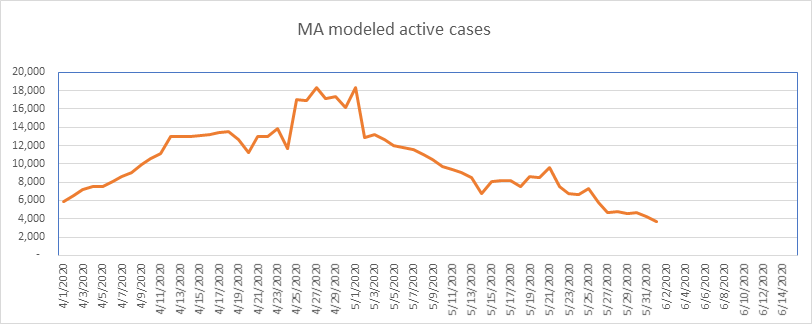
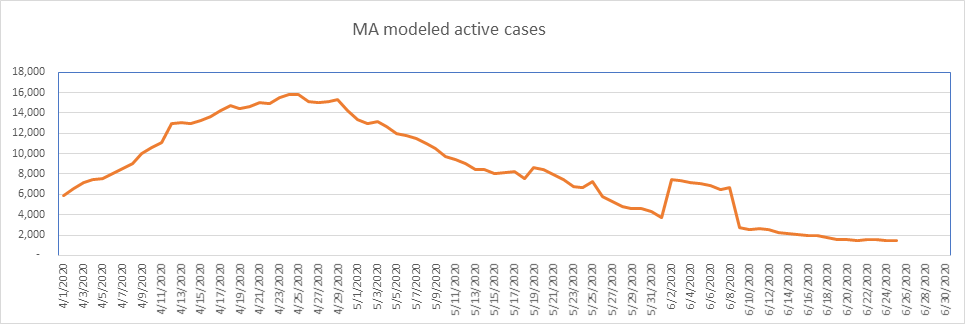
At the beginning of June, MA reported nearly 4,000 historical but newly discovered cases, which skewed the data. Now that we’re 2 weeks past this event, I’m now modeling based on the data as reported. That’s what that bump in cases in early June is all about on the graph. It’s not real. If something like this happens again, I may have to do the work of adjusting for it, but for now, I’m letting it flow through. MA is another state that double counts cases by reporting each positive test as its own case. Nonetheless, I model them with about 1,400 known and still active cases left.
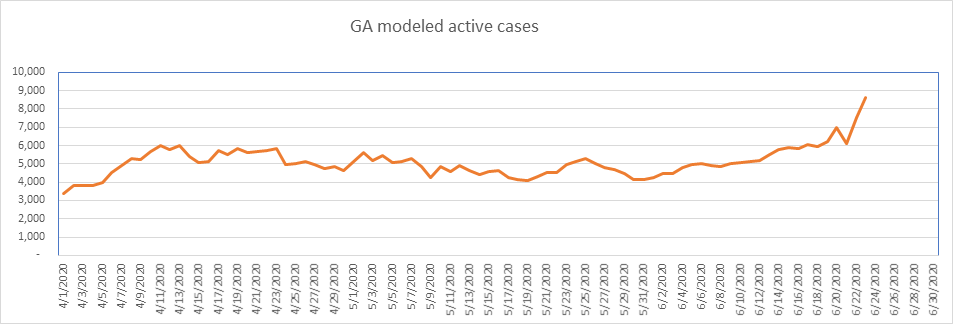
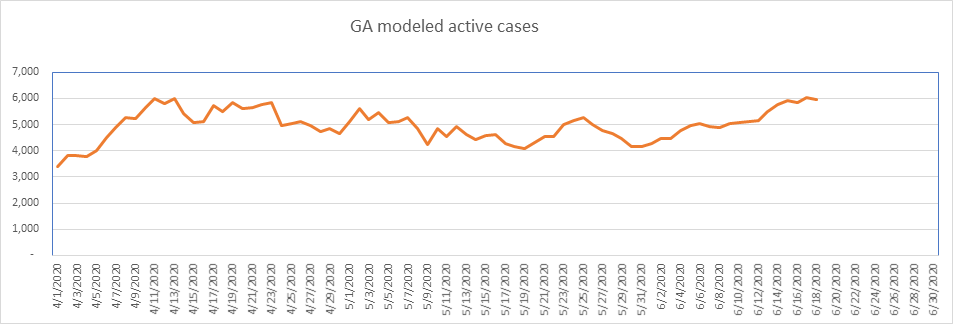
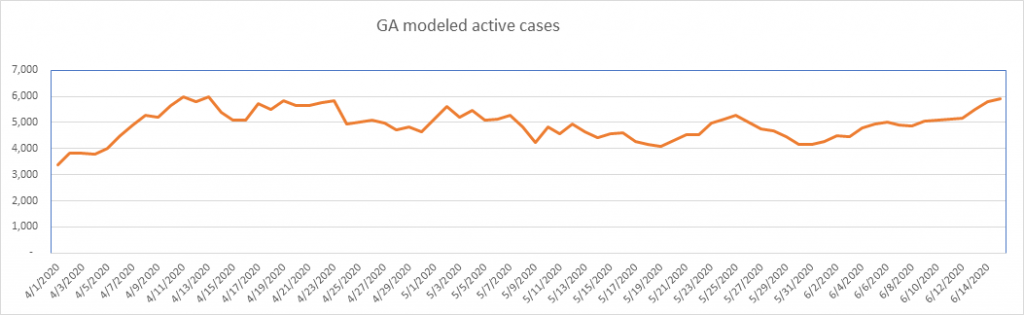
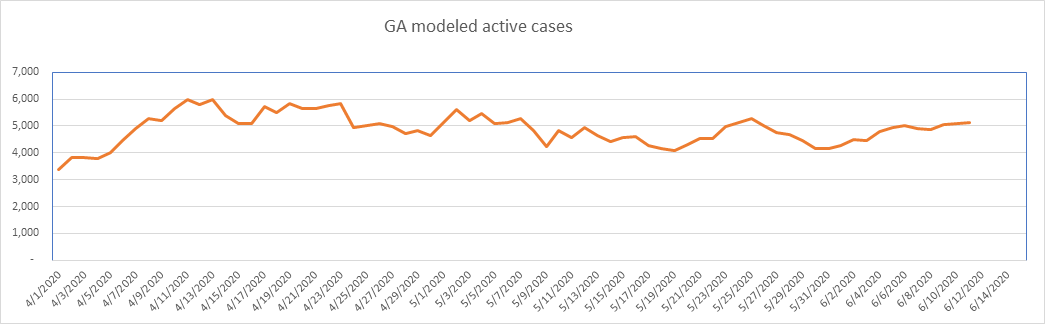
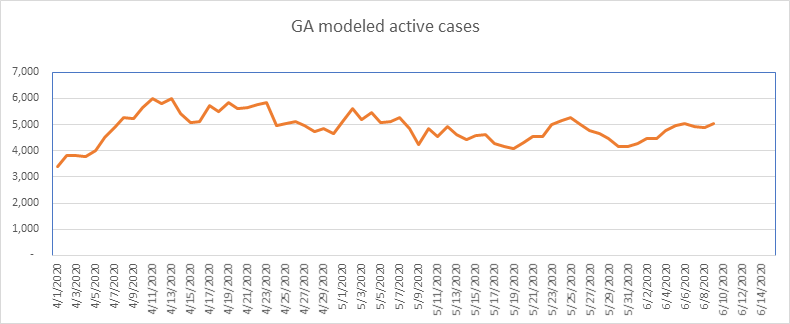
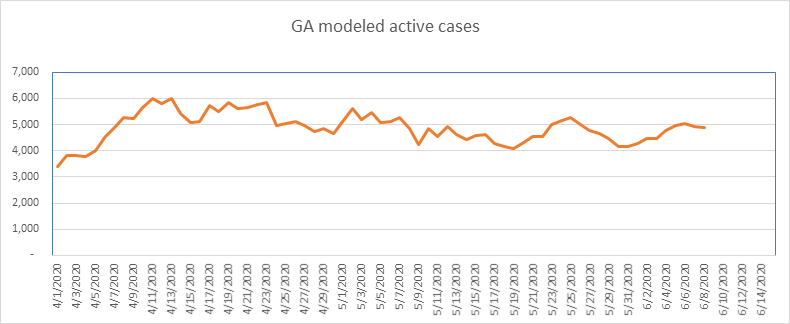
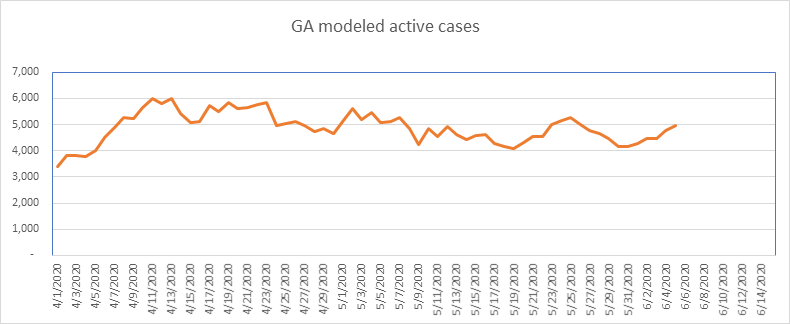
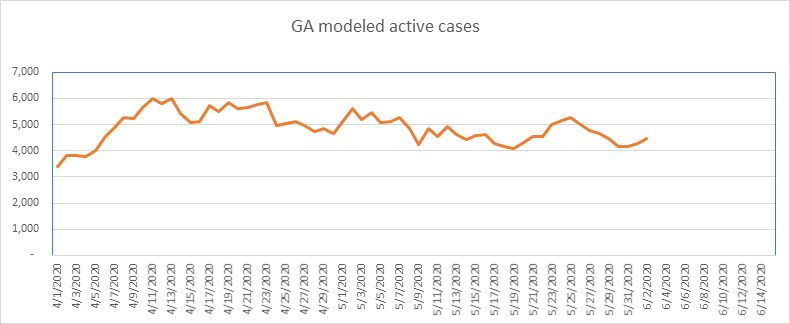
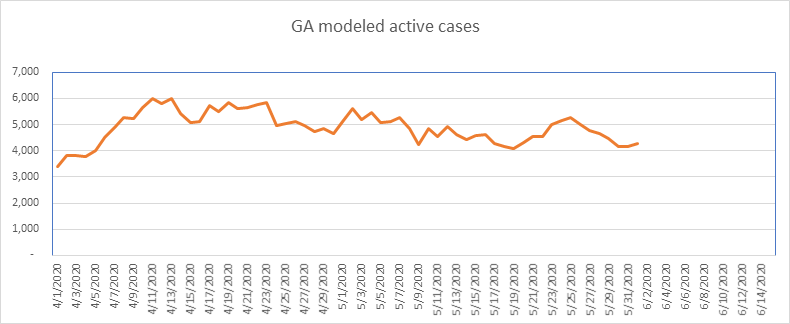
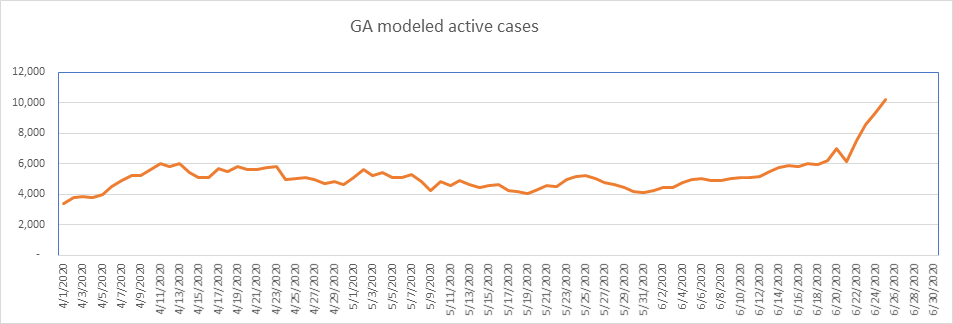
Georgia is looking worse over the past four days. If this keeps up, I’m going to add them to my “problem” list. Here again, the numbers are exaggerated. Georgia counts each positive test as a case. To make matters more distorted, until May 27th GA reported positive antibody tests as new cases.
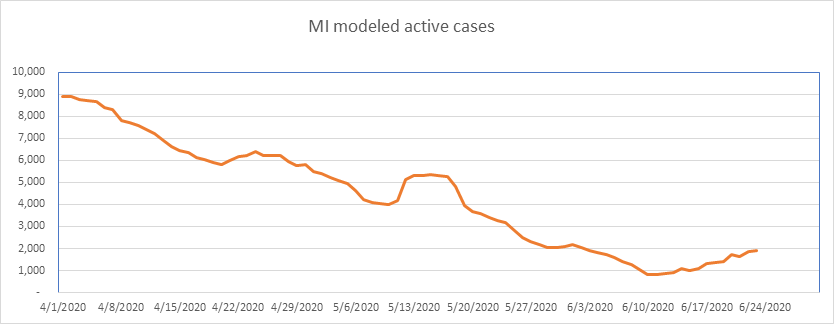
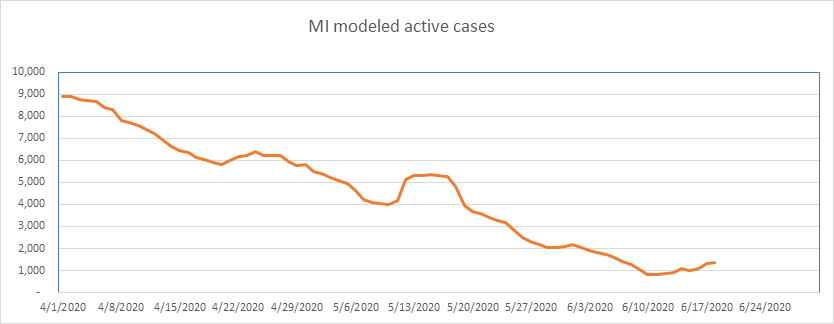
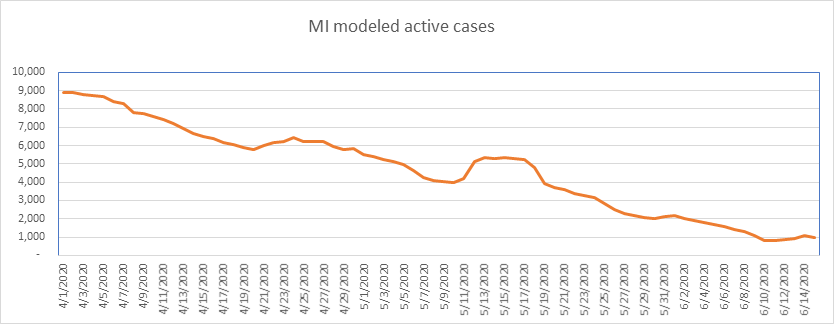
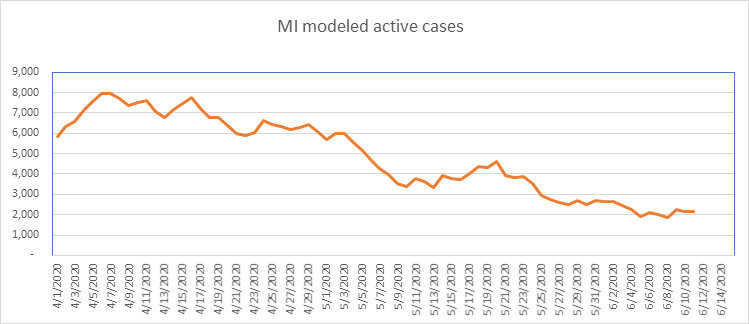
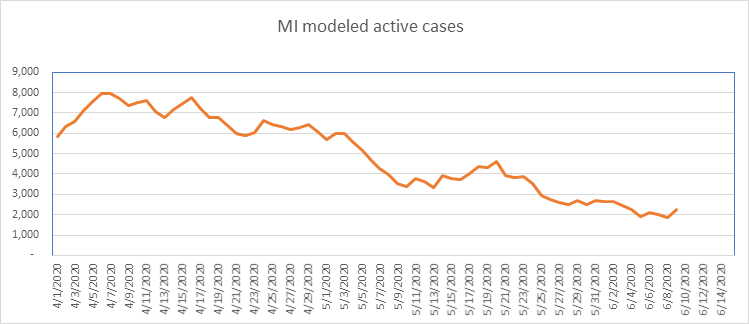
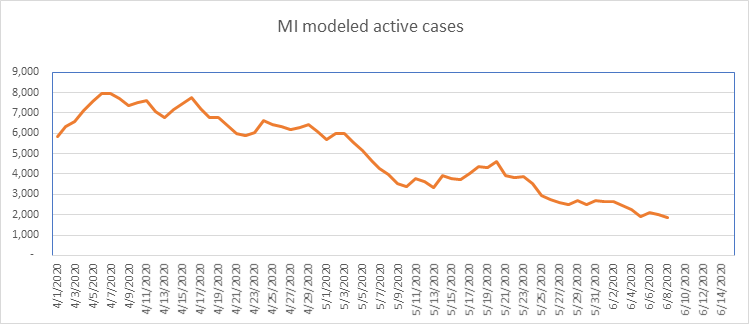
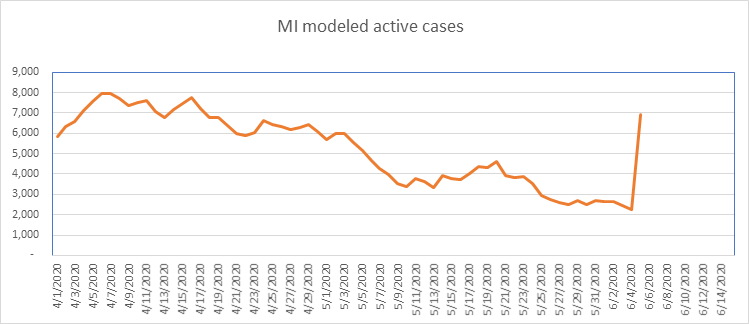
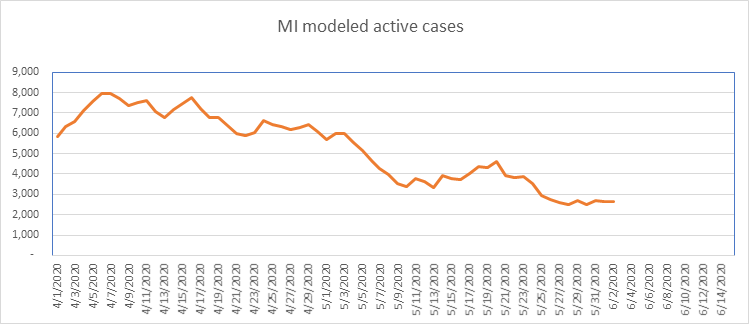
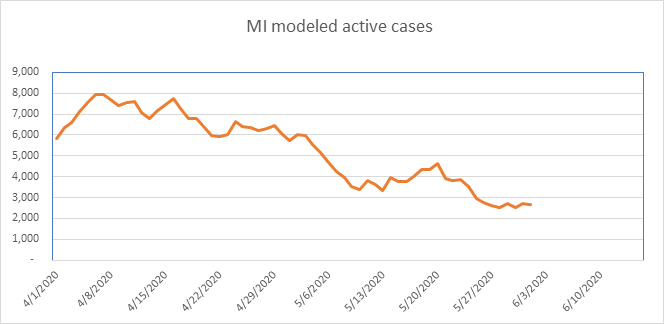
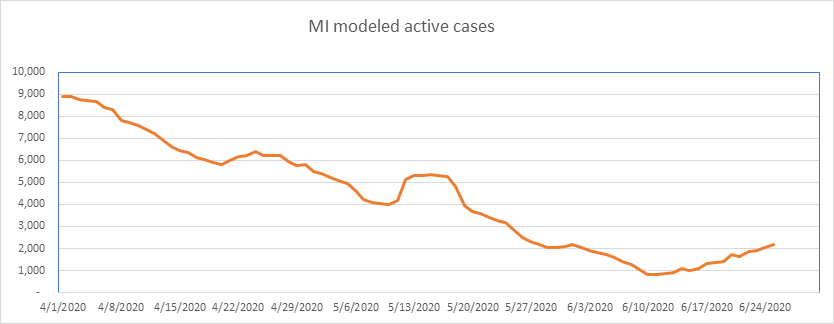
…And here is Michigan. Looking beautiful until June 10th, then beginning a slow drift upwards. Michigan still has the second lowest concentration of COVID of the 15 states I model, so it’s not on my radar yet. They’ve also had a lot of data anomalies, so I look at this graph with a grain of salt.
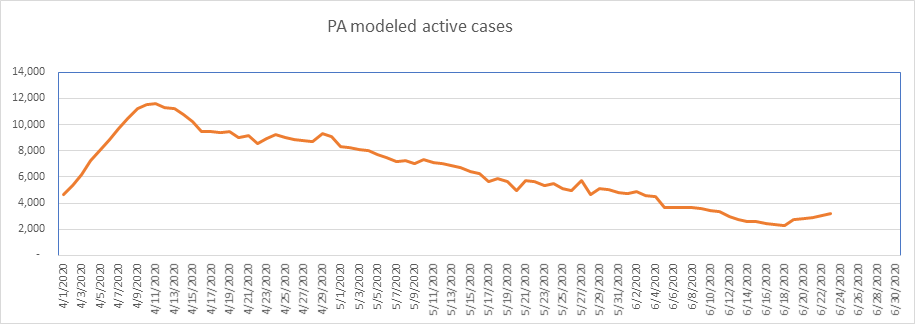
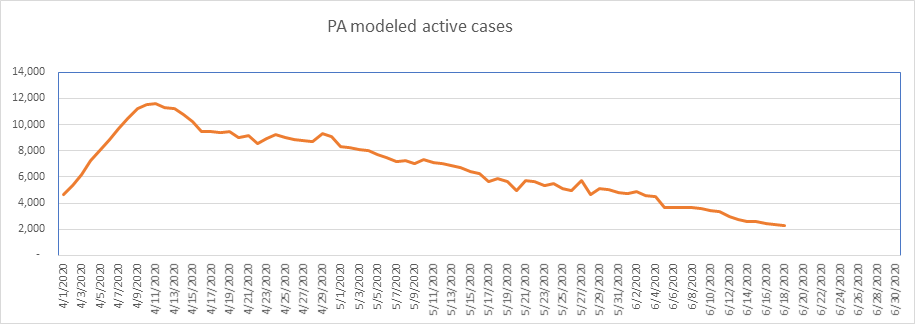
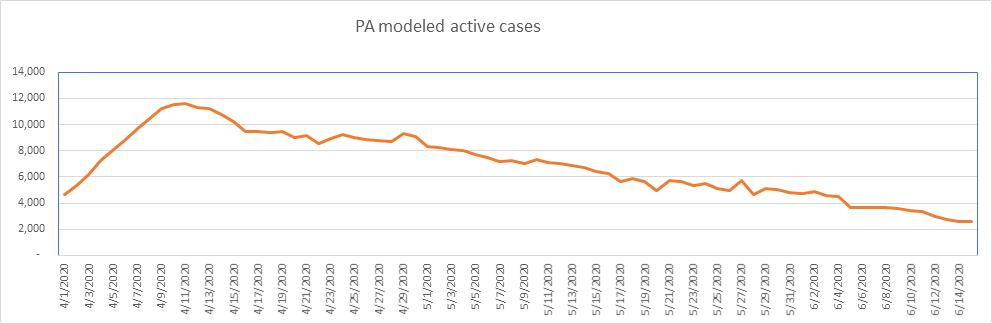
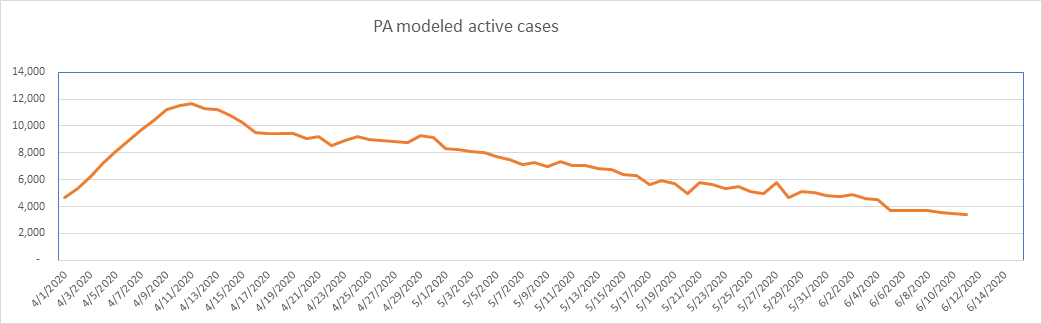
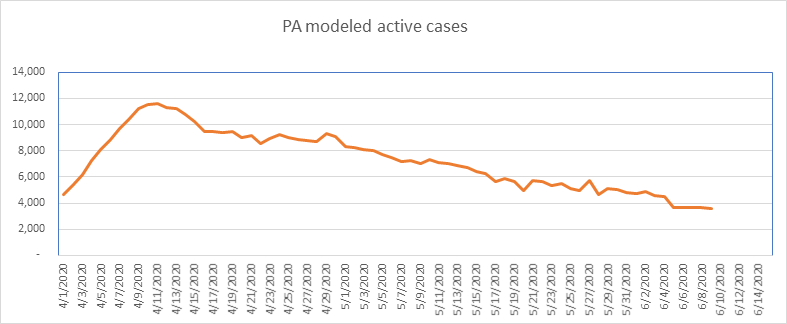
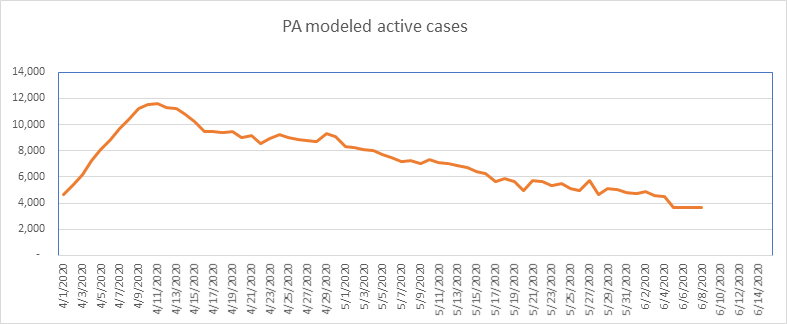
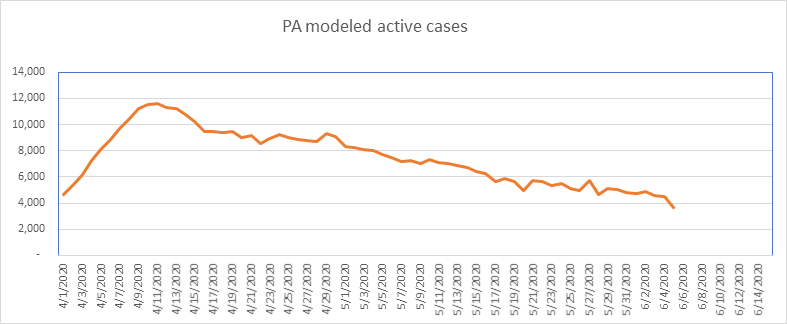
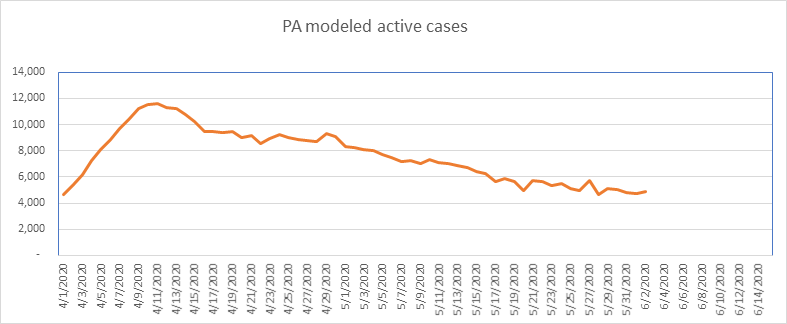
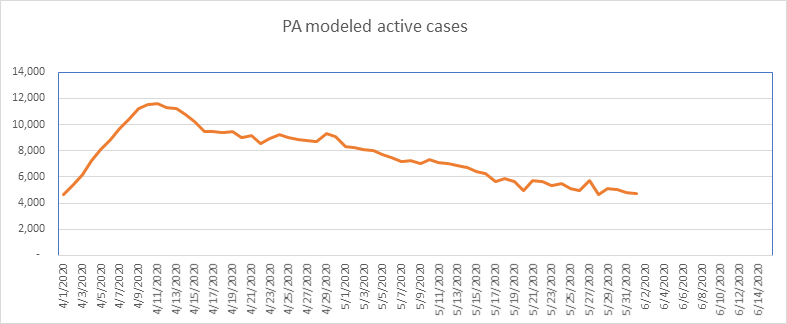
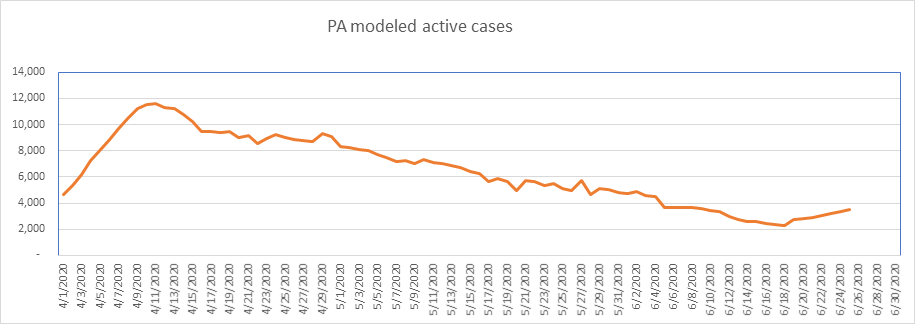
PA has been drifting up for 7 days. Worth watching, but still low on a per capita basis.
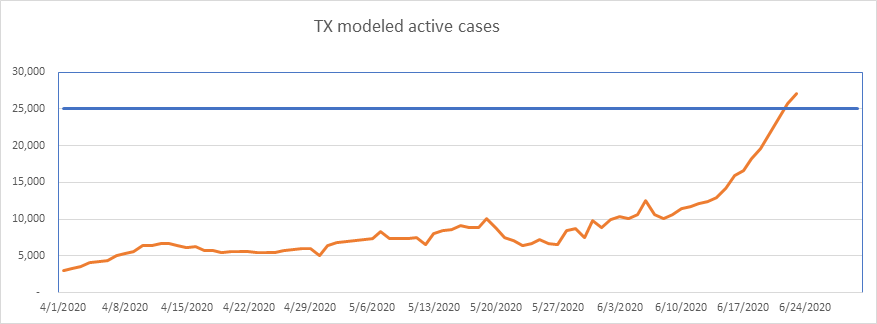
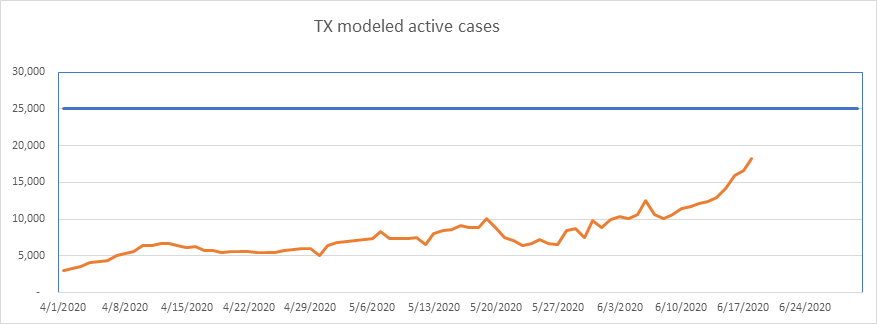
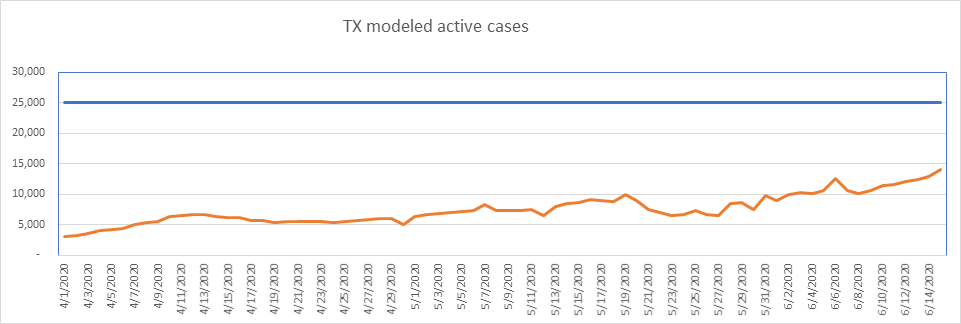
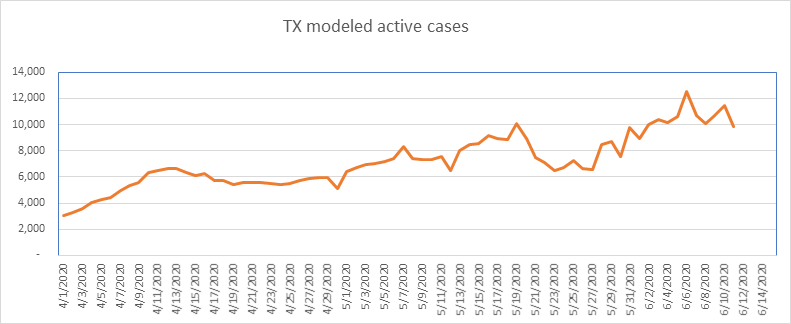
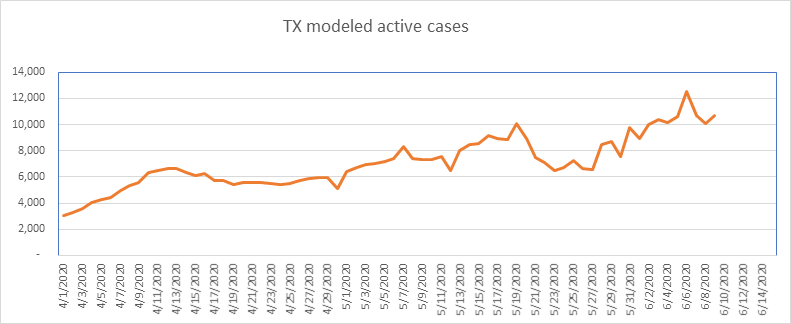
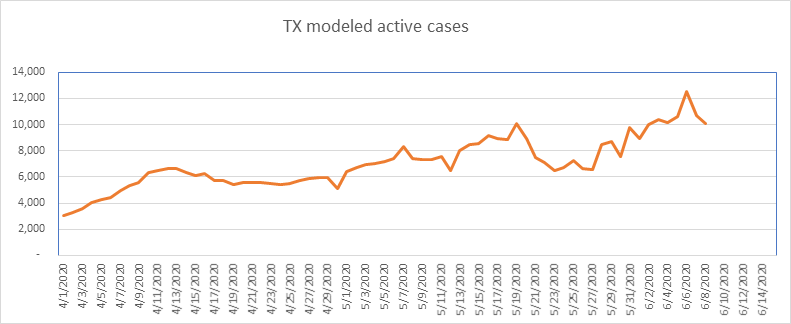
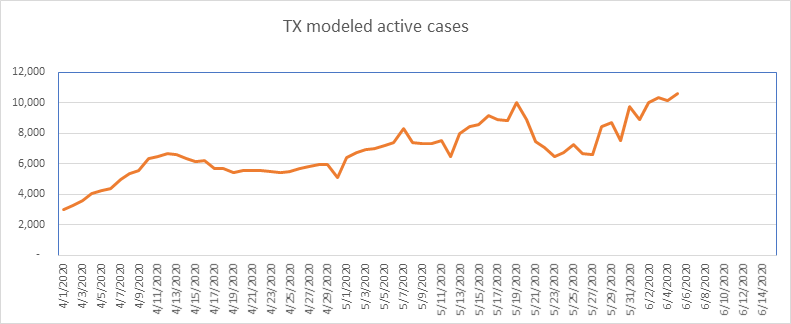
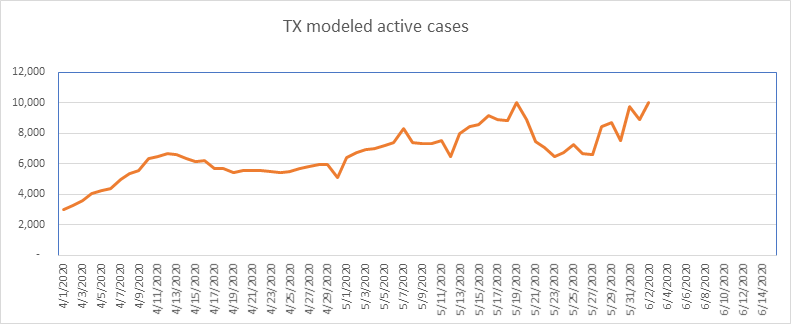
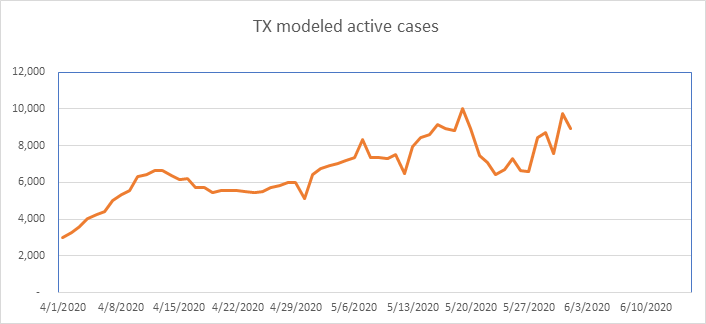
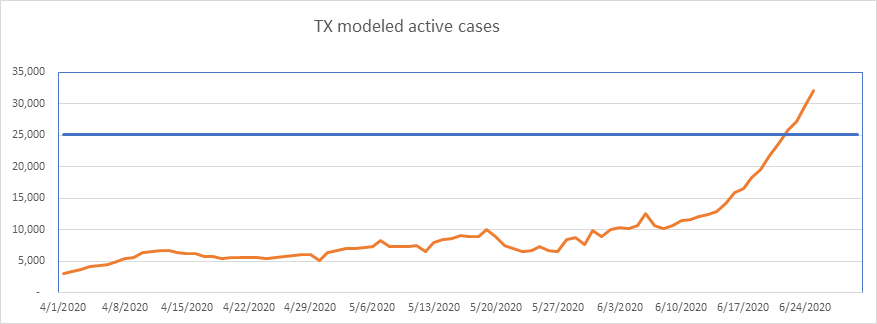
Texas still shows no signs of slowing down. Texas also reports positive tests as cases, so is doing some level of double counting, but not enough to explain this growth.
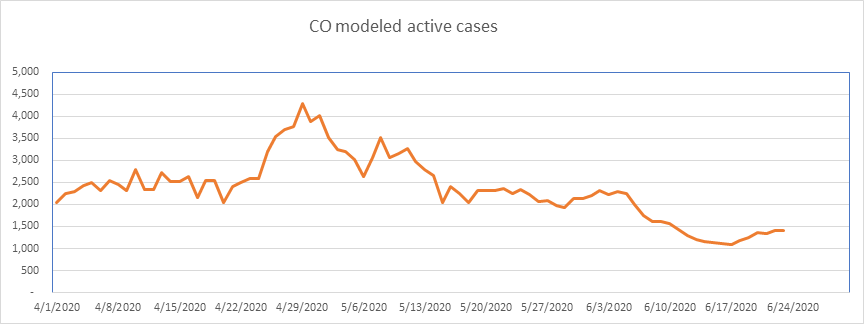
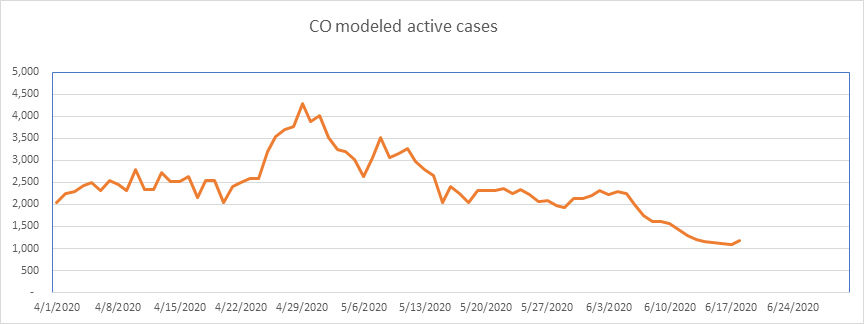
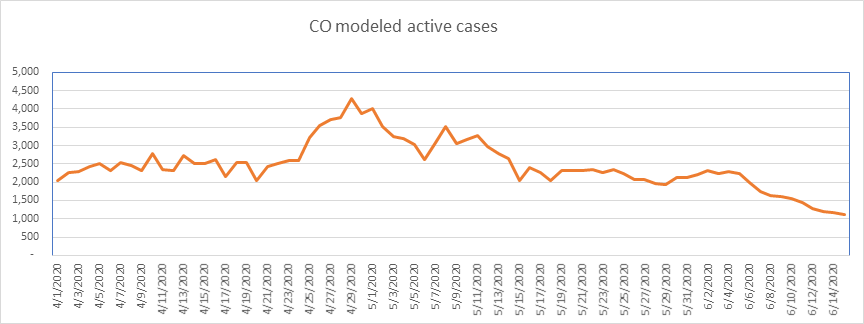
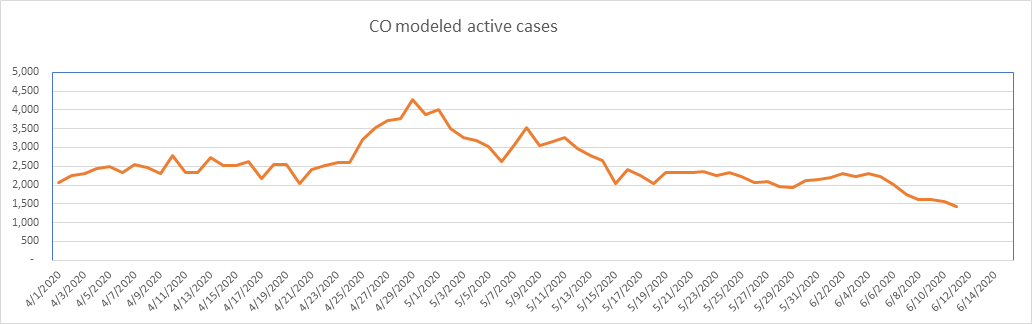
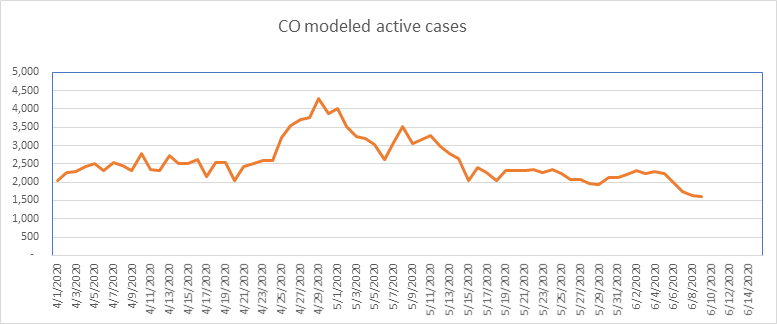
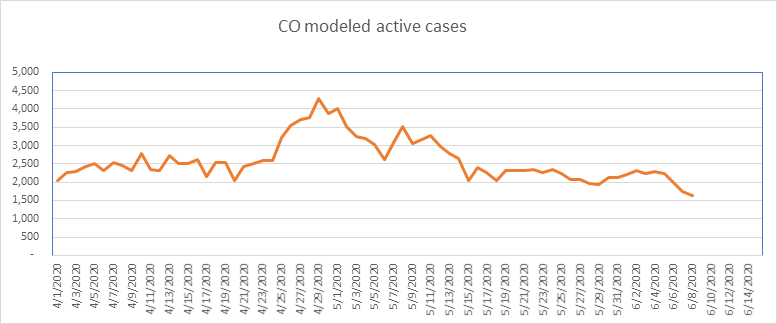
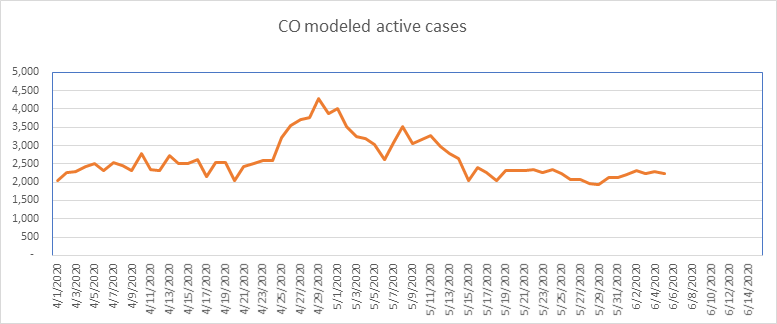
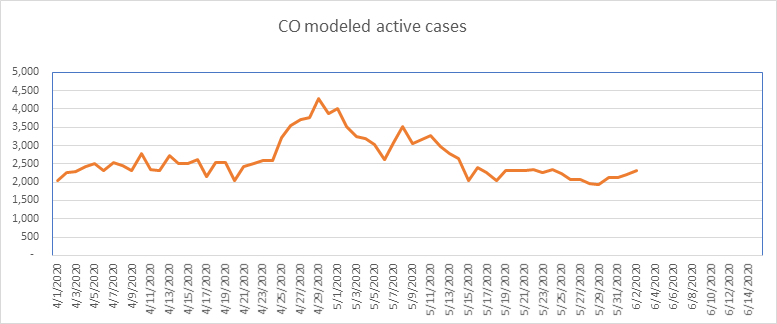
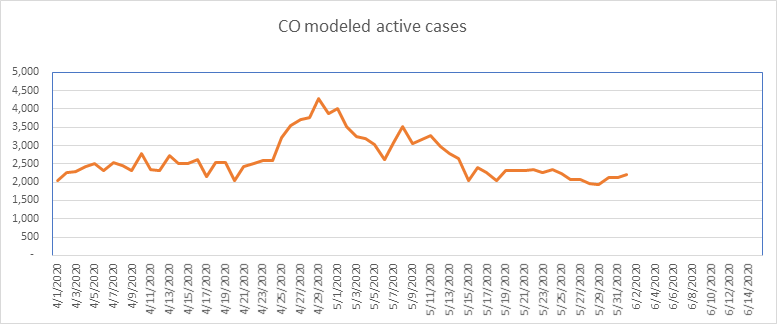
And finally, here is Colorado. Colorado is one of the states that has had aberrations in their data. I still report it, but I’ve shied away from any conclusions in this state due to the data irregularities. Very small numbers here.
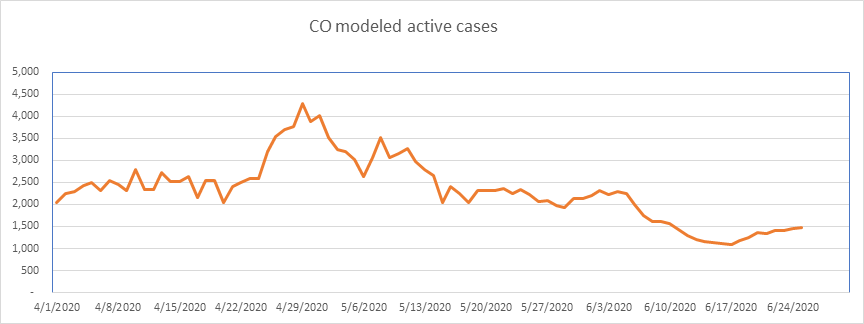
So that’s it for today. The numbers are very small as a percentage of the population. Unless you’re in a high density area, your chances of contracting COVID are very small. However, even though the probability is very small, that doesn’t help if you’re the one catching it. Everyone please continue to be as cautious as you feel necessary.

–Shane Chalke, FSA
Categories
COVID Archives

National daily death count declining – All eyes on AZ, CA, TX

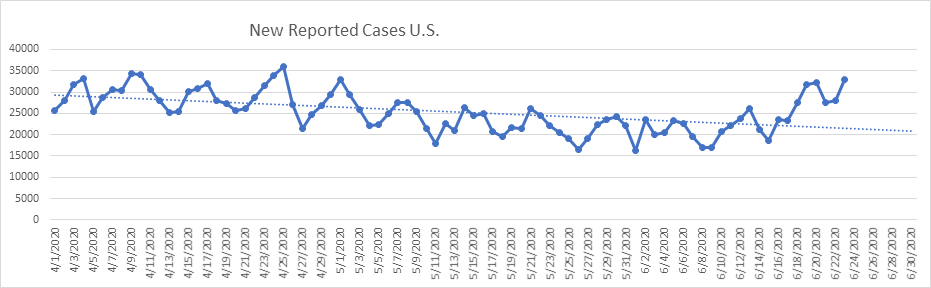
Today we had the highest new reported cases we’ve seen since May 1st, about seven weeks ago. Today’s new case count came in at 32,984. These numbers are pushed up almost entirely by 5 states: Arizona, California, Florida, South Carolina, and Texas. 18,299 new cases came from these 5 states alone today – over 55% of all new cases. These are the states to watch. Lately Florida and South Carolina have been slowing, but Arizona, Texas, and California are not.

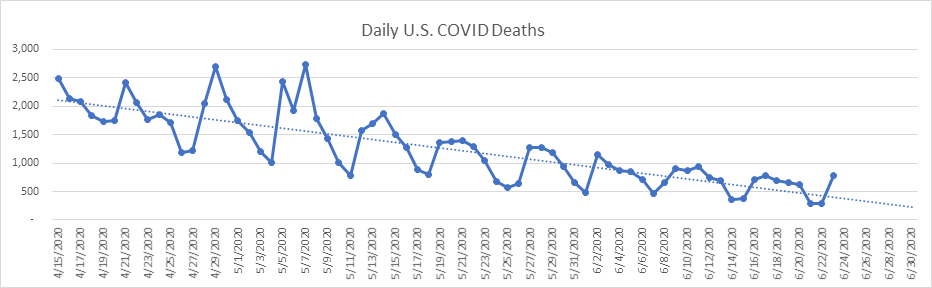
Deaths, on the other hand, continue their downward trend, with 775 deaths reported today, and less than 300 each on Sunday and Monday. In fact, yesterday’s reported deaths were the lowest we’ve seen since March 25th, quite early in the epidemic. National cases have been on the rise for 2 weeks now, and we haven’t seen any increase in daily death reports. If we don’t see any meaningful increases this week, I’m going to conclude that one or more of the following (and maybe all) is responsible for the increased case counts without increased mortality:

  • We’re testing people who are less ill
  • We’re testing a younger demographic
  • Double counting of cases is increasing, including antigen and antibody tests, as well as PCR tests – we know that AZ, CA, TX, and SC double count cases

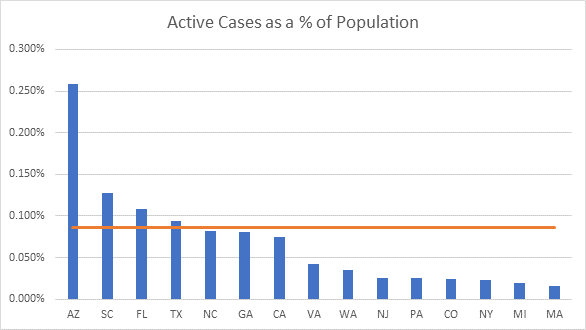
To help with some perspective, here is a picture of active cases for the 15 states as a percentage of population. I’ve added the average peak line as a reference. AZ, TX, and CA are the three states I’m most concerned about. Of these, you can see that Arizona is the outlier. As a percentage of population, it’s still below the peaks of NJ and NY, but it’s shaping up to be a similar story, at least with active case count. Interestingly, both new hospitalizations and daily deaths continue to drop in Arizona, so there is where it parts company with the northeast states. https://www.azdhs.gov/preparedness/epidemiology-disease-control/infectious-disease-epidemiology/covid-19/dashboards/index.php

I’ll report again on Friday…

As always, feel free to send me your questions about my assumptions, methodology, or modeling in general.

  • Likely date of active case peak (Chalke modeling): April 10
  • Likely date of peak deaths (IHME): April 16 (last revision on June 15)
  • Total Test Results reported today: 505,573 (extremely high)
  • Total Pending tests reported today: 1,891 (extremely low)
  • National reported case Growth Rate today: 1.44% (low)

Shane Chalke Interviews

https://www.fredericksburg.com/opinion/editorial-unlock-demographically-not-geographically/article_a62e6e70-dccd-51cf-b7b2-16d77a90fd9c.html

Website

Groom Ventures has agreed to host a website that will archive my daily reports, and supplement with other commentary. John Groom worked at one of my companies back in the day, and is an excellent writer. The website is: www.howmuchrisk.com For those of you that post my daily report on Facebook, let me suggest you link to this site, as the direct Facebook posts don’t seem to copy the graphs.

Daily Analysis

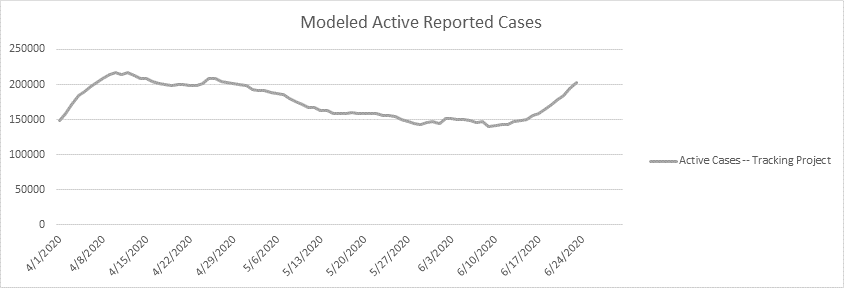
Here is the national picture of active cases – It’s been rising now for 2 weeks, driven almost entirely by AZ, CA, FL, SC, and TX. I’m modeling about 203,000 known active cases. Over half of the active cases I’m modeling come from the 5 problem states. Again, this number is high (I don’t know by how much), as many states routinely double count cases.

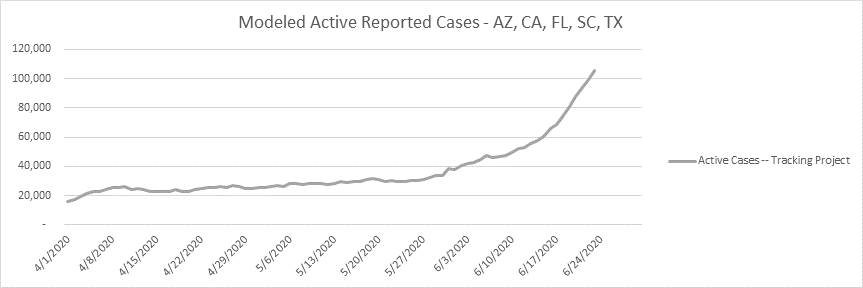
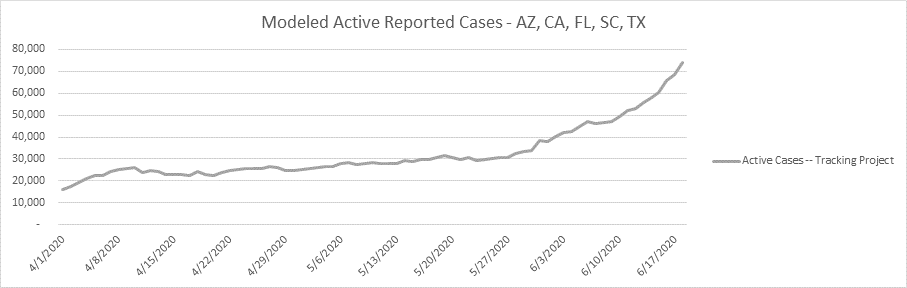
Here is the same picture showing only the 5 hot spot states. This looks much worse. I’m seeing a slowing in FL and SC, so this is now a story about AZ, CA, and TX.

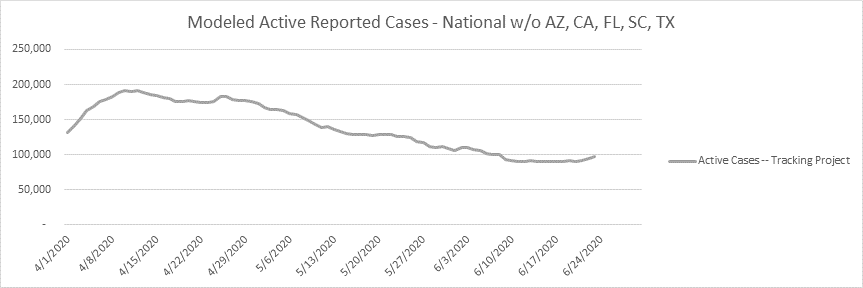
And finally, here is the rest of the country without the 5 focus states. A much better picture.

Here are the new reported cases nationally. Increasing for a week now – the majority of new cases are in 5 states.

Here are the daily death reports. Deaths are running a small fraction of what the experts predicted for June. This week will be telling, as the deaths lag cases by about 2 weeks (or at least have until now). I’m not expecting an increase though, as new hospitalizations in Arizona (one of the most problematic states) are in decline.

On to the states. NC has been roughly level for 9 days now – this is a significant improvement from the growth rate in the previous 2 weeks. It looks like it may be peaking a bit below the average as a percent of the population, and at a lower rate per capita than Virginia. NC is expected to enter Phase 3 on June 28th – I don’t know if this will happen, but based on this data I think it could.

Not only is Arizona increasing at an elevated growth rate, it is also well above the average peak as a percent of the population. AZ is now at currently at 0.26% of the population, almost in NJ territory. Arizona’s data is exaggerated, since they count specimens tested rather than people, and it’s not uncommon to get multiple tests if you’re sick – each time you’re tested you’d show up as a new case. Even worse, Arizona counts positive antibody tests as new cases. We’ll see where this levels off.

South Carolina is now above the average peak (the blue line), but has slowed down somewhat in the past few days. South Carolina also double counts cases, as they treat each positive test as a new case. Worse still, until June 11th, SC counted positive antibody tests as new cases.

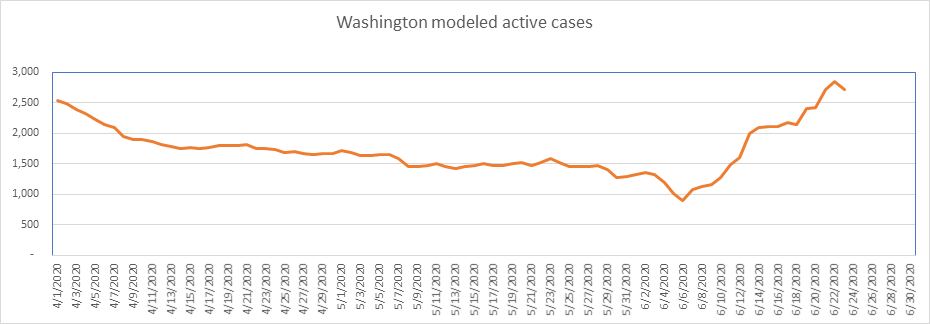
Washington reached a new peak, but still at a low level as a percentage of population – 0.035%. I’d add them to the “problem” list, but the growth rate is low and the numbers are small – a couple of hundred cases a day – so they hardly impact the national numbers.

The Florida growth rate has been slowing for the past 4 days – you can see it in the slight inflection on the curve.

Both NY and NJ continue to be great recovery stories. I’ll keep reporting on these two states in case something happens out of pattern. It’s been a very long time since anything surprising has happened here, though.

The growth rate in California has increased since my last report. California is one of the states that double counts cases, so that could explain some of it. California is still below the average peak as a percentage of the population (shown on the blue line).

At the beginning of June, MA reported nearly 4,000 historical but newly discovered cases, which skewed the data. Now that we’re 2 weeks past this event, I’m now modeling based on the data as reported. That’s what that bump in cases in early June is all about on the graph. It’s not real. If something like this happens again, I may have to do the work of adjusting for it, but for now, I’m letting it flow through. MA is another state that double counts cases by reporting each positive test as its own case.

Georgia had a spike in new cases yesterday, but lower today. Georgia has now exceeded its previous peak, but is still below the average — if this continues I’ll add it to the hot spot list, but we’ll need more than just 2 days of data. Here again, the numbers are exaggerated. Georgia counts each positive test as a case. To make matters more distorted, until May 27th GA reported positive antibody tests as new cases.

…And here is Michigan. Drifting upward for 12 days now. Michigan still has the second lowest concentration of COVID of the 15 states I model, so it’s not on my radar yet. They’ve also had a lot of data anomalies, so I look at this graph with a grain of salt.

PA has been drifting up for 5 days. They are also in the bottom half of my list – see above.

Texas shows no signs of slowing down. As they cross the average peak (the blue line) I would expect it to. Texas also reports positive tests as cases, so is doing some level of double counting.

And finally, here is Colorado. Colorado is one of the states that has had aberrations in their data. I still report it, but I’ve shied away from any conclusions in this state due to the data irregularities. Very small numbers here.

So that’s it for today. The numbers are very small as a percentage of the population. Unless you’re in a high density area, your chances of contracting COVID are very small. However, even though the probability is very small, that doesn’t help if you’re the one catching it. Everyone please continue to be as cautious as feel necessary.

–Shane Chalke, FSA
Categories
COVID Archives

Watching AZ, CA, FL, SC, TX

Today we had the highest new reported cases we’ve seen since May 8th, about six weeks ago. Today’s new case count came in at 27,496. These numbers are pushed up almost entirely by 5 states: Arizona, California, Florida, South Carolina, and Texas. 14,318 new cases came from these 5 states alone today, or about 52% of all new cases. These are the states to watch.

Deaths, on the other hand, continue their downward trend, with 695 deaths reported today. Deaths lag cases by about 2 weeks, so either we’ll start to see an upward trend in deaths in another week, or the new cases are less deadly than they were previously, as we’re testing more and more people who are less ill and/or asymptomatic. We’ll know soon. We do know that Arizona, California, Texas, and SC double count cases – by reporting specimen results rather than people tested. Since it’s not possible (theoretically) to double count deaths, this could explain some of the case count/death disparity as well.

I’ll report again on Monday…

As always, feel free to send me your questions about my assumptions, methodology, or modeling in general.

  • Likely date of active case peak (Chalke modeling): April 10
  • Likely date of peak deaths (IHME): April 16 (last revision on June 15)
  • Total Test Results reported today: 465,621 (high)
  • Total Pending tests reported today: 1,903 (extremely low)
  • National reported case Growth Rate today: 1.28% (low)

Shane Chalke Interviews

https://www.fredericksburg.com/opinion/editorial-unlock-demographically-not-geographically/article_a62e6e70-dccd-51cf-b7b2-16d77a90fd9c.html

Website

Groom Ventures has agreed to host a website that will archive my daily reports, and supplement with other commentary. John Groom worked at one of my companies back in the day, and is an excellent writer. The website is: www.howmuchrisk.com For those of you that post my daily report on Facebook, let me suggest you link to this site, as the direct Facebook posts don’t seem to copy the graphs.

Daily Analysis

Here is the national picture of active cases – It’s been rising now for 8 days, driven almost entirely by AZ, CA, FL, SC, and TX. I’m modeling about 164,000 known active cases left. Over 74,000 of these are in the 5 problem states. Again, this number is high (I don’t know by how much), as many states routinely double count cases.

Here is the same picture showing only the 5 hot spot states. A very different story indeed. I’ll continue to show this graph so long as these 5 states remain an issue.

Here are the new reported cases nationally. Increasing over the past week, and we know where it’s happening.

Here are the daily death reports. This is still looking far better than the experts predicted. If we don’t see a spike by next weekend, we’ll know that either there is more double counting than I thought, or the new cases are less severe than in the past.

On to the states. It’s great to see NC leveling off. If in fact NC peaks here, it will have peaked at a lower per capita rate than Virginia. Remember that the grey line is the average peak for states past peak (w/o NY and NJ).

Not only is Arizona increasing at an elevated growth rate, it is also well above the average peak as a percent of the population. AZ is currently at 0.165% of the population, about the level of the peak in MA, but well below NJ and NY. Arizona’s data is exaggerated, since they count specimens tested rather than people, and it’s not uncommon to get multiple tests if you’re sick – each time you’re tested you’d show up as a new case. Even worse, Arizona counts positive antibody tests as new cases. Therefore, Arizona is not as bad as the data makes it appear, but it’s still bad.

South Carolina is now above the average peak (the blue line), but has slowed down somewhat in the past few days. South Carolina also double counts cases, as they treat each positive test as a new case. Worse still, until June 11th, SC counted positive antibody tests as new cases.

Washington peaked at a surprisingly low 0.03% of the population, so it might not be over yet. It’s been increasing for 9 days, but lately shows signs of leveling off.

Florida has risen since May 28th. It’s now approaching the average peak. There is a lot of vacation activity in Florida just now, which could explain the growth rate (nearly 4%!).

Both NY and NJ are in the end game, with a small percentage of COVID compared to their peaks. NY is now down 92% from their peak – I model only about 4,900 cases remaining. NJ is down 91% with about 2,300 active cases remaining. This is very small for these state’s populations, and especially small given where they’ve been.

California is increasing at a moderate pace compared to Florida and Arizona, but is still far below the average peak. California data is exaggerated by the fact that they report all positive tests as cases. With testing more ubiquitous, some people with the disease are tested multiple times.

So it’s been tedious to continually adjusting for Massachusetts’ method of reporting historical cases. At the beginning of June, MA reported nearly 4,000 historical but newly discovered cases, which skewed the data. Now that we’re 2 weeks past this event, I’m now modeling based on the data as reported. That’s what that bump in cases in early June is all about on the graph. It’s not real. If something like this happens again, I may have to do the work of adjusting for it, but for now, I’m letting it flow through. MA is another state that double counts cases by reporting each positive test as its own case. MA is down 89% from the peak.

Georgia has been in the 4-6K range for 2 months. Here again, the numbers are exaggerated. Georgia counts each positive test as a case. To make matters more distorted, until May 27th GA reported positive antibody tests as new cases. Nonetheless, GA is leveling off lately. GA is a state that peaked well below average as a percent of the population (at 0.06%), so could have more to run. We’ll see.

…And here is Michigan. Drifting upward for the past week. Michigan has had a lot of data anomalies, so I’ll check this out when I have time.

Continued, almost straight line, decline in Pennsylvania. PA is now down 80% from the peak.

Texas is rising at a faster rate lately. Texas is still well under the average peak (shown in blue). Texas is a low-density state, so I expect it to peak below the blue line. Texas also reports positive tests as cases, so is doing some level of double counting. This drives me crazy.

And finally, here is Colorado. Colorado is one of the states that has had aberrations in their data. I still report it, but I’ve shied away from any conclusions in this state due to the data irregularities.

So that’s it for today. The numbers are very small as a percentage of the population. Unless you’re in a high density area, your chances of contracting COVID are very small. However, even though the probability is very small, that doesn’t help if you’re the one catching it. Everyone please continue to be as cautious as feel necessary.

–Shane Chalke, FSA
Categories
COVID Archives

Record High Tests, Low Deaths

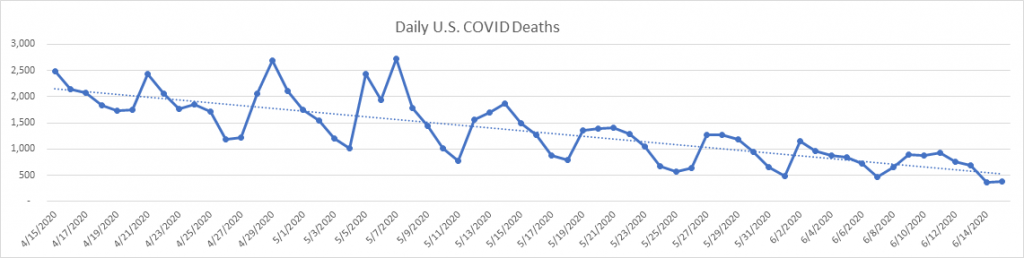
Over the past few days we’ve seen record high reported testing (over 629,000 on Friday) and the lowest daily death count since March 26 (358 yesterday).

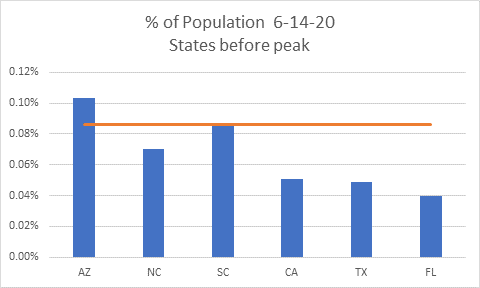
I’ve been tracking 15 states, representing about 207 million of population, or about 2/3 of the United States. Of these, I model that 9 states have passed peak known active cases, and 6 states are still increasing. I’ve not been able to find a pattern based on social distancing or mandates. Why, for example, is California growing so much faster than Georgia? One factor is that 4 of the 6 increasing states double count cases (more on this in the individual state discussions). A more powerful commonality I’ve noticed in the 6 increasing states is that they have less active cases as a percentage of population than the 9 states had when they peaked at their maximums. This has me thinking that there might be a critical mass of COVID where the disease naturally peaks. So let’s take a look at this.

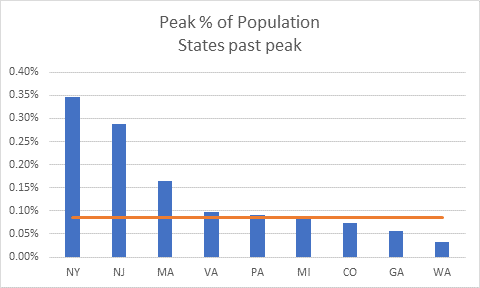
Here are the 9 states I’m following that have already peaked. This chart shows active cases at the peak as a percentage of the respective state’s population. I think there are two things interesting about this. First, I’m actually surprised about how tightly this clusters. Although from high to low it’s about 10 to 1, the data ranges from 0.03% to 0.35%. But why aren’t we seeing any states where it gets to, say, 1%? We’ve been told at various times that the disease propagates easily, and eventually we will all get it. So why are we seeing an upper bound of 0.35%?

The second interesting observation is that the high population density states are clustered to the left, with less dense states on the right. I’m now speculating that the level of peak active cases is dependent on total population and population density.

The horizontal line on the chart is the average peak as a percentage of the population for the states that have already peaked. I have left NY and NJ out of the average, as they are very high density outliers – NY because of NYC, and NJ as a whole has the highest density of any state in the Union. The Average of all 9 states is 0.14% of population, while the average excluding NY and NJ is 0.09% of population. The horizontal line is drawn at the 0.09% level.

Now, here is the interesting thing. Here are the 6 states I’m modeling that are still increasing. I’ve drawn the same horizontal line on this chart at the adjusted average above of 0.09%. I find it fascinating that, with the exception of Arizona, these states have not yet reached the level of COVID that the improving states experienced – and Arizona is close.

Could it be that these states will reach a similar level of COVID prevalence before beginning the decline? I think there might be something to this. I’m going to project peak active cases for these 6 states based on the adjusted average of 0.09% of population, and paint this line on the modeled active case graph for each of these states. It will be interesting to see what happens.

I’ll report again on Thursday…

As always, feel free to send me your questions about my assumptions, methodology, or modeling in general.

  • Likely date of active case peak (Chalke modeling): April 10
  • Likely date of peak deaths (IHME): April 16 (last revision on June 15)
  • Total Test Results reported today: 449,448 (high)
  • Total Pending tests reported today: 1,619 (extremely low)
  • National reported case Growth Rate today: 0.89% (extremely low)

Shane Chalke Interviews

https://www.fredericksburg.com/opinion/editorial-unlock-demographically-not-geographically/article_a62e6e70-dccd-51cf-b7b2-16d77a90fd9c.html

Website

Groom Ventures has agreed to host a website that will archive my daily reports, and supplement with other commentary. John Groom worked at one of my companies back in the day, and is an excellent writer. The website is: www.howmuchrisk.com For those of you that post my daily report on Facebook, let me suggest you link to this site, as the direct Facebook posts don’t seem to copy the graphs.

Daily Analysis

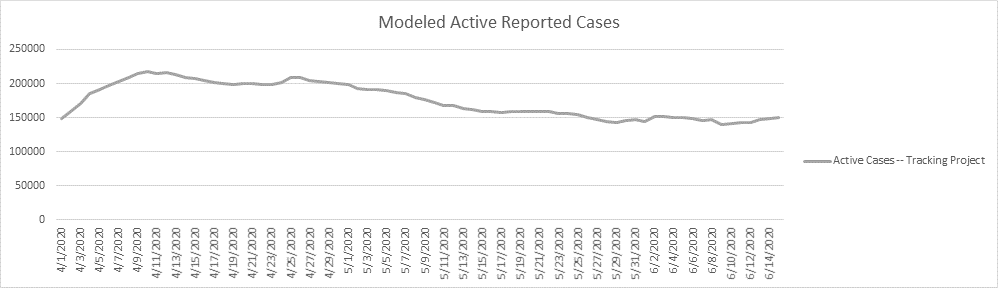
Here is the national picture of active cases – It’s been rising over the past 6 days, primarily driven by FL, TX, and AZ. I’m still modeling less than 150,000 known active cases left. This number is high though, as many states routinely double count cases.

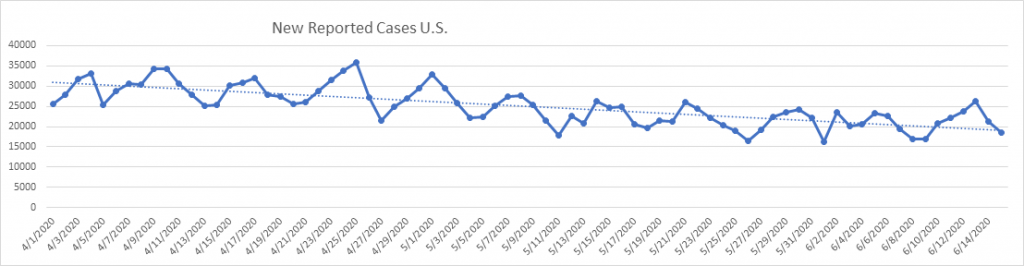
Here are the new reported cases nationally. Long, slow decline – dropping fast in many areas, and increasing in some.

Here are the daily death reports. This is looking far better than expected — We’ve had two days in a row of well under 500 deaths. This should be headline news.

On to the states. Virginia is looking great, now down 37% from the peak. The grey line is the average peak for states past peak (w/o NY and NJ). If NC peaks around that level it will fit in nicely with the other states. New reported cases have fallen 3 days in a row here, so it might be happening soon.

Arizona is all in the news lately. It is the one state I model that is already above the average peak as a percent of the population. AZ is currently at 0.10% of the population. It appears to show signs of leveling over the past few days. Arizona’s data is exaggerated, since they count specimens tested rather than people, and it’s not uncommon to get multiple tests if you’re sick – each time you’re tested you’d show up as a new case. Even worse, Arizona counts positive antibody tests as new cases. Therefore, Arizona is not as bad as the data makes it appear.

South Carolina is currently sitting right about on the average peak (the blue line). South Carolina also double counts cases, as they treat each positive test as a new case. Worse still, until June 11th, SC counted positive antibody tests as new cases.

Washington peaked at a surprisingly low 0.03% of the population, so it might not be over yet. It’s been increasing for 9 days, but lately shows signs of leveling off. The Covid Tracking Project recently recast a lot of cases to previous dates (you might remember this has been a significant problem with Washington data), so my curve looks a bit different, but presumably more accurate.

Florida has risen since May 28th. It’s interesting that Florida is still far below the average peak, so based on this it could have more to run. To reach the average peak, we’d need to see nearly 50% more active cases. Let’s hope not – we’ll watch it.

Both NY and NJ are in the end game, with a small percentage of COVID compared to their peaks. NY is now down 92% from their peak – I model only about 5,000 cases remaining. NJ is down 90% with about 2,600 active cases remaining. This is very small for these state’s populations, and especially small given where they’ve been.

California is now behaving as it should, cresting now. IHME has moved back their peak daily death projection to June 25th. California is still far below the average peak, but looks pretty flat lately. California data is exaggerated by the fact that they report all positive tests as cases. With testing more ubiquitous, some people with the disease are tested multiple times.

So it’s been tedious to continually adjusting for Massachusetts’ method of reporting historical cases. At the beginning of June, MA reported nearly 4,000 historical but newly discovered cases, which skewed the data. Now that we’re 2 weeks past this event, I’m now modeling based on the data as reported. That’s what that bump in cases in early June is all about on the graph. It’s not real. If something like this happens again, I may have to do the work of adjusting for it, but for now, I’m letting it flow through. MA is another state that double counts cases by reporting each positive test as its own case. MA is down 87% from the peak.

Georgia has been in the 4-6K range for 2 months. Here again, the numbers are exaggerated. Georgia counts each positive test as a case. To make matters more distorted, until May 27th GA reported positive antibody tests as new cases. Nonetheless, GA has seen a day to day decline in new cases for a couple of days now. GA is a state that peaked well below average as a percent of the population, so could have more to run. We’ll see.

…And here is Michigan. The COVID Tracking Project recently cleaned up Michigan’s data, which was driving me crazy. I’m now modeling less than 1,000 active cases left in Michigan.

Continued, almost straight line, decline in Pennsylvania. PA is now down 78% from the peak.

Texas is rising slowly but steadily. Texas is still well under the average peak (shown in blue). Texas is a low-density state, so I expect it to peak below the blue line. Texas also reports positive tests as cases, so is doing some level of double counting.

And finally, here is Colorado. Colorado is one of the states that has had aberrations in their data. I’m modeling that they are 74% below peak, but I’ve shied away from any conclusions in this state due to the data irregularities.

So that’s it for today. The numbers are very small as a percentage of the population. Unless you’re in a high density area, your chances of contracting COVID are very small. However, even though the probability is very small, that doesn’t help if you’re the one catching it. Everyone please continue to be as cautious as feel necessary.

–Shane Chalke, FSA
Categories
COVID Archives

COVID analytical update – Thursday, June 11

So the WHO statement that asymptomatic carriers don’t propagate COVID had the expected effect. The WHO qualified this within hours. They didn’t reverse it, but said they don’t really know. I’ve seen this movie before. Back when I was a young actuary during the AIDS epidemic, we witnessed the WHO actively suppressing research that didn’t fit their narrative that it was “everyone’s disease”. In this case, I suspect there is some truth to the initial statement. As I understand it, they developed this opinion from contact tracing from positive, but asymptomatic, carriers. Seeing very little incidence of asymptomatic transmission led to the conclusion. It wasn’t peer reviewed research, and perhaps not very scientific, but I’m inclined to believe the kernel of the statement, since it explains the data to a degree. We’re not seeing a clear pattern of societal restriction and growth rate, so the idea that asymptomatic infections don’t propagate – or propagate less – makes a great deal of sense.

By the way, here’s the latest on lockdown vs. propagation in the state of Wisconsin. As you know, the state supreme court overruled the stay at home order, so we have an uncharacteristically sudden release of restrictions. Here is the relevant quote from the abstract: ”we find no evidence that the repeal of the state SIPO impacted social distancing, COVID-19 cases, or COVID-19-related mortality during the fortnight following enactment”. The first part of this sentence is the relevant one to me, that about no impact on social distancing. I’ve been theorizing this all along, that people behave as they will, regardless of authority. They are not saying that social distancing has no impact on COVID propagation – they are saying that lockdowns have little effect on social distancing.

You can read the study here: https://www.nber.org/papers/w27322

My personal observations in being out and about now cause me to conclude that people, by and large, have a high degree of trust with friends and family, and are more cautious with strangers. Being a musician, and now back at work, I get a lot of chances to observe behavior. I’ve seen time and time again couples in restaurants greeting friends with hugs and air kisses, but making sure they are 6 feet from the next table. Of course, this makes little mathematical sense, but it’s ingrained human behavior.

I’ve been puzzled about why some states are seeing growth, and the majority are seeing steady improvement. I have a theory that I’m testing now – that COVID reaches a certain critical mass in terms of active cases as a percent of the population, and then declines. I’ll show some results of this study in a few days, but it’s looking good.

You’ve seen in the news that Arizona is the new high growth state. I’ve added it to my analysis beginning today. I’ve been tracking 15 states, representing about 2/3 of the national population. Of these, 11 states are past their peak, and 4 are still increasing. I’ll begin concentrating on the states that are growing, and try and make sense of that for you. That means we’ll pay special attention to Florida, Arizona, North Carolina, and South Carolina, although I model that North Carolina will peak very shortly.

I’m working the next few nights, but will report again on Monday.

As always, feel free to send me your questions about my assumptions, methodology, or modeling in general.

  • Likely date of active case peak (Chalke modeling): April 10
  • Likely date of peak deaths (IHME): April 14 (last revision on June 10)
  • Total Test Results reported today: 420,248 (high)
  • Total Pending tests reported today: 2,978 (extremely low)
  • National reported case Growth Rate today: 1.03% (low)

Shane Chalke Interviews

https://www.fredericksburg.com/opinion/editorial-unlock-demographically-not-geographically/article_a62e6e70-dccd-51cf-b7b2-16d77a90fd9c.html

Website

Groom Ventures has agreed to host a website that will archive my daily reports, and supplement with other commentary. John Groom worked at one of my companies back in the day, and is an excellent writer. The website is: www.howmuchrisk.com For those of you that post my daily report on Facebook, let me suggest you link to this site, as the direct Facebook posts don’t seem to copy the graphs.

Daily Analysis

Here is the national picture of active cases – Very slow decline – as you know, it’s a mixture of steadily declining states, and a few still increasing.

Here are the new reported cases nationally. The trend is still solid, but the overall decline is slow.

Here are the daily death reports. Daily deaths continue to fall steadily. We’ve been at or below 1,000 daily deaths for 2 weeks now. You might remember that all we heard a month ago was that we’d be up to 3,000 deaths a day by June. Thankfully, it’s not happening. Daily deaths are falling more quickly than active cases, partially as a result of widespread testing. We’re finding more positives that are less sick.

On to the states. Virginia is looking much better lately, now down 43% from the peak. I’m projecting that North Carolina reaches peak active cases in the next day or two. If my current theory is correct, both states will peak at a similar percentage of their respective populations. Virginia peaked at about 0.10% of the population, and NC is currently at 0.07%.

I’m adding back South Carolina, as it has now grown steadily for about 3 weeks. Known active cases now stand at about 0.06% of the population. IHME now has daily deaths peaking near the end of July, at about 17 per day.

Washington has been slowly rising for almost 2 weeks. Their peak was very low, at about 0.04% of the population. IHME shows daily deaths peaked on April 7th. I’m modeling known active cases currently at 0.028% of the population.

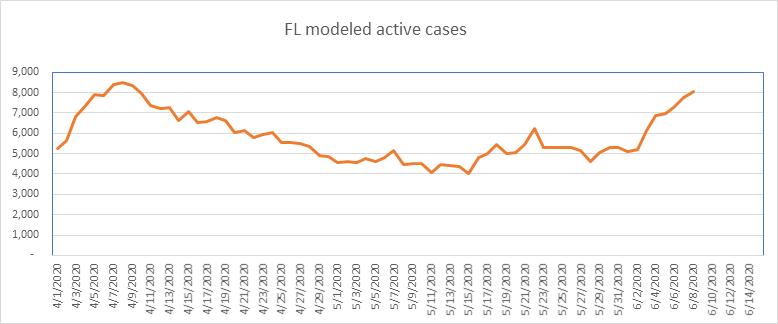
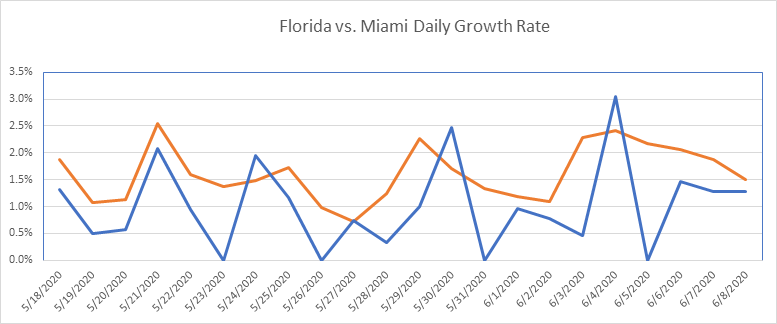
Florida has risen since May 28th. I’ve read a lot of theories about what’s going on in Florida. We now know that’s it’s not growing in Miami as fast as in other areas of the state. IHME projects daily deaths in Florida flat for the foreseeable future, at about 30 per day. I think Florida still has a way to go, as current known actives are only 0.04% of the population. The average peak has been at 0.11% of the population (more on this in a few days).

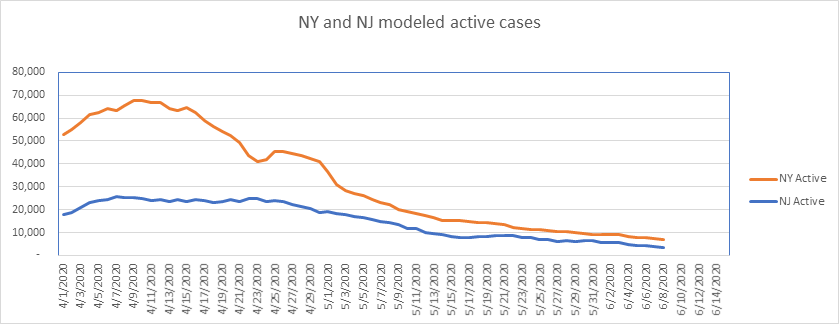
Both NY and NJ are in the end game. NY is now down 91% from their peak – I model only about 5,800 cases remaining, representing 0.03% of the population. NJ is down 87% with less than 3,300 known active cases remaining, representing 0.037% of the population.

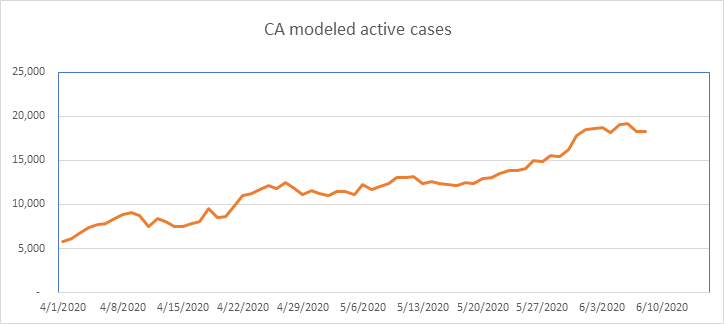
I believe California should be cresting now. IHME has moved up their peak daily death projection to June 17th, so I don’t expect any big increases here on out.

Not much to say about Massachusetts – it’s down 86% down from the peak, and is in the end game. Massachusetts began opening up on May 18th, and is still looking good. I model known active cases currently at 0.027% of the population.

Georgia looks to be stationary over the past 6 weeks. I’m modeling a noticeable decline beginning about June 14.

…And here is Michigan. 73% below their peak.

Continued, almost straight line, decline in Pennsylvania. PA is now down 71% from the peak. Known active cases are now 0.026% of the population.

Texas is showing signs of leveling off, but I’m not prepared to declare the peak yet. IHME now projects peak deaths after August 1st! I’m not sure what their drivers are, but when we see a definitive peak here, then peak deaths are usually a couple of weeks away. This one will be very interesting to watch over the next week or so.

And finally, here is Colorado. Colorado is one of the states that has had aberrations in their data. I’m modeling that they are 66% below peak, but I’ve shied away from any conclusions in this state due to the data irregularities. I’ll probably remove them from the daily analysis and bring them back if I see anything notable. Remaining cases are about 0.025% of the population.

So that’s it for today. The numbers are very small as a percentage of the population. Unless you’re in a high density area, your chances of contracting COVID are very small. However, even though the probability is very small, that doesn’t help if you’re the one catching it. Everyone please continue to be as cautious as feel necessary, especially in Florida and Arizona.

–Shane Chalke, FSA

Categories
COVID Archives

Well, well, this is a surprise…

I wasn’t going to report again until Thursday, but this is blockbuster news: https://www.cnbc.com/2020/06/08/asymptomatic-coronavirus-patients-arent-spreading-new-infections-who-says.html

The WHO now says that it’s rare for an asymptomatic person to spread COVID. The WHO took a lot of heat for this, as it doesn’t fit the narrative we’ve heard for the past 3 months. However, if this is true, it has a lot of implications for public policy, and helps explain what I’ve been seeing.

First, and most important, it sheds doubt on the effectiveness of restricting the movement of healthy people. It would logically guide policy makers to concentrate on the sick, with quarantine and tracing. It also would explain why we don’t see any real correlation between movement restrictions and disease propagation. Sick people generally stay home, and we all know to avoid people exhibiting symptoms.

Second, this really undercuts the argument to wear masks if you’re not ill. You’ve heard the argument many times – the masks aren’t for sick people, they’re for asymptomatic spreaders. But if asymptomatic people don’t spread the virus, then masks are not needed.

I’ll report again on Thursday…

As always, feel free to send me your questions about my assumptions, methodology, or modeling in general.

  • Likely date of active case peak (Chalke modeling): April 10
  • Likely date of peak deaths (IHME): April 14 (last revision on June 8)
  • Total Test Results reported today: 432,880 (high)
  • Total Pending tests reported today: 1,661 (extremely low)
  • National reported case Growth Rate today: 0.94% (extremely low)

Shane Chalke Interviews

https://www.fredericksburg.com/opinion/editorial-unlock-demographically-not-geographically/article_a62e6e70-dccd-51cf-b7b2-16d77a90fd9c.html

Website

Groom Ventures has agreed to host a website that will archive my daily reports, and supplement with other commentary. John Groom worked at one of my companies back in the day, and is an excellent writer. The website is: www.howmuchrisk.com For those of you that post my daily report on Facebook, let me suggest you link to this site, as the direct Facebook posts don’t seem to copy the graphs.

Daily Analysis

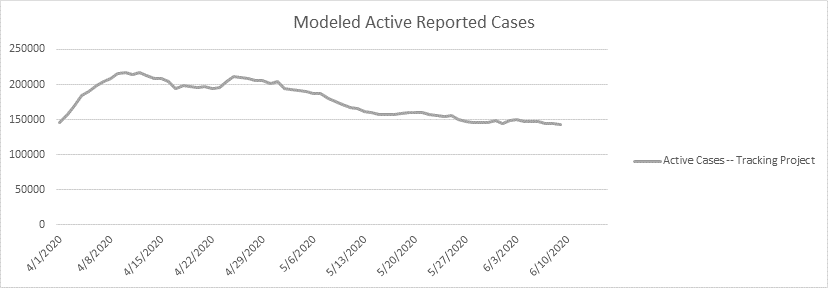
Here is the national picture of active cases – I’m modeling about 142,000 known active cases left. We’re 35% below the peak.

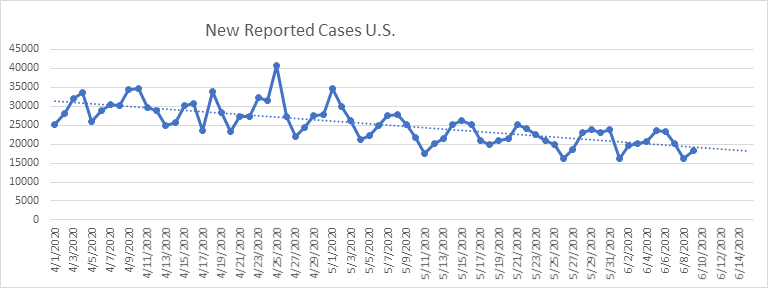
Here are the new reported cases nationally. The trend is still solid.

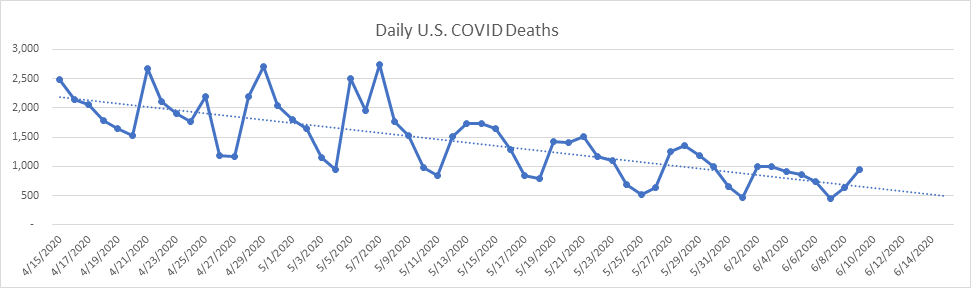
Here are the daily death reports. Daily deaths continue to fall steadily. We’ve been at or below 1,000 daily deaths for almost 2 weeks now. You might remember that all we heard 3 weeks ago was that we’d be up to 3,000 deaths a day by June. Thankfully, it’s not happening.

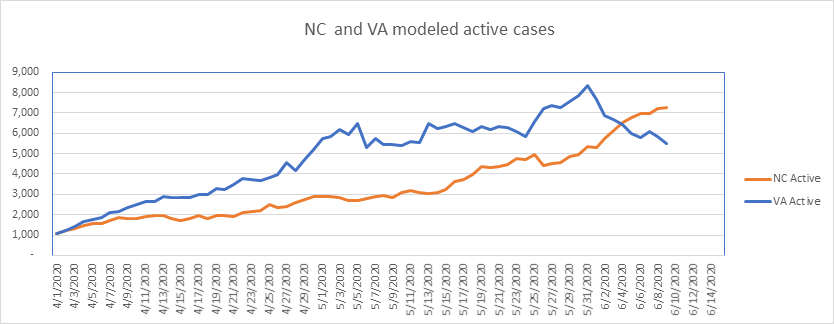
On to the states. Virginia is looking much better lately, now down 34% from the peak. I’m projecting that North Carolina reaches peak active cases about June 12.

No surprises with Washington – looks pretty flat for the past week, and there’s not much there.

Florida has risen since May 28th. I’ve read a lot of theories about what’s going on in Florida. We now know that’s it’s not growing in Miami as fast as in other areas of the state. IHME projects daily deaths in Florida flat for the foreseeable future, at about 30 per day. I model that Florida has nearly as much active COVID as NY and NJ combined. This is the part of my report to pay attention to in the next couple of weeks.

Both NY and NJ are in the end game, with a small percentage of COVID compared to their peaks. NY is now down 90% from their peak – I model only about 6,500 cases remaining. NJ is down 87% with about 3,300 active cases remaining.

California is now behaving as it should, cresting now. IHME has moved up their peak daily death projection to June 17th, so this makes sense, as peak deaths have been happening about 2 weeks after peak active cases.

Not much to say about Massachusetts – it’s down 85% down from the peak, and is in the end game. Massachusetts began opening up on May 18th, and is still looking good.

Georgia looks to be stationary over the past 5 weeks. I’m modeling a noticeable decline beginning about June 14.

…And here is Michigan. Still looking good. Significantly down from the peak on April 6.

Continued, almost straight line, decline in Pennsylvania. PA is now down 70% from the peak.

Texas is showing signs of leveling off. IHME now projects peak deaths after August 1st! I’m not sure what their drivers are, but when we see a definitive peak here, then peak deaths are usually a couple of weeks away. This one will be very interesting to watch over the next week or so.

And finally, here is Colorado. Colorado is one of the states that has had aberrations in their data. I’m modeling that they are 63% below peak, but I’ve shied away from any conclusions in this state due to the data irregularities.

So that’s it for today. The numbers are very small as a percentage of the population. Unless you’re in a high density area, your chances of contracting COVID are very small. However, even though the probability is very small, that doesn’t help if you’re the one catching it. Everyone please continue to be as cautious as feel necessary.

–Shane Chalke, FSA
Categories
COVID Archives

Florida still increasing, and it’s not Miami

It’s been a few days, and most everything is looking good. Florida continues to be a trouble spot (more on this when I discuss Florida below), but all else is steady or improving. Daily deaths have been at or below 1,000 per day for a week and half now, far better than the pundits predicted. We recorded the lowest daily growth rate today since the beginning of the disease, at 0.84%. When we use the expression “going viral” this is not what we’re talking about. This is a very slow crawl. We’ve also had several days of record testing reports with very low positive rates.

There has been much talk of the “second wave” next winter. This may be just the musings of an actuary, but I don’t see how this could happen. In order for a second wave to occur, the disease must show some seasonality, like the flu. However, the lingering trouble areas have all been in hot climates. If there is no seasonal effect, we’d be seeing spikes by now from the increased social and business mobility, but we’re not seeing that. There just doesn’t seem to be evidence that the disease dies off in the summer, and flourishes in cold weather.

Now that I’m back working again (thank goodness), I’ll be reporting every few days, unless something unusual happens.

As always, feel free to send me your questions about my assumptions, methodology, or modeling in general.

  • Likely date of active case peak (Chalke modeling): April 10
  • Likely date of peak deaths (IHME): April 14 (last revision on June 8)
  • Total Test Results reported today: 379,625 (high)
  • Total Pending tests reported today: 1,606 (extremely low)
  • National reported case Growth Rate today: 0.84% (a record low)

Shane Chalke Interviews

https://www.fredericksburg.com/opinion/editorial-unlock-demographically-not-geographically/article_a62e6e70-dccd-51cf-b7b2-16d77a90fd9c.html

Website

Groom Ventures has agreed to host a website that will archive my daily reports, and supplement with other commentary. John Groom worked at one of my companies back in the day, and is an excellent writer. The website is: www.howmuchrisk.com For those of you that post my daily report on Facebook, let me suggest you link to this site, as the direct Facebook posts don’t seem to copy the graphs.

Daily Analysis

Here is the national picture of active cases – continued, slow decline. We’re 34% below the peak. Many states are at a small fraction of their maximums, with a few states cresting now, and then there is Florida, which is still growing.

Here are the new reported cases nationally. Steady decline.

Here are the daily reported tests. We’ve seen a couple of days in the 550,000 range. We’ve now reported almost 21 million tests, representing well over 6% of the population. The positive rate has been running only 4.3% the past few days.

Here are the daily death reports. Daily deaths continue to fall steadily. It looks like we’re on trend to be below 500 per day by mid-month, although IHME is projecting more like 750. We’ll see.

On to the states. I’m projecting that North Carolina reaches peak active cases about June 12. Virginia looks like it may have peaked on May 31st.

No surprises with Washington – looks like it’s leveling off after a week of upward drift. The numbers are small here.

Florida has risen since May 28th. For days I’ve been saying it must be in Miami – that’s all we’ve heard on the news. It doesn’t look like that’s the case, though.

Florida has reported testing volume as a percentage of the population consistent with the rest of the United States, so it’s not that. Look at this graph of daily growth rates in Miami vs. all of Florida. The brown line is Florida, and the blue line is Miami, which is consistently lower than the rest of the state. I’m not sure where the highest growth rate is – it would take a lot of hours to figure this out. IHME models peak deaths way back in mid-April, but flat from here on out, at about 25 deaths per day. Florida is the remaining mystery to me at the moment.

Both NY and NJ are in the end game, with a small percentage of COVID compared to their peaks. NY is now down 90% from their peak – I model only about 7,000 cases remaining. NJ is down 86% with about 3,500 active cases remaining.

California looks like it might be turning the corner. IHME has moved up their peak daily death projection to June 17th, so this makes sense, as peak deaths have been happening about 2 weeks after peak active cases.

Massachusetts is another state with very little COVID left. MA is 85% down from the peak. Unless something flairs up, this story is almost over.

Georgia’s decline continues to be painfully slow – no real change to this story yet. There has been no flare up as feared, though.

…And here is Michigan. I corrected for the historical “probable” cases that showed up as new cases in the numbers on Friday, so this picture is more realistic. Michigan is down 77% from the peak.

Continued, almost straight line, decline in Pennsylvania. PA is now down 69% from the peak.

Texas is showing signs of leveling off. IHME now projects peak deaths after August 1st! I’m not sure what their drivers are, but when we see a definitive peak here, then peak deaths are usually a couple of weeks away.

And finally, here is Colorado. Colorado is one of the states that has had aberrations in their data. I’m modeling that they are 62% below peak, but I’ve shied away from any conclusions in this state due to the data irregularities.

So that’s it for today. The numbers are very small as a percentage of the population. Unless you’re in a high density area, your chances of contracting COVID are very small. However, even though the probability is very small, that doesn’t help if you’re the one catching it. Everyone please continue to be as cautious as feel necessary.

–Shane Chalke, FSA
Categories
COVID Archives

Chasing down irregularities in data…

It seems that as the weeks march on, the quality and consistency of the data are deteriorating. In general, the growth in COVID tends to be exaggerated by several factors, including:

  • Some states report cases based on # of tests, rather than number of people (many positive cases are tested multiple times)
  • Some states report positive Serum tests (anti-body tests) as new cases, even though these people had COVID in the past, and are recovered
  • Some states have reviewed their medical histories as far back as March 1st, and report suspected or probable cases, which are picked up as new cases
  • Likewise, some states have gone back in history to find probable deaths, and newly report them

I have no argument with the classification that states are doing, as it largely (but not always) makes sense. The issue is where the cases are placed in the data. Since most of the reporting sites (Johns Hopkins, COVID Tracking, Infection2020) pick up total cases and deaths each day from the various state sites, many historical cases show up as new cases, which exaggerate the growth of COVID. I try to back this data out when it’s obvious and where I can find the correct data, but it’s a chore. Today my problems are with Michigan data – I’ll describe more fully below.

I’ve been seeing more and more reports that the virus is attenuating, or declining in strength. I first heard about this from Professor Martin Zelder at UNC. He calculated that the percentage of COVID cases that end up with hospital stays in NC has declined from 12% to 3% in one month’s time. He points out that this could be because we are testing more and more people that are less sick as testing expands. Then we saw the report from Italy last week that the viral load in tested subjects was a fraction of what it was (it sparked a lot of controversy).

And here is the latest from Pennsylvania: https://www.foxnews.com/health/pittsburgh-hospital-officials-coronavirus-appears-less-potent-than-before

If this is true, then this is great news.

Testing reports reached a new record today, at over 550,000. I need to spend some time thinking about how to adjust for increases in test volume and whether to do it by state or nationally. All you scientists and actuaries on this list, please send me your ideas…

I’m working tomorrow night (jazz), so will report again on Sunday.

As always, feel free to send me your questions about my assumptions, methodology, or modeling in general.

  • Likely date of active case peak (Chalke modeling): April 10
  • Likely date of peak deaths (IHME): April 16 (last revision on May 29)
  • Total Test Results reported today: 550,915 (a new record)
  • Total Pending tests reported today: 1,749 (extremely low)
  • National reported case Growth Rate today: 1.27% (very low)

Shane Chalke Interviews

https://www.fredericksburg.com/opinion/editorial-unlock-demographically-not-geographically/article_a62e6e70-dccd-51cf-b7b2-16d77a90fd9c.html

Website

Groom Ventures has agreed to host a website that will archive my daily reports, and supplement with other commentary. John Groom worked at one of my companies back in the day, and is an excellent writer. The website is: www.howmuchrisk.com For those of you that post my daily report on Facebook, let me suggest you link to this site, as the direct Facebook posts don’t seem to copy the graphs.

Daily Analysis

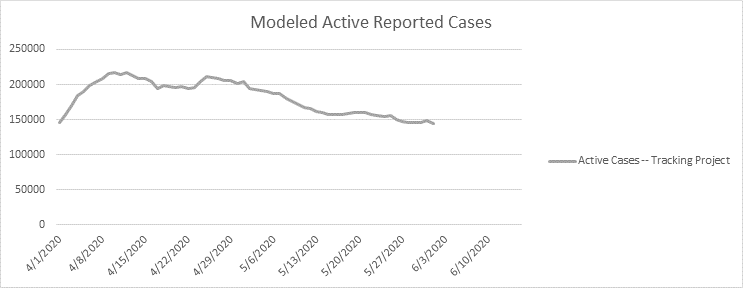
Here is the national picture of active cases – continued, slow decline. I suspect it’s declining faster than this graph suggests, for the reasons I’ve outlined above.

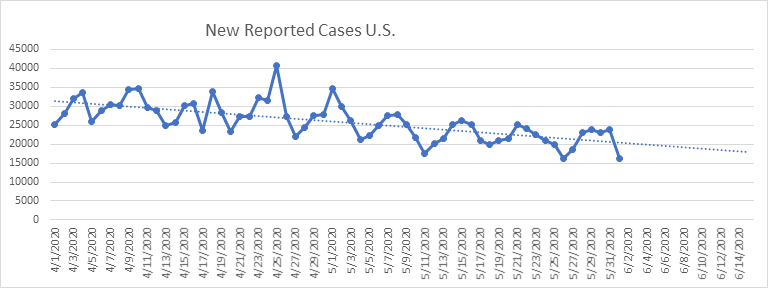
Here are the new reported cases nationally. Look at the trend line. Still tracking in the right direction.

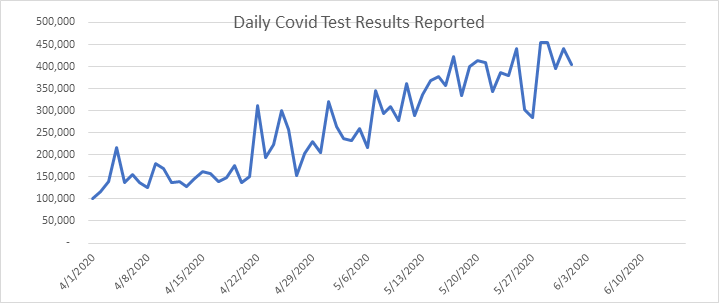
Here are the daily reported tests. Going through the roof now. The U.S. is now approaching 20 million tests.

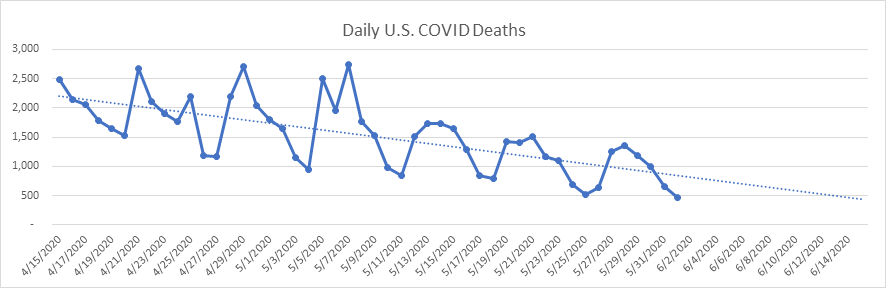
Here are the daily death reports. Daily deaths continue to fall steadily. This is the week that the “experts” said we’d be seeing 3,000 deaths per day. Happily, it’s not happening.

On to the states. Oh, my look at this! Virginia has crossed NC in absolute active cases. VA still has more per capita, but this is really interesting. Next week I’ll update my side by side growth analysis by date to see if I can find any evidence that the differences in restrictions might explain this.

No surprises with Washington – drifting upward lately, but a small downturn today. The numbers are small, and Washington has had several previous episodes of data anomalies.

Florida has risen for a week now. I’m going to take a look to see if it’s all in Miami as soon as I get a chance.

Both NY and NJ are in the end game, with a small percentage of COVID compared to their peaks. NY is now down 88% from their peak and NJ is down 83%. Unless something flairs up in these two states, there isn’t much more to tell…

California continues to be problematic. CA now exceeds NY on a per capita basis. IHME now projects that the California daily death count doesn’t peak until June 27th, so California could be rising for another week or two.

Massachusetts continues to do well, with a remarkably rapid recovery. MA is 83% down from the peak. Again, unless something flairs up, this story is almost over.

Georgia’s decline continues to be painfully slow – enough said.

…And here is Michigan. Does something look wrong with this picture? I’ve been studying COVID data for 3 months now, and I’ve noticed that the data everywhere is relatively continuous. This sort of spike has never happened. After much investigation, I’ve concluded (but don’t know with certainty), that Michigan has reported an extra 5,014 “probable” cases today, and 239 “probable” deaths. Michigan is also a state that reports tests as cases, rather than people. They also confound things by reporting positive antibody tests as cases. I’ve found the data necessary to adjust for this, and will by my next report. This graph DOES NOT represent what’s going on in Michigan.

Continued, almost straight line, decline in Pennsylvania. PA is now down 68% from the peak.

Texas has been rising for the past 9 days. IHME projects peak deaths in Texas on May 17, so I need to do some work to correlate what I’m seeing with the IHME data.

And finally, here is Colorado. Colorado is one of the states that has had aberrations in their data. It’s showing about flat for 2 weeks, but I’ve shied away from any conclusions in this state due to the data irregularities.

So that’s it for today. The numbers are very small as a percentage of the population. Unless you’re in a high density area, your chances of contracting COVID are very small. However, even though the probability is very small, that doesn’t help if you’re the one catching it. Everyone please continue to be as cautious as circumstances dictate.

–Shane Chalke, FSA
Categories
COVID Archives

CDC finally confirms my mortality estimates from April…

Back in April I published my mortality estimates for COVID. You can read details at the bottom of this report, but I estimated the overall mortality to be:

Overall: 0.53%

Ages 0 – 59: 0.09%

Ages 60+: 2.5%

I took a lot of heat for this, as it was widely reported that the “case fatality rate” was about 6%, and my numbers are a tiny fraction of that.

Well, low and behold, last week the CDC published new “Guidelines for Researchers”, where they provided their current best estimates for mortality. Their published best estimates are:

Overall: 0.40%

Ages 0 – 49: 0.05%

Ages 50 – 64: 0.2%

Ages 65+: 1.3%

Well, their overall mortality doesn’t look a lot different from mine back in April. I feel vindicated. The good news here is that the CDC numbers represent the fatality rate for symptomatic patients. They estimate that 35% of patients are asymptomatic, so the overall mortality rate from the CDC accounting for all infections would be about 0.3%. This is a long way from the current wisdom in April that spawned a national panic!

The new CDC Guidelines for Researchers can be found here (not for the faint of heart): https://www.cdc.gov/coronavirus/2019-ncov/hcp/planning-scenarios.html If you don’t have the stomach for that, you can read about it in the news from CNN here: https://www.cnn.com/2020/05/22/health/cdc-coronavirus-estimates-symptoms-deaths/index.html Of course, the CNN headline says nothing about mortality – you have to read the article. For more inciteful reporting, you can read about this in Reason Magazine here: https://reason.com/2020/05/24/the-cdcs-new-best-estimate-implies-a-covid-19-infection-fatality-rate-below-0-3/?utm_medium=email

Overall, this is fantastic news, as this puts COVID at least on the same playing field as the seasonal flu.

Now that there are a number of random testing studies available, I’m going to refine my mortality estimates soon.

As always, feel free to send me your questions about my assumptions, methodology, or modeling in general.

  • Likely date of active case peak (Chalke modeling): April 10
  • Likely date of peak deaths (IHME): April 16 (last revision on May 29)
  • Total Test Results reported today: 417,156 (very high)
  • Total Pending tests reported today: 4,054 (very low)
  • National reported case Growth Rate today: 1.09% (very low)

Shane Chalke Interviews

https://www.fredericksburg.com/opinion/editorial-unlock-demographically-not-geographically/article_a62e6e70-dccd-51cf-b7b2-16d77a90fd9c.html

Website

Groom Ventures has agreed to host a website that will archive my daily reports, and supplement with other commentary. John Groom worked at one of my companies back in the day, and is an excellent writer. The website is: www.howmuchrisk.com For those of you that post my daily report on Facebook, let me suggest you link to this site, as the direct Facebook posts don’t seem to copy the graphs.

Daily Analysis

Where do I even begin to describe how inflated the data has become? I noticed a large increase in active cases nationally today, and it didn’t seem right, so I dug in. There are mysteries in several states, but the worst was Massachusetts. Massachusetts has been reported between 600 and 700 new cases a day lately, and today they reported 4,198 new cases. I knew this couldn’t be accurate, and in fact, it isn’t. Here is this published today on the Massachusetts department of health website:

As of June 1st, the Department of Public Health began reporting both confirmed and probable COVID-19 cases and deaths. This change is in accordance with guidance from the Centers for Disease Control to include “probable” COVID-19 cases and deaths in data collection and reporting efforts. This change will increase the number of cases and deaths reported in Massachusetts. Starting June 1st, the newly reported totals are a result of a retrospective review of probable cases and deaths dating back to March 1, 2020.

Massachusetts has done this before, and rolled historical data into the current numbers. To make matters worse, Massachusetts says they now report positive results from antibody tests in their current numbers. Antibody tests in Massachusetts represent about 15% of total tests, but they don’t report positive rates for antibody vs. RNA tests. In the past, I’ve just let this roll through the data, but this time I backed out the historical cases from the current numbers. I have no idea now many other states are doing this, but it improperly exaggerates the current state of COVID. I’ll keep looking for this, but the reporting is inconsistent and incomplete, so I can only do so much. We’ve seen Colorado use this same methodology, so they may also be exaggerating the current numbers.

Here is the national picture of active cases – continued, slow decline. I suspect it’s declining faster than this graph suggests, for a number of reasons I’ve discussed from time to time.

Here are the new reported cases nationally. All still tracking in the right direction.

Here are the daily reported tests. We are solidly in the 400K+ range now. The U.S. has now processed just under 18 million tests.

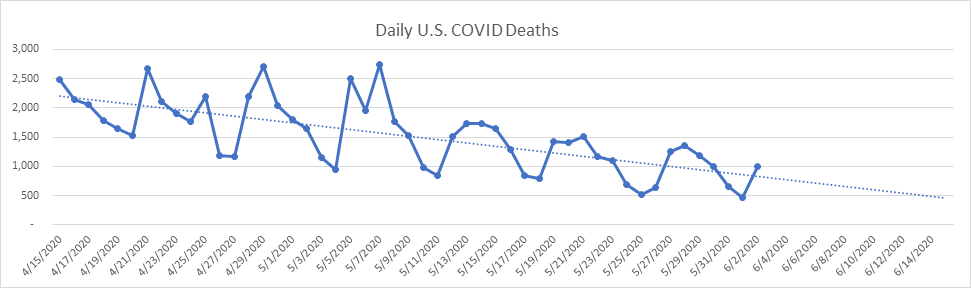
Here are the daily death reports. Daily deaths are falling steadily. I don’t know how many of these new deaths are weeks or months old – I’ll keep trying to find out.

On to the states. Big change in Virginia, but they report inconsistently so we’ll know more after a few days.

No surprises with Washington – drifting upward lately. The numbers are small, and Washington has had several previous episodes of increases. Washington is another state with a history of data anomalies.

Florida has been more or less flat for 2 weeks now. The hot spot in Florida continues to be Miami. Other than in SE Florida, COVID presence is small.

Both NY and NJ are in the end game, with a small percentage of COVID compared to their peaks. I think they will continue to decline slowly from this point.

California continues to be problematic. CA is now similar to NY on a per capita basis. IHME now projects that the California daily death count doesn’t peak until June 27th, so California could be rising for another week or two.

Massachusetts continues to do well, with a remarkably rapid recovery. I adjusted MA numbers to remove historical cases from today’s new cases. Otherwise, you’d see a dramatic and unexplainable increase.

Georgia’s decline is painfully slow – enough said.

Michigan has been flat for a few days, but remarkably, down 67% from the peak on April 6th.

Continued, almost straight line, decline in Pennsylvania. Very pretty graph (to a math nerd).

Texas has been rising for the past 5 days, but Texas has a small COVID presence per capita.

And finally, here is Colorado. Colorado is one of the states that has had aberrations in their data. It’s showing about flat for 2 weeks, but I’ve shied away from any conclusions in this state due to the data irregularities.

So that’s it for today. The numbers are very small as a percentage of the population. Unless you’re in a high density area, your chances of contracting COVID are very small. However, even though the probability is very small, that doesn’t help if you’re the one catching it. Everyone please continue to be as cautious as circumstances dictate.

–Shane Chalke, FSA
Categories
COVID Archives

Kiss a random stranger or drive 200 miles?

I am bombarded with probability questions from family and friends about COVID. Common questions are:

  • What are the chances I’ll catch COVID?
  • What are the chances I’ll catch COVID and die?
  • What are the chances I’ll die of COVID if I go to a restaurant? If I go to church? At the grocery store?

It goes on and on – these are all legitimate questions from people just trying to figure out how dangerous this thing really is. In fact, all these probabilities are quite low, and in the range of the probability of death from other normal activities.

I thought I’d compare the probability of death from kissing a random stranger with driving a car. Driving a car is an inherently risky activity with more than 35,000 deaths per year in the U.S., but we’ve developed a sense of just how much risk we’re taking verses the benefit of taking that risk. COVID is new and scary, so we just don’t have the ingrained metrics to know how we want to behave. In any event, I estimate the risk of kissing a random stranger about equal to driving 154 miles. I think most of us wouldn’t hesitate to hop in the car a few times and drive a couple hundred miles this week, but not many would kiss the random stranger, which is arguably a bit safer.

So here’s how I did my calculations: I’m currently modeling about 145,000 known and active cases of COVID in the U.S. Or course, this is likely just a fraction of the total people sick with COVID, but we can use the NY study to help us. Back in late April, we knew that about 10 times more people had COVID than those revealed by daily testing. That multiple is likely quite a bit lower now that testing has more than doubled since then. I’ll be conservative and call the multiple 5, so we’ll assume that 725,000 people are sick with COVID at the moment. With a population of about 330 million, that means that the chances that the random American you are kissing has COVID would be about 0.0022, or 0.22%. From my previous mortality work, I estimate the probability of dying from COVID if you contract the disease and under age 60 at about 0.0009, or about 0.09%. Multiply these two together and get the chances of a COVID death from kissing a random stranger at 0.000002, or about 0.0002%.

In the U.S., we lose about 1.3 lives per 100 million miles driven – the chance of dying per mile is about 0.000000013. To increase that probability to that of dying from COVID from kissing a random person you’d have to drive 154 miles. Of course, this would vary considerably by where you live (is COVID widespread or scarce?) what sort of driving you do, and your age, but you get the idea. In general, if you’re young, it’s probably fine to kiss random strangers, but if you’re older, better not.

As always, feel free to send me your questions about my assumptions, methodology, or modeling in general.

  • Likely date of active case peak (Chalke modeling): April 10
  • Likely date of peak deaths (IHME): April 16 (last revision on May 29)
  • Short term projection for active cases tomorrow: 142,000
  • Total Test Results reported today: 403,791 (very high)
  • Total Pending tests reported today: 3,455 (very low)
  • National reported case Growth Rate today: 0.9% (record low)

Shane Chalke Interviews

https://www.fredericksburg.com/opinion/editorial-unlock-demographically-not-geographically/article_a62e6e70-dccd-51cf-b7b2-16d77a90fd9c.html

Website

Groom Ventures has agreed to host a website that will archive my daily reports, and supplement with other commentary. John Groom worked at one of my companies back in the day, and is an excellent writer. The website is: www.howmuchrisk.com For those of you that post my daily report on Facebook, let me suggest you link to this site, as the direct Facebook posts don’t seem to copy the graphs.

Daily Analysis

Here is the national picture of active cases – continued, slow decline. I suspect it’s declining faster than this graph suggests, as the testing has ramped up so fast we’re now finding cases where people are marginally sick. We know this because the fraction of those testing positive that end up in the hospital has declined dramatically (thank you to Professor Martin Zelder at UNC for showing me this). I’ll continue to work on a credible method of adjusting for this. Until then, I’ll continue to model active cases from the raw total case data.

Here are the new reported cases nationally. All still tracking in the right direction.

Here are the daily reported tests. We’ve set several new records recently, with no weekend slowdowns…

Here are the daily death reports. Daily deaths are falling steadily. Today’s report was the lowest in over 2 months. You won’t see that in the news…

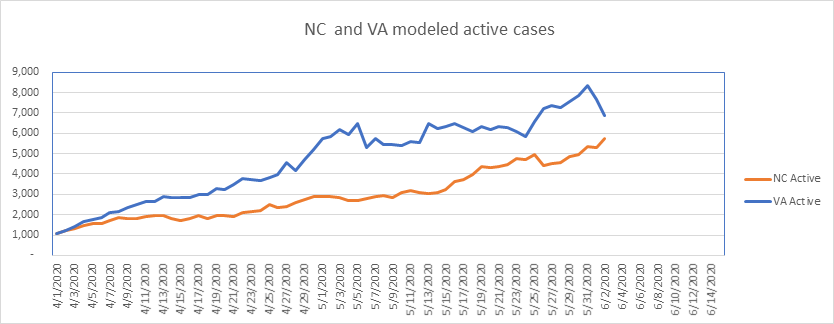
On to the states. It’s always interesting to look at VA and NC side by side, as the states are quite similar except for the degree of lockdown.

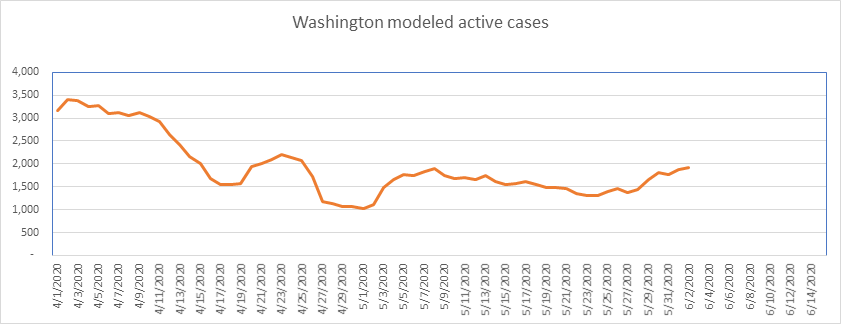
No surprises with Washington – drifting upward lately. The numbers are small, and Washington has had several previous episodes of increases.

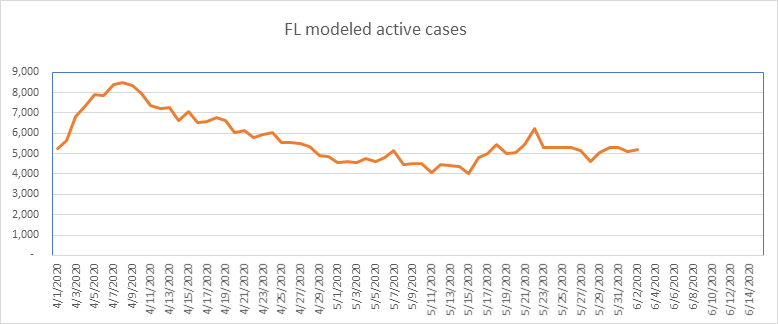
Florida has been more or less flat for 2 weeks now. The hot spot in Florida continues to be Miami. Other than in SE Florida, COVID presence is small.

Well, look at that! NY state now below 9,000 cases. That’s less than ½ of California now. NJ is looking good too, with less than 6,000 cases. NY is now down 87% from the peak, which is remarkable. Both states are recovering well.

California continues to be problematic. CA is now similar to NY on a per capita basis. IHME now projects that the California daily death count doesn’t peak until June 27th, so California could be rising for another week or two.

Massachusetts continues to do well, with a remarkably rapid recovery. MA didn’t report today, so expect a bump tomorrow. Massachusetts is now down 78% from the top.

Georgia’s decline is painfully slow, but continues to follow the trend.

Michigan has been flat for a few days, but remarkably, down 67% from the peak on April 6th.

Continued, almost straight line, decline in Pennsylvania today, 60% below their peak.

Up and down the past few days in Texas. I believe Texas peaked on May 19th. Texas has a small COVID presence per capita.

And finally, here is Colorado. Colorado is one of the states that has had aberrations in their data. It’s showing about flat for 2 weeks, but I’ve shied away from any conclusions in this state due to the data irregularities.

So that’s it for today. The numbers are very small as a percentage of the population. Unless you’re in a high density area, your chances of contracting COVID are very small. However, even though the probability is very small, that doesn’t help if you’re the one catching it. Everyone please continue to be as cautious as circumstances dictate.

–Shane Chalke, FSA
Site powered by   

Foundation for Sane Public Policy

Visit John F. Groom on Amazon and Groom Media Membership

Publicty