Categories
COVID Archives

Some thoughts on the daily death count

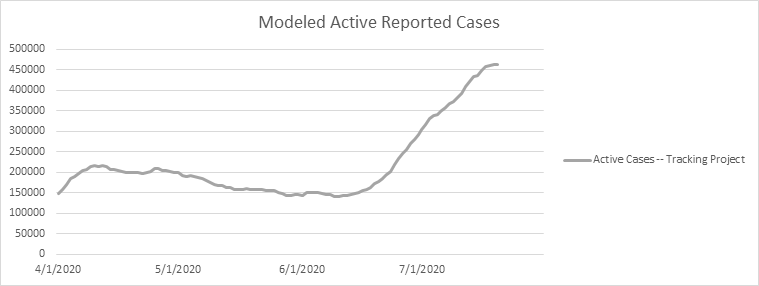
The acceleration of cases, which began around June 10th, leveled off last week, and now appears to be in decline. Here is what it looks like today:
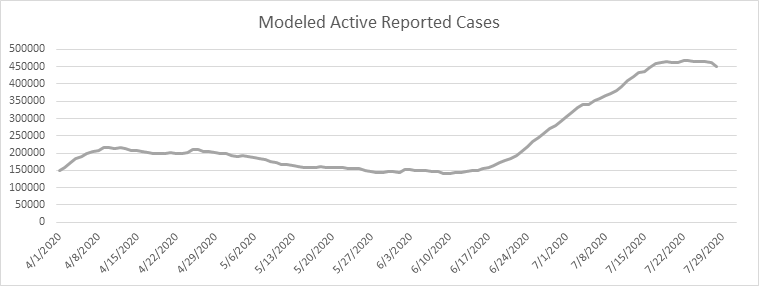
Every one of the 6 hot spots from the beginning of July is level or in decline. We’ve now had about 20 days of flat new cases.

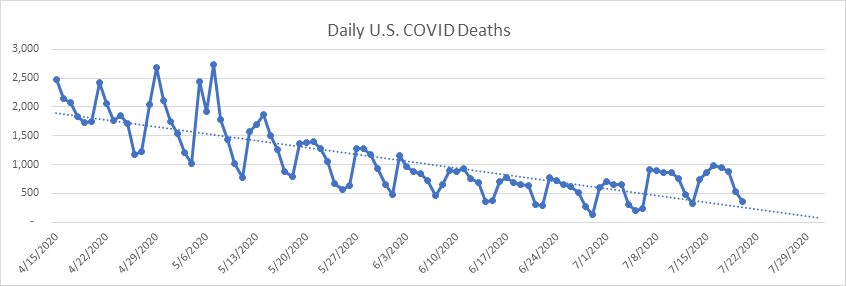
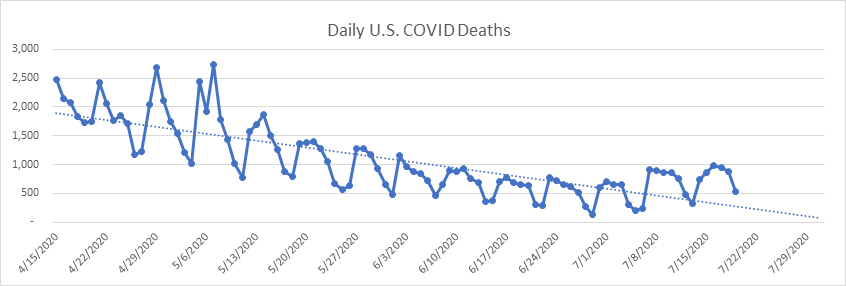
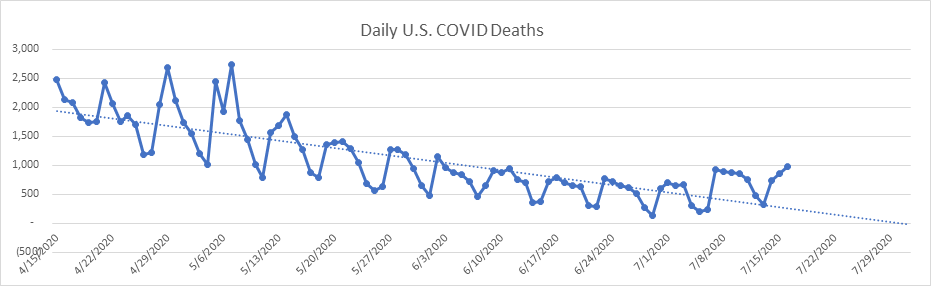
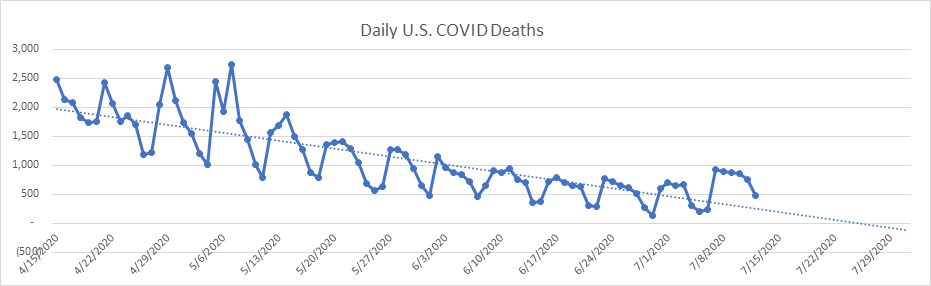
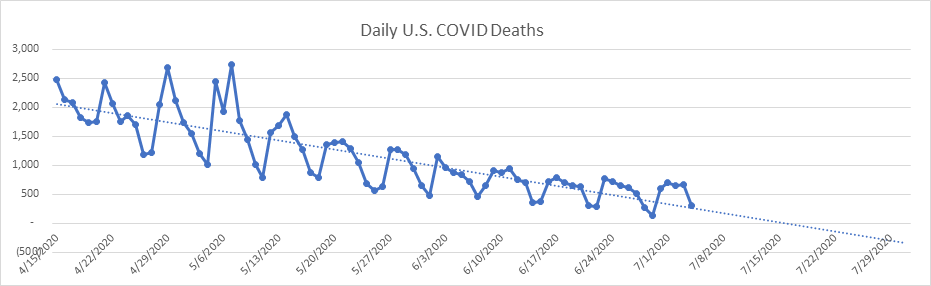
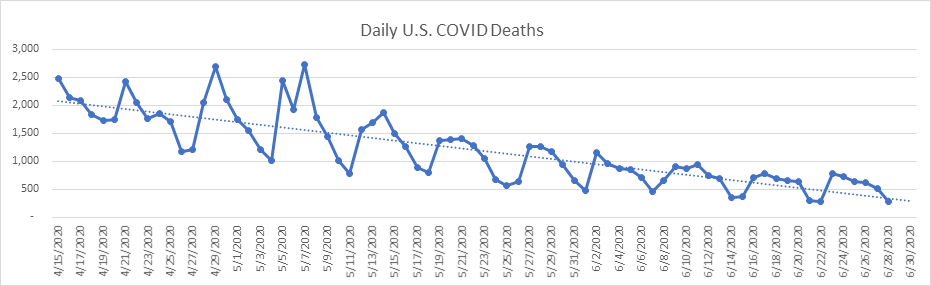
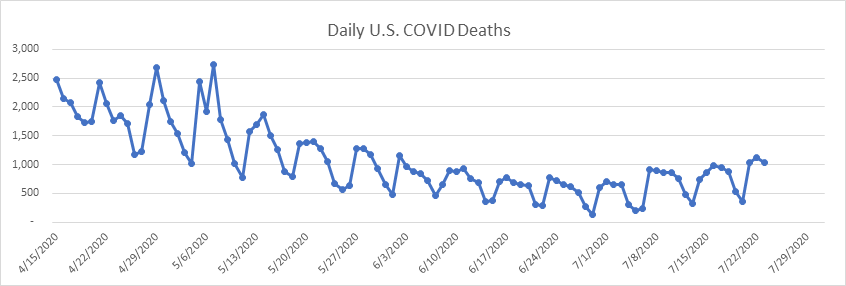
All the news now is about the daily death count, so let’s take a look at that. Here are the daily national deaths (the dotted line is the 14 day moving average):
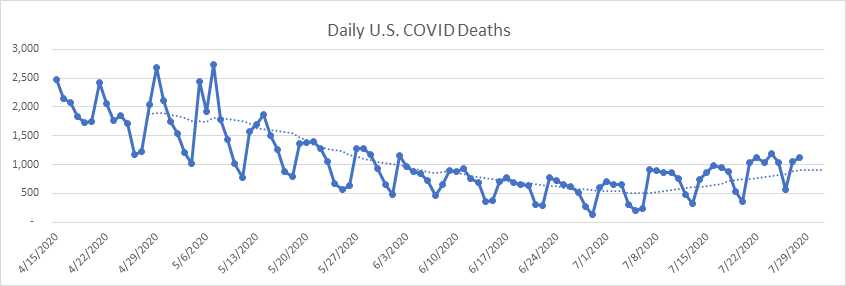
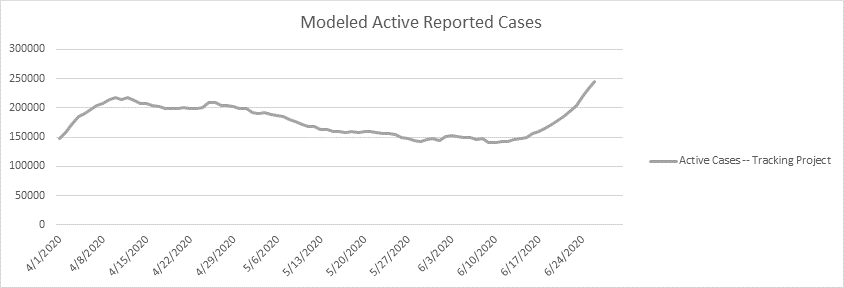
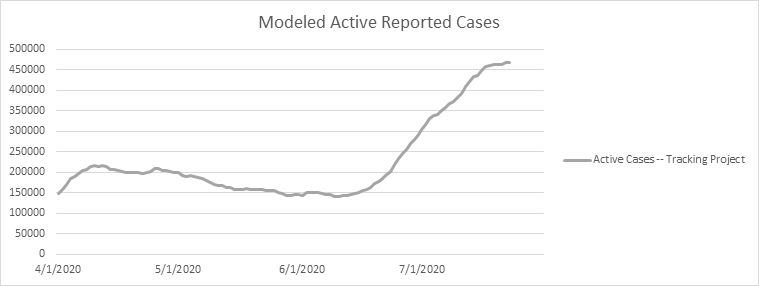
Deaths have risen from roughly 500 per day at the end of June to roughly 1,000 a day over the past week. However, this rise in daily deaths is actually small in proportion to the increased active case count. Looking at the Active Case graph, you can see a local peak on April 10th of about 217,000 active cases (the “first wave”). Yet now we see another local peak on July 23 of about 468,000 active cases (the “second wave”). To me, the logical way to look at this is the number of daily deaths per active case. Here is a graph of daily deaths per 1,000 active cases going back to April 15.
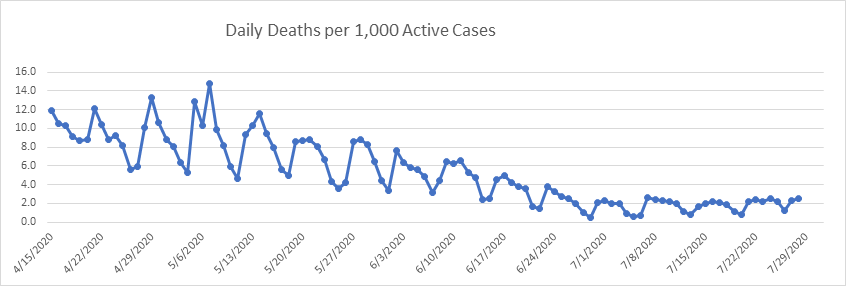
Two observations jump out at us. Most importantly, during the first wave we saw about 10 daily deaths per 1,000 known active cases. During the second wave we’re seeing just over 2 daily deaths per 1,000 cases, or about 1/5 the number. It is clear that the second wave is far less deadly in relation to active case count. The second observation is that the daily death count per active case looks relatively stable – that’s a pretty flat line through all of July. This reaffirms my conclusion that we won’t see the spike in deaths predicted by the press (not by modelers – IHME projects that we won’t average more than about 1,000 deaths per day, and that this number will peak in a week or so). For my reasoning behind this, see my discussion from July 16th at the bottom of this report.

As always, feel free to send me your questions about my assumptions, methodology, or modeling in general.

  • Likely date of active case peak (Chalke modeling): July 23
  • Likely date of peak deaths (IHME): April 16 (last revision on July 22)
  • Total Test Results reported today: 733,243 (very high)
  • Total Pending tests reported today: 3,600 (extremely low)
  • National reported case Growth Rate today: 1.25% (low)

Shane Chalke Interviews

https://www.fredericksburg.com/opinion/editorial-unlock-demographically-not-geographically/article_a62e6e70-dccd-51cf-b7b2-16d77a90fd9c.html

Website

Groom Ventures has agreed to host a website that will archive my daily reports, and supplement with other commentary. John Groom worked at one of my companies back in the day, and is an excellent writer. The website is: www.howmuchrisk.com For those of you that post my daily report on Facebook, let me suggest you link to this site, as the direct Facebook posts don’t seem to copy the graphs.

Daily Analysis

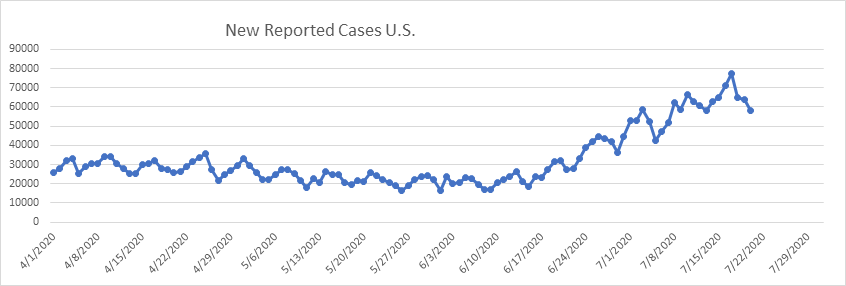
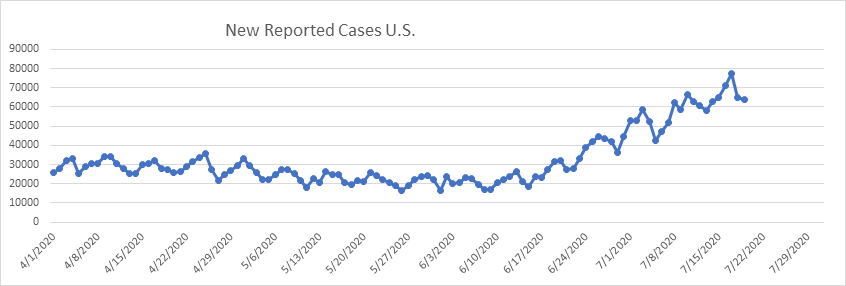
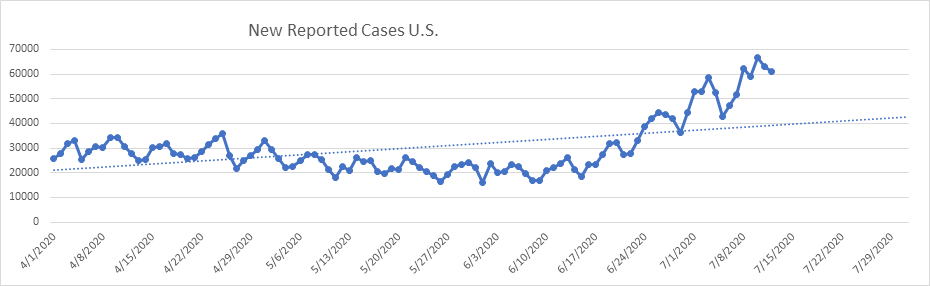
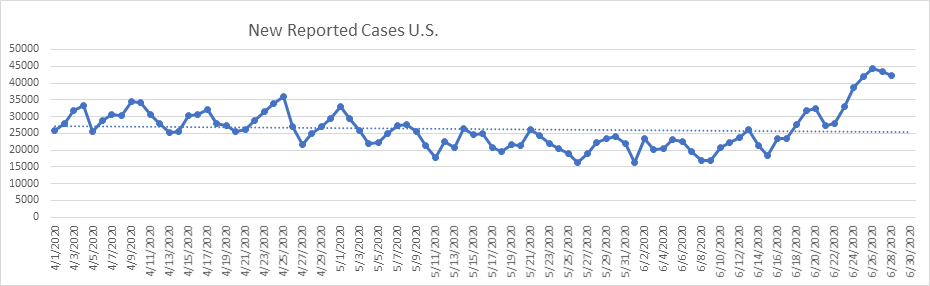
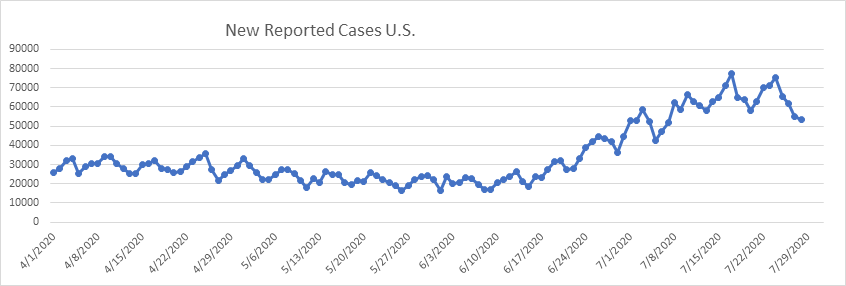
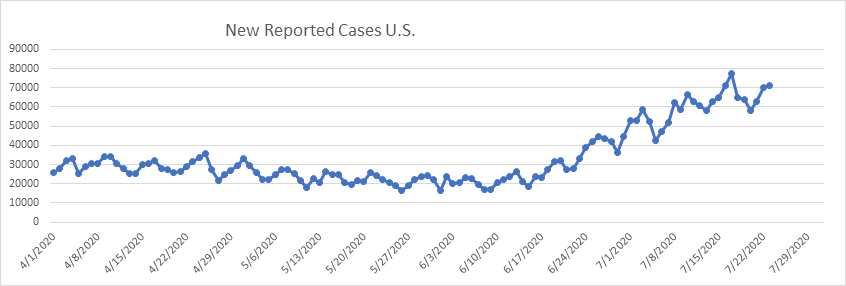
Here are the new reported cases nationally – You can see the negative convexity over the past 3 weeks. The daily growth rate continues to decline, reaching the lowest point today in 5 weeks (1.25%). This should provide some comfort, as I believe it is the reports of “out of control” growth that is most frightening. We are not seeing that.
On to the states.

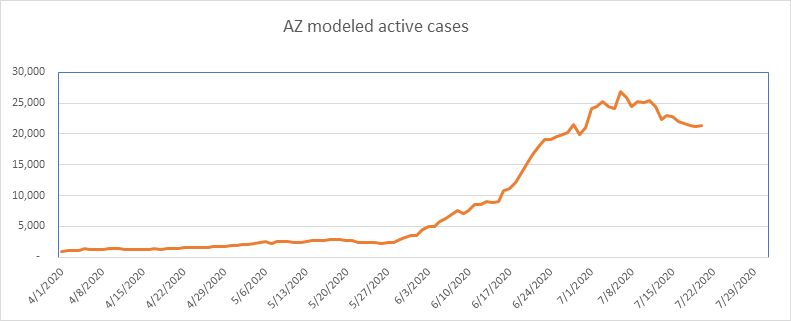
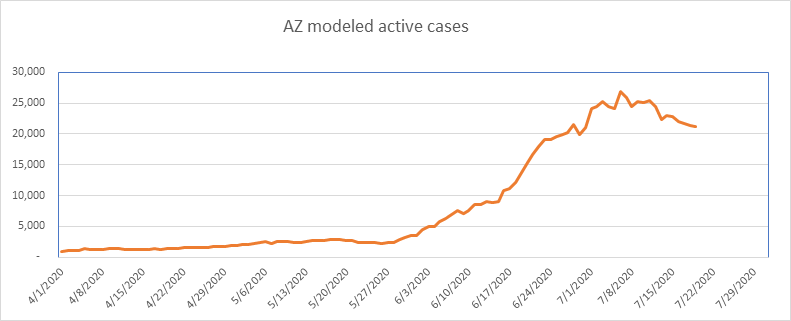
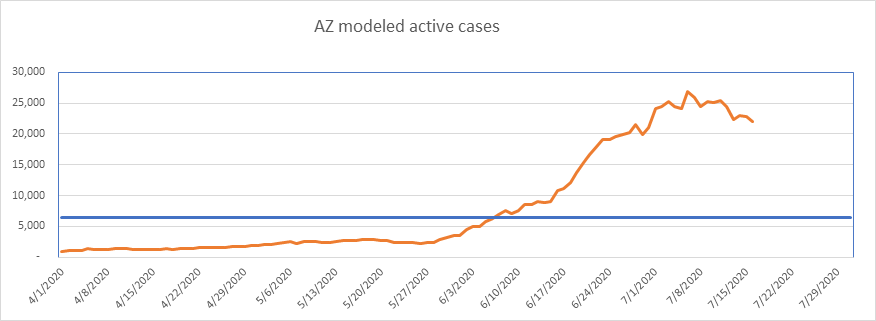
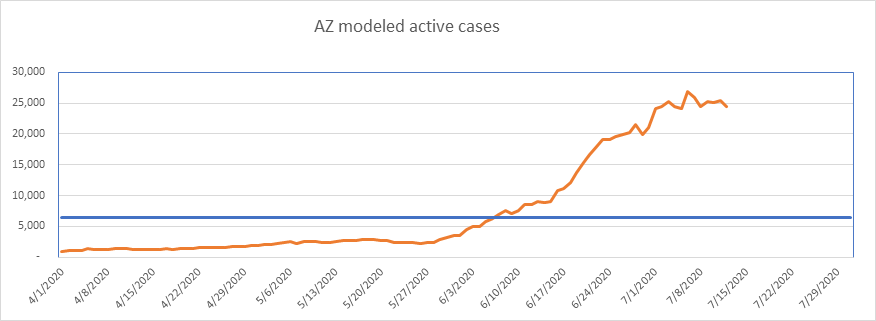
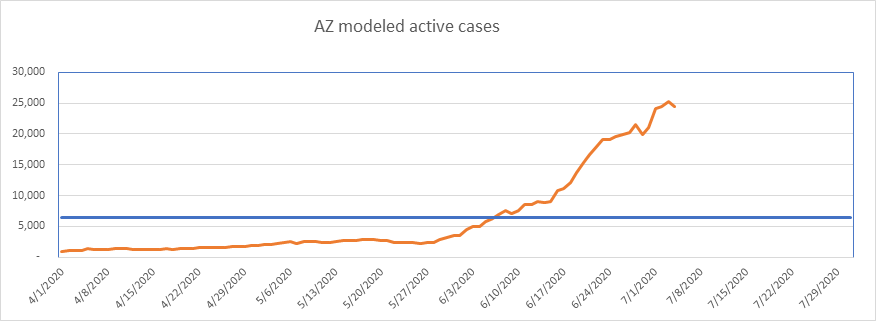
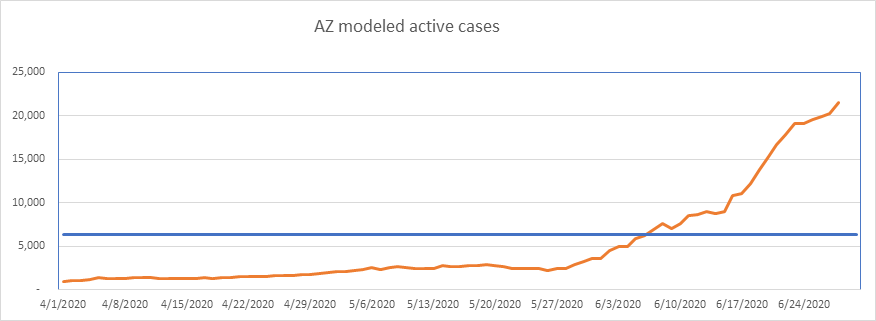
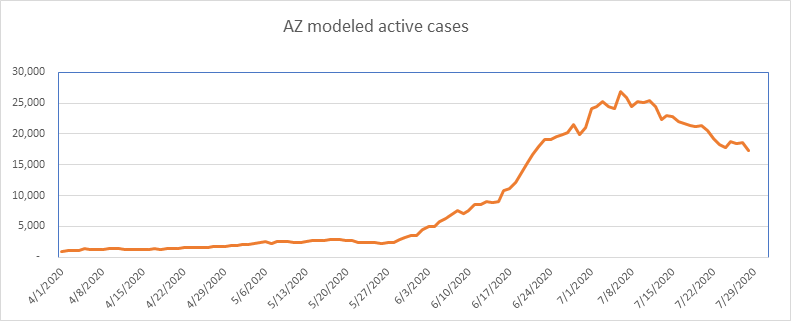
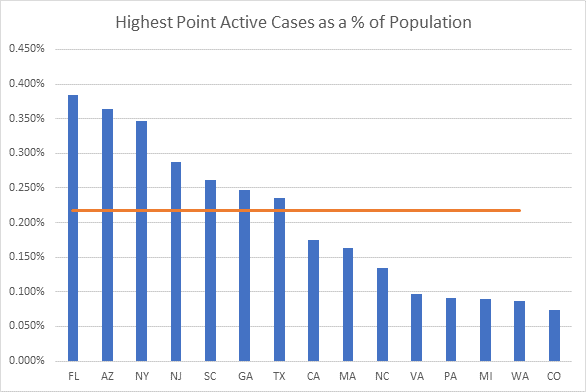
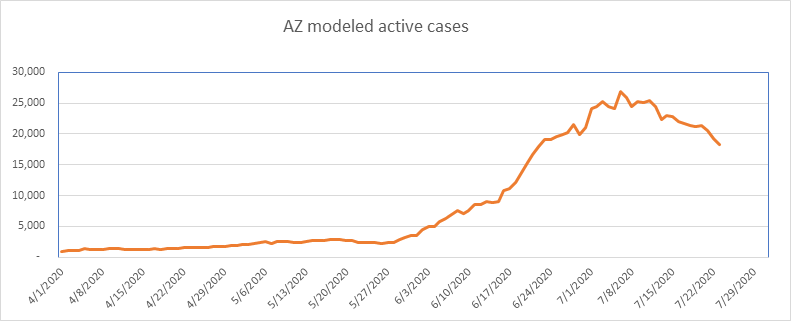
As I mentioned last week, Arizona is starting to look a lot like NY or MA, with a hard bounce off the population ceiling and a rapid decline from the peak. This state is down an amazing 36% from the peak of just three weeks ago.
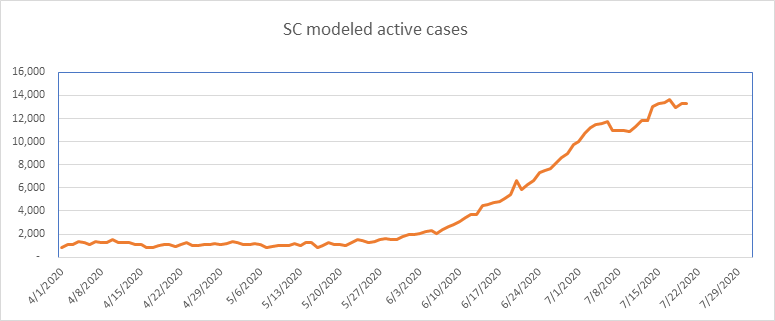
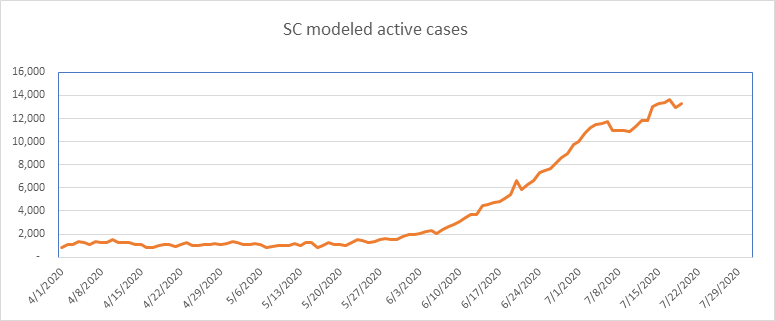
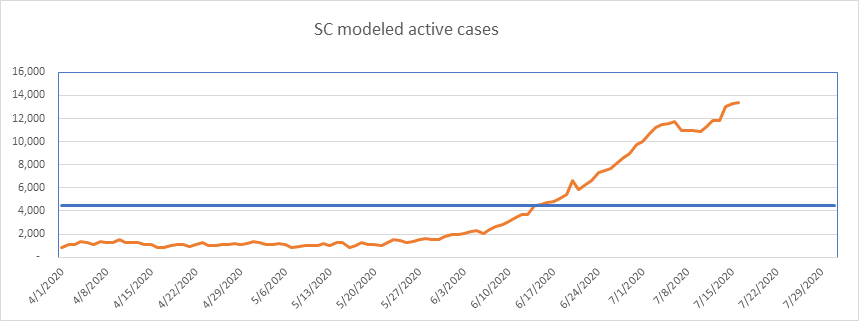
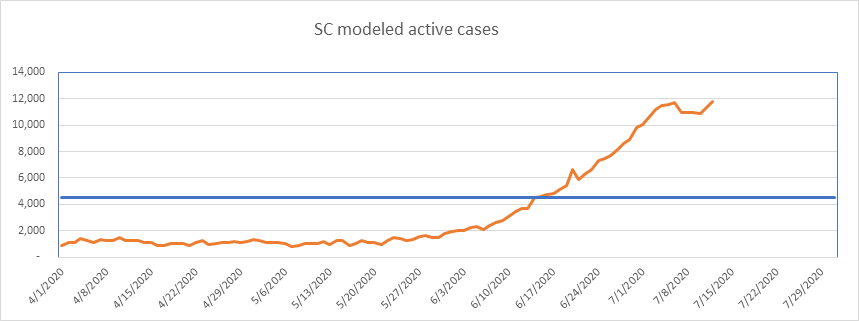
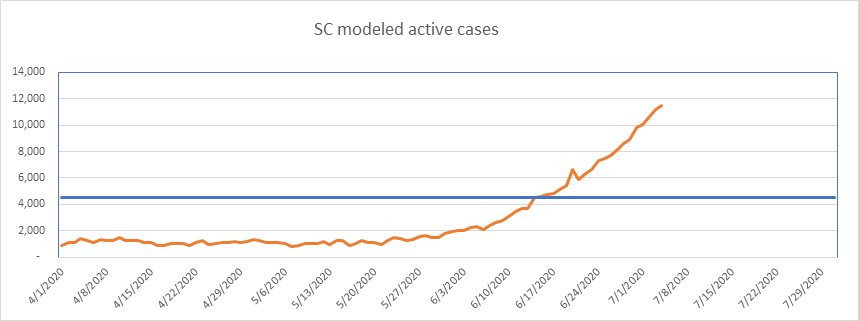
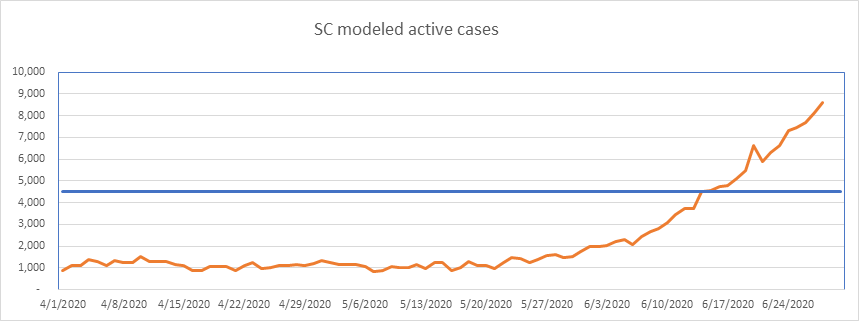
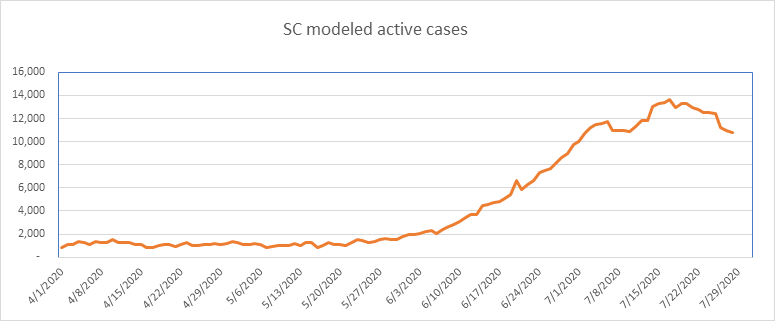
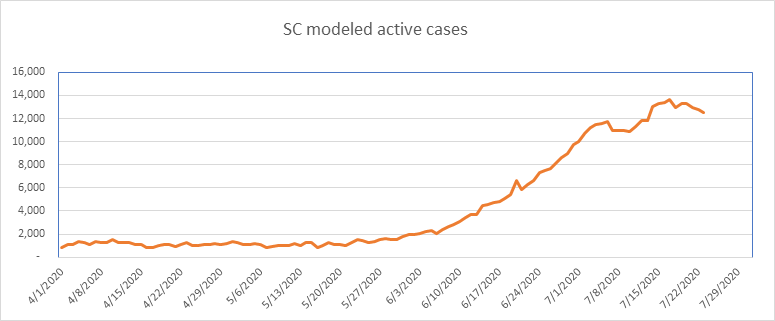
SC is now 11 days past peak, and now down 21% from the top. SC Peaked at 0.26% of the population, so I suspect this peak will hold. Note that South Carolina double counts cases, as they treat each positive test as a new case (per The COVID Tracking Project).
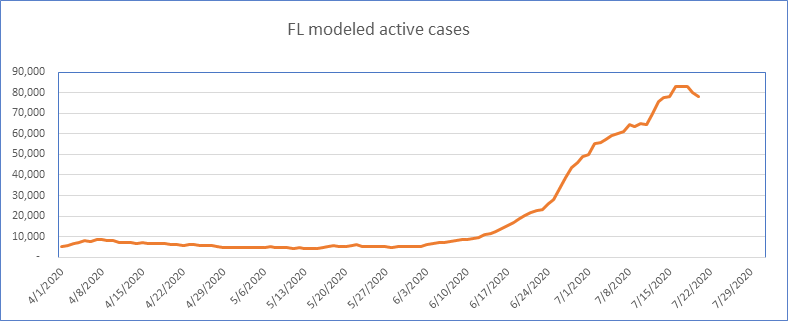
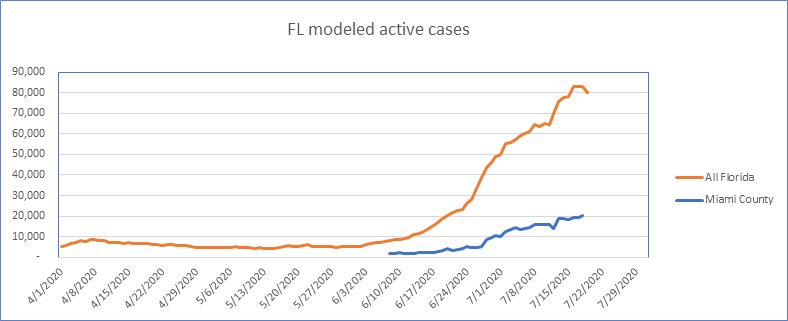
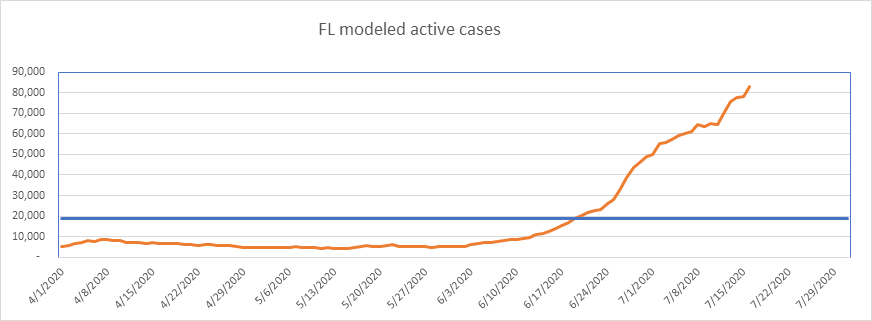
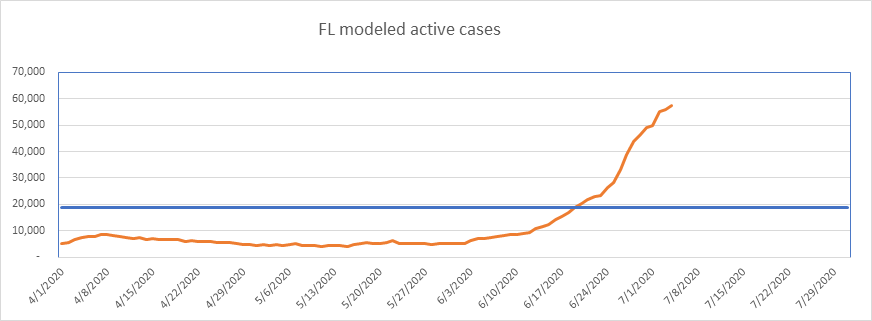
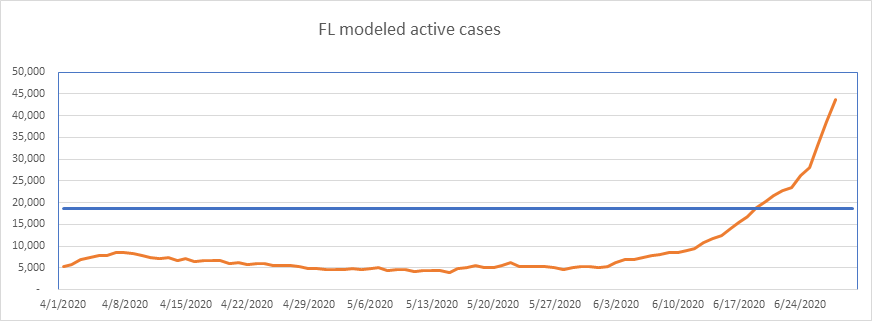
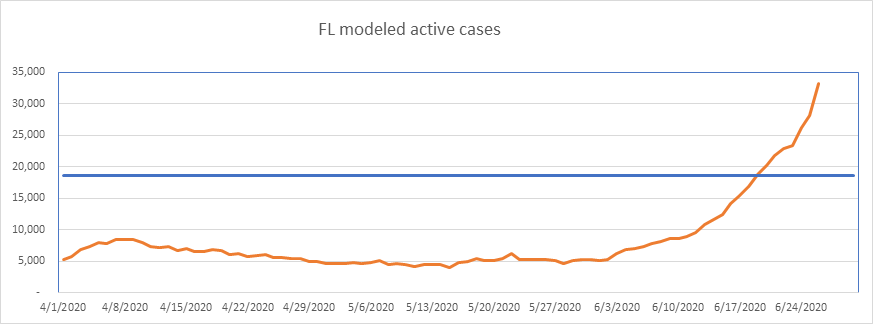
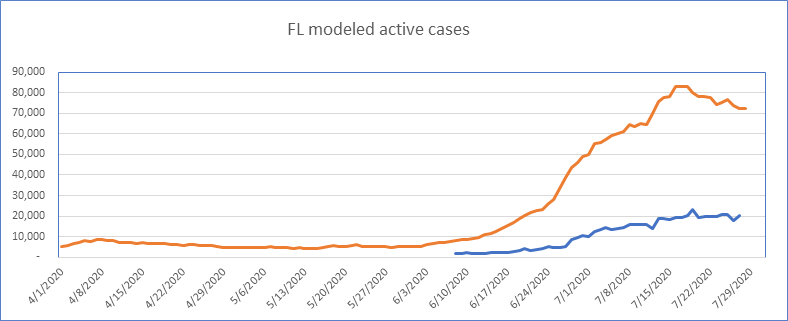
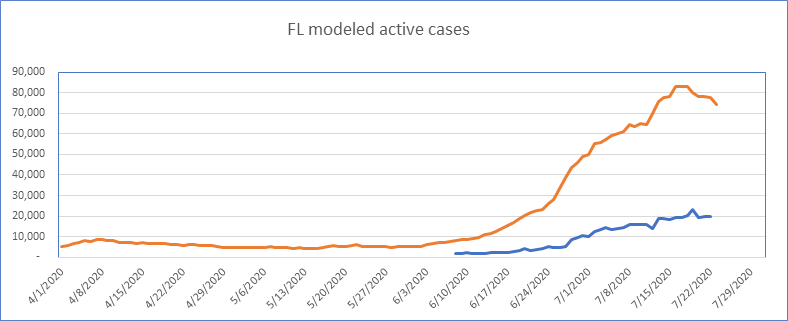
Here is Florida – 12 days past peak active cases. Interestingly, I noticed Miami flattening first, but Miami remains flat – it hasn’t declined yet at all, differing from the state as a whole. Florida peaked high, at 0.38% of the population, so I think this peak will hold.
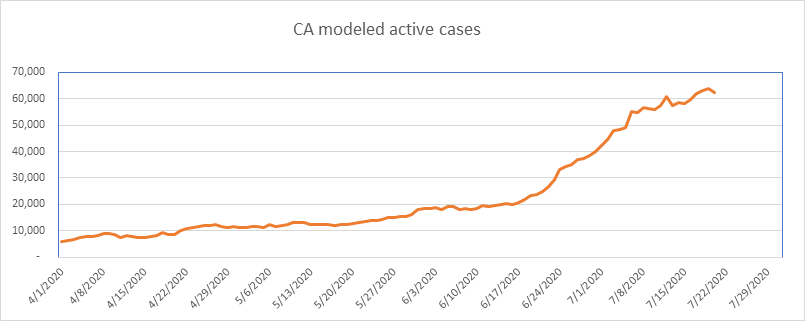
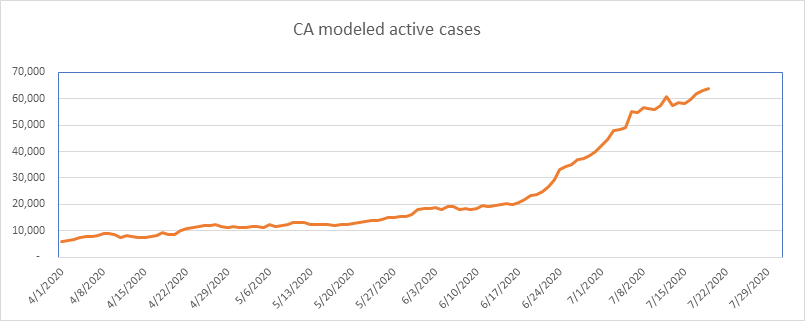
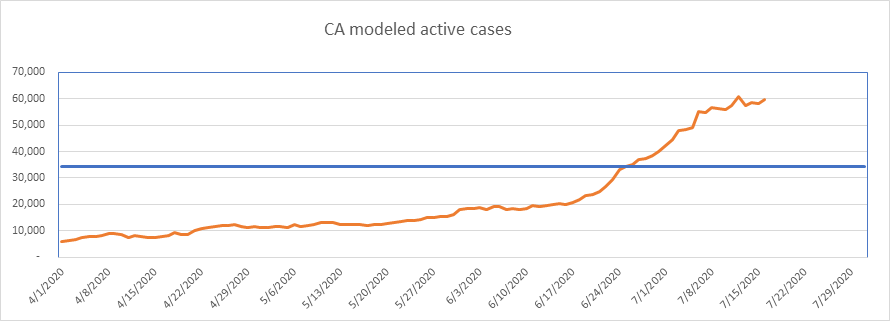
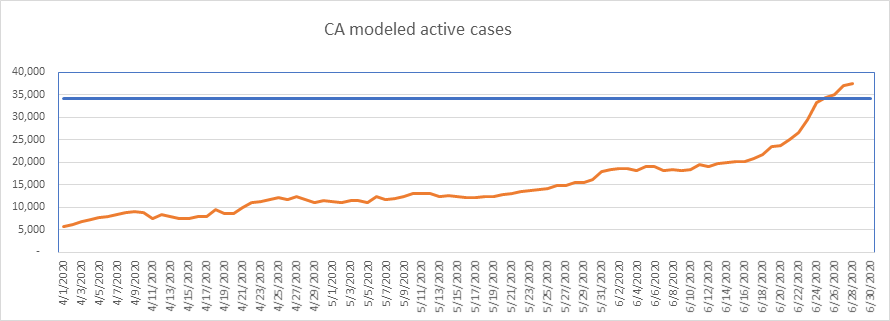
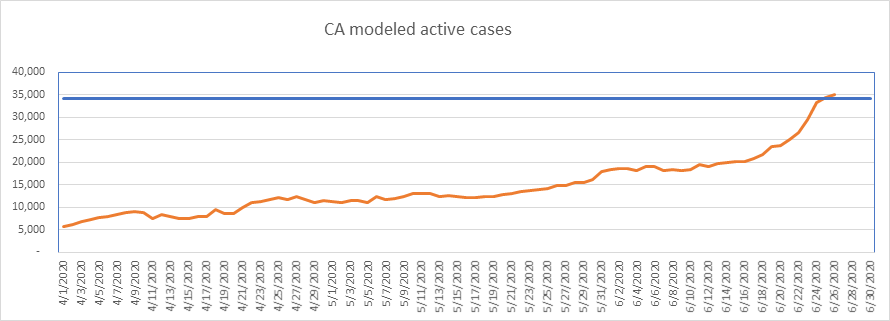
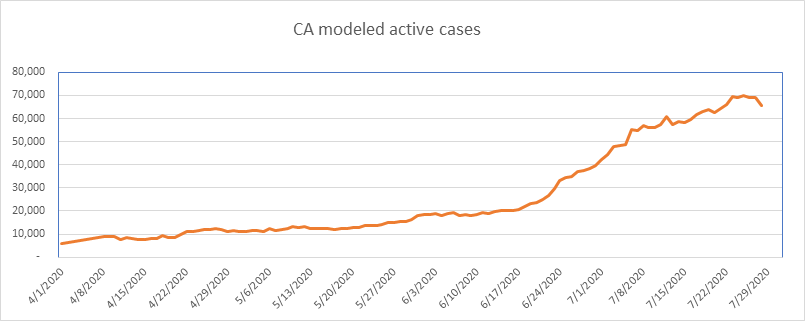
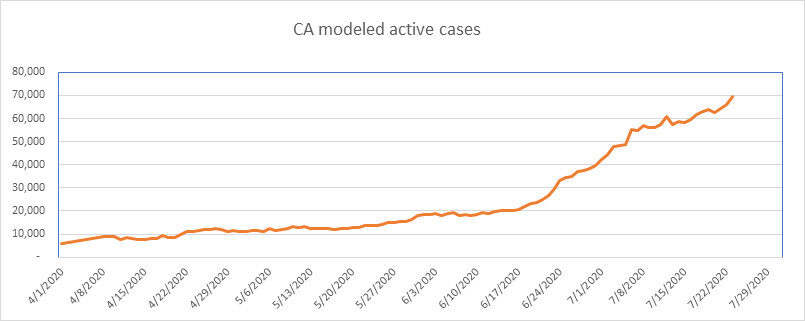
Some potentially good news from California – a definitive slowing over the past two weeks. California today sits at 0.18% of the population, so I’m thinking it has more growth to come, but I like “slow”. As always, I need to report that California is one of the states that counts tests rather than people.
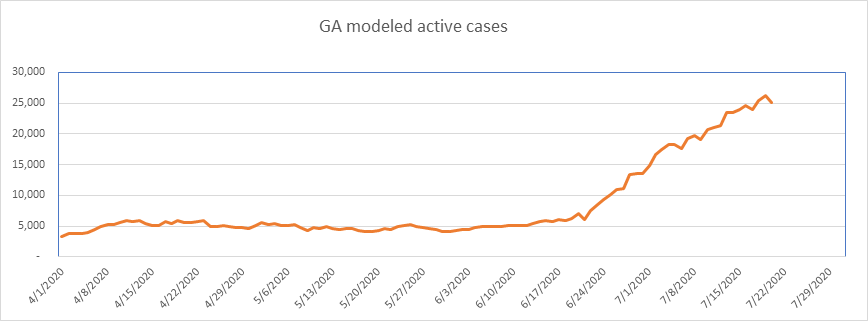
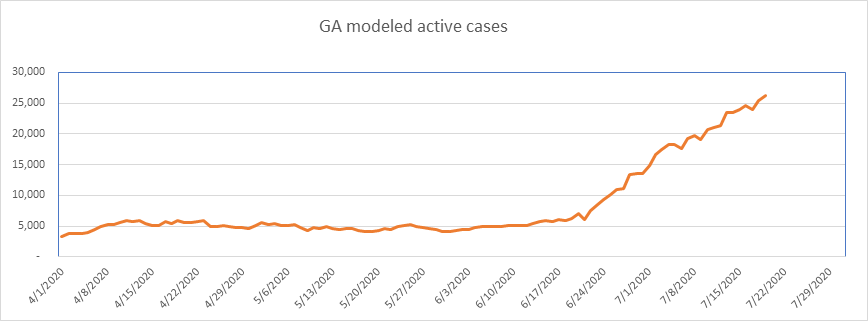
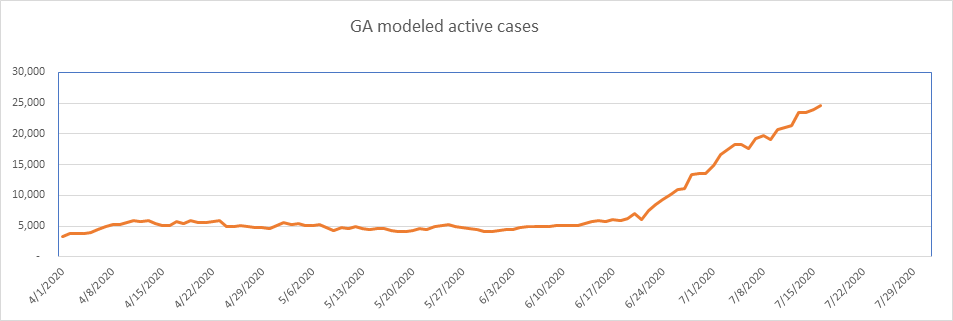
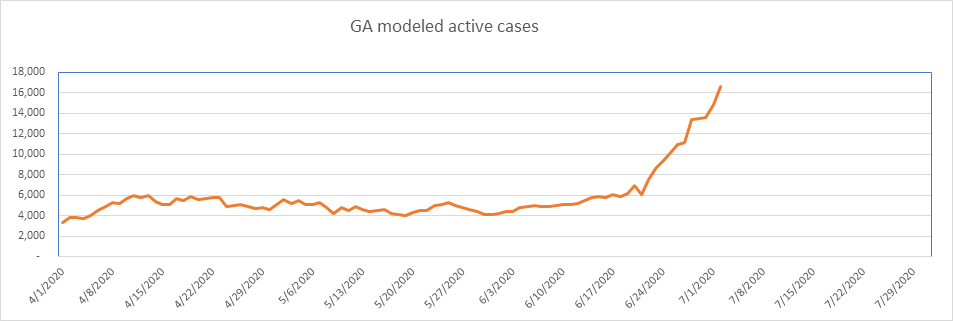
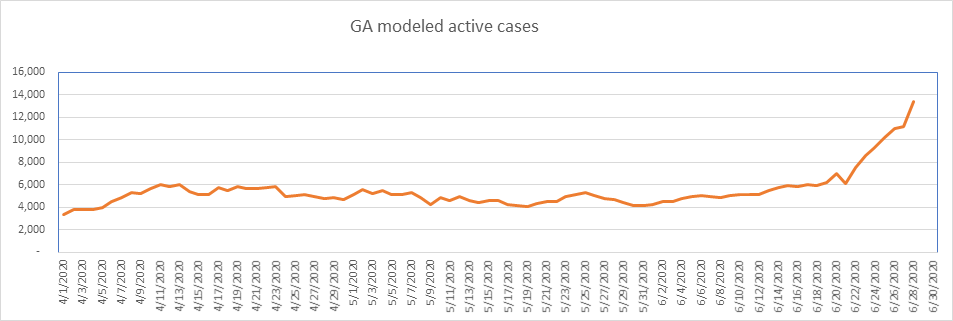
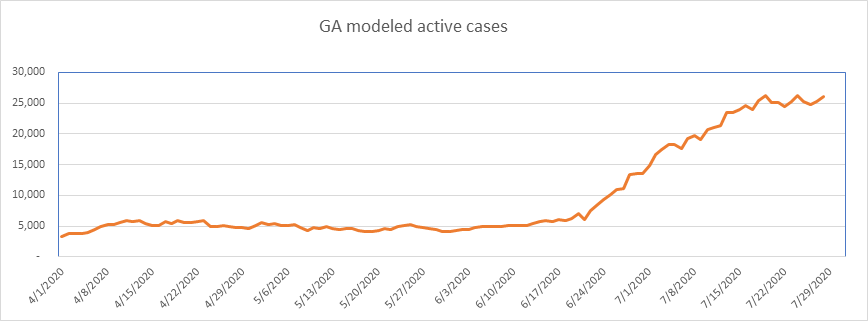
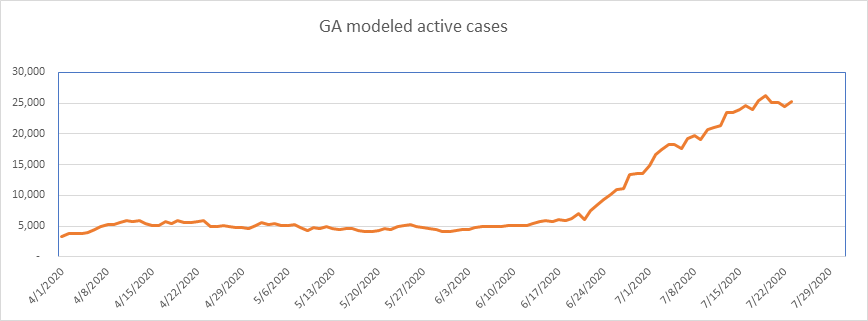
Georgia has been slowing for over 2 weeks, and is now flat for 10 days. Is this the top for Georgia? I don’t know. Georgia hit a high of 0.25% of the population, so this could be the ceiling – just below the average for states that have peaked. Note here again, the case numbers are exaggerated. Georgia counts each positive test as a case (according to The COVID Tracking Project).
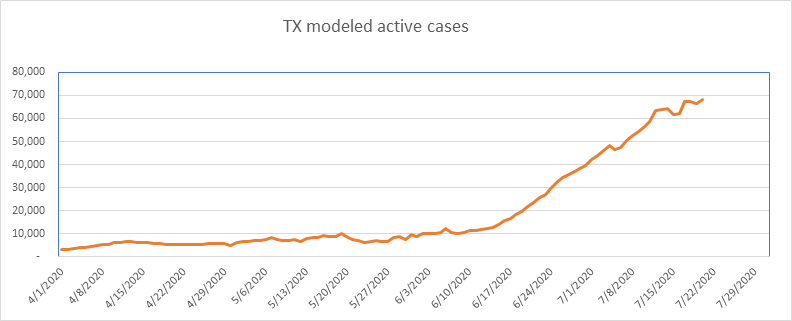
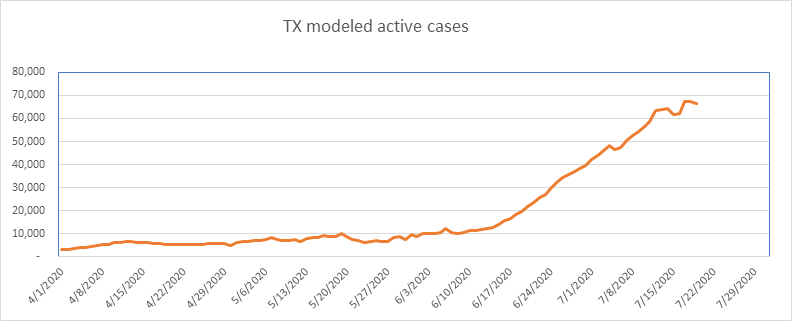
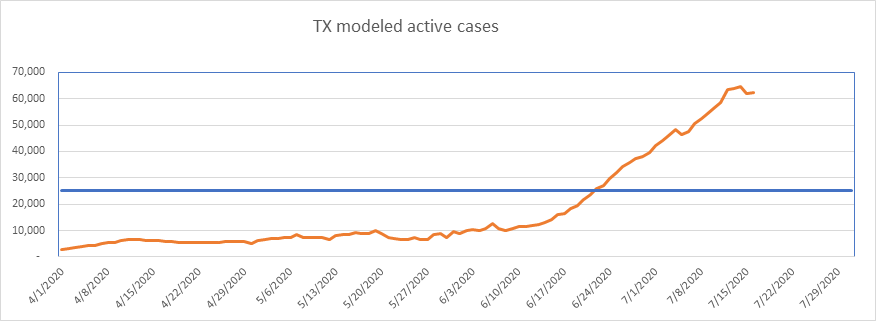
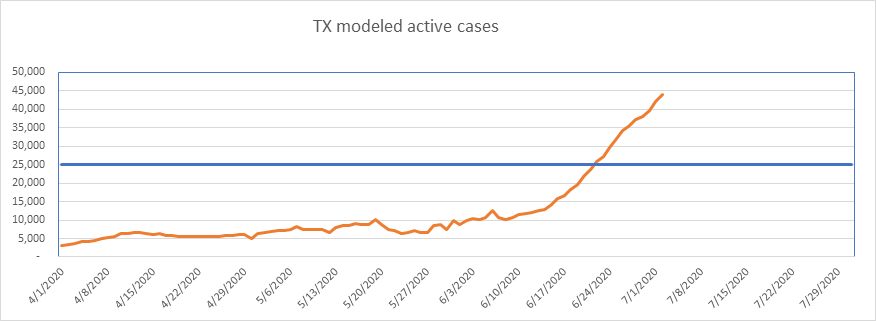
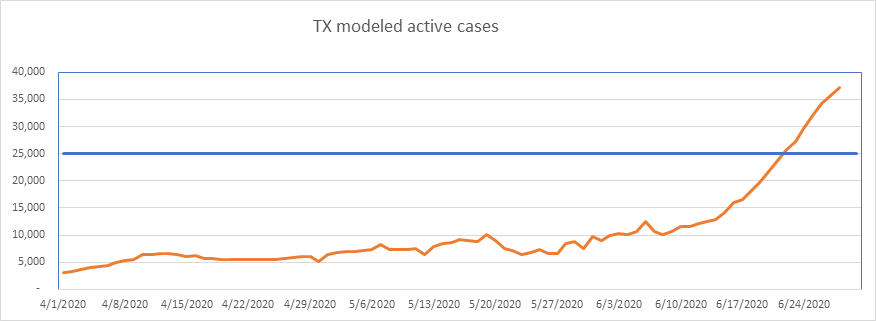
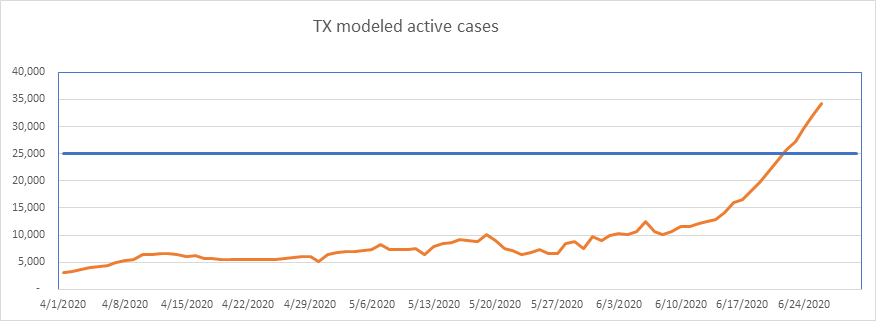
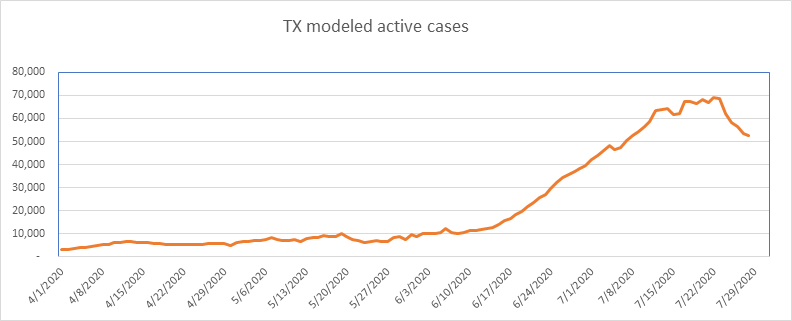
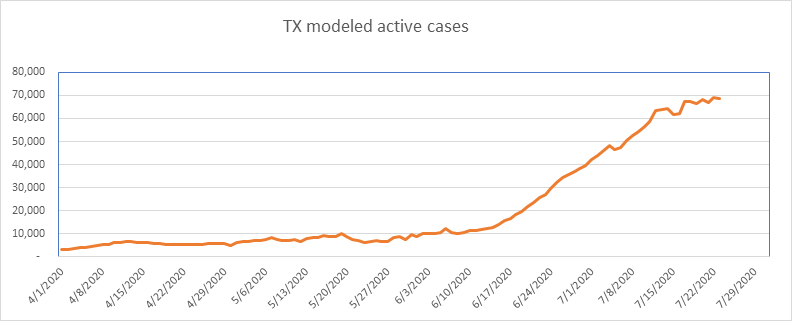
Big improvement in Texas since my last report. IF Texas peaked, it was 5 days ago at 0.23% of the population. I don’t know if this will hold, but it’s looking promising, down 24% in just five days – looking like another Massachusetts. Texas also reports positive tests as cases, so is doing some level of double counting.
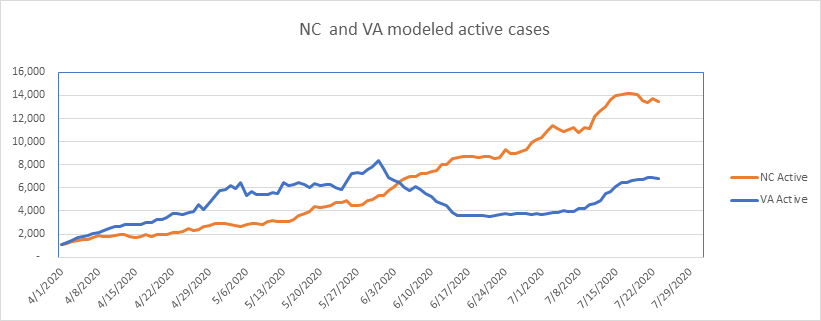
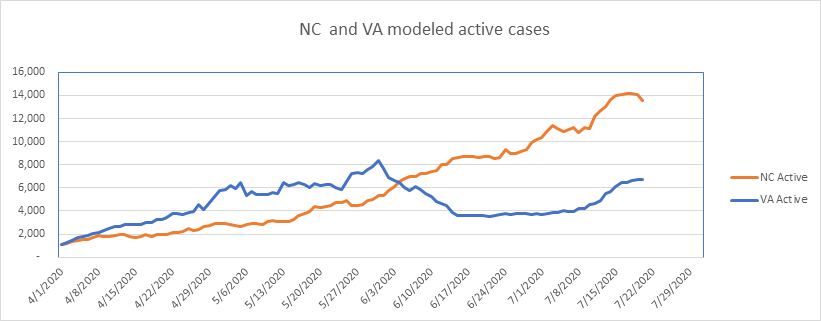
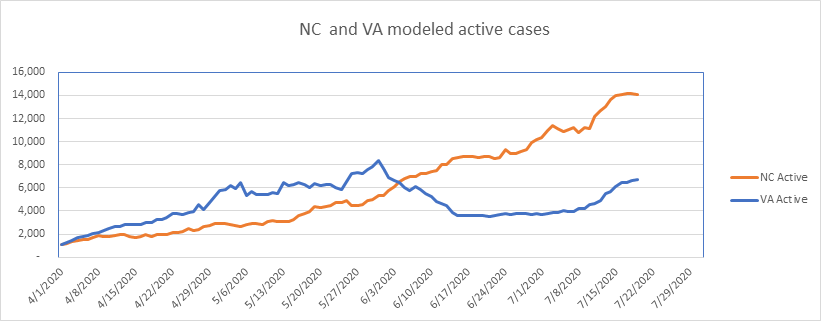
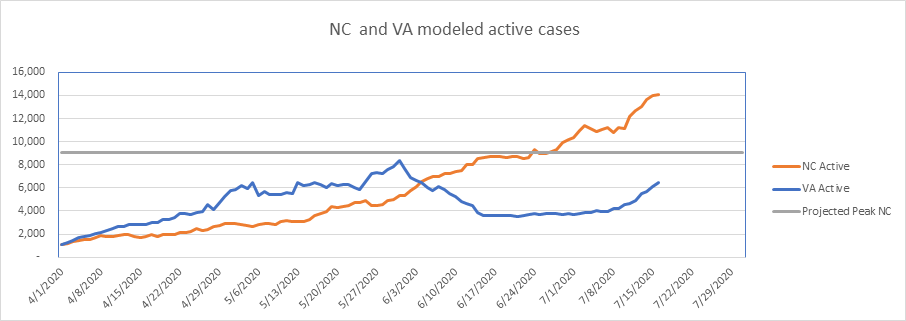
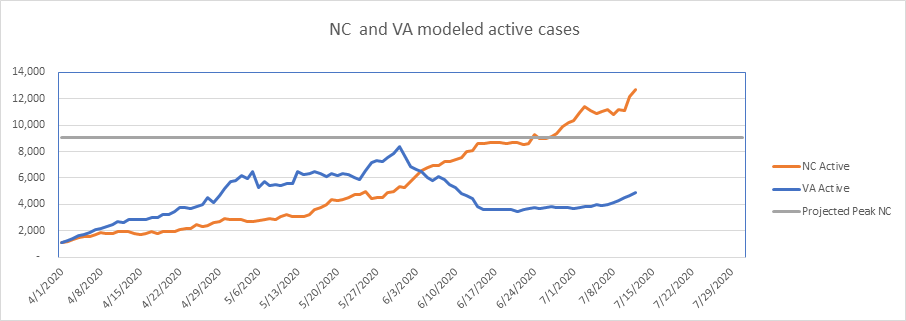
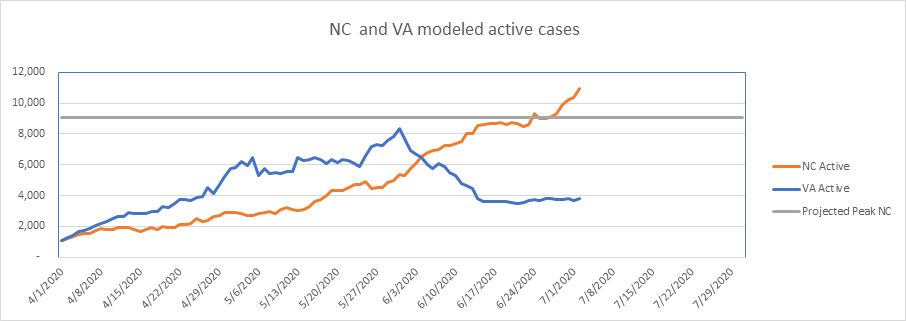
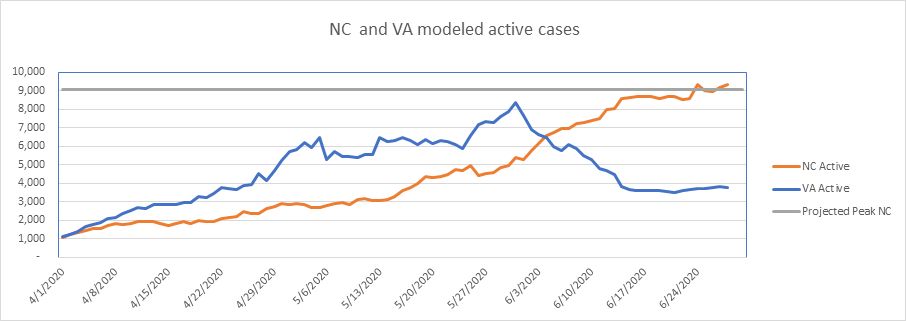
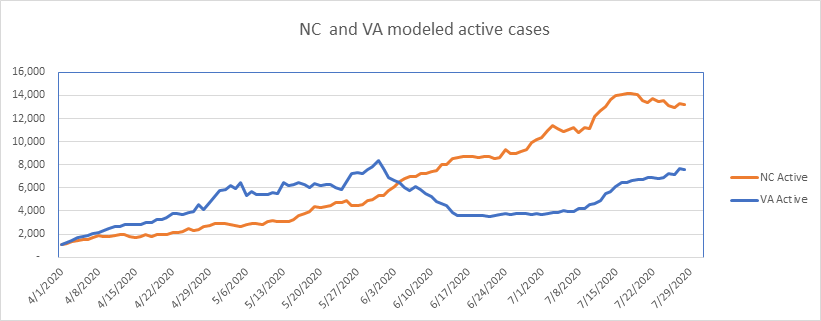
NC is looking pretty good for 12 days now, but if this is the peak, it’s at a very low level (0.14%). We’re scheduled to remain in Phase 2 until August 7th, but I’m thinking the case and death numbers are such that we’ll move to Phase 3 then. IHME is projecting peak daily deaths in NC in the first few days of August. It’s interesting how NC and VA now move together since mid-June.
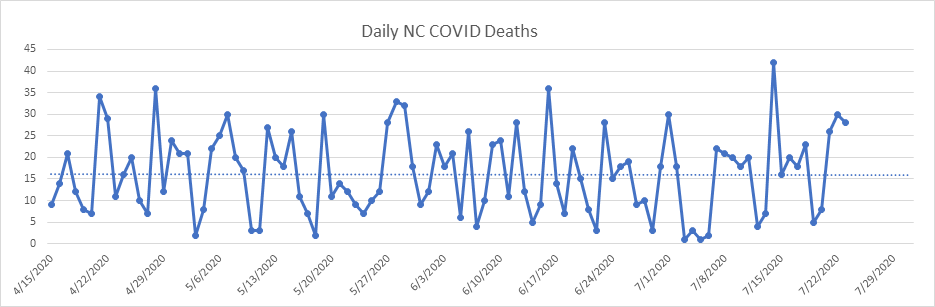
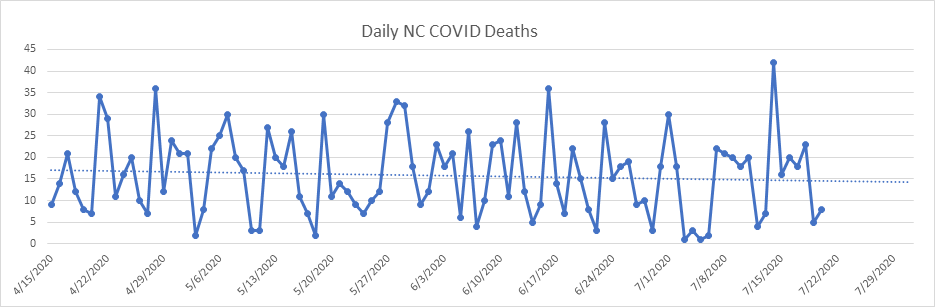
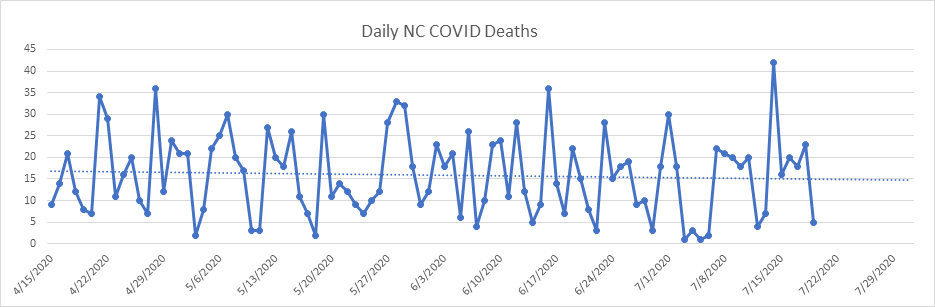
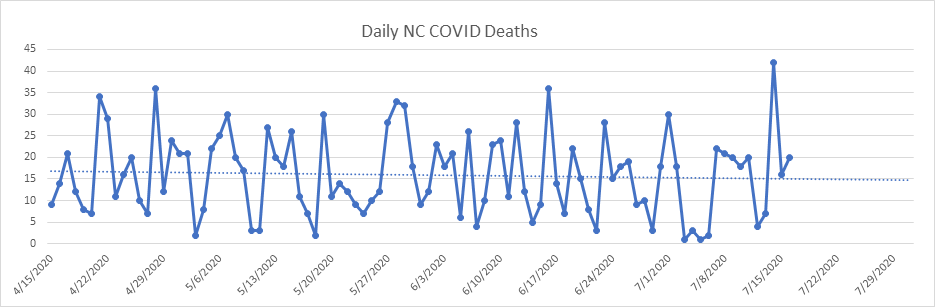
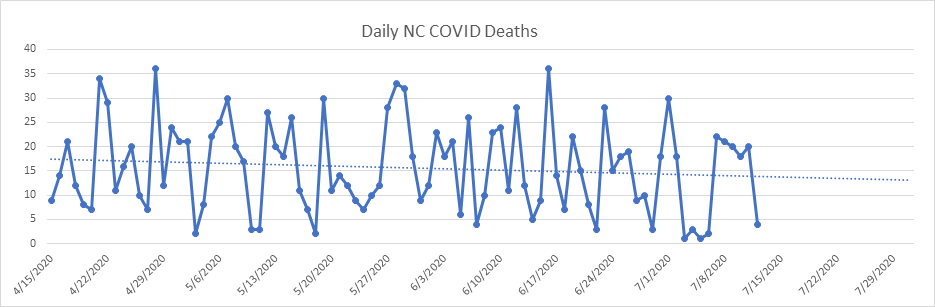
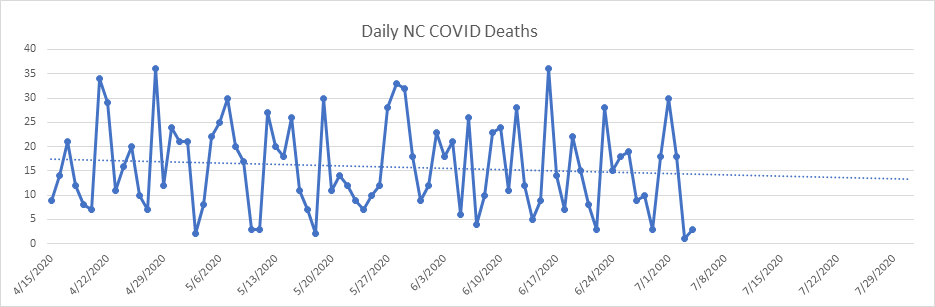
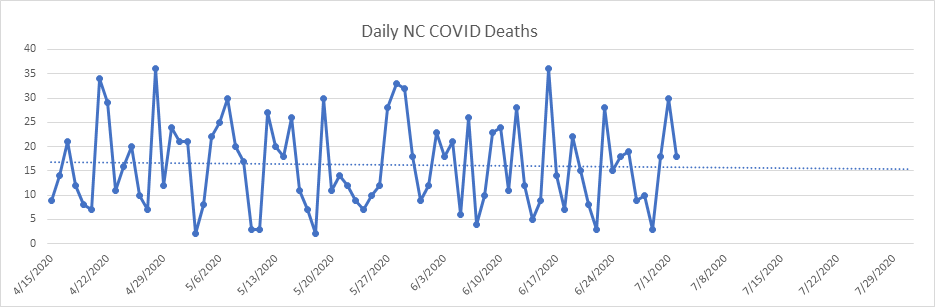
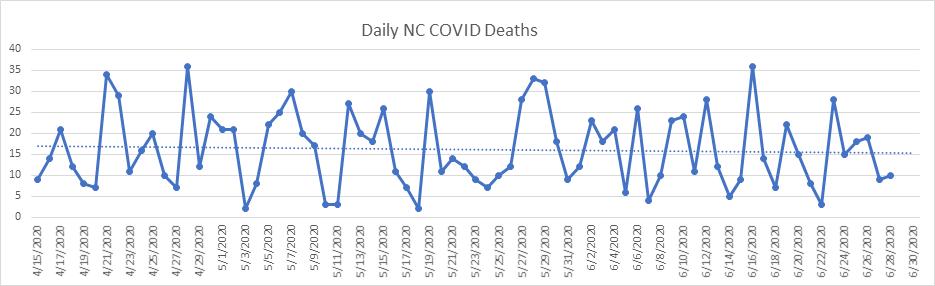
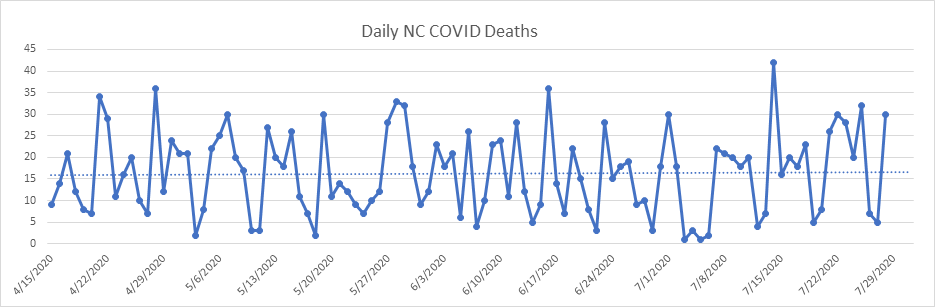
Here is the daily death report for NC. There is no visible upward drift in daily deaths yet, despite the fact that NC has had active cases increasing monotonically for over 3 months. NC extended Phase 2 until August 7th. I think we’ll actually go to Phase 3 this time if this pattern persists.
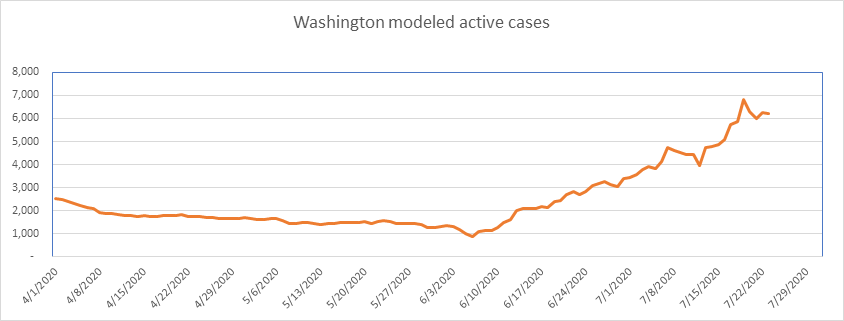
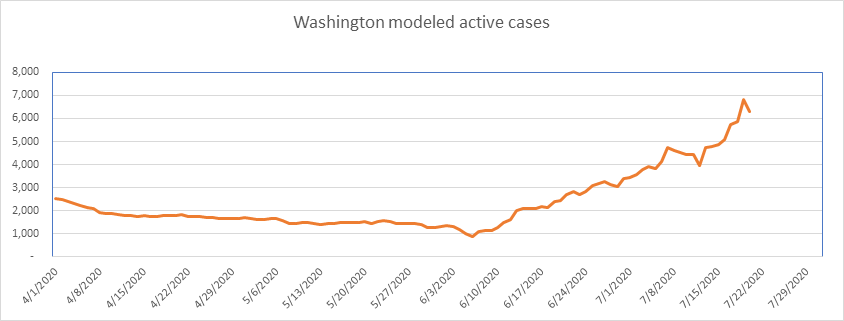
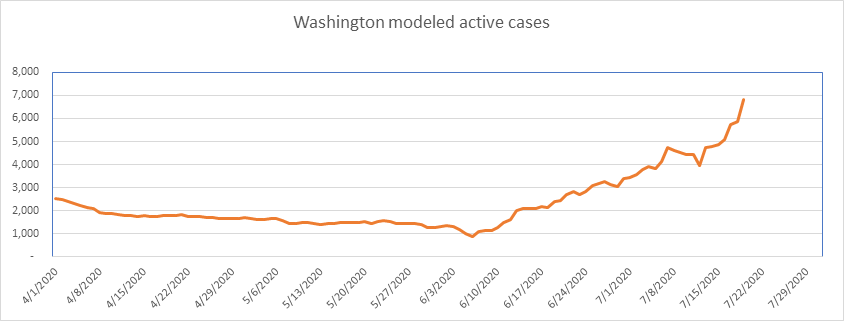
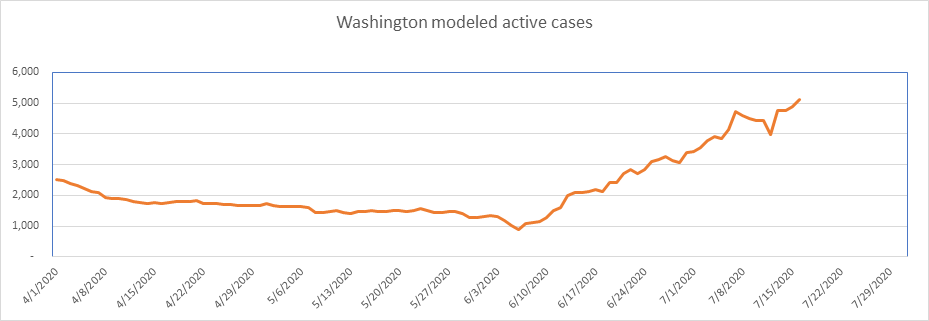
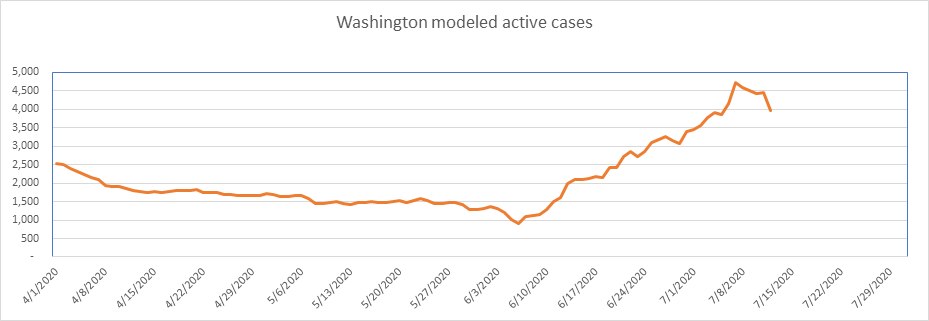
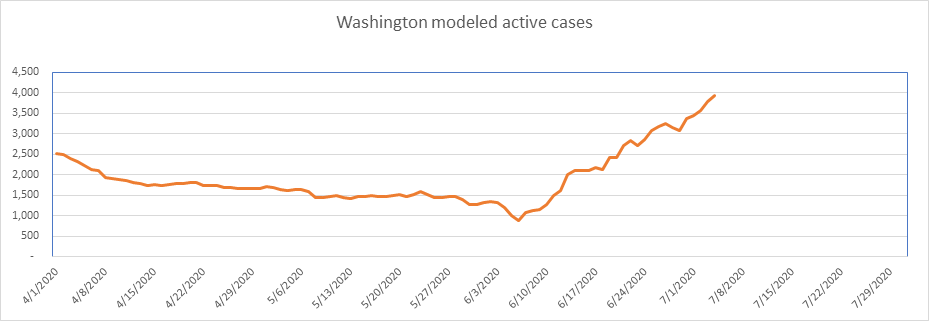
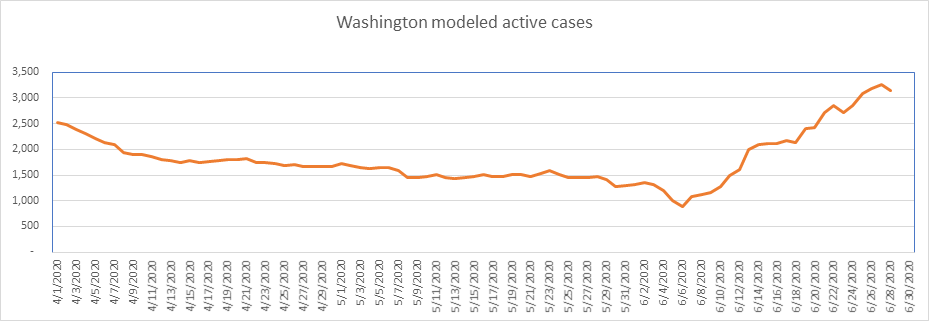
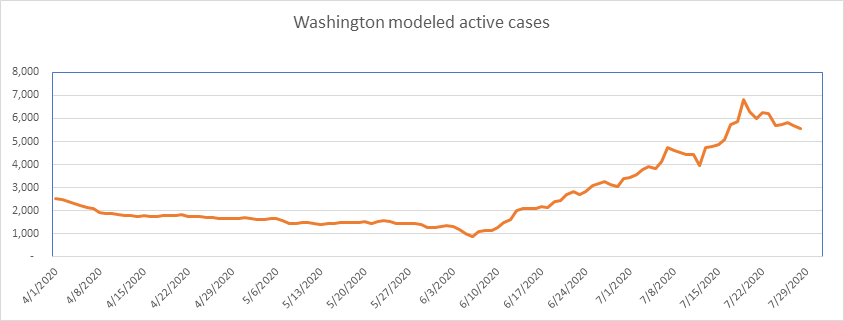
Washington could have peaked, but I’m skeptical, as the high water mark you see here is at just 0.087% of the population. It’s been 9 days, though, so this is hopeful.
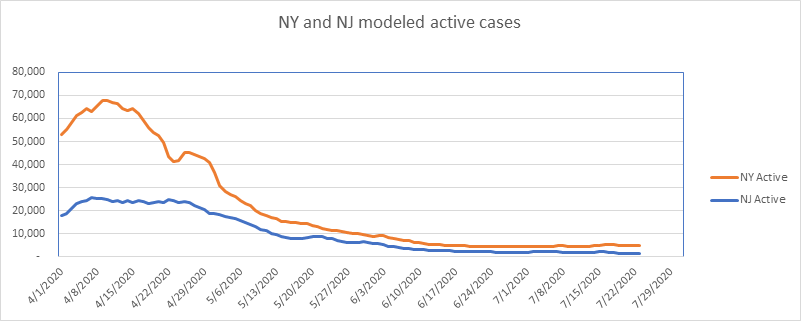
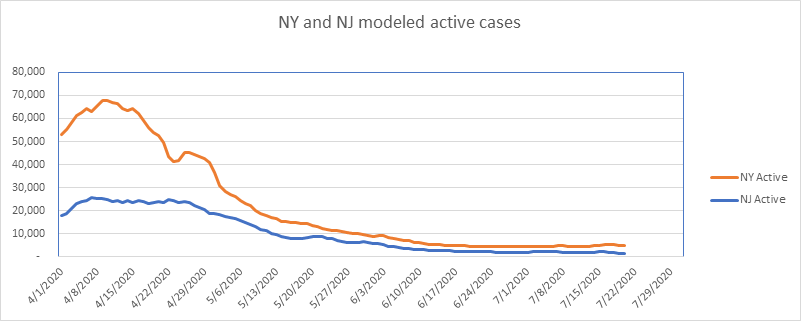
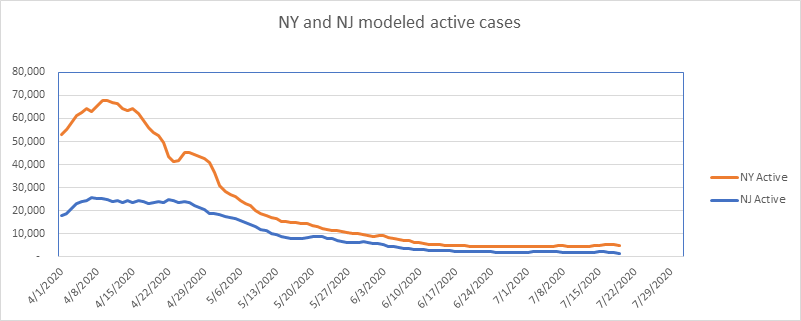
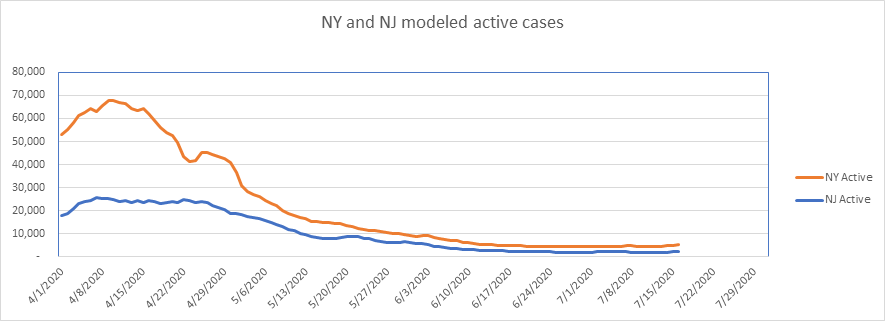
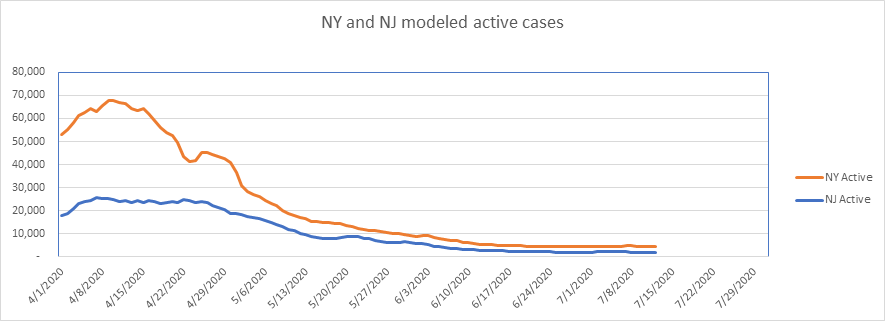
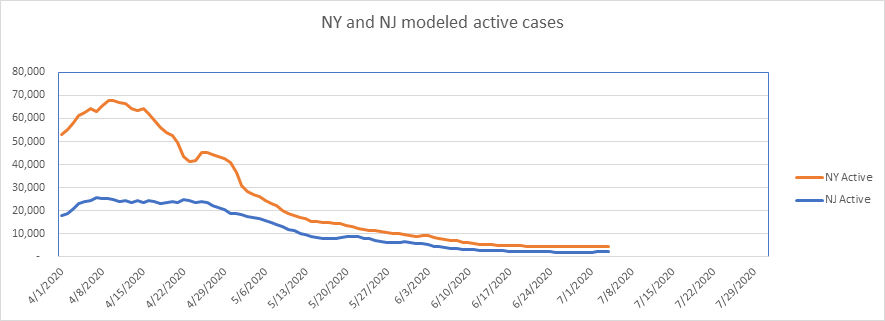
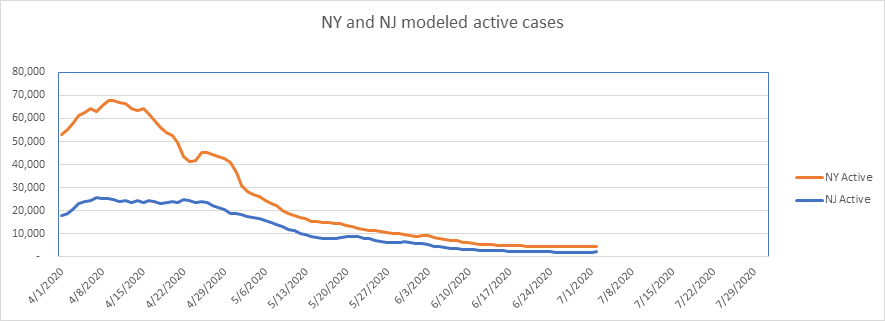
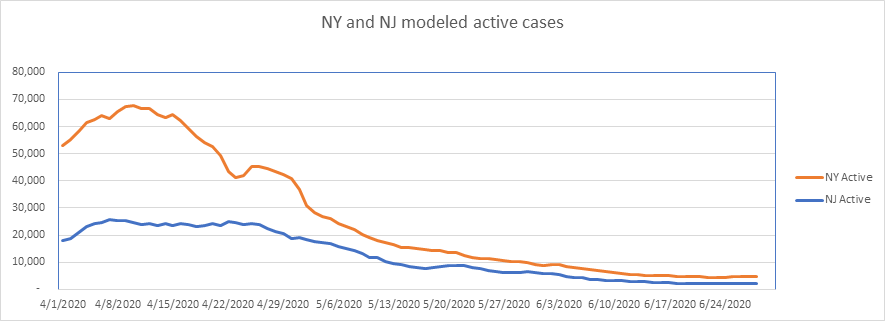
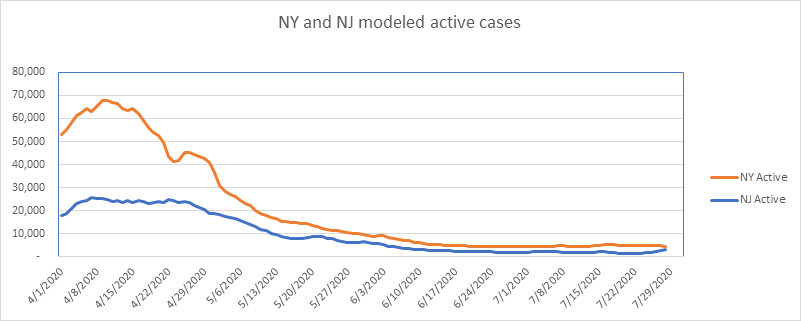
Nothing to say about NY and NJ – the picture says it all. Interesting that NJ is drifting upward lately, which NY continues to gradually fall.
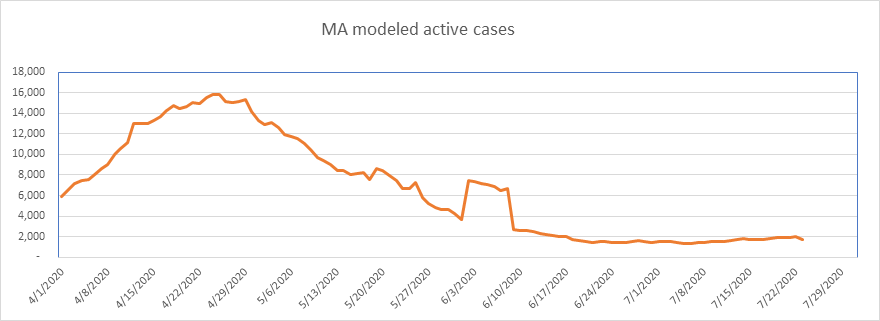
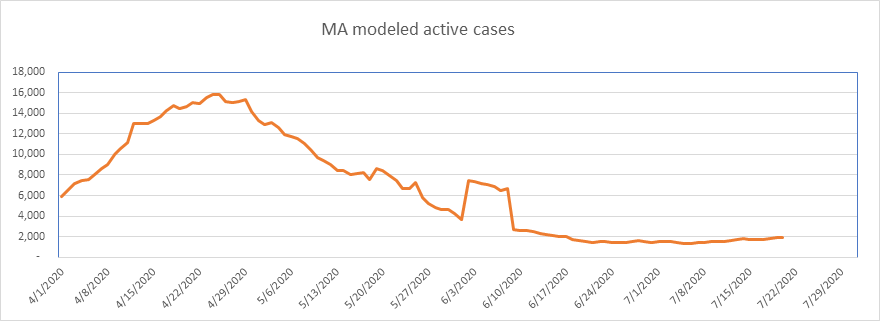
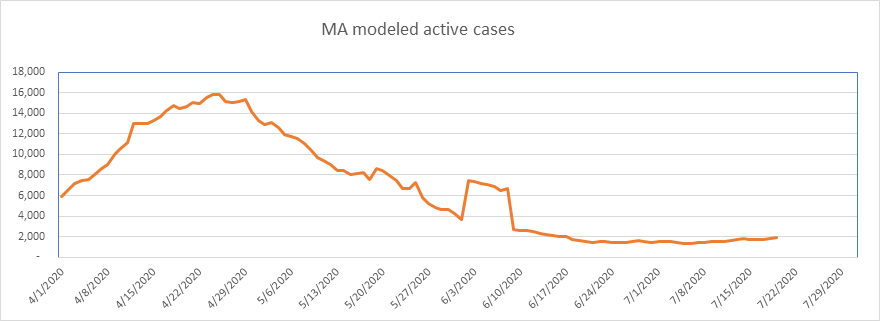
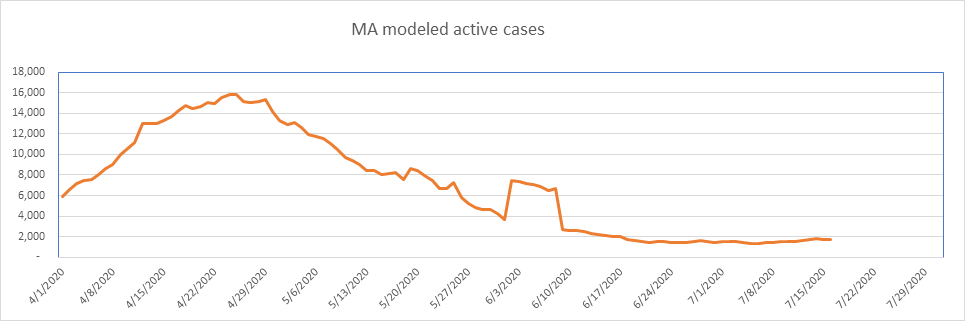
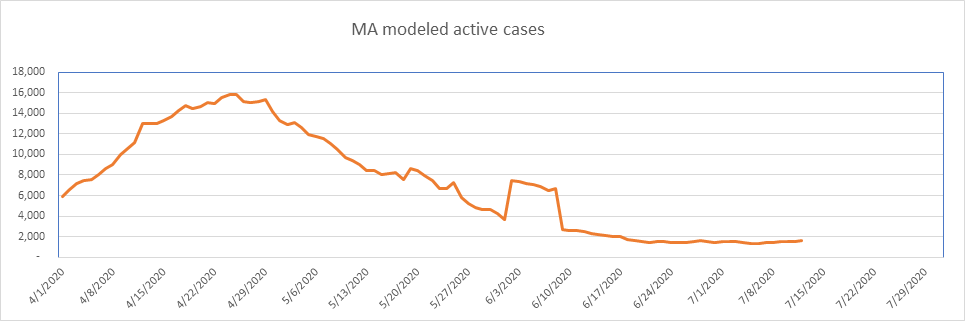
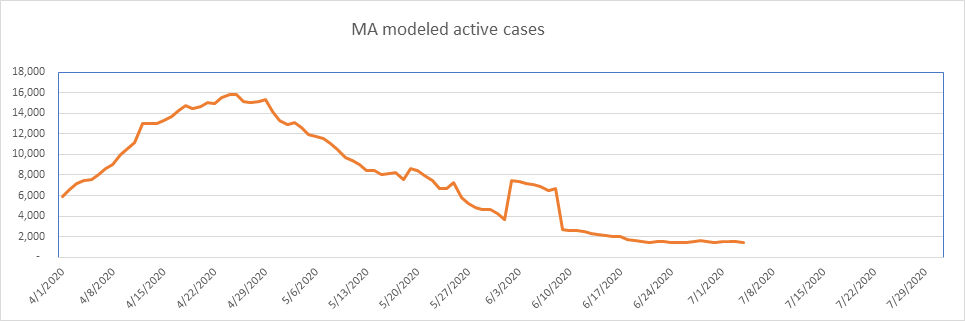
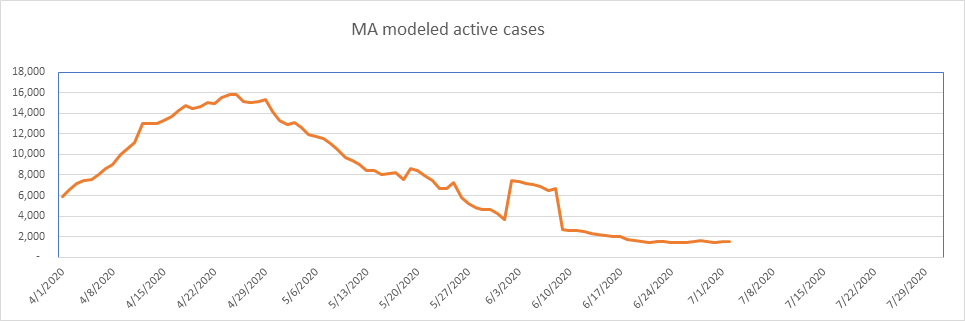
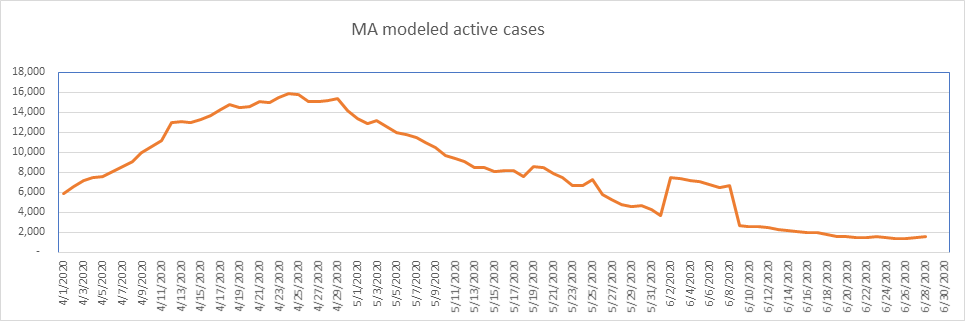
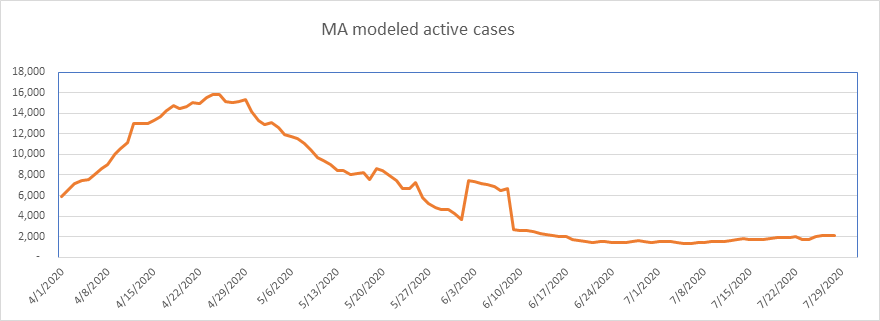
Massachusetts has exhibited a slight upward drift for the better part of July, but it’s very slight.
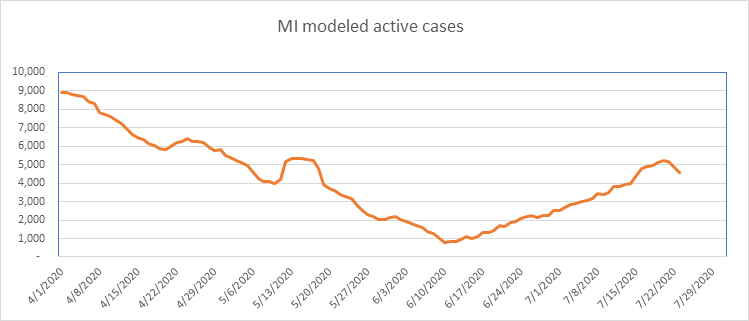
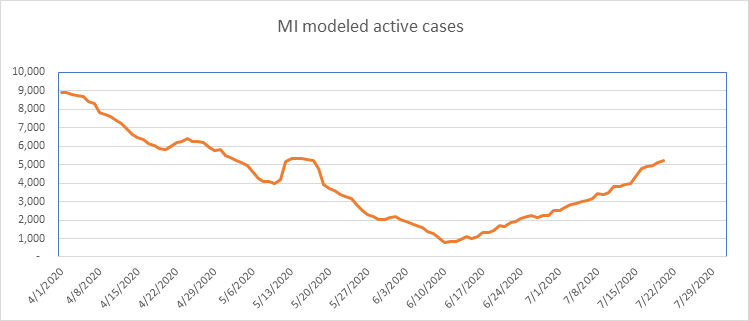
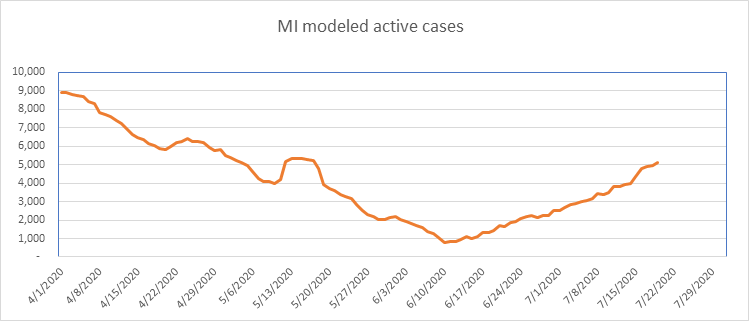
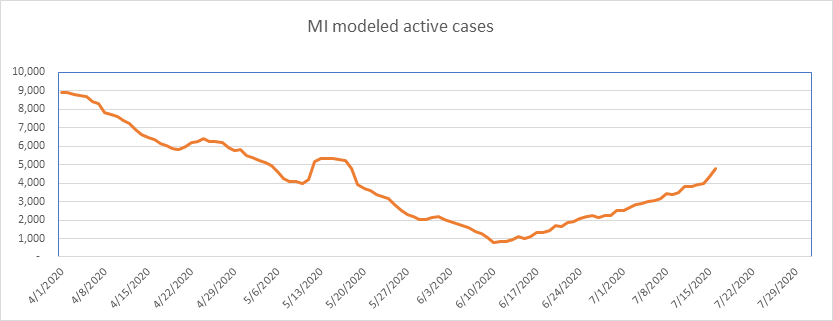
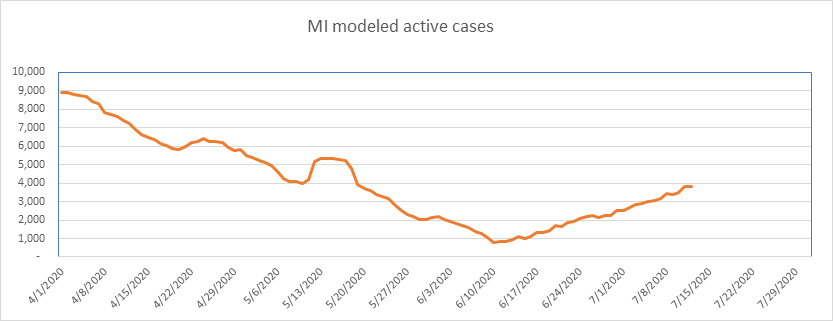
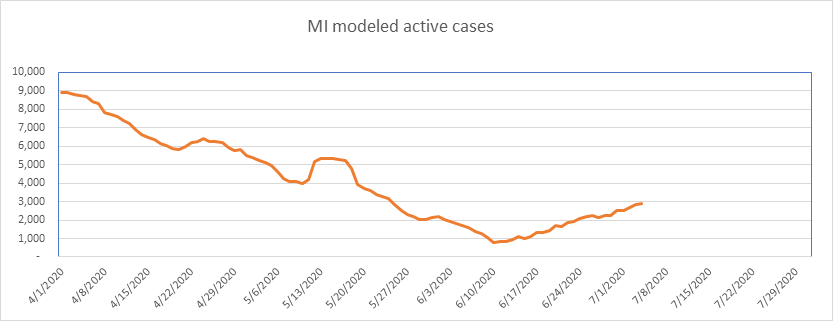
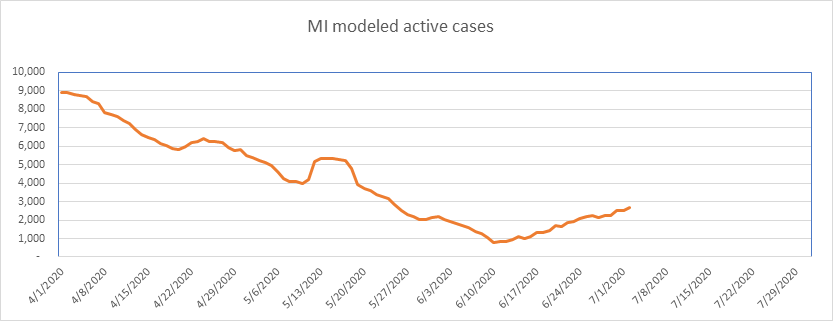
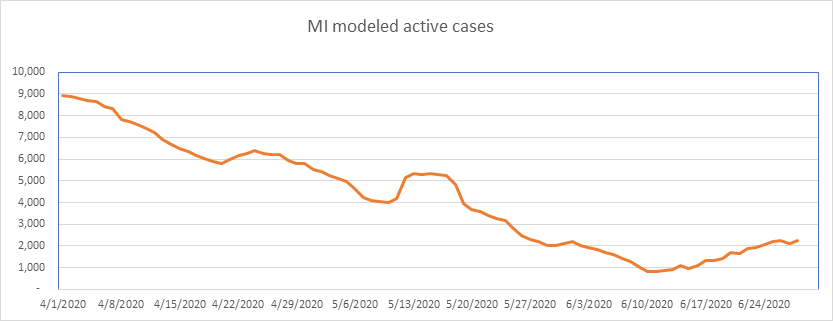
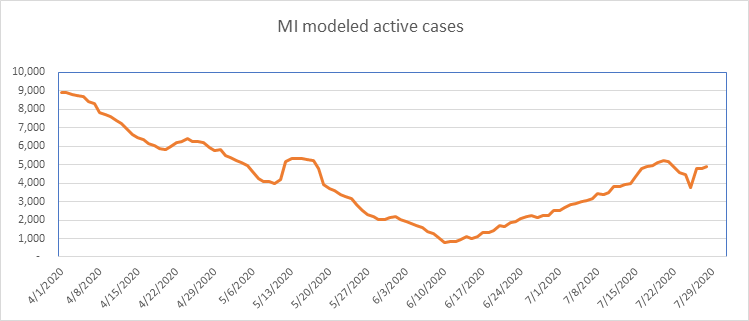
…And here is Michigan. Looking beautiful until June 10th, then beginning a steady upward drift. Michigan peaked at a low percentage of population (0.089%), so may continue to grow if my theory is correct. It is just one of several states that peaked early and low, and doesn’t seem to be done with COVID yet. Nonetheless, we’re down from a week ago, which is welcome news.
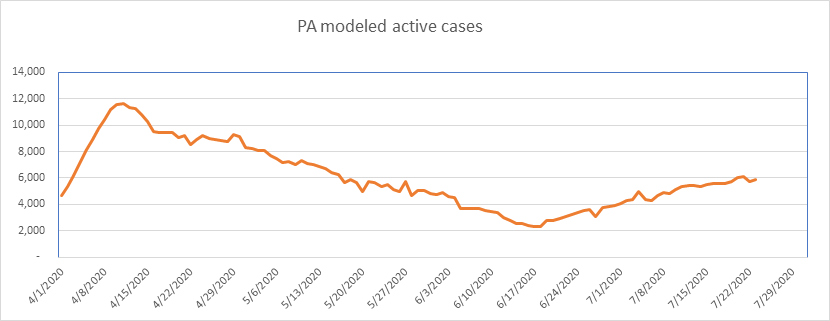
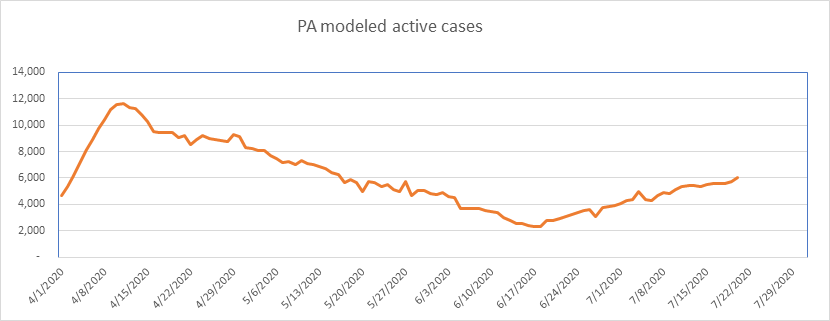
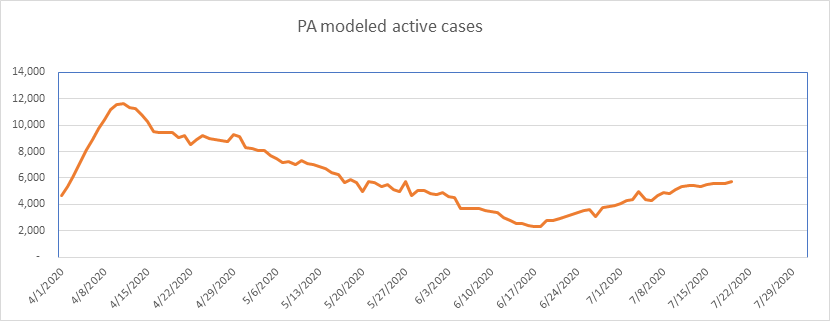
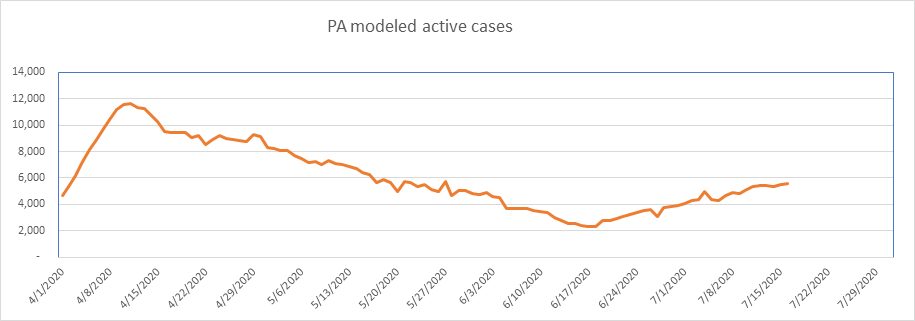
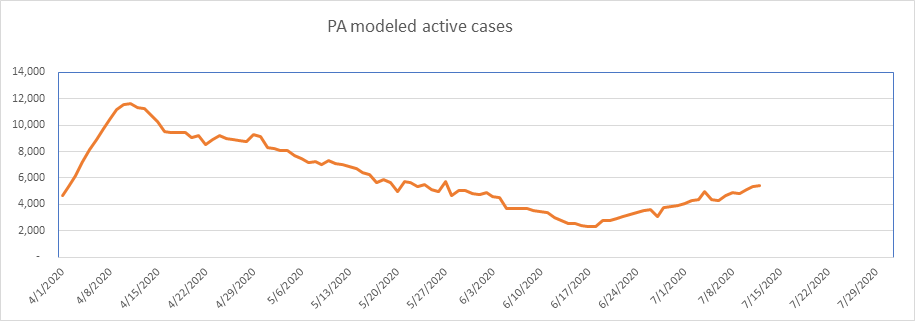
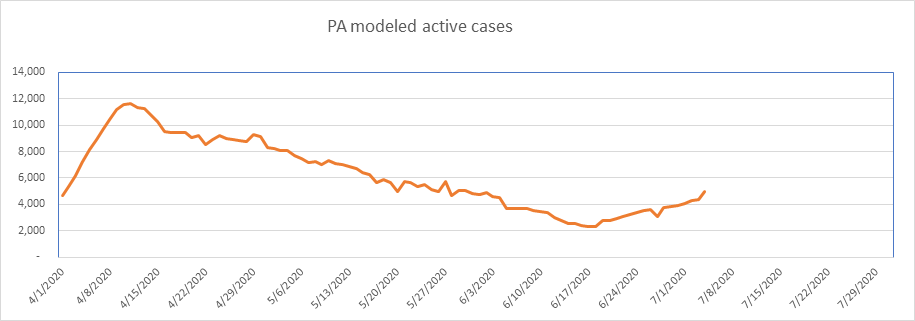
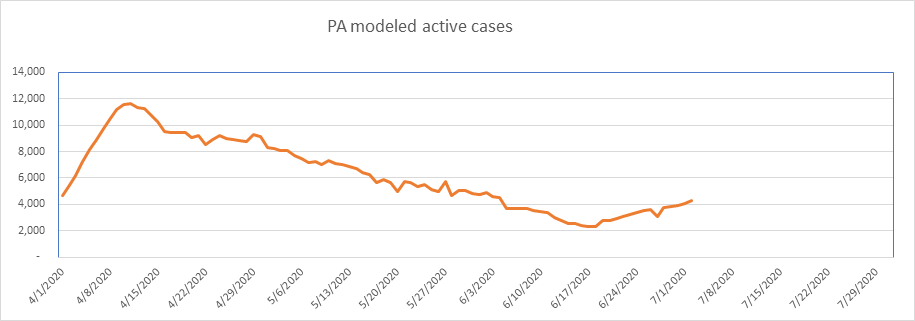
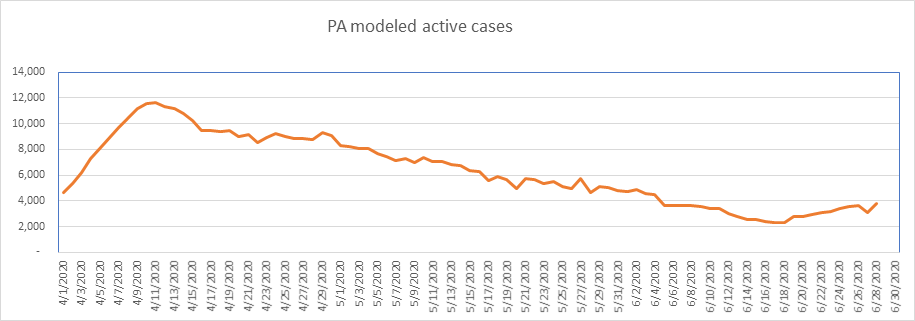
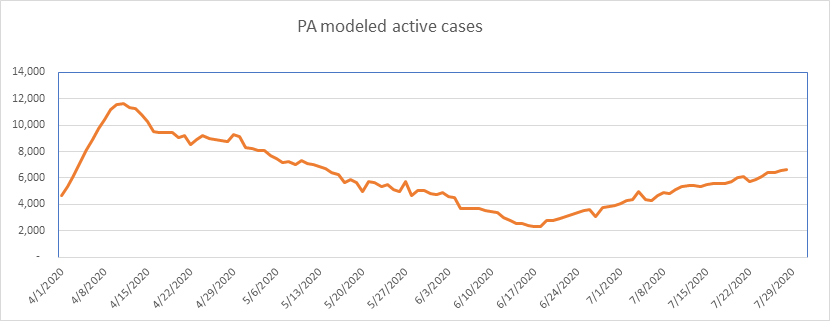
PA looks like Michigan, so the same comments apply. Like MI, PA peaked at a very low population percentage (0.091%), so my expectation is that it will continue to grow.
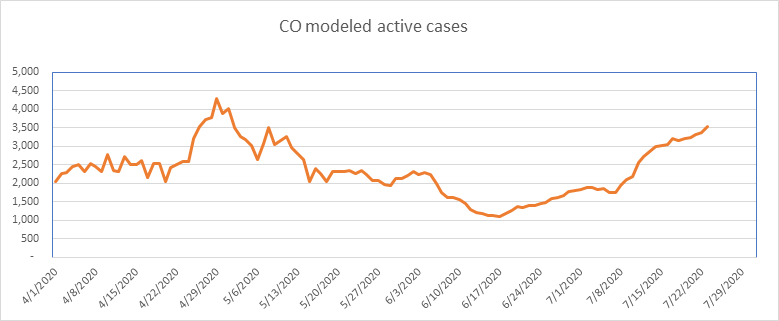
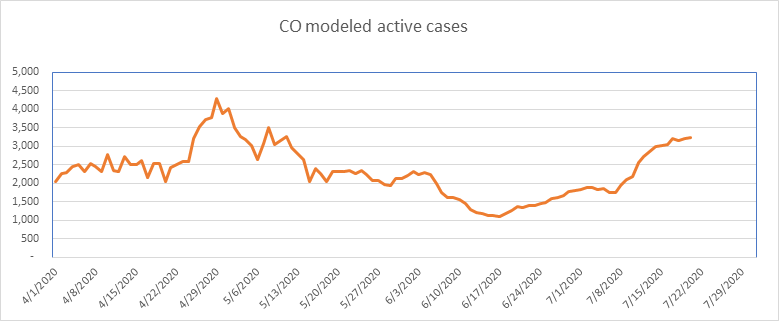
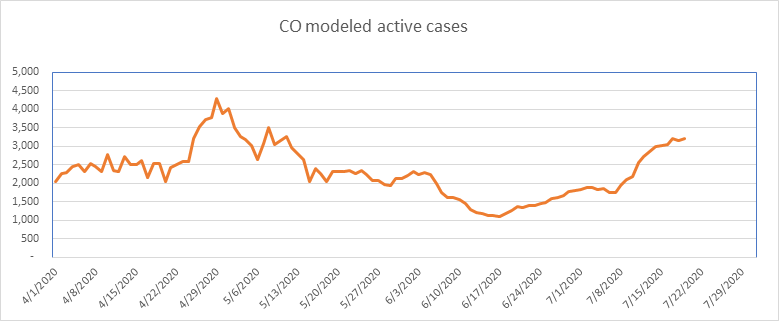
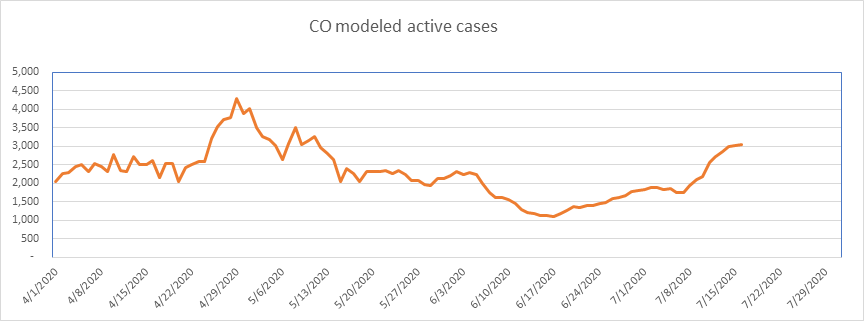
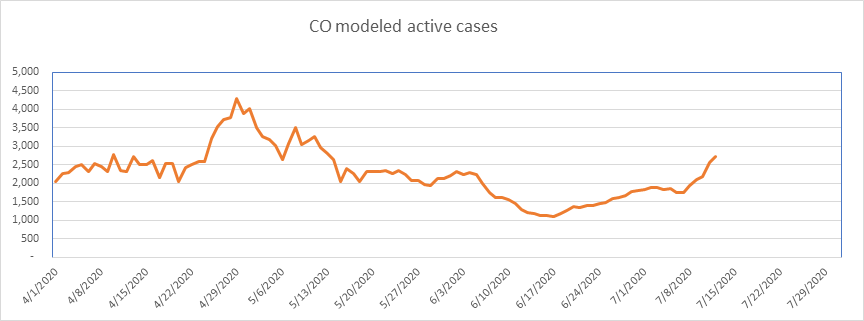
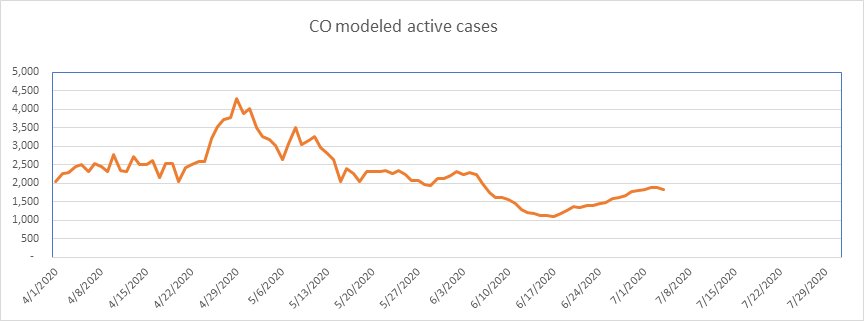
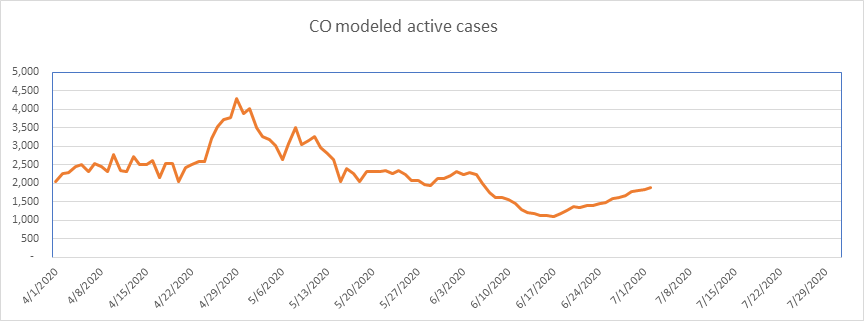
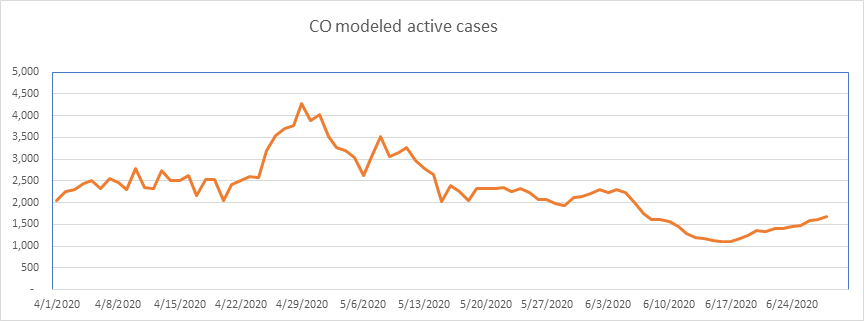
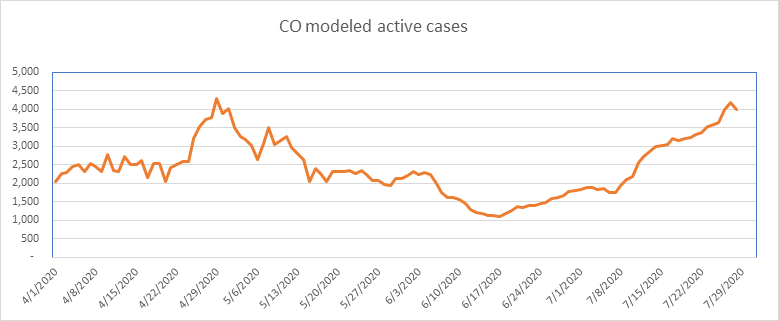
And finally, here is Colorado. Colorado is one of the states that has had aberrations in their data. I still report it, but I’ve shied away from any conclusions in this state due to the data irregularities. Very small numbers here. Colorado peaked at a very small percentage, so could peak again as well. It’s pretty close to a new high lately.
So that’s it for today. I’ll report again on Saturday or Sunday.

The numbers are still very small as a percentage of the population. Unless you’re in a high-density area, your chances of contracting COVID are very small. However, even though the probability is very small, that doesn’t help if you’re the one catching it. Everyone please continue to be as cautious as you feel necessary.

–Shane Chalke, FSA
Categories
COVID Archives

Concerned about California, but everything else better…

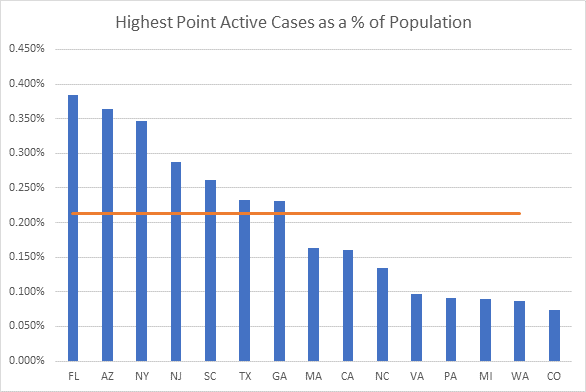
The acceleration of cases, which began around June 10th, is now leveling off, and this new peak has arrived with far fewer fatalities than the initial active case peak of April 12. Of the 15 states that I track, only California and Colorado are growing.

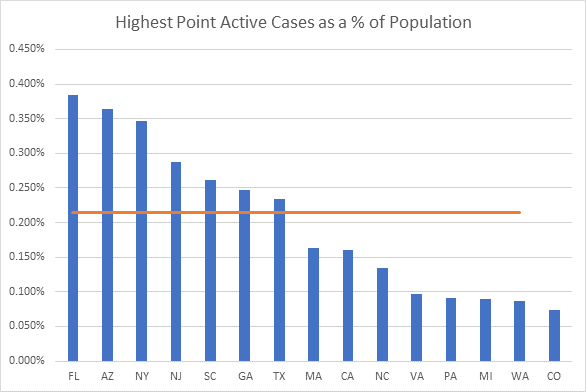
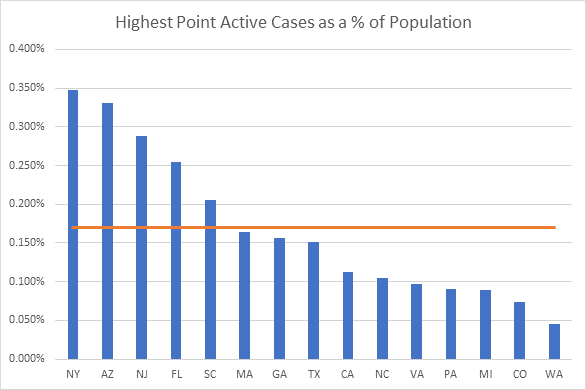
Here is the peak active case count to date for the states I monitor:

All states on this chart are in decline or plateau other than CA and CO. I still believe the states on the right side will still see some growth, as they peaked so far below the average. Florida, which set a record for known active cases at 0.38% of the population, looks like it peaked on July 17th, and is already down 11% since then. Arizona, the most serious hotspot of early July, peaked on July 6, and is now down an amazing 32% since the peak. California is the most serious state that I track now, but I think it could have more to run, as the current active case count is only 0.18% of the population.

As always, feel free to send me your questions about my assumptions, methodology, or modeling in general.

  • Likely date of active case peak (Chalke modeling): July 24
  • Likely date of peak deaths (IHME): April 16 (last revision on July 22)
  • Total Test Results reported today: 774,193 (very high)
  • Total Pending tests reported today: 3,179 (extremely low)
  • National reported case Growth Rate today: 1.80% (low)

Shane Chalke Interviews

https://www.fredericksburg.com/opinion/editorial-unlock-demographically-not-geographically/article_a62e6e70-dccd-51cf-b7b2-16d77a90fd9c.html

Website

Groom Ventures has agreed to host a website that will archive my daily reports, and supplement with other commentary. John Groom worked at one of my companies back in the day, and is an excellent writer. The website is: www.howmuchrisk.com For those of you that post my daily report on Facebook, let me suggest you link to this site, as the direct Facebook posts don’t seem to copy the graphs.

Daily Analysis

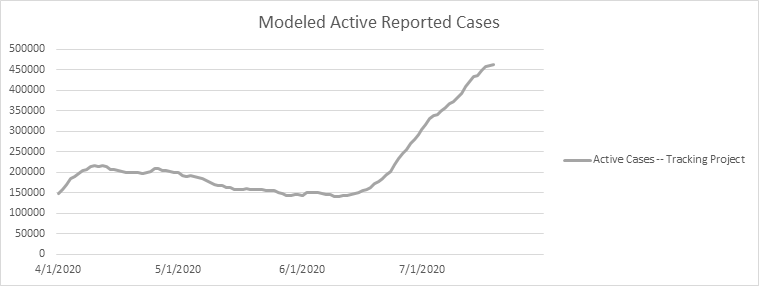
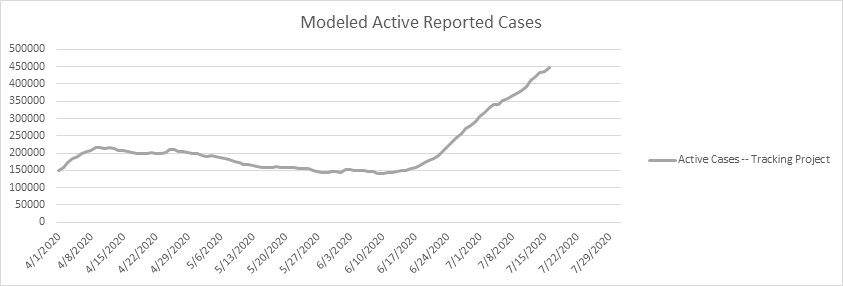
Here is the national picture of active cases – I’m modeling about 468,000 known active cases. We’ve seen a definitive slowing over the past 6 days. I don’t know if this plateau is going to form a peak – I think it depends on what happens in California.

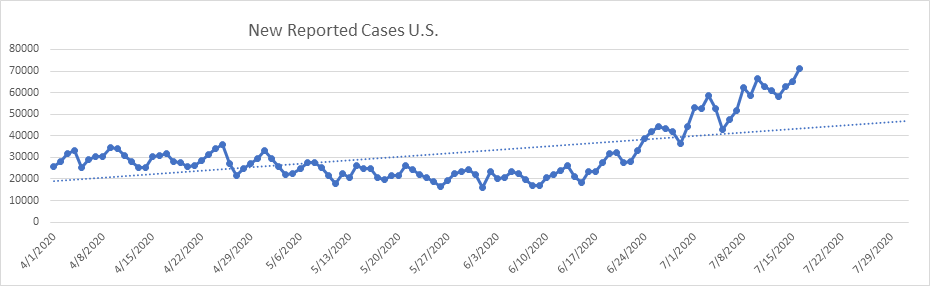
Here are the new reported cases nationally – You can see the trajectory slowing over the past 2 weeks. I believe what scares people the most is the “not knowing” – when you see new records being set every day it’s frightening. We’re past that now with a growth rate solidly below 2% — this is nothing like April.

As I’ve been predicting, we’re seeing a gradual rise in the daily death count. The rise in deaths is small in proportion to the rise in cases. We’ve seen the new daily death count go from about 600 to 1,000, while the daily new case count rose from about 20,000 to 70,000. Many on the news have talked about the lengthy time between case growth and death count, so I examined a few states that are well past peak to see how that worked out.

New York hit peak active cases on April 10th, the same day they hit peak daily deaths. Massachusetts peaked with active cases on April 25th, and peak daily deaths happened on day later on April 26th. Pennsylvania had the longest lag time – peak cases on April 11, and peak daily deaths on May 1, almost 3 weeks later. I’m thinking that IF we are cresting with active cases now, then we’ll see peak daily deaths in 10-15 days, somewhere between August 3 and August 8. The latest IHME model is projecting a new crest in daily deaths on August 13th, at just under 1,000, and far less than the peak on April 16, where we were seeing over 2,300 deaths per day. There are a number of reasons for this (see discussion at the very bottom of this report). Primary, though, is societal behavior. Seniors and those with health problems are exhibiting social distancing, quarantine, and other precautionary measures, while the disease spreads among a younger demographic, with a much lower mortality rate. We know that the mortality rate for pre-retirees without serious pre-existing conditions is very near zero.

On to the states.

Arizona is starting to look a lot like NY or MA, with a rapid decline from the peak. This state is down an amazing 32% from the peak just 16 days ago.

Here is SC, now 6 days past peak. SC Peaked at 0.26% of the population, so I suspect this peak will hold. Note that South Carolina double counts cases, as they treat each positive test as a new case (per The COVID Tracking Project).

Here is Florida – my wife says I’m cocky for pointing out that I predicted this last week. For that, I apologize, but we should all breathe a sigh of relief looking at this graph. It may not be over, but it sure is propagating at a snail’s pace compared to late June.

California slows down and speeds up from day to day. California today sits at 0.18% of the population, so I’m afraid it has more to come. I think CA will approach 100,000 known active cases before it turns. As always, I need to report that California is one of the states that counts tests rather than people.

Georgia has been slowing for over 2 weeks, and is now flat for 4 days. Is this the top for Georgia? I don’t know. Georgia only hit a high of 0.23% of the population, so could have more growth to come. Here again, the case numbers are exaggerated. Georgia counts each positive test as a case (according to The COVID Tracking Project).

Texas has seen almost zero growth for 5 days now. If Texas is peaking, it’s only at 0.23% of the population, so my confidence that we’ve seen the top here is not very high. Texas also reports positive tests as cases, so is doing some level of double counting.

NC is looking pretty good for over a week now, but if this is the peak, it’s at a very low level (0.14%). We’re scheduled to remain in Phase 2 until August 7th, but I’m thinking the case and death numbers are such that we’ll move to Phase 3 then. IHME is projecting peak daily deaths in NC in the first few days of August. It’s interesting how NC and VA now move together.

Here is the daily death report for NC. I’m detecting a slight upward bias lately, but the data is erratic, so it’s hard to tell so far. This is a good case study, as NC has had active cases increasing monotonically for over 3 months, but little change in the daily death count. NC extended Phase 2 until August 7th. I think we’ll actually go to Phase 3 this time if this pattern persists.

Washington could have peaked, but I’m skeptical, as the high water mark you see here is at just 0.087% of the population.

Nothing to say about NY and NJ – the picture says it all.

Massachusetts has exhibited a slight upward drift for a week now, but it’s very slight. We need to watch this. For some reason, MA didn’t report today by the 4:00pm data collection deadline.

…And here is Michigan. Looking beautiful until June 10th, then beginning a steady upward drift. Michigan peaked at a low percentage of population (0.089%), so may continue to grow if my theory is correct. It is just one of several states that peaked early and low, and doesn’t seem to be done with COVID yet. Nonetheless, we see a decline over the past two days, which is welcome news.

PA looks like Michigan, so the same comments apply. Like MI, PA has slowed for a few days now.

And finally, here is Colorado. Colorado is one of the states that has had aberrations in their data. I still report it, but I’ve shied away from any conclusions in this state due to the data irregularities. Very small numbers here. Colorado peaked at a very small percentage, so could peak again as well.

So that’s it for today. I’ll report again next Tuesday, or possibly Saturday if something interesting happens.

The numbers are still very small as a percentage of the population. Unless you’re in a high density area, your chances of contracting COVID are very small. However, even though the probability is very small, that doesn’t help if you’re the one catching it. Everyone please continue to be as cautious as you feel necessary.

–Shane Chalke, FSA
Categories
COVID Archives

Looking better nationally

I wasn’t going to report so soon, but things are looking better, and I can’t report again until the end of the week, so here goes…

Known active cases nationally continue to slow, with today’s growth rate the slowest in 15 days (1.5%). Of the 6 watch states only Georgia continues to increase, and I expect that to change soon.

Here is the peak active case count to date for the states I monitor:

In general, the states on the left side of the chart are slowing or in decline, and the states on the right side of the chart are still growing. I suspect this graph will level out over time, with all states ending up somewhere in the ¼ to ½ of one percent range.

As always, feel free to send me your questions about my assumptions, methodology, or modeling in general.

  • Likely date of active case peak (Chalke modeling): July 24
  • Likely date of peak deaths (IHME): April 16 (last revision on July 14)
  • Total Test Results reported today: 735,197 (very high)
  • Total Pending tests reported today: 3,003 (extremely low)
  • National reported case Growth Rate today: 1.54% (low)

Shane Chalke Interviews

https://www.fredericksburg.com/opinion/editorial-unlock-demographically-not-geographically/article_a62e6e70-dccd-51cf-b7b2-16d77a90fd9c.html

Website

Groom Ventures has agreed to host a website that will archive my daily reports, and supplement with other commentary. John Groom worked at one of my companies back in the day, and is an excellent writer. The website is: www.howmuchrisk.com For those of you that post my daily report on Facebook, let me suggest you link to this site, as the direct Facebook posts don’t seem to copy the graphs.

Daily Analysis

Here is the national picture of active cases – I’m modeling about 464,000 known active cases. This is our first day of decline in a very long time, and is good to see.

Here are the new reported cases nationally – We’ve now seen a 3 day decline, but we need an entire weekly pattern to draw any conclusions. The positivity rate continues to fall, now down to 7.9%.

Despite the increase in active known cases, we’re seeing only a mild increase in daily deaths, or maybe even flat. We’ll know in a few more days. I pinned my theory about this to the bottom of the page in case you want to reference it. I continue to believe that this is primarily explained by demographics. I’ve long been a proponent of protecting those potentially most affected by the disease, and letting others make their own decisions about daily life, as the mortality rate among pre-retirees is so very low. I believe this is exactly what is happening in society right now. Seniors and those with health problems are exhibiting social distancing, quarantine, and other precautionary measures, while the disease spreads among a younger demographic, with a much lower mortality rate.

On to the states.

Arizona continues to decline, having peaked on July 6. Arizona was at my hypothesized population ceiling, so I think this trend will continue. In fact, I think Arizona is in for some strong declines in the next few days as we emerge from the bubble. Arizona dominated the news 2 weeks ago – this should be big news.

Here is SC, now relatively flat for 6 days. Note that South Carolina double counts cases, as they treat each positive test as a new case (per The Covid Tracking Project). Nonetheless, it’s nice to see it leveling off.

Last week I said “I believe that Florida doesn’t have much more growth to go – in a week I’ll remind you I said that, and I’ll look smart, or maybe not.” Well, here we are. I get to be smart at least once.

California continues to slow, and we even have a decline today. I’m far less confident about California, since it sits at about 0.15% of the population, which is quite low. As always, I need to report that California is one of the states that counts tests rather than people.

We have a down day in Georgia today, but one day isn’t meaningful. Georgia only hit a high of 0.23% of the population, so could have more growth to come. Here again, the case numbers are exaggerated. Georgia counts each positive test as a case (according to The COVID Tracking Project).


Texas has been flat for 3 days now. If Texas is peaking, it’s only at 0.23% of the population, so my confidence that we’ve seen the top here is low. Texas also reports positive tests as cases, so is doing some level of double counting.

The news in NC is good today. We’re scheduled to remain in Phase 2 until August 7th, but I’m thinking the case and death numbers are such that we’ll move to Phase 3 then.

Here is the daily death report for NC, with no discernable upward trend yet. This is a good case study, as NC has had active cases increasing monotonically for over 3 months, but little change in the daily death count. NC extended Phase 2 until August 7th. I think we’ll actually go to Phase 3 this time if this pattern persists.

Washington has been erratic over the past week. The active case high water mark is at just 0.87% of the population, so it wouldn’t surprise me if it keeps growing.

Nothing to say about NY and NJ – the picture says it all. Significant decline again in NJ today, but it’s hard to see on this graph, as the residual numbers are so small. I model that NJ has just about 1,400 known active cases remaining.

Massachusetts has exhibited a slight upward drift for a week now, but it’s very slight. We need to watch this.

…And here is Michigan. Looking beautiful until June 10th, then beginning a steady upward drift. Michigan peaked at a low percentage of population (0.089%), so may continue to grow if my theory is correct. It is just one of several states that peaked early and low, and doesn’t seem to be done with COVID yet.

PA looks like Michigan, so the same comments apply.

And finally, here is Colorado. Colorado is one of the states that has had aberrations in their data. I still report it, but I’ve shied away from any conclusions in this state due to the data irregularities. Very small numbers here. Colorado peaked at a very small percentage, so could peak again as well. However, we see further signs of a slowdown.

So that’s it for today. I’ll report again on Thursday or Friday.

The numbers are still very small as a percentage of the population. Unless you’re in a high density area, your chances of contracting COVID are very small. However, even though the probability is very small, that doesn’t help if you’re the one catching it. Everyone please continue to be as cautious as you feel necessary.

–Shane Chalke, FSA
Categories
COVID Archives

Only Georgia remains on the watch list

It’s been three days since I reported last. Known active cases nationally are showing signs of slowing, today’s growth rate the slowest in two weeks (1.7%). A lot of this is the turnaround of our 6 watch states, which are looking dramatically better. Arizona peaked on April 6th, now 13 days ago. Texas, South Carolina, and Florida have shown recent peaks, which may or may not hold up, but still a far cry from rapid growth. California is gradually slowing down, and the only state on this list without a reversal of fortune is Georgia, which shows no signs of slowdown yet.

Here is the peak active case count to date for the states I monitor:

ALL of the 6 states on the left side the chart (FL, AZ, NY, NJ, SC, TX) have either peaked or slowed. ALL of the states on the right side of the chart are growing (CO, WA, MI, PA, VA). This supports my theory that the disease reaches a population ceiling with respect to known active cases and then declines. I think this ceiling is between 0.25 and 0.5 percent of the population. (Make sure to read about Florida below for a comparison of Miami to the rest of the state.)

Repeat from last Thursday——-

We continue to see deaths growing at a fraction of the case growth. You’ll read a lot about deaths being a lagging indicator, and although true, the propagation of the disease is skewing younger, so the fatalities are not increasing with the case count. We are now seeing a mild upward trend in daily deaths, but small in proportion to the increased case count. (In fact, the latest revision of the IHME model projects that daily deaths do not go above 1,000 again.) I believe this is because:

  • We’re testing people who are less ill as the testing protocol widens, so the survival rate is higher
  • We are getting better at keeping those that are hospitalized alive
  • The scope of testing is still expanding generally, so the increase in cases is not representative of a like increase in prevalence
  • Younger people are a larger percentage of those newly infected, and their mortality rate is close to nil, so very few show up in the fatality stats
  • Double counting of cases is increasing, including antigen and antibody tests, as well as PCR tests – we know that AZ, CA, TX, and SC double count cases (per the COVID Tracking Project)

As always, feel free to send me your questions about my assumptions, methodology, or modeling in general.

  • Likely date of active case peak (Chalke modeling): July 24
  • Likely date of peak deaths (IHME): April 16 (last revision on July 14)
  • Total Test Results reported today: 768,823 (very high)
  • Total Pending tests reported today: 3,052 (extremely low)
  • National reported case Growth Rate today: 1.73% (low)

Shane Chalke Interviews

https://www.fredericksburg.com/opinion/editorial-unlock-demographically-not-geographically/article_a62e6e70-dccd-51cf-b7b2-16d77a90fd9c.html

Website

Groom Ventures has agreed to host a website that will archive my daily reports, and supplement with other commentary. John Groom worked at one of my companies back in the day, and is an excellent writer. The website is: www.howmuchrisk.com For those of you that post my daily report on Facebook, let me suggest you link to this site, as the direct Facebook posts don’t seem to copy the graphs.

Daily Analysis

Here is the national picture of active cases – I’m modeling about 464,000 known active cases. You can see the very beginning of a national slowdown here, driven by improvements in our 6 watch states.

Here are the new reported cases nationally – steady growth. The positivity rate is starting to fall again, now down into the 8% range. With nearly 46 million tests reported, I’m guessing that at least one out of every 10 people in the U.S. has had a COVID test.

Despite the increase in active known cases, we’re seeing only a mild increase in daily deaths. I continue to believe that this is primarily explained by demographics. I’ve long been a proponent of protecting those potentially most affected by the disease, and letting others make their own decisions about daily life, as the mortality rate among pre-retirees is so very low. I believe this is exactly what is happening in society right now. Seniors and those with health problems are exhibiting social distancing, quarantine, and other precautionary measures, while the disease spreads among a younger demographic, with a much lower mortality rate.

On to the states.

Arizona continues to decline, having peaked 13 days ago. Arizona was at my hypothesized population ceiling, so I think this trend will continue. Arizona dominated the news 2 weeks ago – why isn’t this news?

Here is SC, moving a little slower now. Note that South Carolina double counts cases, as they treat each positive test as a new case (per The COVID Tracking Project). Nonetheless, it’s nice to see it start leveling off.

A few days ago I said “I believe that Florida doesn’t have much more growth to go – in a week I’ll remind you I said that, and I’ll look smart, or maybe not.” I do think it’s happening now. In fact, I’ve been puzzled by Miami. Reported cumulative cases are now at 1 out of every 34 people, so I couldn’t figure out how it could still be growing. So I put the Miami numbers through my model, and… guess what – it’s not growing (or barely growing, depending on your timeframe)! I do think that Miami has hit the population ceiling for active cases, and is the leading indicator for Florida – I believe it will improve from here.

California has definitely slowed, but sits at only 0.16% of the population, so that worries me a bit. California may not be turning for a bit yet. As always, I need to report that California is one of the states that counts tests rather than people.

Georgia continues a steady growth rate, and sits at 0.23% of the population, so could have more growth to come. Here again, the case numbers are exaggerated. Georgia counts each positive test as a case (according to The COVID Tracking Project).

I like the news from Texas since I reported last. If Texas is peaking, it’s only at 0.23% of the population, so my confidence that we’ve seen the top here is low. Texas also reports positive tests as cases, so is doing some level of double counting.

We’ve been seeing NC and VA move in parallel for a while now. Both are low percentages of the population, so no predictions yet.

Here is the daily death report for NC, with no discernable upward trend yet. This is a good case study, as NC has had active cases increasing monotonically for over 3 months, but little change in the daily death count. NC extended Phase 2 until August 7th. I think we’ll actually go to Phase 3 this time if this pattern persists.

Washington has been erratic over the past week. Active cases are at just 0.87% of the population, so it wouldn’t surprise me if it keeps growing.

Nothing to say about NY and NJ – the picture says it all. Significant decline in NJ today, but it’s hard to see on this graph, as the residual numbers are so small.

Massachusetts has exhibited a slight upward drift for a week now. We need to watch this, but the numbers are small for the population of the state.

…And here is Michigan. Looking beautiful until June 10th, then beginning a steady upward drift. Michigan peaked at a low percentage of population (0.089%), so may continue to grow if my theory is correct.

PA is showing signs of a slowdown, but the peak was very low, so I won’t be surprised by further growth.

And finally, here is Colorado. Colorado is one of the states that has had aberrations in their data. I still report it, but I’ve shied away from any conclusions in this state due to the data irregularities. Very small numbers here. Colorado peaked at a very small percentage, so could peak again as well. Here we see some signs of a slowdown.

So that’s it for today. I’ll report again on Sunday or Monday, perhaps earlier if something interesting happens.

The numbers are very small as a percentage of the population. Unless you’re in a high density area, your chances of contracting COVID are very small. However, even though the probability is very small, that doesn’t help if you’re the one catching it. Everyone please continue to be as cautious as you feel necessary.

–Shane Chalke, FSA
Categories
COVID Archives

Arizona now 10 days past peak

It’s been four days since I reported last. Known active cases nationally continue to grow in the 2% range, with daily deaths showing a slight rise over the past week. Of our 6 watch states, Arizona looks to have peaked on July 6th. CA and TX may have peaked, but we’ll give it another week to be sure. SC is slowing a bit, but Florida and Georgia remain problematic. With 4 out of 6 watch states doing so much better, I’m going to stop reporting on them as a group, as it doesn’t inform us any longer.

Do you remember 2 weeks ago when Arizona was the worst thing happening in the United States? Well, look at this:

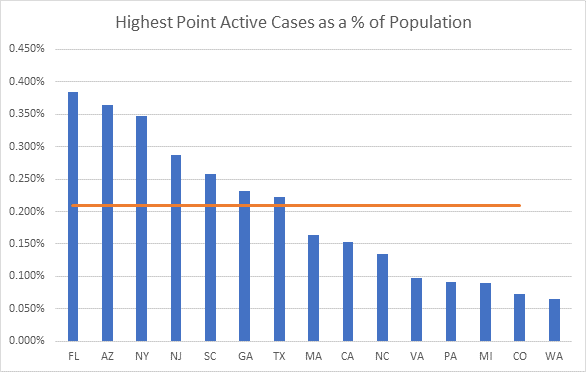
If this peak holds, the AZ will have peaked at 0.37% of the population, just a bit above NY. They are experiencing dramatically fewer deaths per capita than NY, thankfully. Here is the total picture as a percent of the population:

Of the states on the left side of the chart, the ones that have peaked or shown recent peaks are AZ, NY, NJ, TX, MA, and CA. The outlier here is Florida, which has set a record for known active cases as a percent of the population (0.38%) and also shows no signs of slowdown yet. I continue to believe that this disease hits a relatively small population ceiling (between ¼ and ½ of one percent of the population), and then declines. If my theory is correct, then we should see a slowdown in Florida shortly.

We continue to see deaths growing at a fraction of the case growth. You’ll read a lot about deaths being a lagging indicator, and although true, the propagation of the disease is skewing younger, so the fatalities are not increasing with the case count. We are now seeing a mild upward trend in daily deaths, but small in proportion to the increased case count. (In fact, the latest revision of the IHME model projects that daily deaths do not go above 1,000 again.) I believe this is because:

  • We’re testing people who are less ill as the testing protocol widens, so the survival rate is higher
  • We are getting better at keeping those that are hospitalized alive
  • The scope of testing is still expanding generally, so the increase in cases is not representative of a like increase in prevalence
  • Younger people are a larger percentage of those newly infected, and their mortality rate is close to nil, so very few show up in the fatality stats
  • Double counting of cases is increasing, including antigen and antibody tests, as well as PCR tests – we know that AZ, CA, TX, and SC double count cases (per the COVID Tracking Project)

As always, feel free to send me your questions about my assumptions, methodology, or modeling in general.

  • Likely date of active case peak (Chalke modeling): N/A (no peak yet)
  • Likely date of peak deaths (IHME): April 16 (last revision on July 14)
  • Total Test Results reported today: 831,918 (a new record)
  • Total Pending tests reported today: 2,929 (extremely low)
  • National reported case Growth Rate today: 2.05% (low)

Shane Chalke Interviews

https://www.fredericksburg.com/opinion/editorial-unlock-demographically-not-geographically/article_a62e6e70-dccd-51cf-b7b2-16d77a90fd9c.html

Website

Groom Ventures has agreed to host a website that will archive my daily reports, and supplement with other commentary. John Groom worked at one of my companies back in the day, and is an excellent writer. The website is: www.howmuchrisk.com For those of you that post my daily report on Facebook, let me suggest you link to this site, as the direct Facebook posts don’t seem to copy the graphs.

Daily Analysis

Here is the national picture of active cases – I’m modeling about 448,000 known active cases.

Here are the new reported cases nationally – steady growth. We set a record today of just over 71,000 new cases. We also set a record today of about 832,000 tests reported. With over 43 million tests reported, I’m guessing that at least one out of every 10 people in the U.S. has had a COVID test.

Despite the increase in active known cases, we’re seeing only a mild increase in daily deaths. I continue to believe that this is primarily explained by demographics. I’ve long been a proponent of protecting those potentially most affected by the disease, and letting others make their own decisions about daily life, as the mortality rate among pre-retirees is so very low. I believe this is exactly what is happening in society right now. Seniors and those with health problems are exhibiting social distancing, quarantine, and other precautionary measures, while the disease spreads among a younger demographic, with a much lower mortality rate.

On to the states.

Arizona is looking far better than last week. I like this pattern – if this peak holds, it will be just a bit higher than NY.

Here is SC, moving a little slower now. Note that South Carolina double counts cases, as they treat each positive test as a new case (per The COVID Tracking Project).

Florida’s growth rate has been hovering around 4%, which is down from about 7% three weeks ago, but still growing uncomfortably fast. I believe that Florida doesn’t have much more growth to go – in a week I’ll remind you I said that, and I’ll look smart, or maybe not.

California has definitely slowed, but sits at only 0.15% of the population, so that worries me a bit. As always, I need to report that California is one of the states that counts tests rather than people.

Georgia continues a steady growth rate, and sits at 0.23% of the population, so could have more growth to come. Here again, the case numbers are exaggerated. Georgia counts each positive test as a case (according to The COVID Tracking Project).

I like the news from Texas since I reported last. If Texas is peaking, it’s only at 0.22% of the population, so my confidence that we’ve seen the top here is low. Texas also reports positive tests as cases, so is doing some level of double counting, but not enough to explain this growth.

We’re now seeing NC and VA grow in lockstep. Both are low percentages of the population, so no predictions yet.

Here is the daily death report for NC, with a possible recent upward trend, but it’s hard to tell. NC has an erratic pattern of daily deaths, as you can see, so we need more of a trend to interpret it. This is a good case study, as NC has had active cases increasing almost monotonically for over 3 months, but little change in the daily death count. NC extended Phase 2 until August 7th. I think we’ll actually go to Phase 3 this time.

Washington has been erratic over the past week. Active cases are the smallest per capita of all the states I track, so it wouldn’t surprise me if it keeps growing.

Nothing to say about NY and NJ – the picture says it all. The decline in both states seems to have stopped, and active cases have stabilized at a low level.

Massachusetts looks great. Cases have been stable for some time in the 1,500 range, quite small for the size of the state.

…And here is Michigan. Looking beautiful until June 10th, then beginning a steady. Michigan peaked at a low percentage of population (0.089%), so could peak again if my theory is right.

PA is showing signs of a slowdown, but the peak was very low, so I won’t be surprised by further growth.

And finally, here is Colorado. Colorado is one of the states that has had aberrations in their data. I still report it, but I’ve shied away from any conclusions in this state due to the data irregularities. Very small numbers here. Colorado peaked at a very small percentage, so could peak again as well.

So that’s it for today. I’ll report again on Sunday or Monday, perhaps earlier if something interesting happens.

The numbers are very small as a percentage of the population. Unless you’re in a high density area, your chances of contracting COVID are very small. However, even though the probability is very small, that doesn’t help if you’re the one catching it. Everyone please continue to be as cautious as you feel necessary.

–Shane Chalke, FSA
Categories
COVID Archives

Arizona and South Carolina looking much better…

It’s been over a week since I reported last. Known active cases nationally continue to grow in the sub 2% range, with daily deaths showing a slight rise over the past week. Of our 6 watch states, Arizona has been in decline for about a week, and may have peaked. Georgia is slowing, as is Florida (expect for today). South Carolina has been flat for a week, and may be peaking now. Texas and California concern me the most, as they show no signs of cresting yet.

I continue to believe that this disease hits a relatively small population ceiling, and then declines. I’ve seen more and more supporting this. The latest was sent to me today from one of the doctors on this list: https://www.inverse.com/science/coronavirus-could-it-be-burning-out-after-20-of-a-population-is-infected This article speculates that the ceiling is about 20% of the population. This is measured on a cumulative basis, and I think there might be something to it. NY, for example, has seen a bit over 400,000 documented cases, or about 2% of the population. It’s not unreasonable to assume that 10 times as many people have had the disease than the number documented. At the end of April, the random antibody testing study in NY found in excess of 15% of those tested had the disease. Back at that time NY state had recorded about 300,000 cases, or about 1.6% of the population, so aggregate prevalence was about 10x.

Let’s look at where we are today with known active cases as a percent of the population.

z

We now see Arizona just above the peak in NY, with Arizona possibly past peak, or at the very least dramatically slowed. We also see Florida in that ballpark. Georgia and South Carolina are around the average peak, and are slowing and flat, respectively. I’m obviously using a different metric than in the above article. I’m measuring concurrent known infections (which I derive from modeling — it’s a stat that is not reported anywhere), and I believe the natural ceiling is between ¼ and ½ of 1 percent (0.0025 to 0.005).

We also continue to see deaths growing at a fraction of the case growth. You’ll read a lot about deaths being a lagging indicator, and although true, the propagation of the disease is skewing younger, so the fatalities are not increasing with the case count. Arizona is having a very different experience than NY. Arizona is now at a higher known prevalence than NY at its peak, but NY has had 24,979 deaths, and Arizona 2,237. That’s one death in NY per every 779 people, and one death in Arizona for every 3,263 people. Of course, Arizona will experience more deaths over the next month, while daily deaths are very low in NY, but even anticipating this, Arizona is having a much better experience than NY.

I believe that we will see an increase in daily deaths, but small in proportion to the increased case count. This is because:

  1. We’re testing people who are less ill as the testing protocol widens, so the survival rate is higher
  2. The scope of testing is still expanding generally, so the increase in cases is not representative of a like increase in prevalence
  3. Younger people are a larger percentage of those newly infected, and their mortality rate is close to nil, so very few show up in the fatality stats
  4. Double counting of cases is increasing, including antigen and antibody tests, as well as PCR tests – we know that AZ, CA, TX, and SC double count cases (per the COVID Tracking Project)

As always, feel free to send me your questions about my assumptions, methodology, or modeling in general.

  • Likely date of active case peak (Chalke modeling): N/A (no peak yet)
  • Likely date of peak deaths (IHME): April 16 (last revision on July 7)
  • Total Test Results reported today: 728,781 (extremely high)
  • Total Pending tests reported today: 2,639 (extremely low)
  • National reported case Growth Rate today: 1.89% (low)

Shane Chalke Interviews

https://www.fredericksburg.com/opinion/editorial-unlock-demographically-not-geographically/article_a62e6e70-dccd-51cf-b7b2-16d77a90fd9c.html

Website

Groom Ventures has agreed to host a website that will archive my daily reports, and supplement with other commentary. John Groom worked at one of my companies back in the day, and is an excellent writer. The website is: www.howmuchrisk.com For those of you that post my daily report on Facebook, let me suggest you link to this site, as the direct Facebook posts don’t seem to copy the graphs.

Daily Analysis

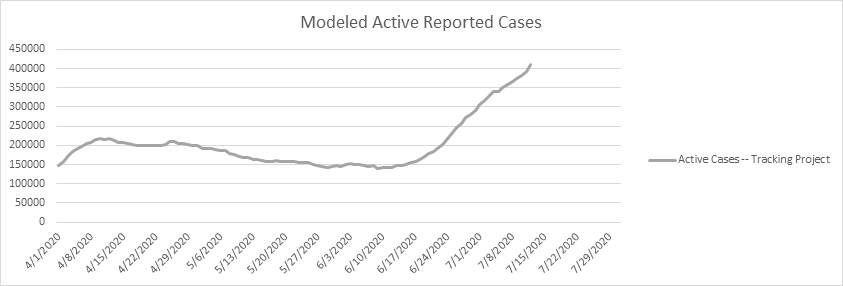
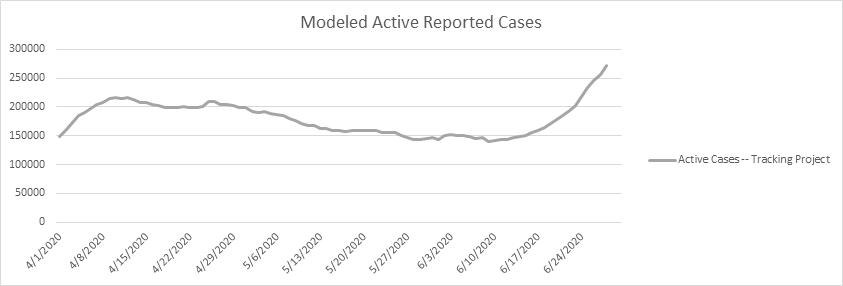
Here is the national picture of active cases – I’m modeling about 411,000 known active cases. 61% of the active cases I’m modeling come from the 6 states on my watch list. Again, this number is high (I don’t know by how much), as many states count positive tests instead of people (I sound like a broken record, but this is important).

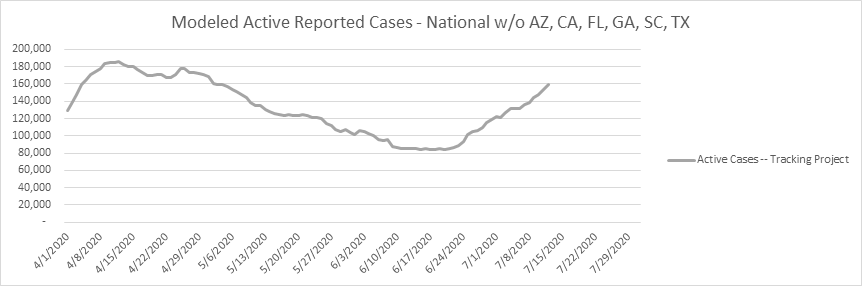
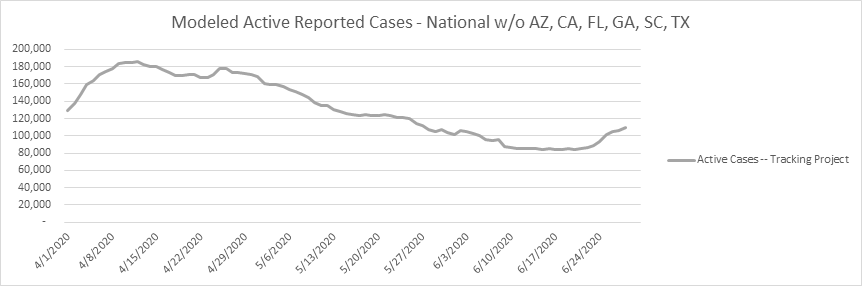
Here is the rest of the country without the 6 watch list states – a much better picture. There is growth in many places other than the 6 watch states, but slower.

Here are the new reported cases nationally – steady growth.

Despite the increase in active known cases, we’re seeing the beginnings of a mild rise in daily deaths. I continue to believe that this is primarily explained by demographics. I’ve long been a proponent of protecting those potentially most affected by the disease, and letting others make their own decisions about daily life, as the mortality rate among pre-retirees is so very low. I believe this is exactly what is happening in society right now. Seniors and those with health problems are exhibiting social distancing, quarantine, and other precautionary measures, while the disease spreads among a younger demographic, with a much lower mortality rate.

On to the states.

Arizona is looking far better than last week. If, in fact, that what we’re seeing is the peak, it came in just a bit higher than NY.

Here is SC, more or less flat from a week ago. South Carolina also double counts cases, as they treat each positive test as a new case (per The Covid Tracking Project).

Florida’s growth rate has been measurably slowing, with the exception of the spike today. Florida is at about 0.32% of the population, so if I’m right, it doesn’t have much growth left.

California has no pattern of slowing growth yet, and sits now at just 0.15% of the population, so I won’t be surprised to see it continue to grow. As always, I need to report that California is one of the states that counts tests rather than people.

Georgia is now showing a somewhat slower growth rate. Georgia is now at 0.2% of the population (about the average). Here again, the case numbers are exaggerated. Georgia counts each positive test as a case (according to The COVID Tracking Project). To make matters more distorted, until May 27th GA reported positive antibody tests as new cases.

Texas is still growing fast. Texas is now at 0.22% of the population, so could have more to run. Texas also reports positive tests as cases, so is doing some level of double counting, but not enough to explain this growth.

We’re seeing some recent growth in NC, and somewhat slower growth in VA. Both NC and VA are at comparable percentages of the population.

Here is the daily death report for NC, continuing a slow downward trend, despite near constant growth in active cases for 3 months. This is quite significant. NC’s Phase 2 expires on Friday. My guess is that they could safely move to Phase 3, but won’t based on the growing case count. I predict 2 more weeks at Phase 2.

Washington has been declining for the better part of a week. Active cases are the smallest per capital of all the states I track.

Nothing to say about NY and NJ – the picture says it all.

Massachusetts looks great. Cases have been stable for some time in the 1,500 range, quite small for the size of the state.

…And here is Michigan. Looking beautiful until June 10th, then beginning a steady. Michigan peaked at a low percentage of population (0.089%), so could peak again if my theory is right.

PA looks just like Michigan. PA also peaked at a low percentage of population, so my comments about MI apply here.

And finally, here is Colorado. Colorado is one of the states that has had aberrations in their data. I still report it, but I’ve shied away from any conclusions in this state due to the data irregularities. Very small numbers here. Colorado peaked at a very small percentage, so could peak again as well.

So that’s it for today. I’ll report again later this week, or earlier if something interesting happens.

The numbers are very small as a percentage of the population. Unless you’re in a high density area, your chances of contracting COVID are very small. However, even though the probability is very small, that doesn’t help if you’re the one catching it. Everyone please continue to be as cautious as you feel necessary.

–Shane Chalke, FSA
Categories
COVID Archives

New Study from Stanford

Happy 4th of July to everyone. This will be my last report for a week, as we’re headed to the Smokies for a week of hiking.

New cases have been flat for 4 days. That’s a good sign that this wave might be cresting. Nonetheless, despite growing cases (we’re now running about 52,000 new cases per day) the daily death rate has not increased at all, and maintains a slight downward trend. Testing continues to increase – we set a new record yesterday at over 750,000 tests reported.

I thing two things are going on now:

  • The propagation of the disease is skewing younger, so the fatalities are not increasing with the case count
  • There seems to be a natural ceiling as a percent of the population for this disease, and several new studies could point to why

The latest study that’s congruent with my theory is from Stanford. You can read about it here: https://www.news-medical.net/news/20200629/Stanfords-Nobel-Laureate-develops-a-prediction-model-for-SARS-CoV-2.aspx

Here is the relevant quote: The researchers from Stanford School of Medicine and ShangaiTech University show that the growth of a coronavirus disease (COVID-19) outbreak does not behave in accordance with an exponential growth law, but instead slows down exponentially with time from the very first days.

I noticed this in March, when the growth pattern very early on deviated from exponential, and was already slowing down. They surmise that the high rates of asymptomatic (or “invisible”) carriers means that the infectious have less new people to infect (something like the herd immunity that you’ve heard about, but in the early stages). This, coupled with new theories that a segment of the population may simply be resistant to the disease (perhaps from having a previous Corona Virus caused common cold), could very well explain why the biggest numbers we’ve seen are in fact so low https://reason.com/2020/07/01/covid-19-herd-immunity-is-much-closer-than-antibody-tests-suggest-say-2-new-studies/ . The record so far is NY, which peaked (according to my modeling) at about 0.35% of the population. That seems very low to me in comparison, for example, to how many contract the seasonal flu each year.

As far as the divergence of daily deaths and active cases, my theory continues to be that this is caused by a four factors:

  • We’re testing people who are less ill as the testing protocol widens, so the survival rate is higher
  • The scope of testing is still expanding generally, so the increase in cases is not representative of a like increase in prevalence
  • Younger people are a larger percentage of those newly infected, and their mortality rate is close to nil, so very few show up in the fatality stats
  • Double counting of cases is increasing, including antigen and antibody tests, as well as PCR tests – we know that AZ, CA, TX, and SC double count cases (per the COVID Tracking Project)

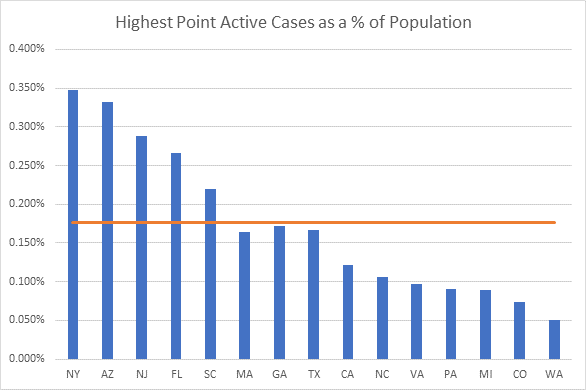
Here is an update of the peak population graph. No state has reached NY levels yet, but AZ is close. It’s interesting that AZ is approaching NY at its highest prevalence, but at a tiny fraction of the deaths. NY has had over 32,000 fatalities, and AZ is currently less than 2,000. Arizona is a dramatically different story than NY, but with similar prevalence. Several of the “problem” states are still below the average peak (GA, TX, CA).

I still expect a mild increase in daily deaths but small in proportion to the increased case count. This still hasn’t happened yet, and may not. In fact, the latest update to the IHME model (June 29th) doesn’t project ANY increase in the daily death count.

As always, feel free to send me your questions about my assumptions, methodology, or modeling in general.

  • Likely date of active case peak (Chalke modeling): N/A (no peak yet)
  • Likely date of peak deaths (IHME): April 16 (last revision on June 29)
  • Total Test Results reported today: 644,930 (extremely high)
  • Total Pending tests reported today: 2,083 (extremely low)
  • National reported case Growth Rate today: 1.88% (low)

Shane Chalke Interviews

https://www.fredericksburg.com/opinion/editorial-unlock-demographically-not-geographically/article_a62e6e70-dccd-51cf-b7b2-16d77a90fd9c.html

Website

Groom Ventures has agreed to host a website that will archive my daily reports, and supplement with other commentary. John Groom worked at one of my companies back in the day, and is an excellent writer. The website is: www.howmuchrisk.com For those of you that post my daily report on Facebook, let me suggest you link to this site, as the direct Facebook posts don’t seem to copy the graphs.

Daily Analysis

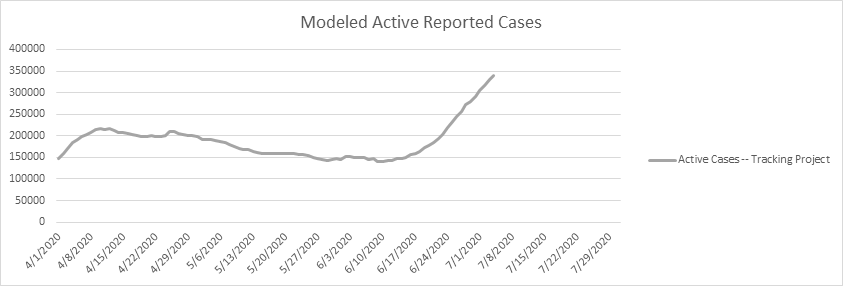
Here is the national picture of active cases – I’m modeling about 340,000 known active cases. 61% of the active cases I’m modeling come from the 6 states on my watch list. Again, this number is high (I don’t know by how much), as many states count positive tests instead of people (I sound like a broken record, but this is important).

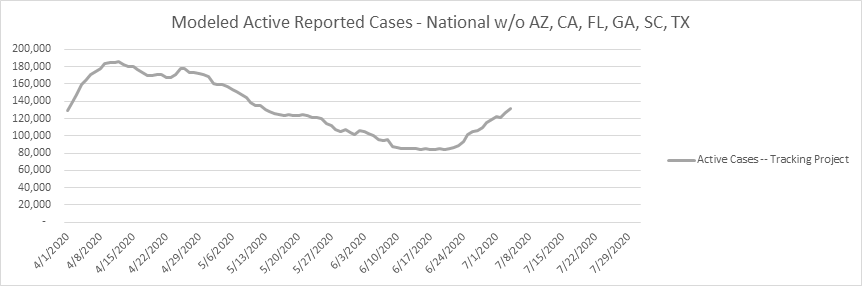
Here is the rest of the country without the 6 watch list states – a much better picture.

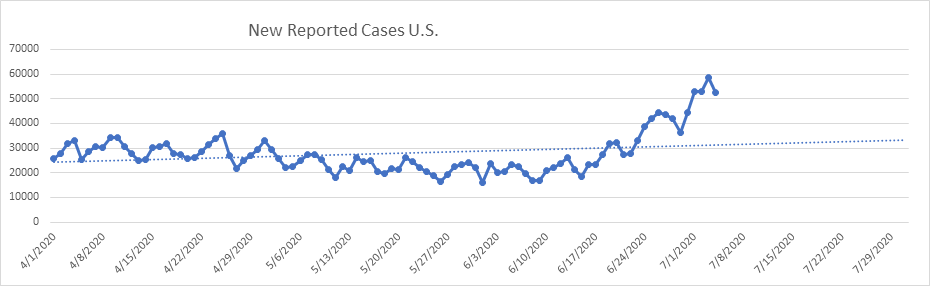
Here are the new reported cases nationally. Flat for 4 days now, but 4 days doesn’t make a pattern yet.

Despite the increase in active known cases, daily deaths continue a slow decline. I continue to believe that this is primarily explained by demographics. I’ve long been a proponent of protecting those potentially most affected by the disease, and letting others make their own decisions about daily life, as the mortality rate among pre-retirees is so very low. I believe this is exactly what is happening in society right now. Seniors and those with health problems are exhibiting social distancing, quarantine, and other precautionary measures, while the disease spreads among a younger demographic, with a much lower mortality rate.

On to the states.

Arizona continues to slow a bit. Even with this rapid increase in cases, hospital admissions seem to have peaked on June 8th, and daily deaths on June 19th (there is often a lag on death reporting, however).

Here is SC, still growing. South Carolina also double counts cases, as they treat each positive test as a new case. They are at about 0.22% of the population, quite high in relation to most other states, but less than NY and NJ at their peaks.

Florida’s growth rate has been running slower than last week, and you can see the small slowdown in the curve below. The growth rate is still over double the national average, though.

California is growing slower than it was a week ago, and is showing early signs of further slowing. As always, I need to report that California is one of the states that counts tests rather than people.

Georgia is growing fast. I haven’t had time yet to look at the fatality trends here, but will soon. Here again, the case numbers are exaggerated. Georgia counts each positive test as a case (according to The COVID Tracking Project). To make matters more distorted, until May 27th GA reported positive antibody tests as new cases.

Texas is still growing fast. We’ve seen a shallow growth trend in daily deaths since June 15th, but still no higher than they averaged in May. Texas also reports positive tests as cases, so is doing some level of double counting, but not enough to explain this growth.

We’re seeing some recent growth (a decline today) in NC, and relatively flat data in VA. Both NC and VA are at comparable percentages of the population.

Here is the daily death report for NC, continuing a slow downward trend, despite near constant growth in active cases for 3 months. This is quite significant. The last two days have seen the lowest daily death counts for 2 months. Hospitalizations are relatively flat for the past week and a half.

Washington continues to increase, but at a slower rate than the watch list states. Active cases are the smallest per capital of all the states I track, so if my theory is correct, they could double from where they are now.

Nothing to say about NY and NJ – the picture says it all.

Massachusetts looks great. I’m modeling about 1,400 remaining known active cases in the state.

…And here is Michigan. Looking beautiful until June 10th, then beginning a slow drift upwards. Michigan peaked at a low percentage of population (0.089%), so could peak again if my theory is right.

PA looks just like Michigan. PA also peaked at a low percentage of population, so my comments about MI apply here.

And finally, here is Colorado. Colorado is one of the states that has had aberrations in their data. I still report it, but I’ve shied away from any conclusions in this state due to the data irregularities. Very small numbers here.

So that’s it for today. Time to go watch fireworks. I’ll report again around July 13th. If we don’t see a significant rise in daily deaths by then, we’ll know we’re on to something.

The numbers are very small as a percentage of the population. Unless you’re in a high density area, your chances of contracting COVID are very small. However, even though the probability is very small, that doesn’t help if you’re the one catching it. Everyone please continue to be as cautious as you feel necessary.

–Shane Chalke, FSA
Categories
COVID Archives

Something very different going on…

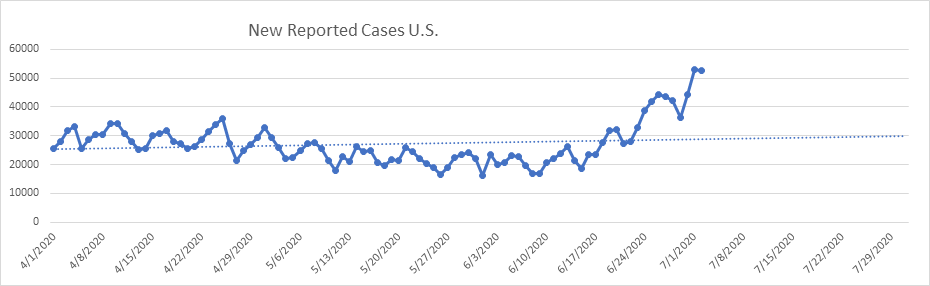
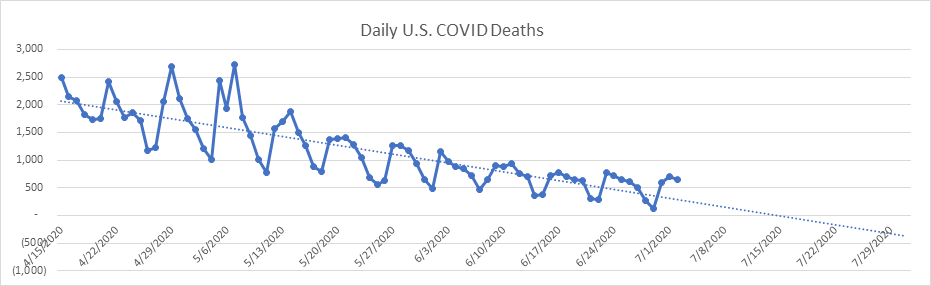
The past two days we’ve reported about 53,000 new cases per day. That’s about 250% of what we were experiencing about 3 weeks ago. Of course, about 2/3 of new cases are coming from my 6 watch list states (AZ, CA, FL, GA, SC, TX). So far, we’re not experiencing a rise in fatalities. Now that we’re 3 weeks into the surge, I would have expected the needle to move, but no.

My theory has been that the increase in cases is not causing a commensurate increase in fatalities because:

  • We’re testing people who are less ill as the testing protocol widens, so the survival rate is higher
  • The scope of testing is still expanding generally, so the increase in cases is not representative of a like increase in prevalence
  • Younger people are a larger percentage of those newly infected, and their mortality rate is close to nil, so very few show up in the fatality stats
  • Double counting of cases is increasing, including antigen and antibody tests, as well as PCR tests – we know that AZ, CA, TX, and SC double count cases

I do believe that all of the above is true, but what is not explained with these factors is why we seem to reach a ceiling in cases as a percentage of the population that is really quite low. Below is a chart of the highest known active cases I’ve modeled as a percentage of the population so far. Some of these states are way past the peak (NY, NJ, MA, VA, PA, MI, CO), and some are either still growing or have not definitively peaked (AZ, FL, SC, GA, TX, CA, NC, WA). The striking thing is that the record high so far is NY, but it’s less than 0.35% of the population. Why? Intuitively, I would have expected a much higher percentage, and so did most of the models. I’ve been puzzled over this for some time. I remain unconvinced that the ceiling is a result of human behavior (i.e. restrictions), as I noticed way back in March that the disease was already moving off exponential, and mathematically slowing down. You’ll find this theme familiar if you’ve been reading my analysis from the beginning.

Here is the first clue that really resonates with what I’ve been seeing in the data. There are two new studies, which, if they bear up under scrutiny, could explain this. There have been several articles about this – here is one: https://reason.com/2020/07/01/covid-19-herd-immunity-is-much-closer-than-antibody-tests-suggest-say-2-new-studies/ Both studies (one from Sweden and one from Germany) suggest that population immunity to COVID-19 is much higher than previously thought. If true, this would explain why the disease began to slow at such a low prevalence.

I do expect a mild increase in daily deaths but small in proportion to the increased case count. This hasn’t happened yet, and may not. In fact, the latest update to the IHME model (June 29th) doesn’t project ANY increase in the daily death count.

As always, feel free to send me your questions about my assumptions, methodology, or modeling in general.

  • Likely date of active case peak (Chalke modeling): N/A (no peak yet)
  • Likely date of peak deaths (IHME): April 16 (last revision on June 29)
  • Total Test Results reported today: 634,822 (extremely high)
  • Total Pending tests reported today: 2,208 (extremely low)
  • National reported case Growth Rate today: 1.97% (low)

Shane Chalke Interviews

https://www.fredericksburg.com/opinion/editorial-unlock-demographically-not-geographically/article_a62e6e70-dccd-51cf-b7b2-16d77a90fd9c.html

Website

Groom Ventures has agreed to host a website that will archive my daily reports, and supplement with other commentary. John Groom worked at one of my companies back in the day, and is an excellent writer. The website is: www.howmuchrisk.com For those of you that post my daily report on Facebook, let me suggest you link to this site, as the direct Facebook posts don’t seem to copy the graphs.

Daily Analysis

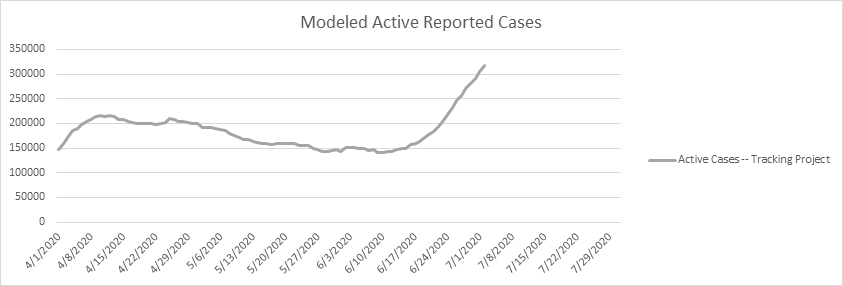
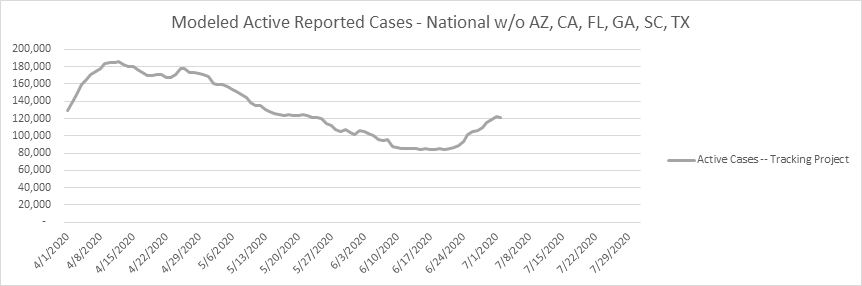
Here is the national picture of active cases – I’m modeling about 317,000 known active cases. 62% of the active cases I’m modeling come from the 6 states on my watch list. Again, this number is high (I don’t know by how much), as many states count positive tests instead of people (I sound like a broken record, but this is important).

Here is the rest of the country without the 6 watch list states – a much better picture, but still increasing (except for today).

Here are the new reported cases nationally. We’re reaching new highs in daily new case reports.

Here is the amazing thing. Way back on April 10th, when we last saw a peak in active cases at about 217,000, we were seeing well over 2,000 deaths per day. Now we’re nearly 50% higher in known active cases, but seeing daily deaths below 1,000 per day. I continue to believe that this is primarily explained by demographics. I’ve long been a proponent of protecting those potentially most affected by the disease, and letting others make their own decisions about daily life, as the mortality rate among pre-retirees is so very low. I believe this is exactly what is happening in society right now. Seniors and those with health problems are exhibiting social distancing, quarantine, and other precautionary measures, while the disease spreads among a younger demographic, with a much lower mortality rate.

On to the states. I’m going to switch up the order and put my “watch list” states first.

Arizona has slowed a bit this week, but not by much. Even with this rapid increase in cases, hospitalizations seem to have peaked on June 8th, and daily deaths on June 15th (there is often a lag on death reporting, however).

Here is SC, still growing, although their small numbers don’t skew any national counts. South Carolina also double counts cases, as they treat each positive test as a new case. They are at about 0.21% of the population, quite high in relation to most other states, but less than NY and NJ at their peaks.

Florida’s growth rate has been slowing for the past 4 days, but still quite alarming in the 4% range.

California is growing slower than it was a week ago. I wish the California Department of Health website was more useful – very difficult to find time series data. As always, I need to report that California is one of the states that counts tests rather than people.

Georgia is growing fast. I haven’t had time yet to look at the fatality trends here, but will soon. Here again, the case numbers are exaggerated. Georgia counts each positive test as a case. To make matters more distorted, until May 27th GA reported positive antibody tests as new cases.

Texas is still growing fast. We’ve seen a shallow growth trend in daily deaths since June 15th. I’ll continue to watch this. Texas also reports positive tests as cases, so is doing some level of double counting, but not enough to explain this growth.

We’re seeing some recent growth in NC, and relatively flat data in VA. Both NC and VA are at comparable percentages of the population.

Here is the daily death report for NC. No sign of upward trend at this time. Hospitalizations peaked 9 days ago, and are flat over the past nine days.

Washington continues to increase, but at a slower rate than the watch list states. Active cases are the smallest per capital of all the states I track.

Nothing to say about NY and NJ – the picture says it all.

Massachusetts looks great. I’m modeling about 1,500 remaining known active cases in the state.

…And here is Michigan. Looking beautiful until June 10th, then beginning a slow drift upwards. Michigan peaked at a low percentage of population (0.089%), so could peak again if my theory is right.

PA looks just like Michigan. PA also peaked at a low percentage of population, so my comments about MI apply here.

And finally, here is Colorado. Colorado is one of the states that has had aberrations in their data. I still report it, but I’ve shied away from any conclusions in this state due to the data irregularities. Very small numbers here.

So that’s it for today. The numbers are very small as a percentage of the population. Unless you’re in a high density area, your chances of contracting COVID are very small. However, even though the probability is very small, that doesn’t help if you’re the one catching it. Everyone please continue to be as cautious as you feel necessary.

–Shane Chalke, FSA
Categories
COVID Archives

Cases Steady, Deaths Down

I wasn’t going to report until later this week, but my concert tonight was cancelled (weather) so here goes.

New cases nationally have been flat for 4 days now, attributable to slowing growth rates in CA, TX, and AZ. On the other hand, GA is accelerating, so I’ve added that state to my watch list. Just about all the action is in AZ, CA, FL, GA, SC, and TX. Over 62% of new cases reported today come from these 6 states. I think AZ, CA, and TX will stabilize first, based on recent trends. The biggest remaining problems are in FL, GA, and SC.

Of course, the good news is that daily deaths continue on a downward slope. Today we reported 273 deaths nationally, the lowest number in over 3 months. I keep looking for growth in daily deaths, but it’s not happening yet. I’ll repeat my thesis here, that the increase in cases is not causing a commensurate increase in fatalities is because:

  • We’re testing people who are less ill as the testing protocol widens, so the survival rate is higher
  • The scope of testing is still expanding generally, so the increase in cases is not representative of a like increase in prevalence
  • Younger people are a larger percentage of those newly infected, and their mortality rate is close to nil, so very few show up in the fatality stats
  • Double counting of cases is increasing, including antigen and antibody tests, as well as PCR tests – we know that AZ, CA, TX, and SC double count cases

I do expect a mild increase in daily deaths but small in proportion to the increased case count. This week will be critical to test this hypothesis, as we’re now over 2 weeks into this current wave. Ill report again on Thursday, and we’ll know by then.

As always, feel free to send me your questions about my assumptions, methodology, or modeling in general.

  • Likely date of active case peak (Chalke modeling): April 10
  • Likely date of peak deaths (IHME): April 16 (last revision on June 24)
  • Total Test Results reported today: 539,333 (very high)
  • Total Pending tests reported today: 2,198 (extremely low)
  • National reported case Growth Rate today: 1.69% (low)

Shane Chalke Interviews

https://www.fredericksburg.com/opinion/editorial-unlock-demographically-not-geographically/article_a62e6e70-dccd-51cf-b7b2-16d77a90fd9c.html

Website

Groom Ventures has agreed to host a website that will archive my daily reports, and supplement with other commentary. John Groom worked at one of my companies back in the day, and is an excellent writer. The website is: www.howmuchrisk.com For those of you that post my daily report on Facebook, let me suggest you link to this site, as the direct Facebook posts don’t seem to copy the graphs.

Daily Analysis

Here is the national picture of active cases – I’m modeling about 272,000 known active cases. 60% of the active cases I’m modeling come from the 6 states on my watch list. Again, this number is high (I don’t know by how much), as many states routinely double count cases (I sound like a broken record, but this is important).

Here is the rest of the country without the 6 watch list states – a much better picture, but still increasing.

Here are the new reported cases nationally. Perhaps a meaningful slowdown, perhaps just the weekend.

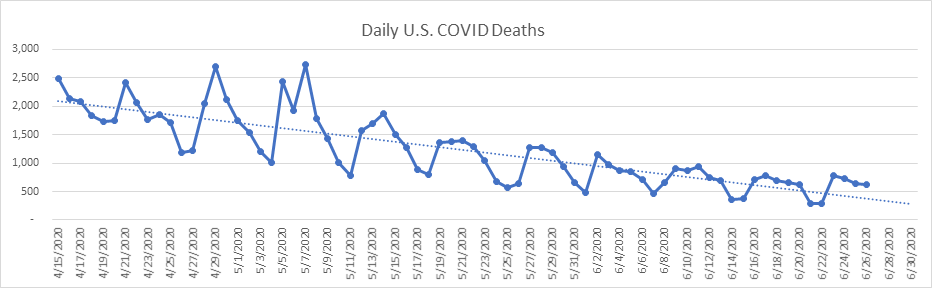
Here are the daily death reports. Deaths are running a small fraction of what the experts predicted for June. Why doesn’t this make news?

On to the states. Both NC and VA look equally stable. It’s really interesting that both states flattened at about the same time.

Ironically, NC decided to remain in Phase 2 for another 3 weeks, but what I see is stable active cases, and flat or slowly declining deaths. Hospitalizations are stable over the past few days as well.

Arizona looks a bit better over the past 5 days, with a somewhat slowing growth rate. I’m guessing AZ will turn out like NJ with respect to cases per capita, but peak at a fraction of NJ’s deaths. Both new hospitalizations and deaths have been declining over the past 2 weeks. As always, I need to point out that Arizona’s data is exaggerated, since they count specimens tested rather than people, and it’s not uncommon to get multiple tests if you’re sick – each time you’re tested you’d show up as a new case. Even worse, Arizona counts positive antibody tests as new cases (antibody tests run about 10% of total tests in AZ).

Here is SC, still growing, although their small numbers don’t skew any national counts. South Carolina also double counts cases, as they treat each positive test as a new case.

We see a small dip today for Washington. They are at a low level per capita, so if we see them level off or begin declining I’ll likely take them off my report. Hospitalizations and deaths are substantially down from the peak as well. For now, we’ll keep watching.

Florida has a fast growth rate, in excess of 6% for the past several days. Emergency room visits have nearly tripled since the beginning of June, but there is no increase in daily deaths yet.

Both NY and NJ continue to be great recovery stories. I’ll keep reporting on these two states in case something happens out of pattern. It’s been a very long time since anything surprising has happened here, though.

California has had a slower growth rate for the past 3 days. As always, I need to report that California is one of the states that double counts cases.

Massachusetts has had a slight drift upwards over the past few days. I’m modeling about 1,600 remaining known active cases in the state.

Georgia is accelerating. I don’t like the look of this. Before next report I’ll take a look at the trends in hospitalizations and daily deaths. Here again, the case numbers are exaggerated. Georgia counts each positive test as a case. To make matters more distorted, until May 27th GA reported positive antibody tests as new cases.

…And here is Michigan. Looking beautiful until June 10th, then beginning a slow drift upwards. It looks like the growth rate is attenuating over the past few days. MI has also had a lot of data anomalies, so I look at this graph with a grain of salt.

PA had been drifting up for 7 days, but now possibly slowing. Worth watching, but still low on a per capita basis.

Texas has slowed ever so slightly over the past 3 days. Texas also reports positive tests as cases, so is doing some level of double counting, but not enough to explain this growth.

And finally, here is Colorado. Colorado is one of the states that has had aberrations in their data. I still report it, but I’ve shied away from any conclusions in this state due to the data irregularities. Very small numbers here.

So that’s it for today. The numbers are very small as a percentage of the population. Unless you’re in a high density area, your chances of contracting COVID are very small. However, even though the probability is very small, that doesn’t help if you’re the one catching it. Everyone please continue to be as cautious as you feel necessary.

–Shane Chalke, FSA
Categories
COVID Archives

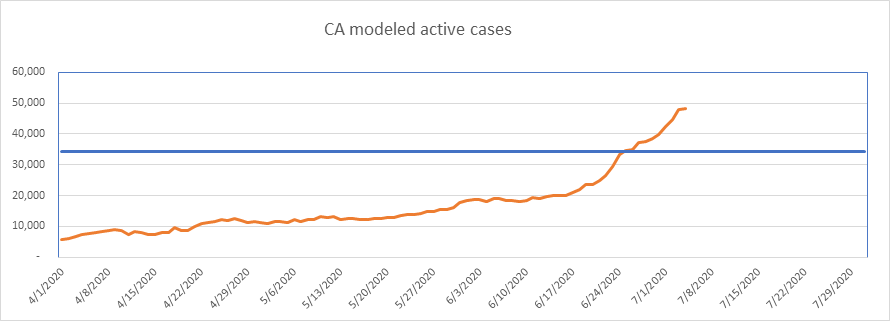
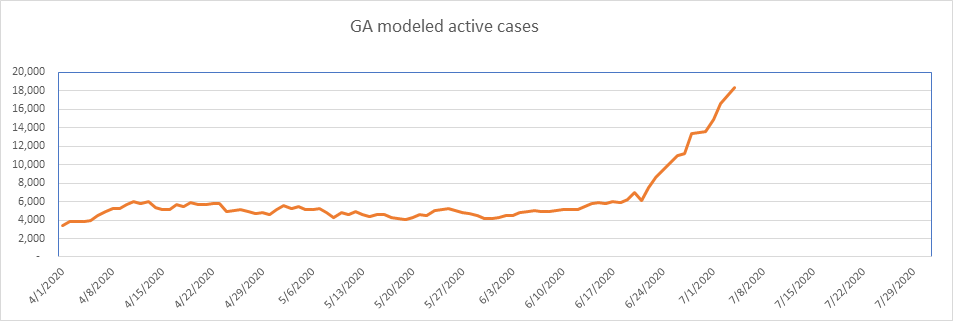
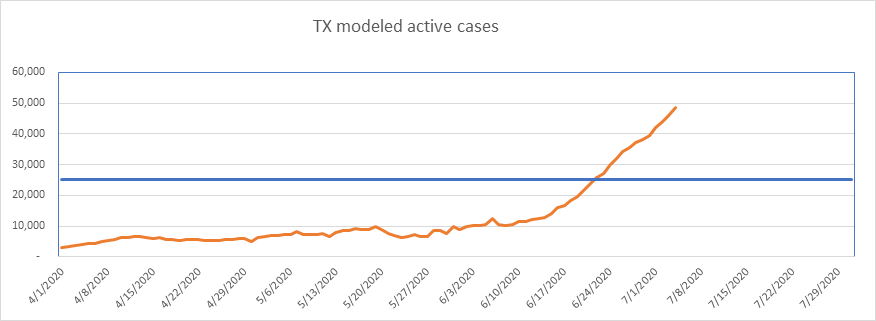
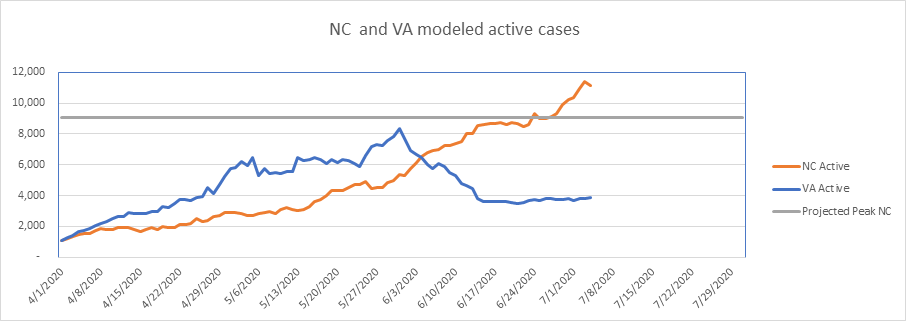
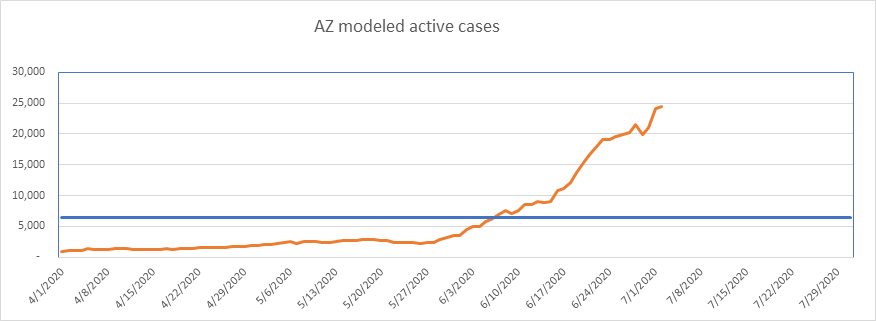
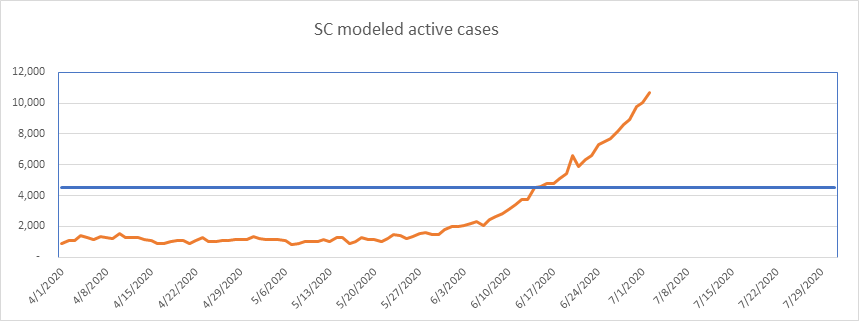
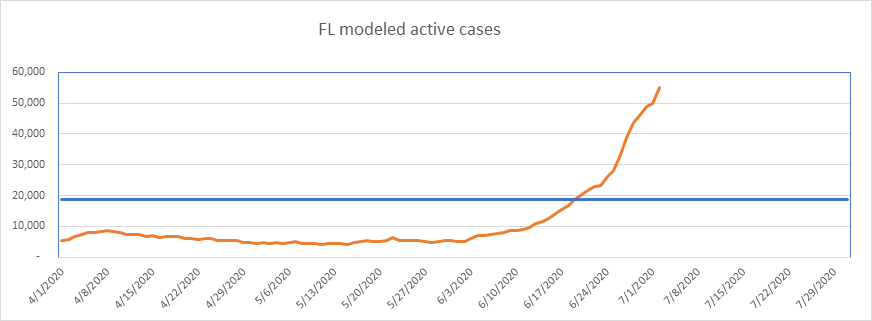
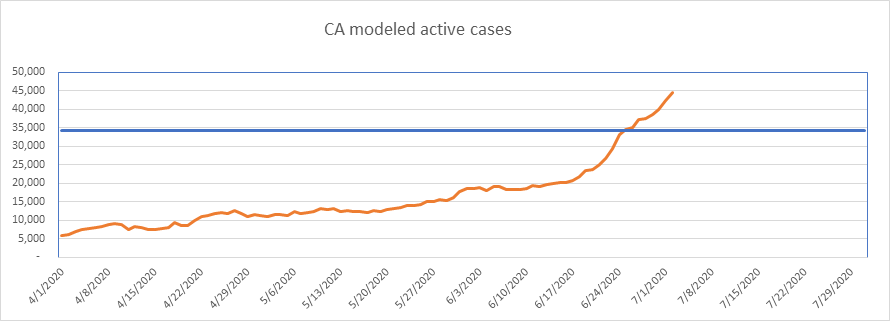
Cases rising fast in problem states, but things are different this time…

It’s only been one day, so this will be an abbreviated report.

You’ve all seen the record new case counts in the news. It’s primarily happening in a handful of states, but the spike in new cases is not accompanied by an increase in fatalities. I’ve been saying for the past few reports that this is likely because:

  • We’re testing people who are less ill as the testing protocol widens
  • The scope of testing is still expanding generally
  • We’re testing a younger demographic, and younger people are a larger percentage of those newly infected (their mortality rate is close to nil, so very few show up in the fatality stats)
  • Double counting of cases is increasing, including antigen and antibody tests, as well as PCR tests – we know that AZ, CA, TX, and SC double count cases

We’re starting to see more and more media reports that the new cases are skewing younger, and of course we know that younger people have much better outcomes after contracting the disease. Here are a couple of good articles today:

https://reason.com/2020/06/24/as-covid-19-infections-rise-patients-are-getting-younger/?utm_medium=email

https://www.wsj.com/articles/coronavirus-surge-in-south-and-west-looks-different-from-norths-11593203105

This goes a long way to explain why we’re not seeing a surge in deaths to match the increasing cases. We’ve seen a rise in known active cases for 15 days now, so it’s still a bit early, but we’d see at least some effect by now if the rise in cases were consistent with historical cases. I don’t think they are. I’ve been preaching for many weeks that the right policy prescription is to protect the vulnerable (the elderly and the infirm), and let the younger population return to normal. I believe that this is what is happening all on its own nationally. Those that need to be cautious are, and those that don’t need to be are returning to normal routines.

I’m working Saturday and Sunday night, and out of town Monday through Wednesday, so I’ll report again next Thursday.

As always, feel free to send me your questions about my assumptions, methodology, or modeling in general.

  • Likely date of active case peak (Chalke modeling): April 10
  • Likely date of peak deaths (IHME): April 16 (last revision on June 24)
  • Total Test Results reported today: 602,947 (very high)
  • Total Pending tests reported today: 2,201 (extremely low)
  • National reported case Growth Rate today: 1.84% (low)

Shane Chalke Interviews

https://www.fredericksburg.com/opinion/editorial-unlock-demographically-not-geographically/article_a62e6e70-dccd-51cf-b7b2-16d77a90fd9c.html

Website

Groom Ventures has agreed to host a website that will archive my daily reports, and supplement with other commentary. John Groom worked at one of my companies back in the day, and is an excellent writer. The website is: www.howmuchrisk.com For those of you that post my daily report on Facebook, let me suggest you link to this site, as the direct Facebook posts don’t seem to copy the graphs.

Daily Analysis

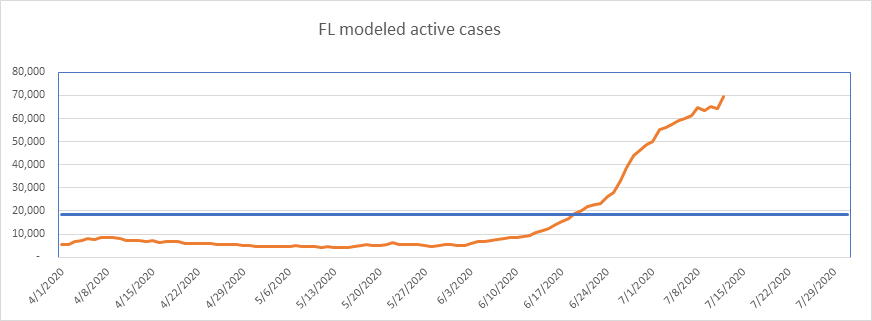
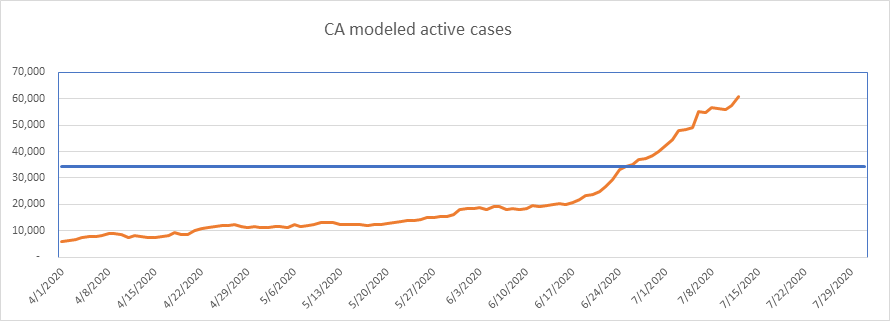
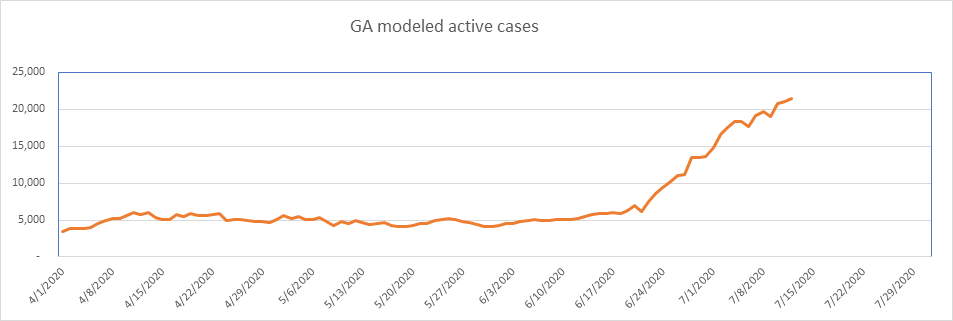
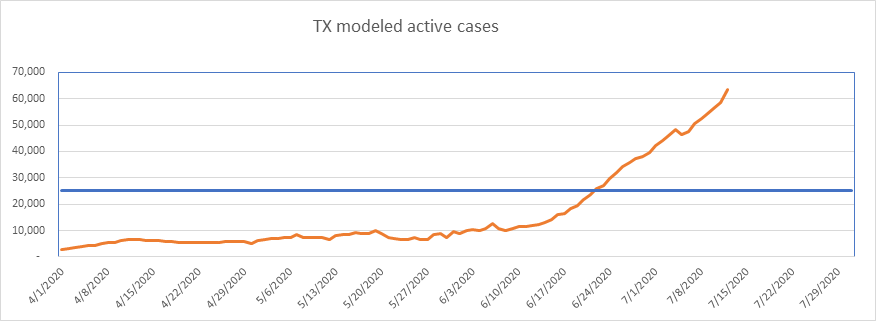
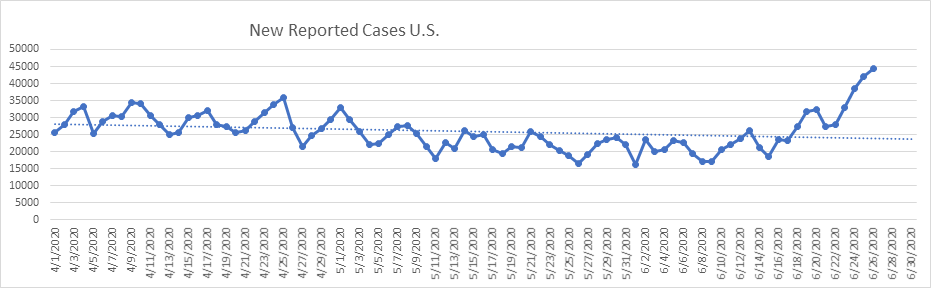
Here is the national picture of active cases – I’m modeling about 245,000 known active cases. Well over half of the active cases I’m modeling come from the 5 problem states. Again, this number is high (I don’t know by how much), as many states routinely double count cases.

Here are the new reported cases nationally. A new record today, and increasing for 10 days now – well over half of all new cases are in 5 states.

Here are the daily death reports. Daily deaths are not rising commensurate with new cases. We’re seeing quite a divergence between active cases and deaths.

On to the states. I’m just going to hit the 5 troubling states today, and return to a full report next week.

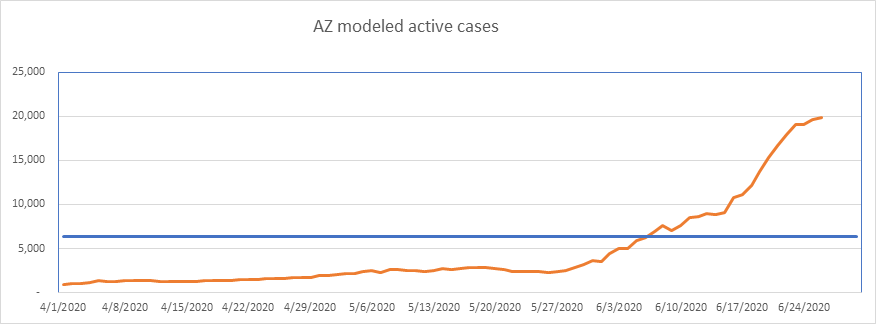
Arizona looks a bit better over the past 3 days, with a markedly lower growth rate — hoping for this improvement to continue. I need to point out every day that Arizona’s data is exaggerated, since they count specimens tested rather than people, and it’s not uncommon to get multiple tests if you’re sick – each time you’re tested you’d show up as a new case. Even worse, Arizona counts positive antibody tests as new cases.

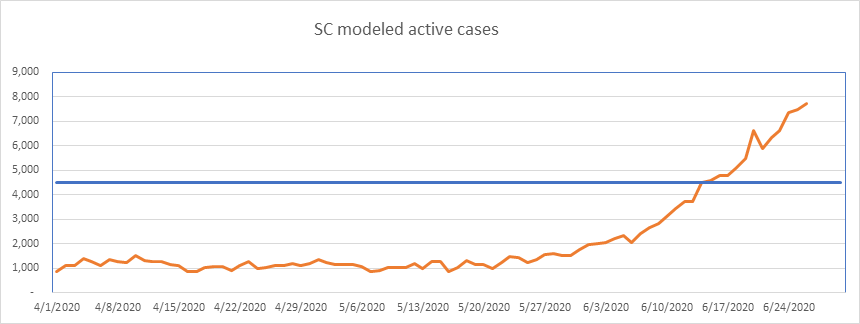
South Carolina is still increasing, but the numbers aren’t large. However, since there is just a minor slowdown, I’ll continue to report on it. South Carolina also double counts cases, as they treat each positive test as a new case. Worse still, until June 11th, SC counted positive antibody tests as new cases.

The Florida growth rate is increasing again, after a 4-day slowdown. The growth rate here is now over 7% — very troubling. However, we’re lately seeing declining daily deaths in Florida, so it’s fitting the pattern of younger new cases.

We now see two days of slowdown California – we’ll know more by next week, but this is hopeful. As always, I need to report that California is one of the states that double counts cases.

Texas still shows no signs of slowing down. Texas also reports positive tests as cases, so is doing some level of double counting, but not enough to explain this growth. Here again, we’re seeing no increase in daily fatalities.

So that’s it for today. The numbers are very small as a percentage of the population. Unless you’re in a high density area, your chances of contracting COVID are very small. However, even though the probability is very small, that doesn’t help if you’re the one catching it. Everyone please continue to be as cautious as you feel necessary.

–Shane Chalke, FSA
Site powered by   

Foundation for Sane Public Policy

Visit John F. Groom on Amazon and Groom Media Membership

Publicty