Categories
COVID Archives

A new piece of the puzzle?

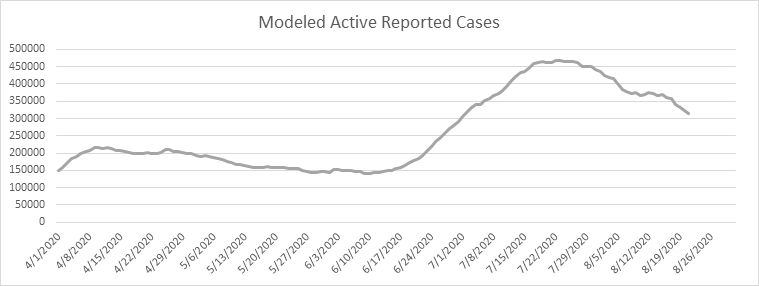
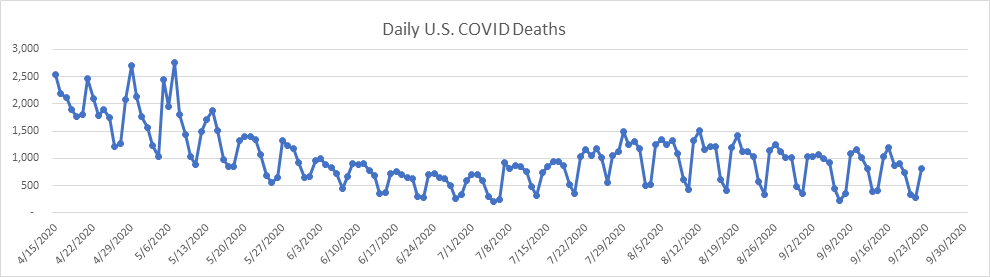
Well, it’s been a long 20 days since my last report. The propagation of this disease continues to be quite slow, and in fact, not a lot has happened in the last 20 days. We’ve added about 45,000 active known cases, yet the daily death count continues to fall (albeit slowly). In both of the last two updates to the IHME model, they have reduced substantially their forward death predictions. Prior to October 2nd, IHME was projecting nearly 3,620 daily deaths by year end. With their October 2nd update, they lowered that to 2,941, and with the October 9th update, that number is now 2,197. That’s a remarkable 40% reduction in 2 weeks (that should make headlines, but no). I still don’t see any indicators that even this will happen. We are currently averaging less than 1,000 deaths per day, and this number is steadily falling. Even though the active case count is increasing, it is skewing younger, and will have a minimal impact on mortality.

Once I was able to calculate mortality rates by age back in April, I thought that the most effective response to the pandemic was to protect those with high COVID mortality rates, and let everyone else get back to life. Here is my quote from April 28th:

So as we recover as a society, the methodology seems settled that we’ll unlock one geographic area at a time. But we have 2 easily identifiable populations, once with relatively high risk, and one with a tiny fraction of the risk. It occurs to me that we could more safely unlock by doing it demographically, rather than geographically. We could extend shelter in place rules for seniors and those with definable risk factors, and eliminate them for the under 65 and healthy population. It would also be fairly easy to define perhaps one concentric circle around the vulnerable by maintaining shelter in place rules for certain caregivers and health care workers. So that’s my message for today: Unlock Demographically, Not Geographically.

At this point, I believe this is what we are naturally doing as a society. Young people have figured out that COVID is not a death sentence for them, and largely bears a similar inconvenience to that of a cold or flu. Those with certain pre-existing diseases and those of advanced age have figured out that they better take the necessary precautions to avoid COVID. Hence the slowly growing case count, and the slowly declining mortality.

This pandemic has eluded modelers from the beginning, including me. I fully expected it to follow the classic Logistic pattern of resource constrained diseases, but it slowed down rapidly and definitively. Here are the puzzling questions:

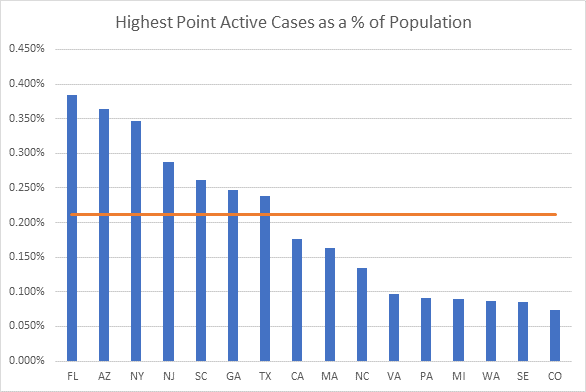
  • Why do so few get this disease? We’ve observed an active case ceiling of about 1/3 of one percent of the population.
  • Why do some areas have a completely different experience than others, irrespective of societal constraints?

I continue to believe that a significant level of innate resistance to the disease is a part of the puzzle, perhaps through T-Cell cross-reactivity with the common cold. This theory is now a central part of the discussion, but science is all over the place about the actual threshold of herd immunity, and to what extent prior resistance contributes to it. Here is a well written article about some of the latest: https://reason.com/2020/09/29/is-the-covid-19-herd-immunity-threshold-as-low-as-15-percent/

There is yet another possible piece of the puzzle, outlined in this article from The Atlantic: https://www.theatlantic.com/health/archive/2020/09/k-overlooked-variable-driving-pandemic/616548/?mod=djemMER_h As modelers we tend to treat all COVID carriers as the same, often quoting the reproduction rate “r”, as if it is homogeneous across carriers. However, research now shows that probability of transmission varies considerably from individual to individual. Put more simply, many, if not most of those with COVID are not contagious at all, with a minority of carriers responsible for most of the spreading. This article cites numbers in the 80/20 range, where 80% of carriers are not likely to transmit the disease, and 20% of carriers are responsible for most of the spreading.

IF this turns out to true, there are a lot of ramifications. Most importantly, it would explain why this disease grows in spurts, which tend to die out rather quickly. Think of it this way – If one out of 5 people infected is a “spreader”, and the R value is 1 (we’re close to that now), then that means that 4 out of five carriers infect no one, and the 5th infects 5 people. Of those 5 new infected people, there is a 33% probability that not one of them is a spreader, and thus the chain is halted. However, there is a 67% chance that 1 or more of the 5 is a “spreader”, so the chain continues. However, if you do the math, we find that once a single person is infected the chance of the chain dying out by the 3rd generation (about 3 weeks) is well over 50%. No one knows yet what the precise numbers look like, but this is the idea. Clusters pop up and then burn out rather quickly. This matches what we observe, and could at least partly explain why this disease hasn’t gotten more purchase (thankfully).

Another ramification of this theory is that, if true, it adds a higher degree of randomness to the propagation. If an area is unlucky enough to have linked together 5 or 6 generations of spreaders in a single chain, they see a quite noticeable eruption. It’s not nearly so smooth as if it were all homogeneous.

Testing has entered a new level, with daily counts in the million range. We set a new daily record on Saturday, with 1,233,178 tests reported. This explains some of the case count growth, as university testing tends to uncover asymptomatic cases that otherwise would never be known. The U.S. has now recorded over 115 million tests.

On another topic, I continue to be plagued by inconsistent, unreliable, and mistaken data. On September 22nd, Texas reported an additional 21,967 historical cases. On September 25, North Carolina began reporting “probable” cases, and increased their total count by 4,563 in a single day. On Saturday, a private lab in Florida reported about 400,000 test results that appear to have been previously reported, and Florida has had its hands full “de-duping” these. And on and on… It’s been too time consuming for me to run my own “shadow” database, so I’m just letting the numbers run through my model, which in most cases has skewed the case counts higher than actual.

Feel free to send me your questions about my assumptions, methodology, or modeling in general.

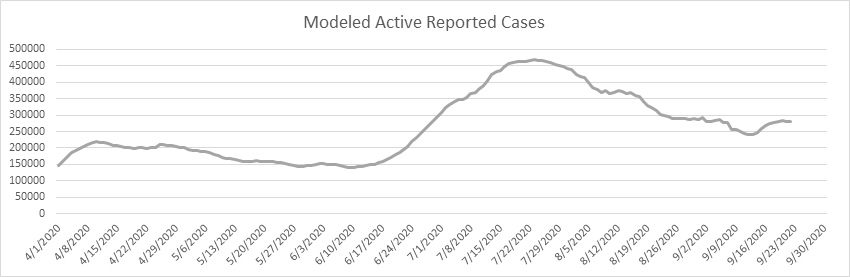
  • Modeled known active cases in U.S. 343,790
  • Likely date of active case peak (Chalke modeling): July 23
  • Likely date of peak deaths (IHME): January 17 (last revision on October 9)
  • Total Test Results reported today: 943,645 (very high)
  • Total Pending tests reported today: 11,261 (very low)
  • National reported case Growth Rate today: 0.61% (very low)

Shane Chalke Interviews

https://www.fredericksburg.com/opinion/editorial-unlock-demographically-not-geographically/article_a62e6e70-dccd-51cf-b7b2-16d77a90fd9c.html

Website

Groom Ventures has agreed to host a website that will archive my daily reports, and supplement with other commentary. John Groom worked at one of my companies back in the day, and is an excellent writer. The website is: www.howmuchrisk.com For those of you that post my daily report on Facebook, let me suggest you link to this site, as the direct Facebook posts don’t seem to copy the graphs.

Daily Analysis

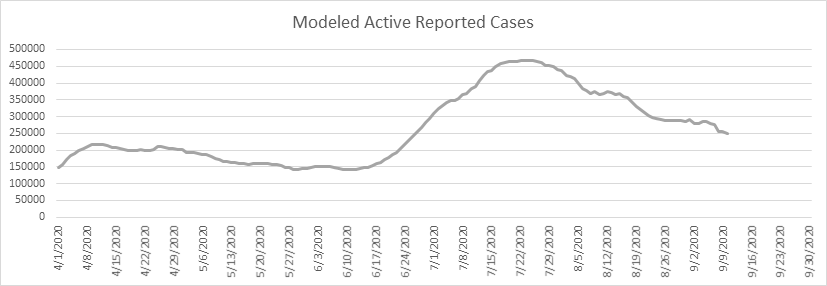
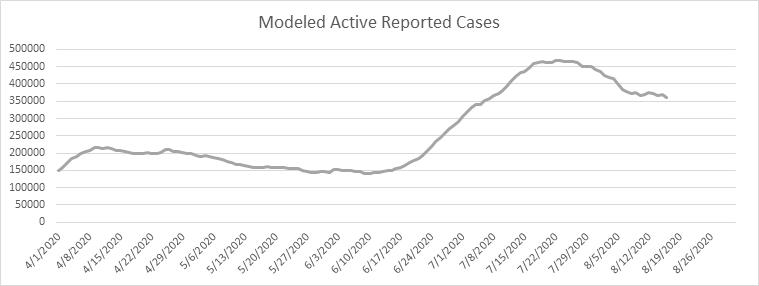
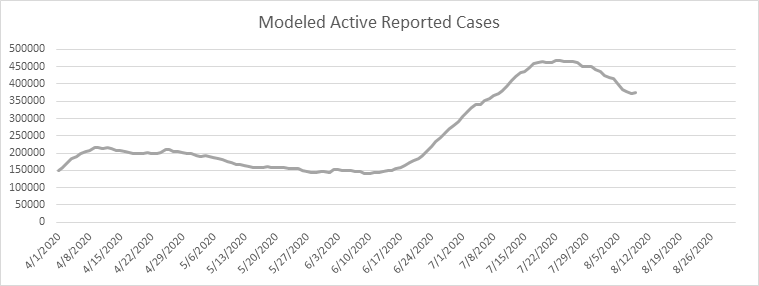
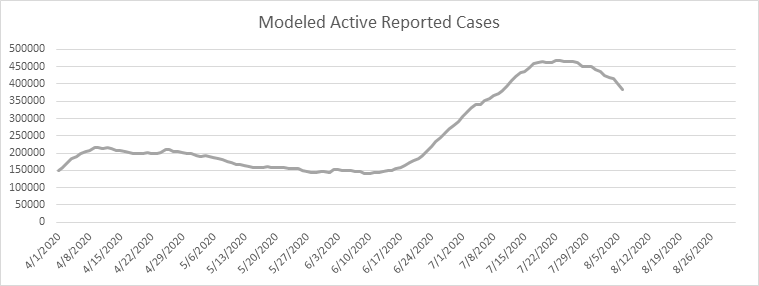
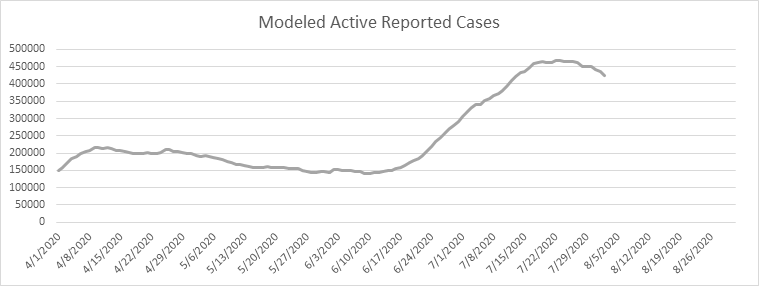
Here is the national picture. Active cases have been trending upwards for nearly 30 days. As always, it’s spotty, with some states seeing increases, and some in continued decline. I mentioned in my last report that I continue to be puzzled by the phenomenon where geographical areas will reach a low level of COVID prevalence, and, rather than continuing the decline, it remains stationary. Will this ultimately be like the common cold (another Coronavirus), where a certain percentage of the population always has it?
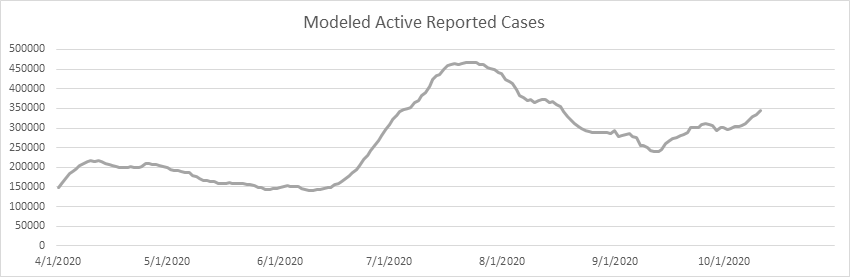
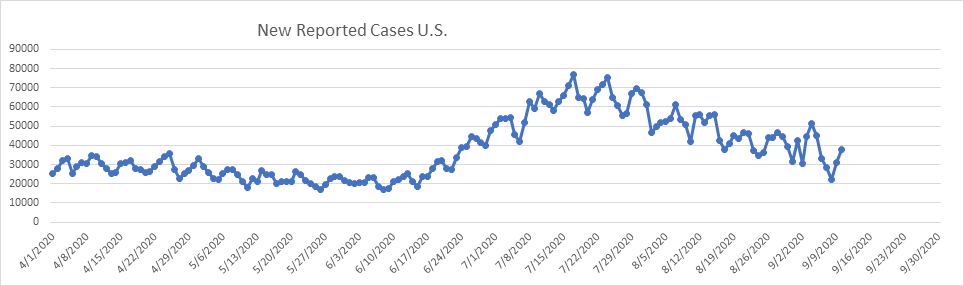
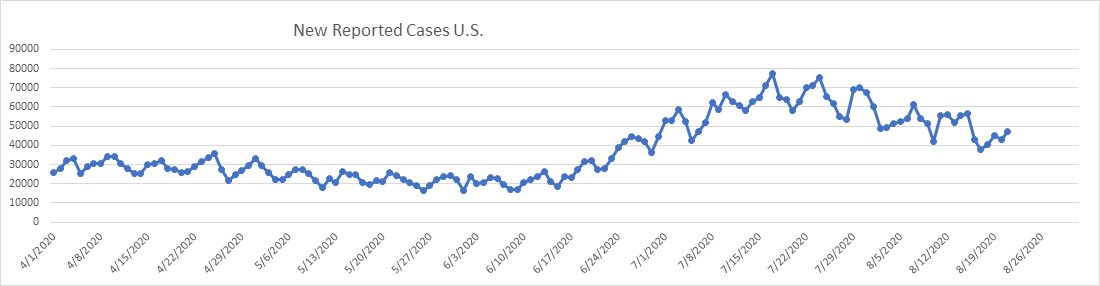
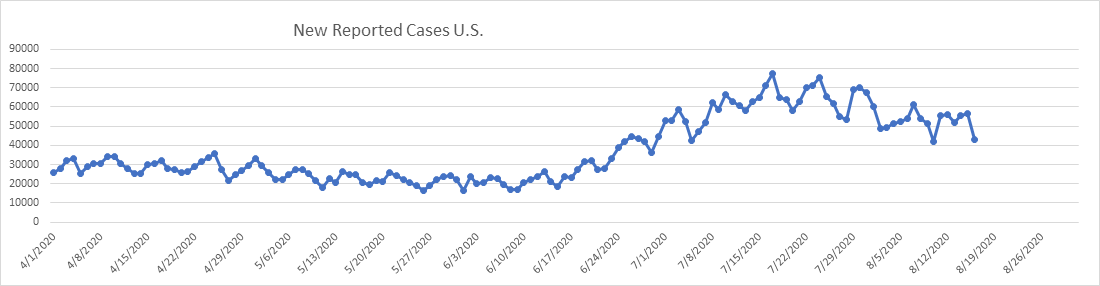
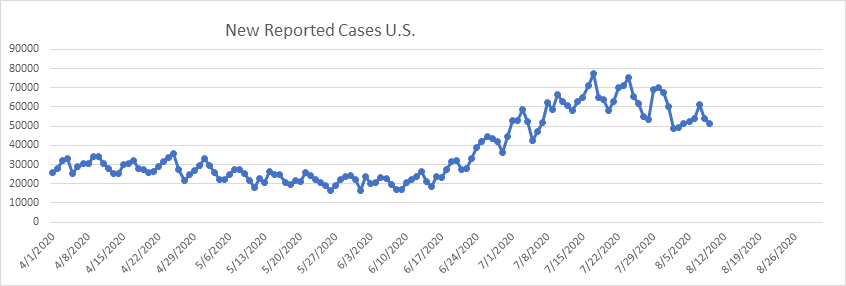
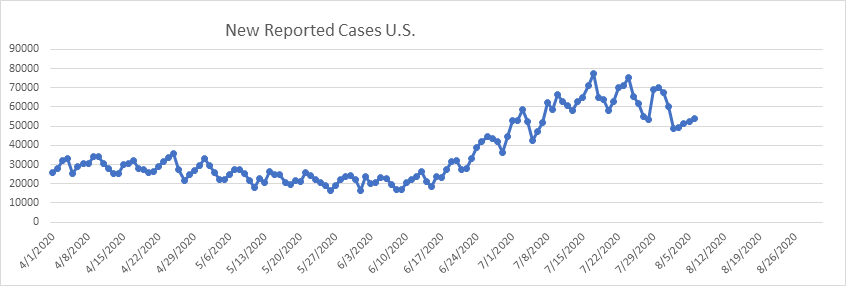
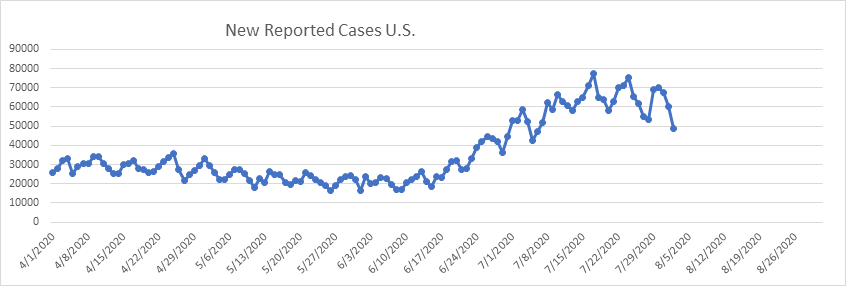
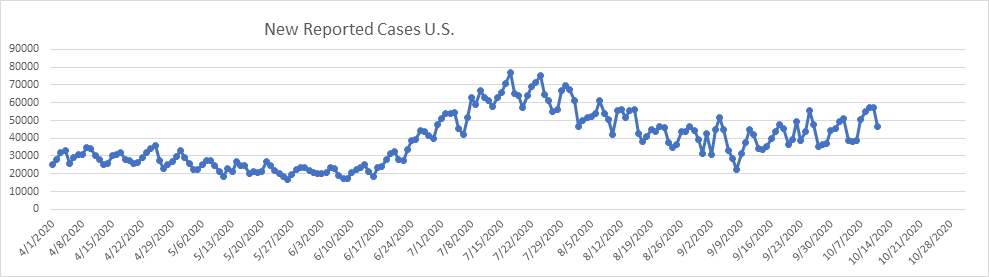
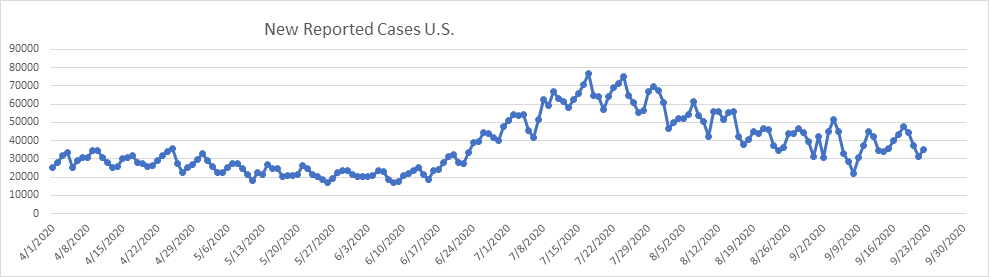
Look at the daily new cases. A strong trend upward since the localized low of early September.
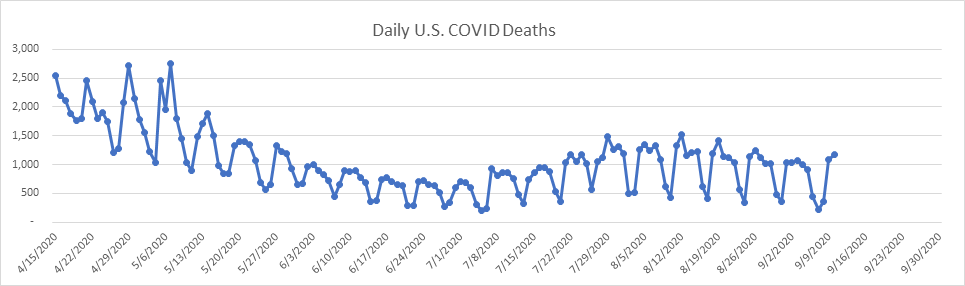
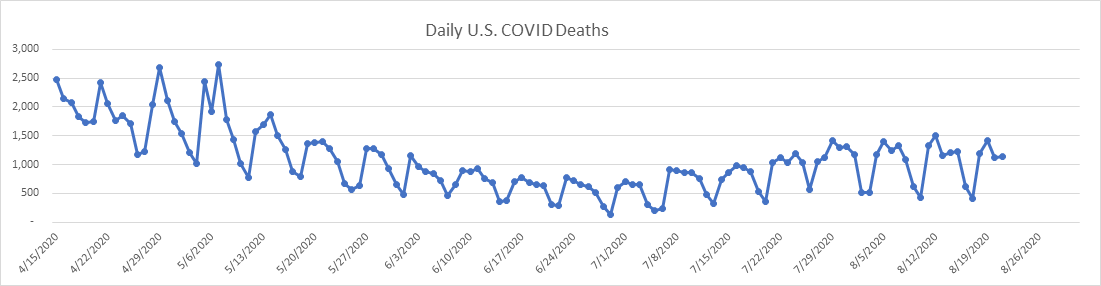
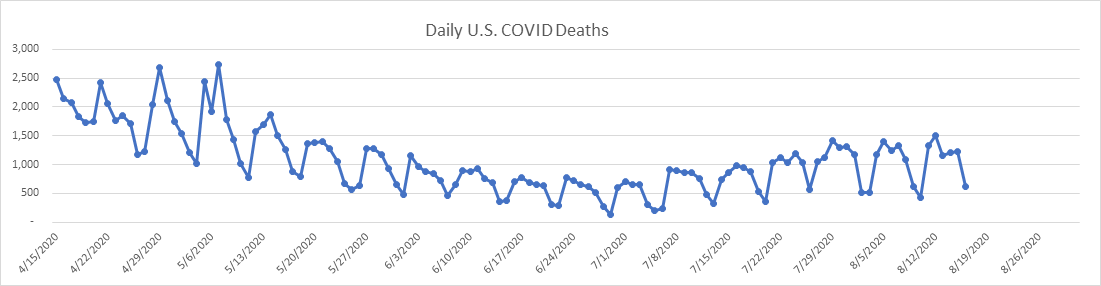
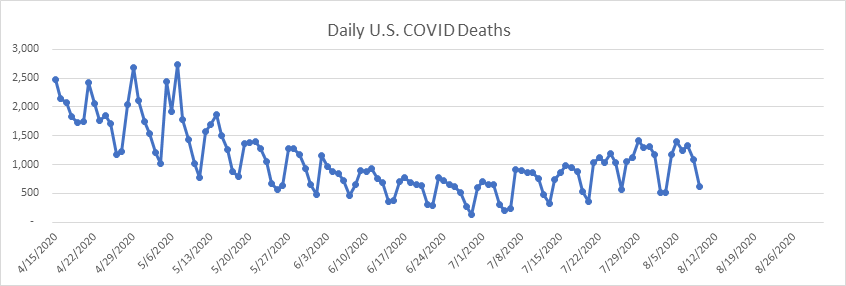
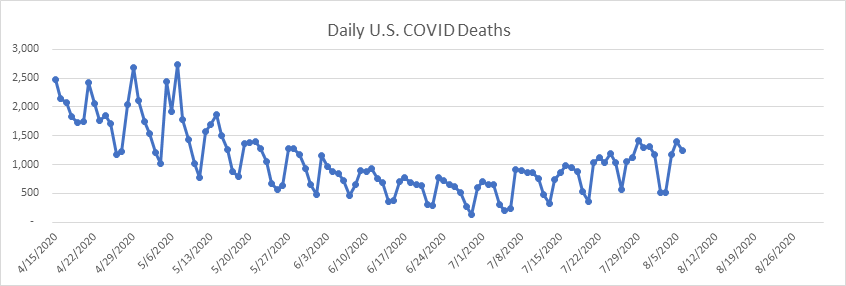
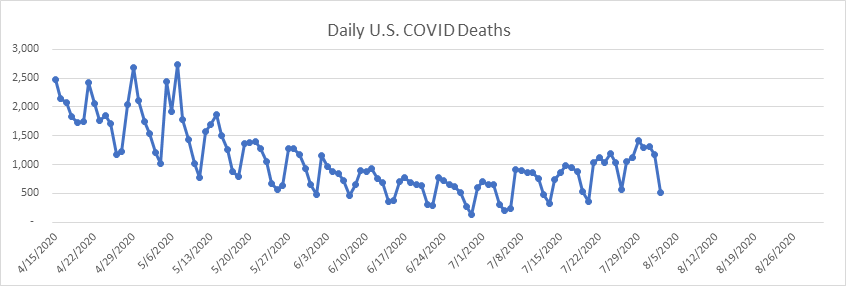
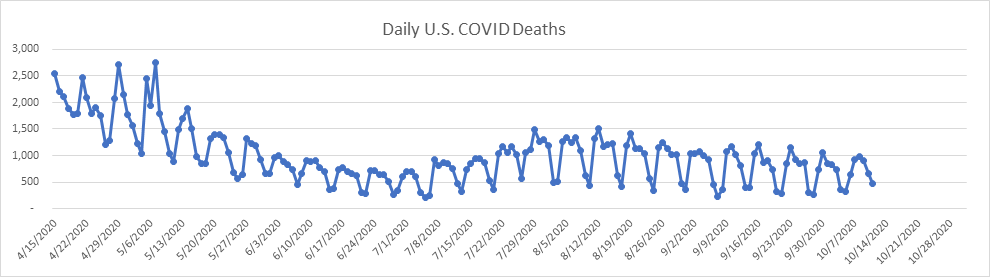
The daily death count is exhibiting a very slow decline for the better part of two months now. Here is the picture:
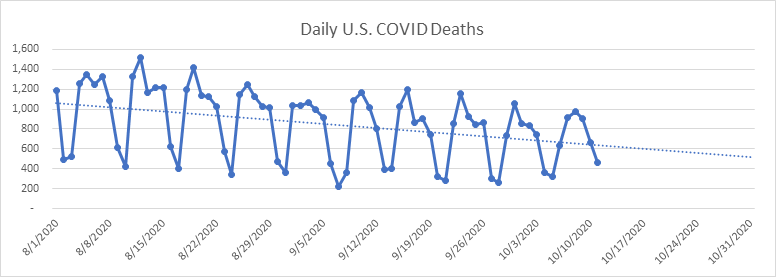
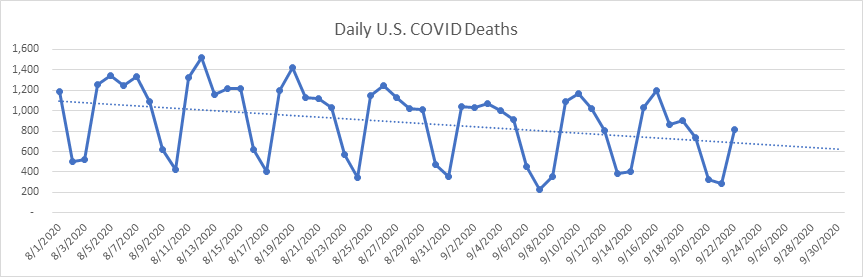
If we isolate the trend since August 1st it becomes obvious. I don’t see anything that threatens to derail this trend.
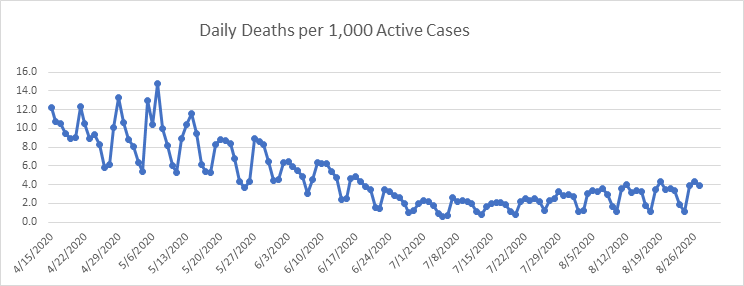
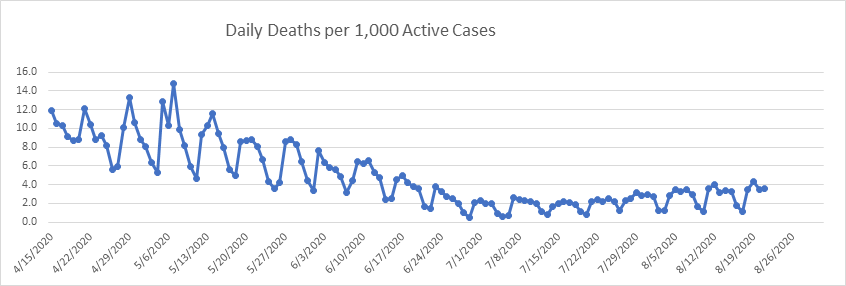
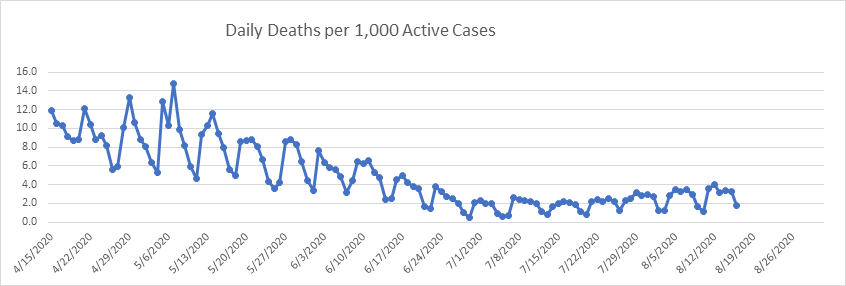
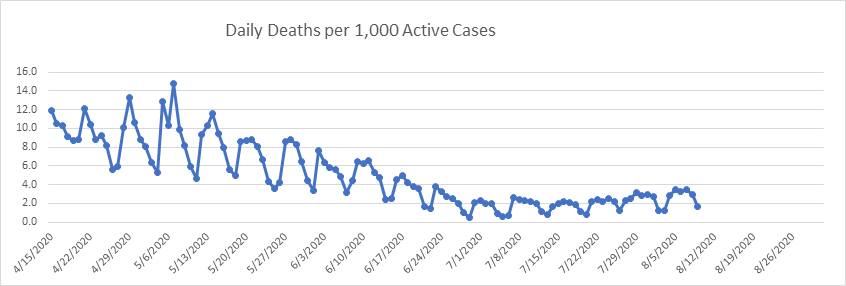
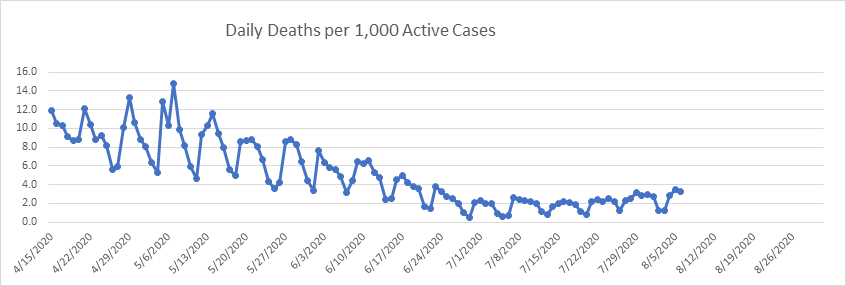
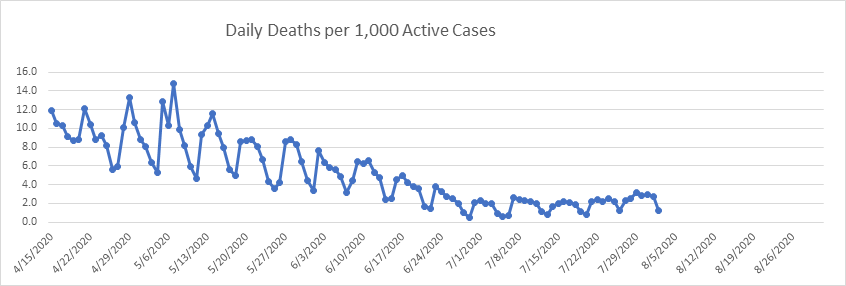
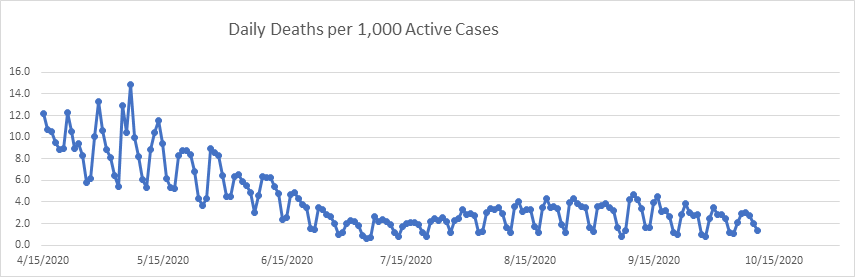
Daily deaths per 1,000 active cases is the best measure of the deadliness of this disease in my opinion. It’s been relatively stable for 2 months now, and decidedly below April and May levels.
On to the states.

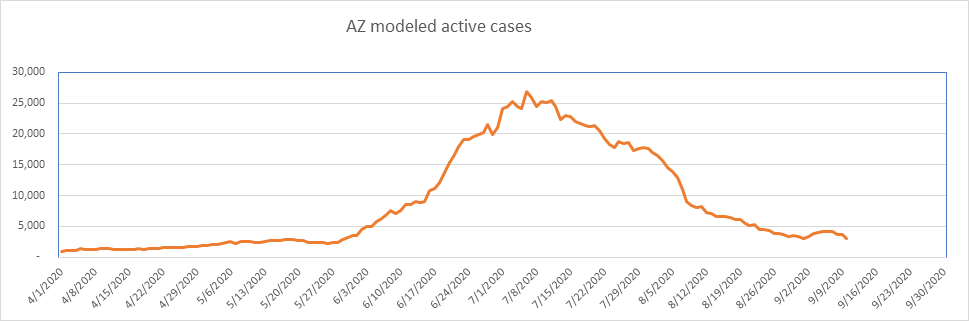
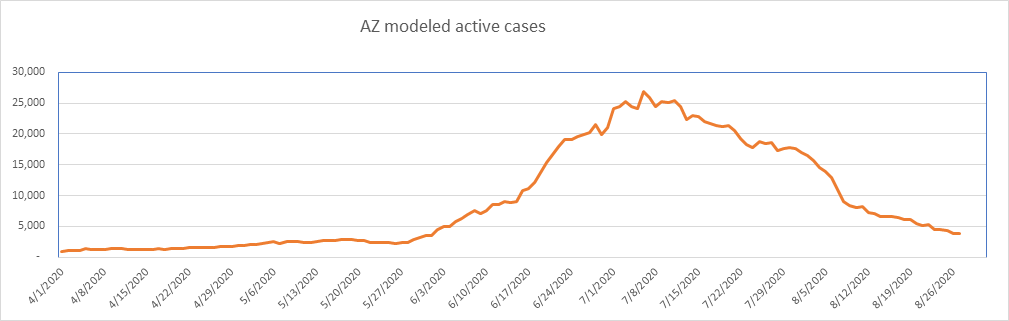
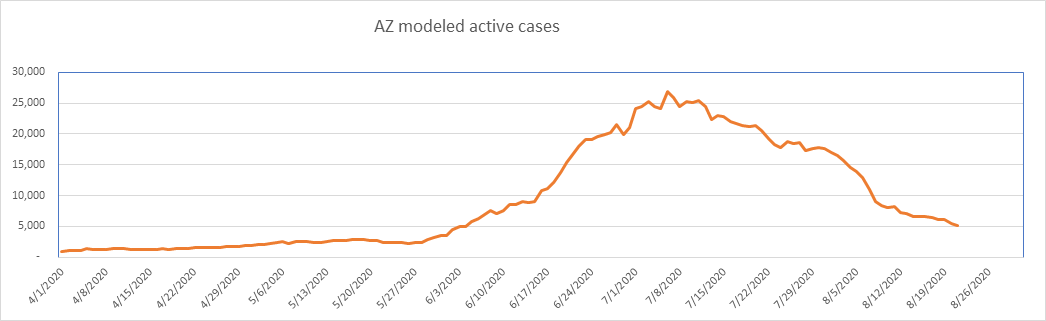
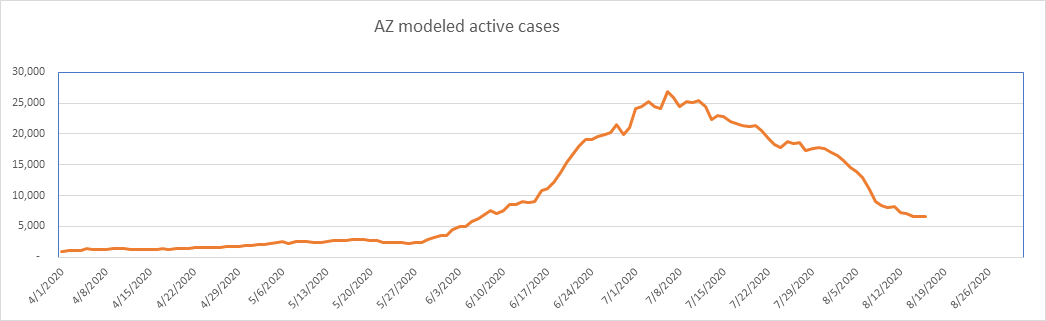
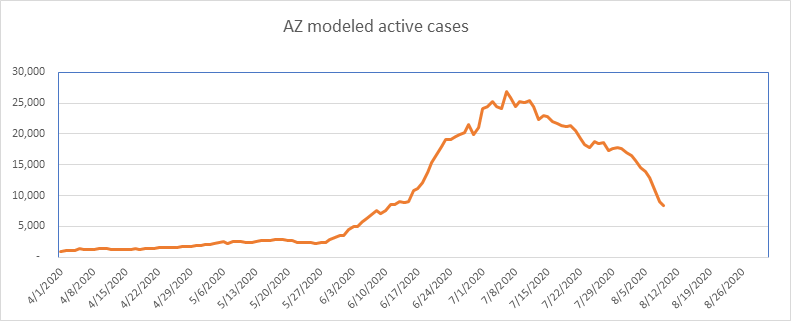
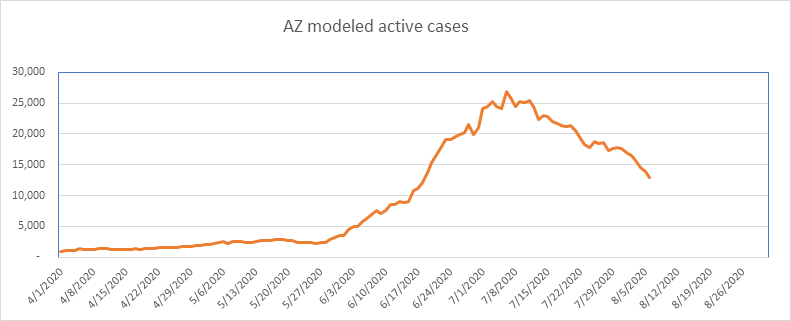
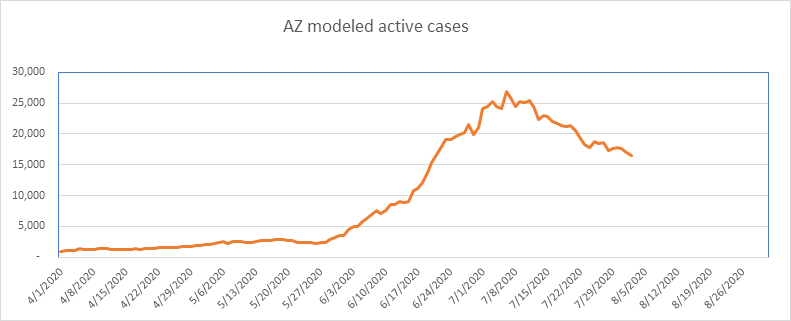
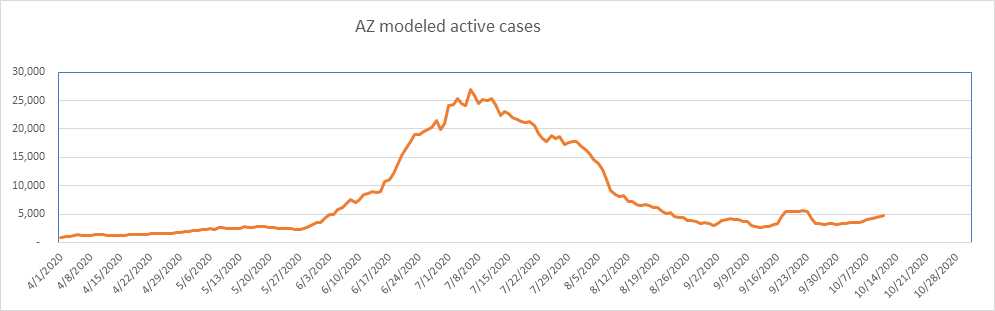
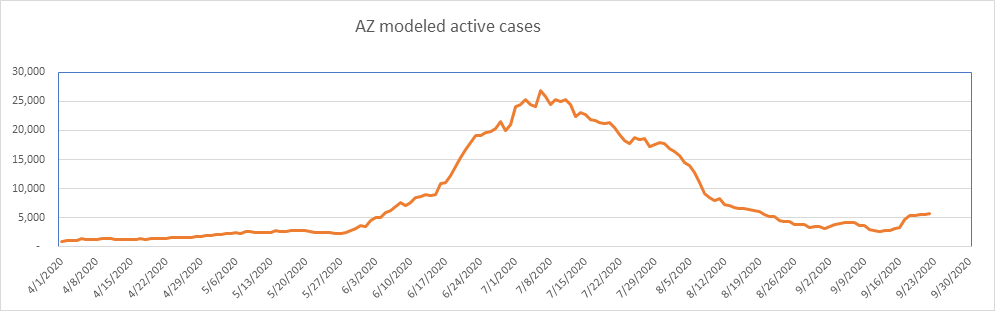
Here is Arizona. They changed their reporting protocol on September 17 to add the results of antigen testing. The mild upward drift is a result of this definitional change. Arizona continues with a fraction of the COVID they had in July.
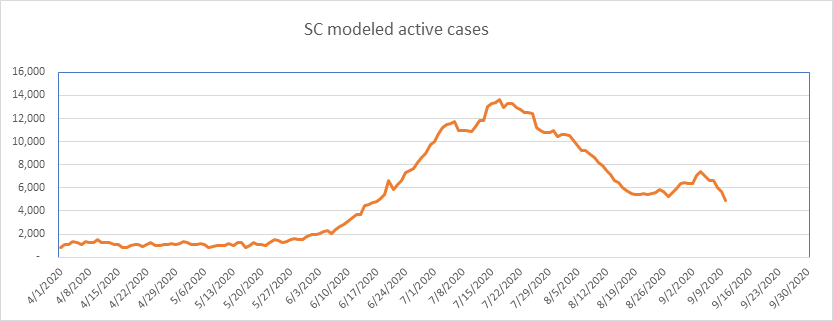
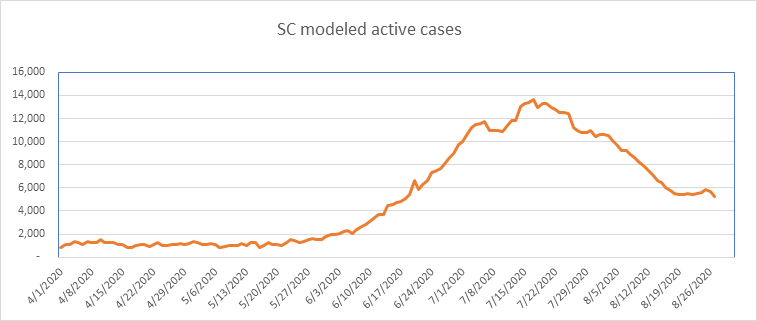
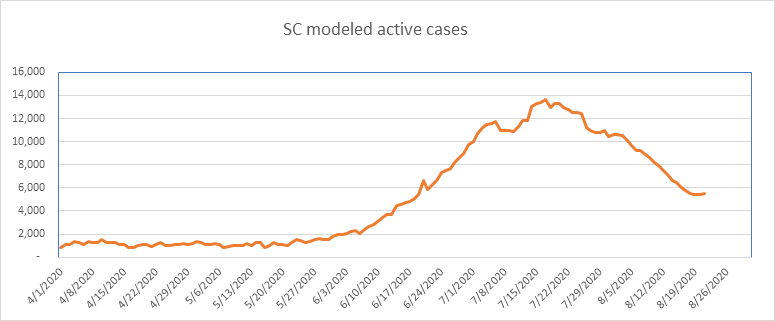
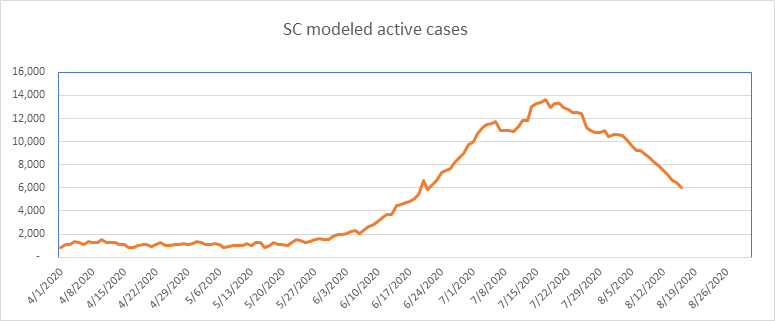
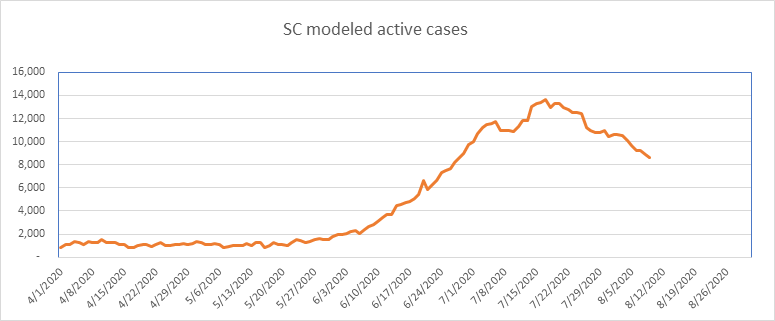
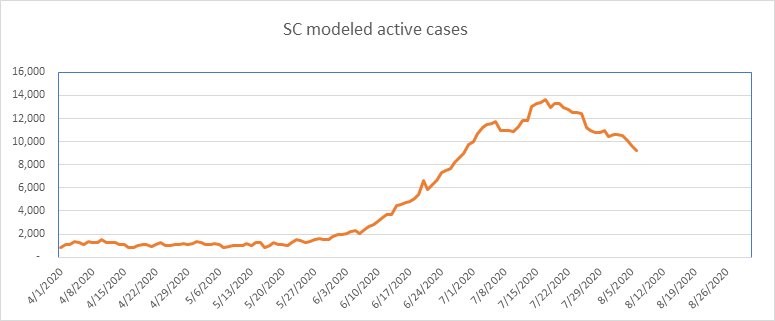
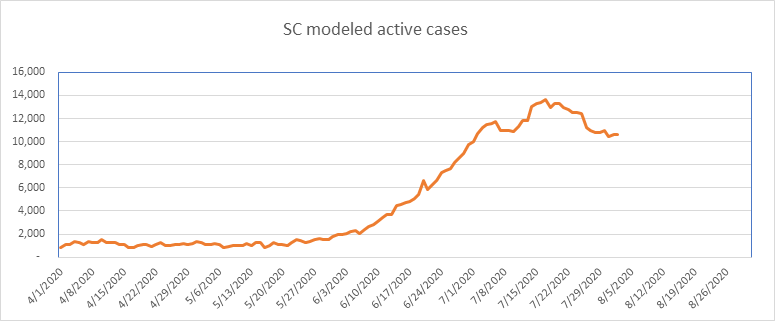
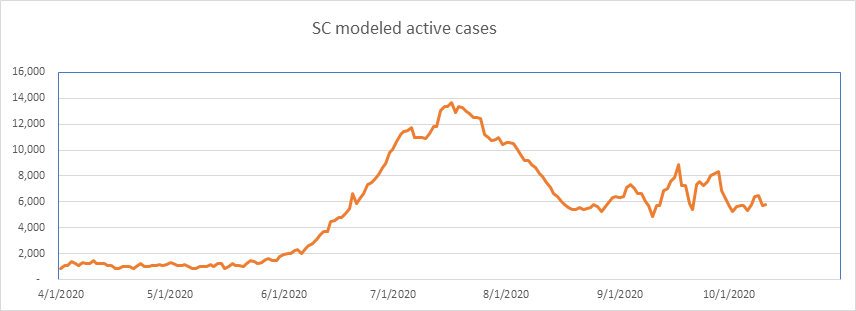
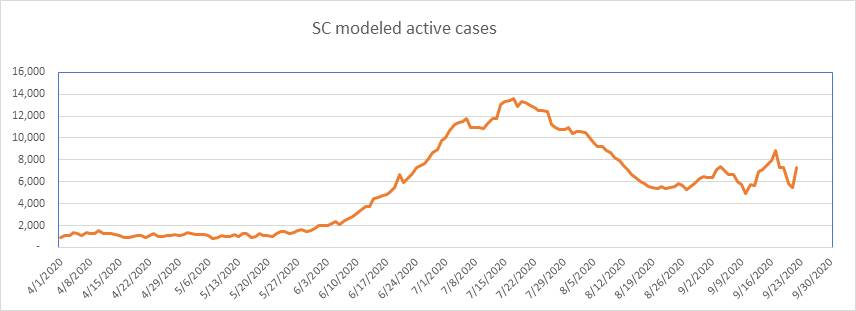
SC has been relatively flat for 6 weeks. Note that South Carolina double counts cases, as they treat each positive test as a new case (per The Covid Tracking Project).
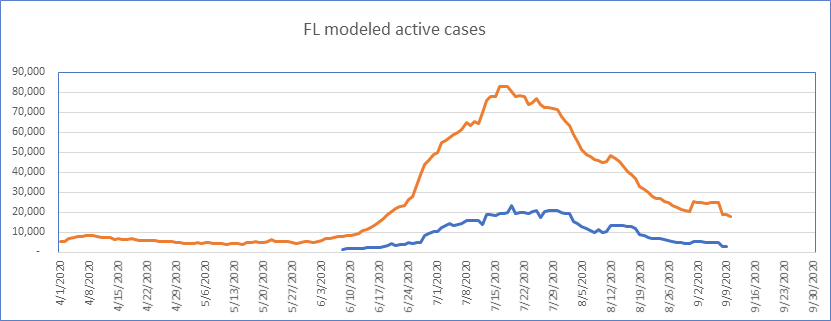
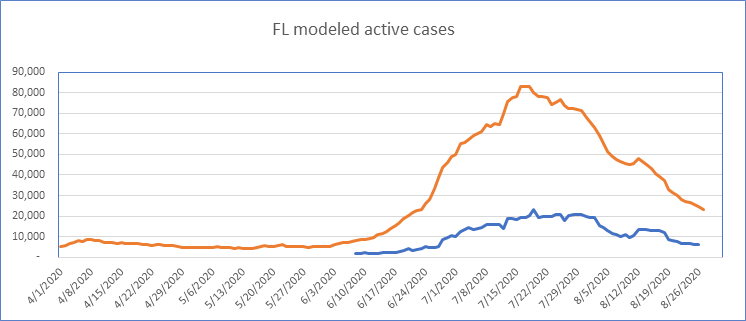
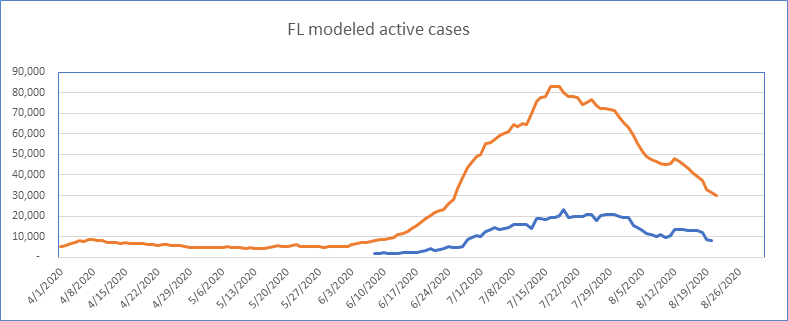
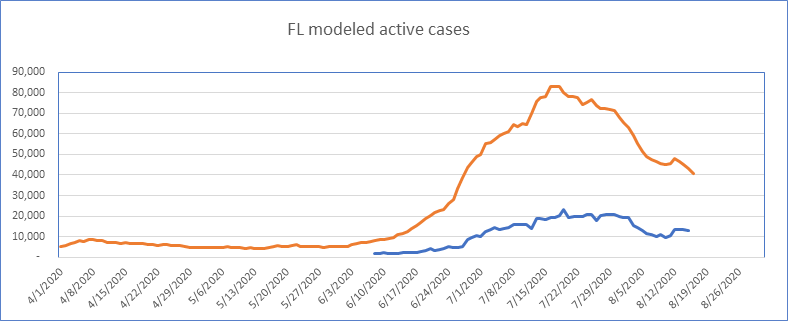
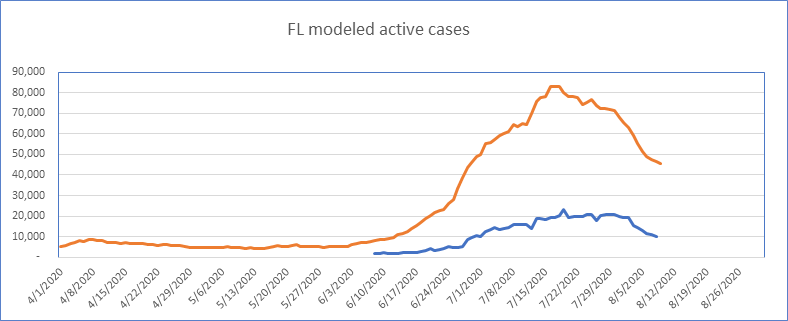
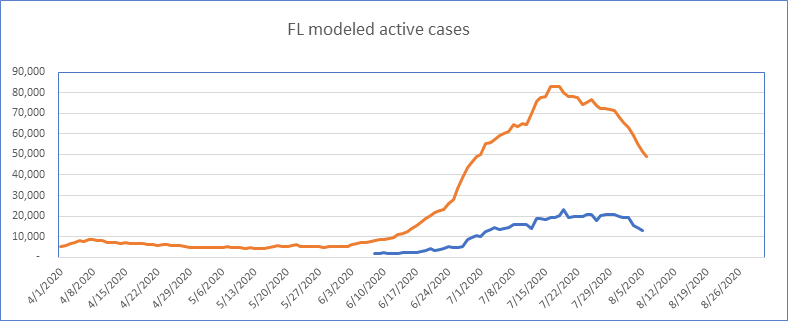
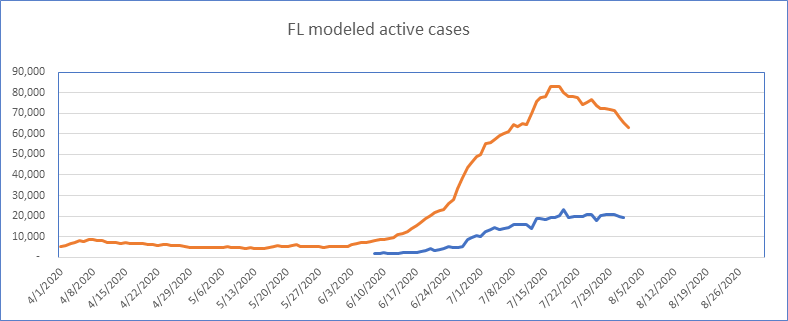
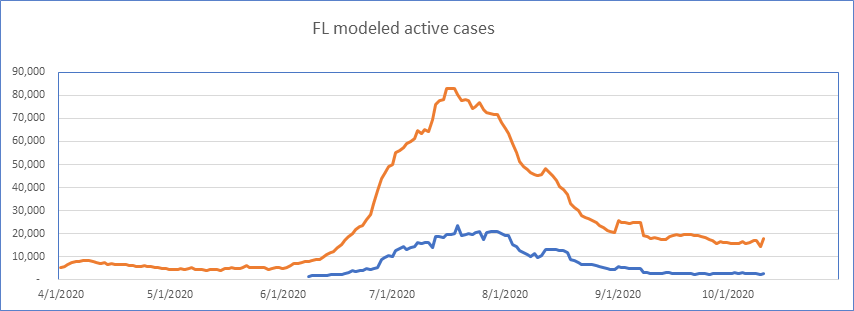
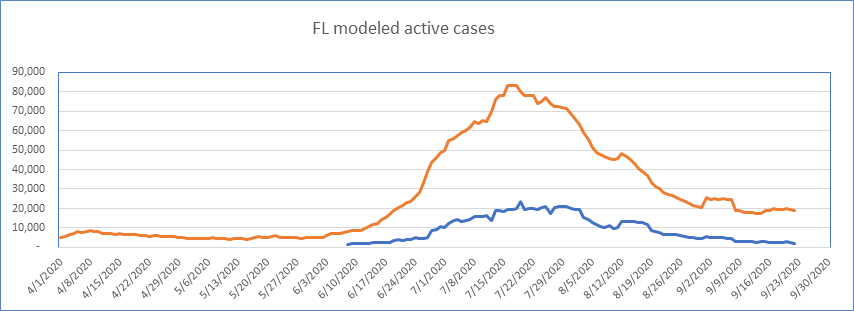
Here is Florida – down dramatically from the top, and fairly flat for a month. Same for Miami.
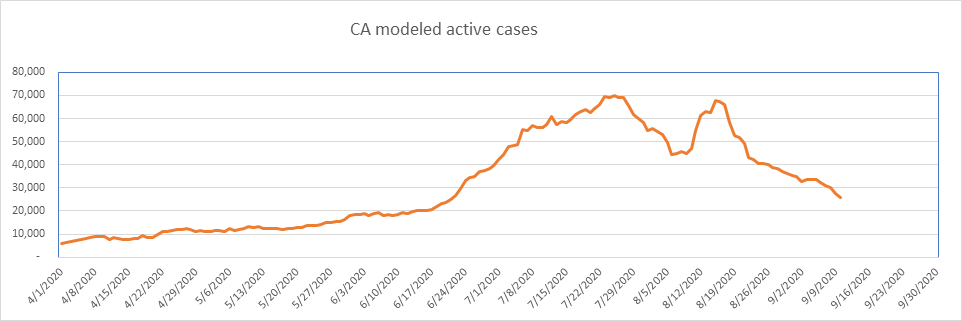
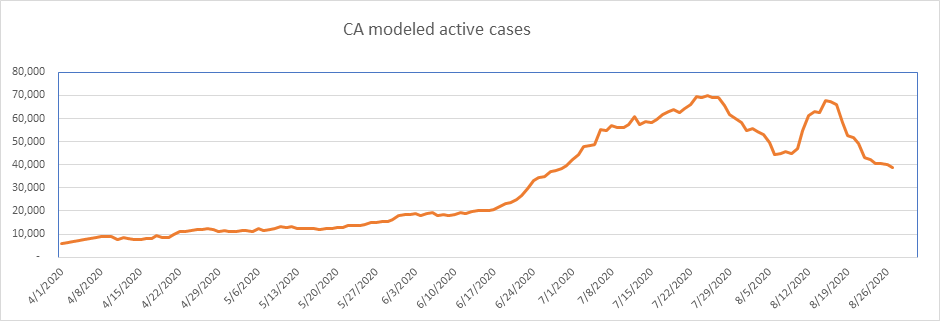
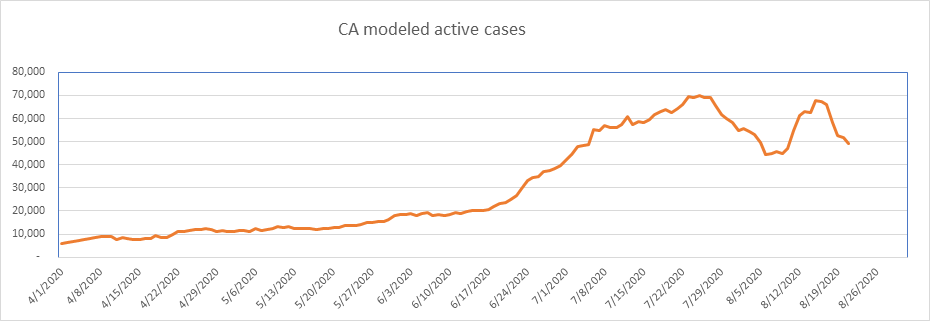
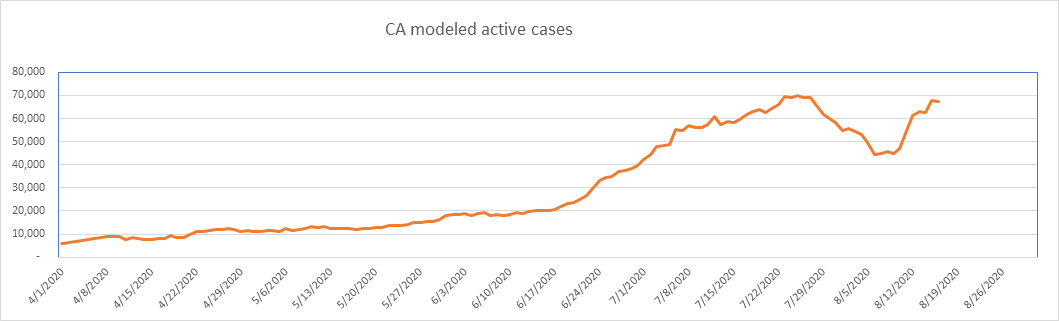
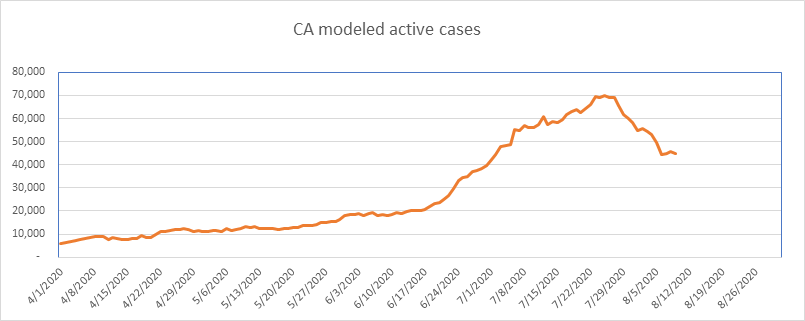
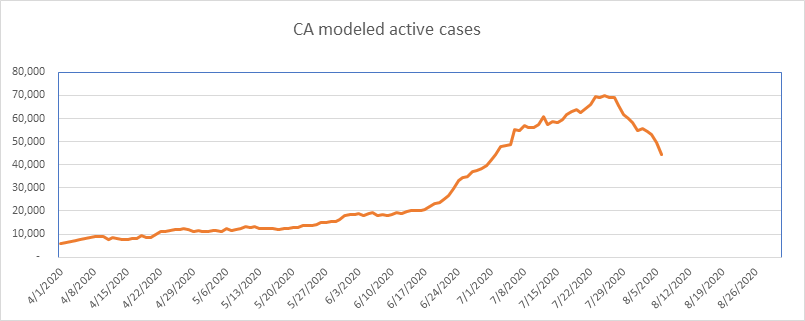
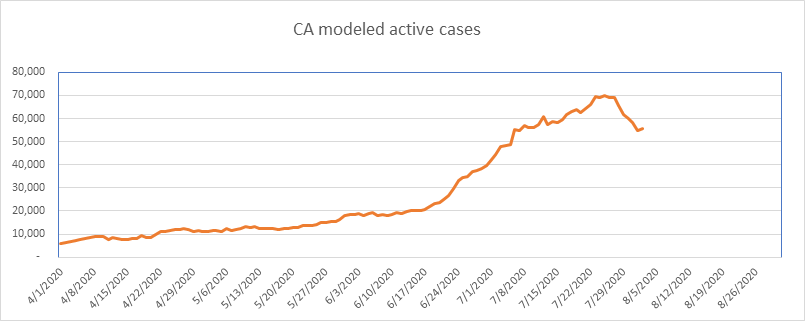
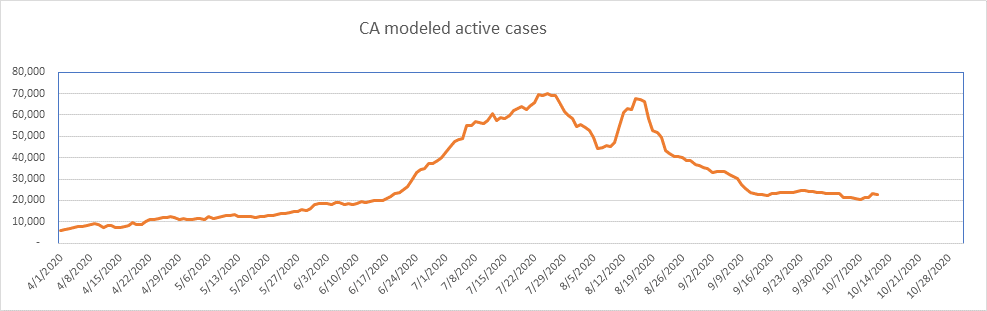
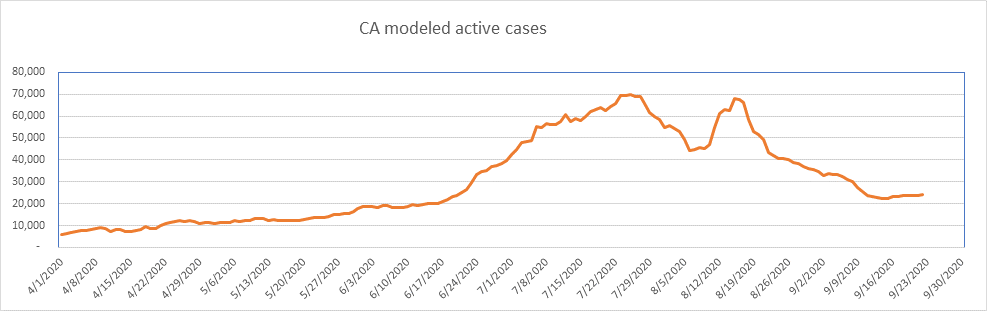
California has had a great recovery, but now flat for the past month. College testing? I think so, but don’t know for sure. As always, I need to report that California is one of the states that counts tests rather than people.
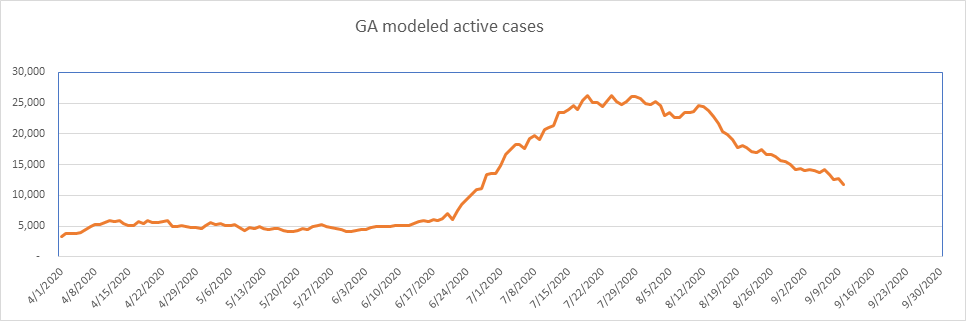
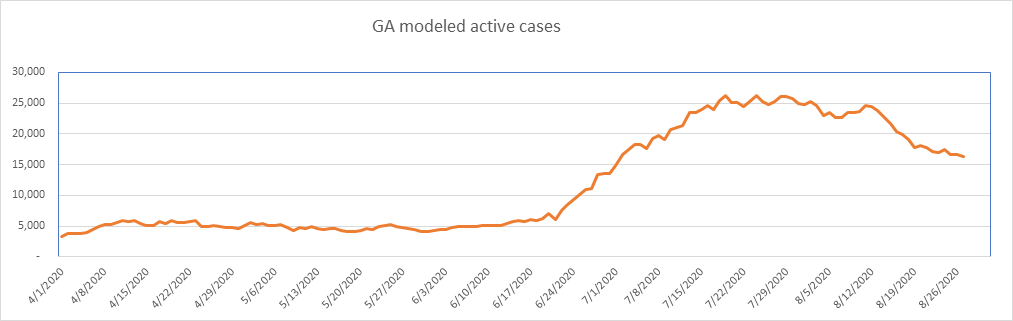
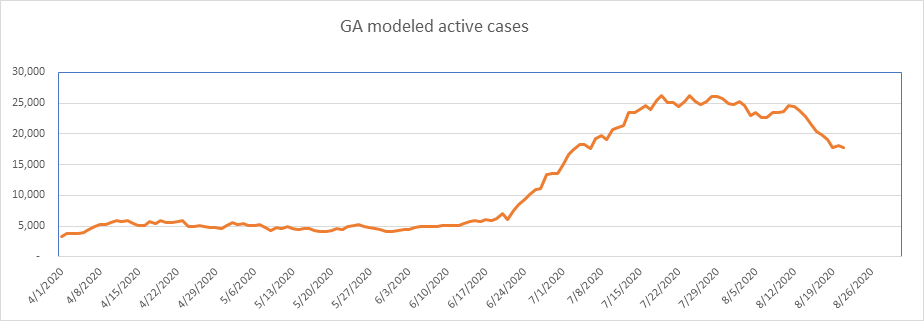
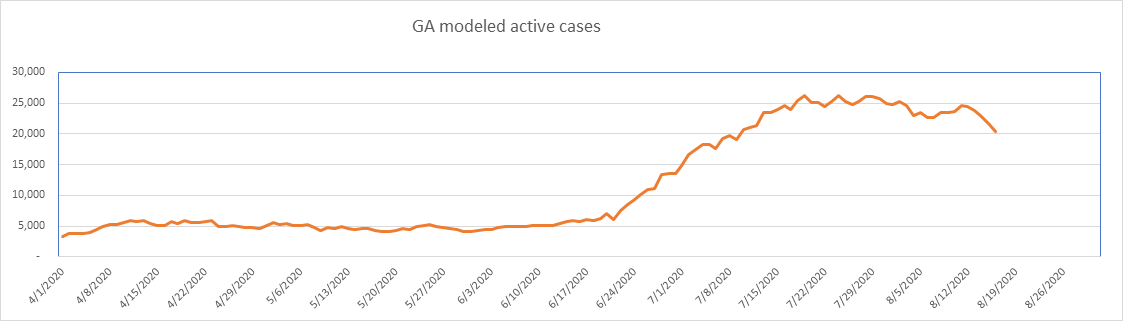
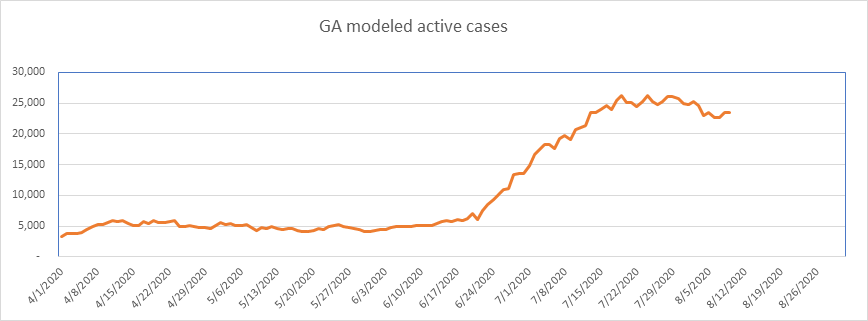
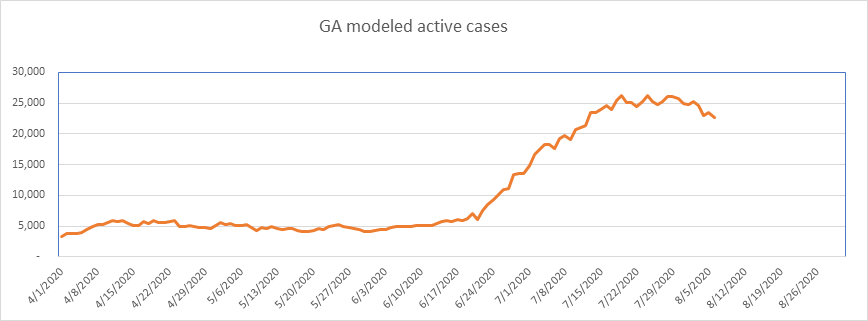
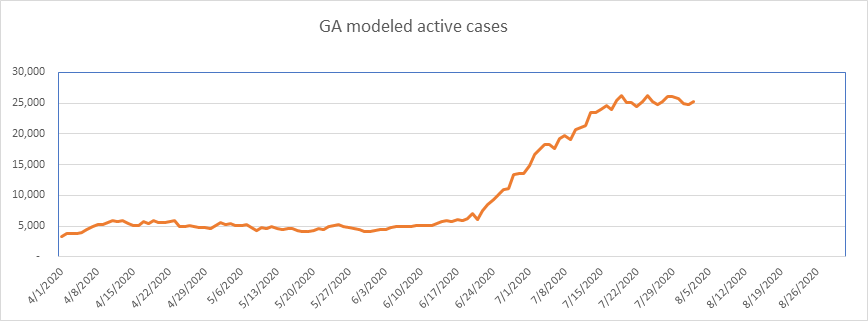
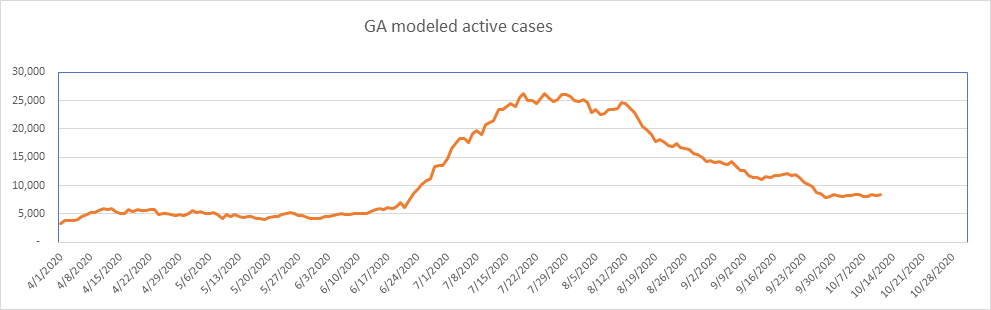
Georgia is still doing pretty well. Flat for a couple of weeks, but no increases. Georgia hit a high of 0.25% of the population, so I’d be surprised to see any real increases here. GA is now down 66% from the peak. Note here again, the case numbers are exaggerated. Georgia counts each positive test as a case (according to The COVID Tracking Project).
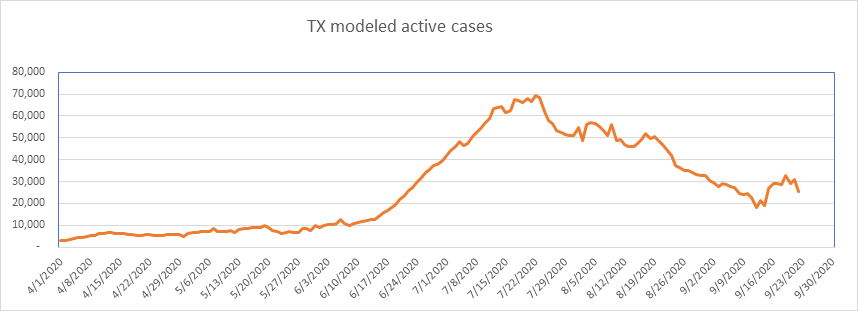
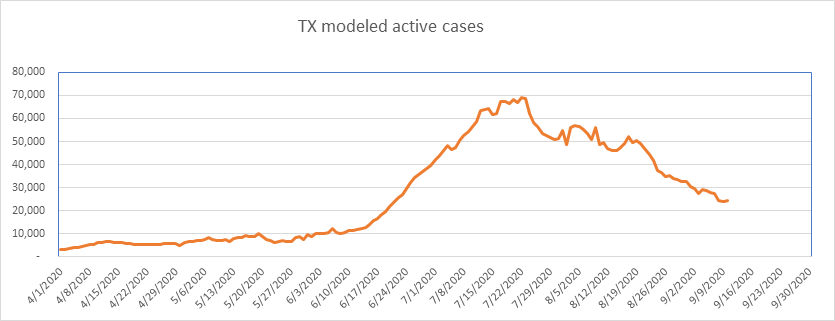
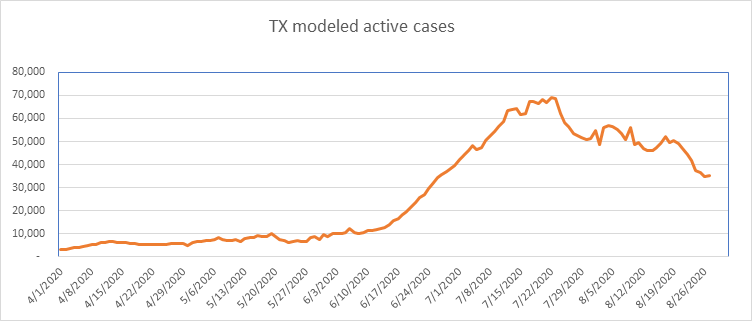
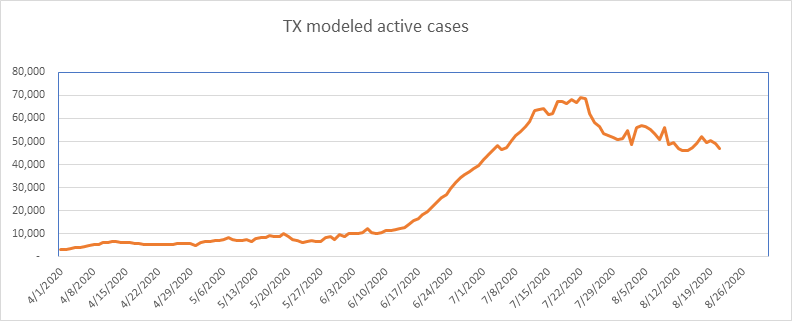
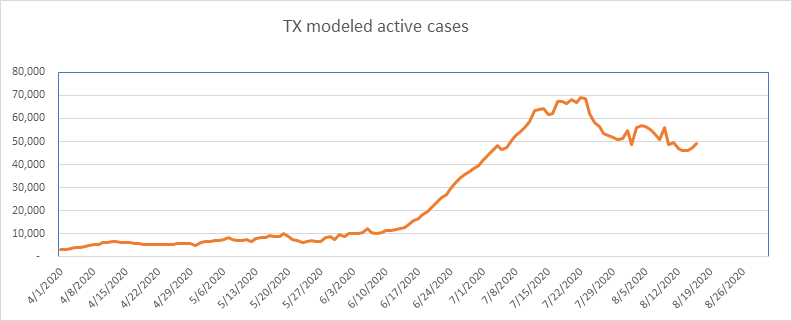
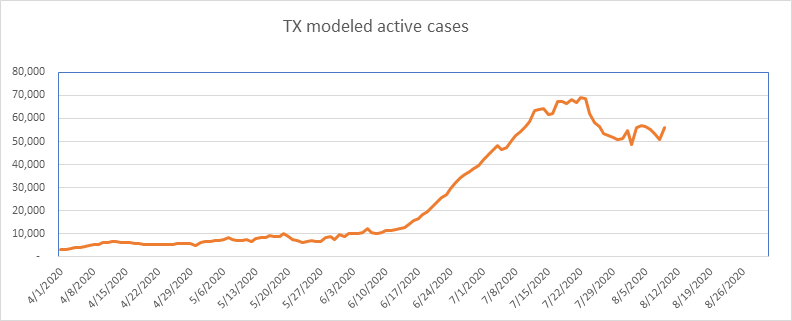
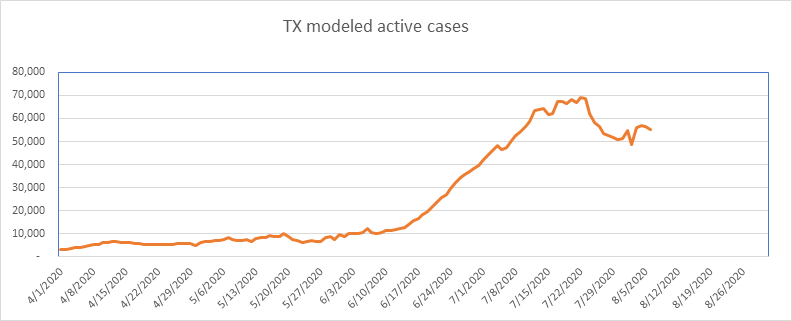
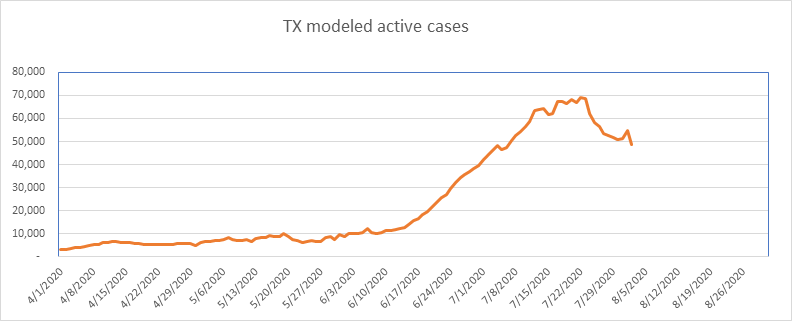
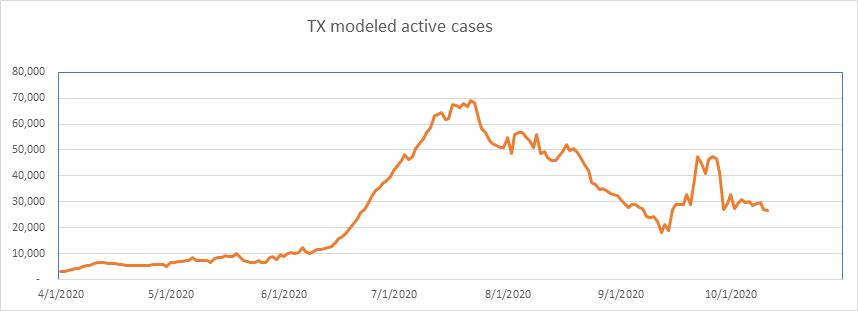
Texas reported nearly 22,000 historical cases around September 23rd, and this skews the data. Note that Texas also reports positive tests as cases, so is doing some level of double counting (per The COVID Tracking Project).
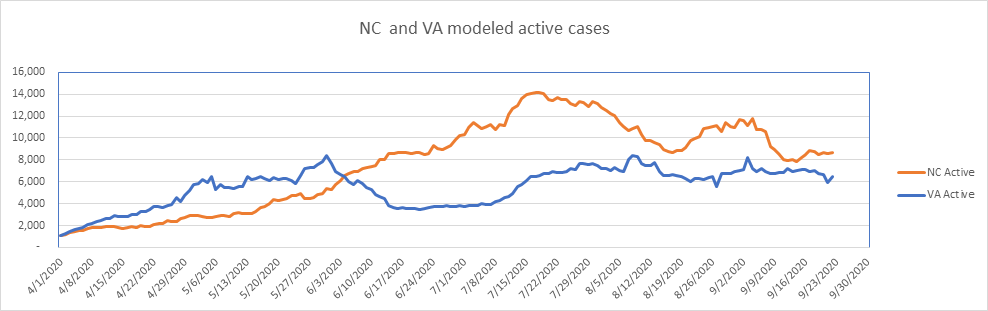
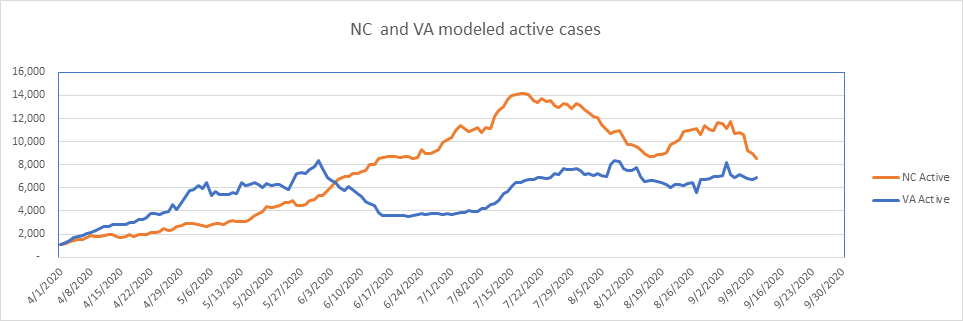
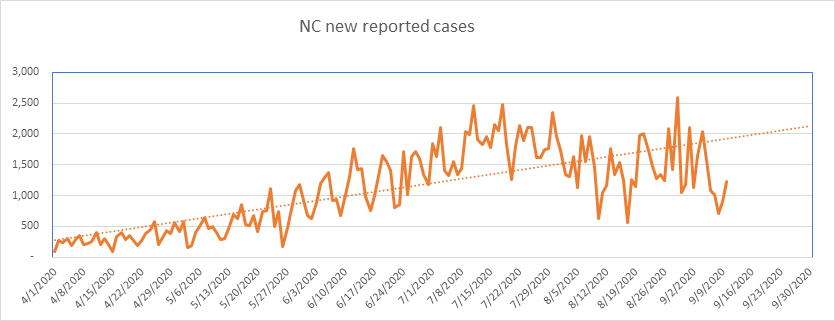
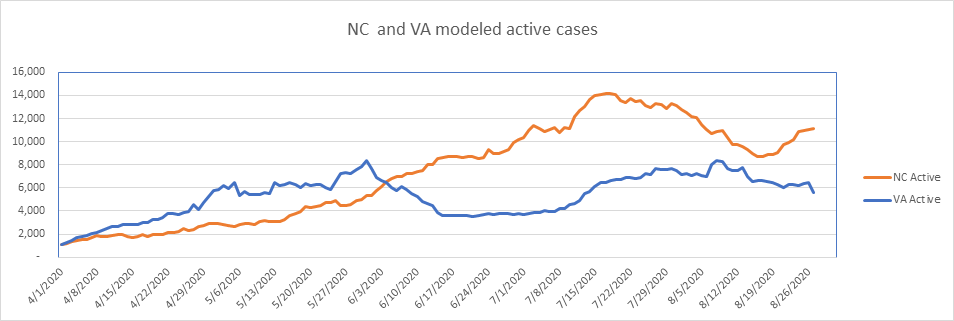
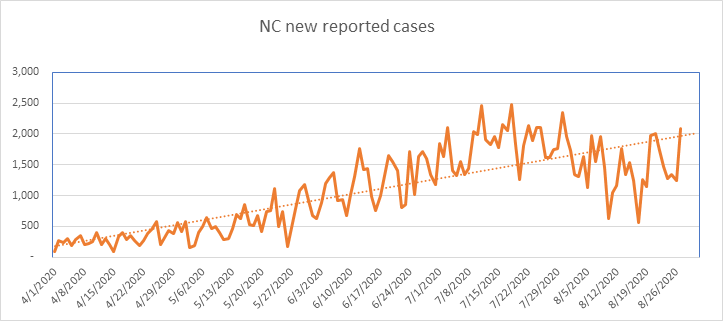
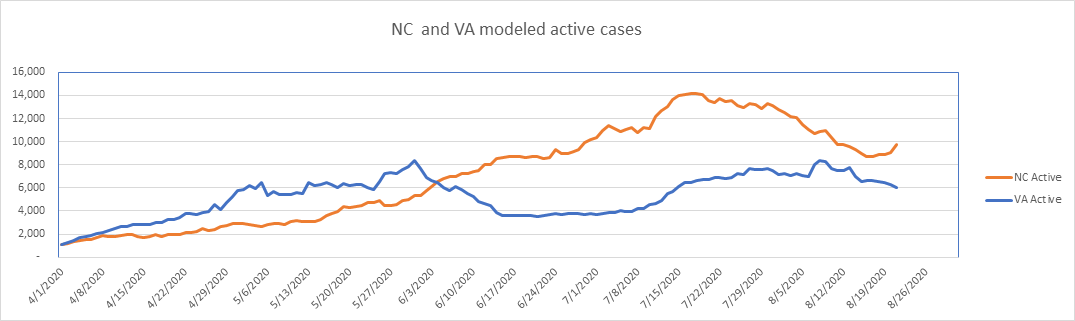
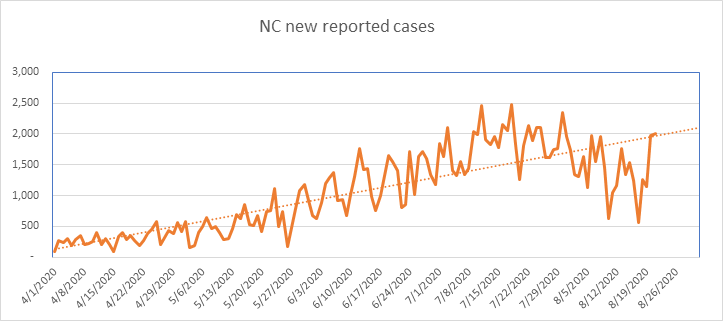
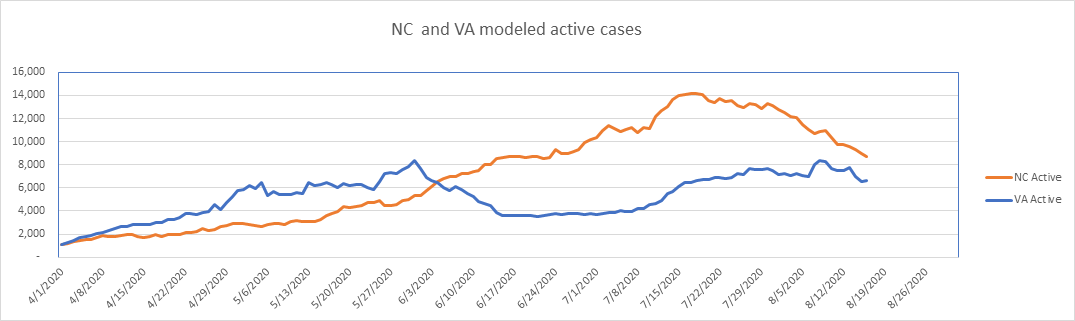
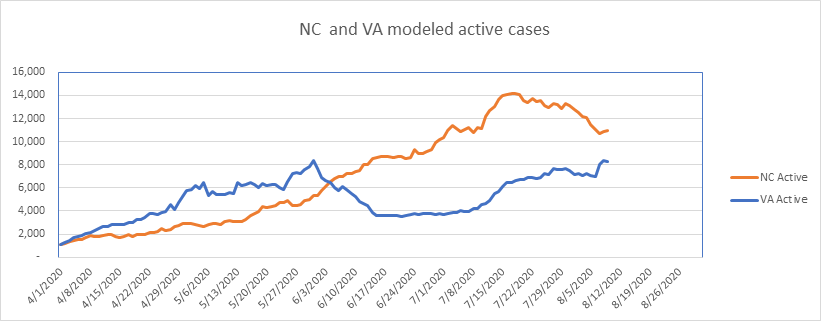
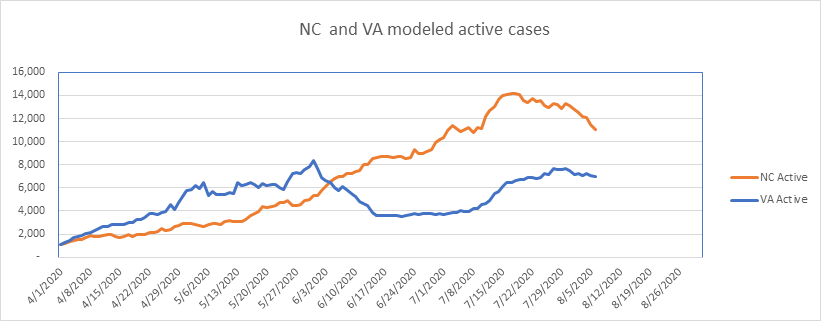
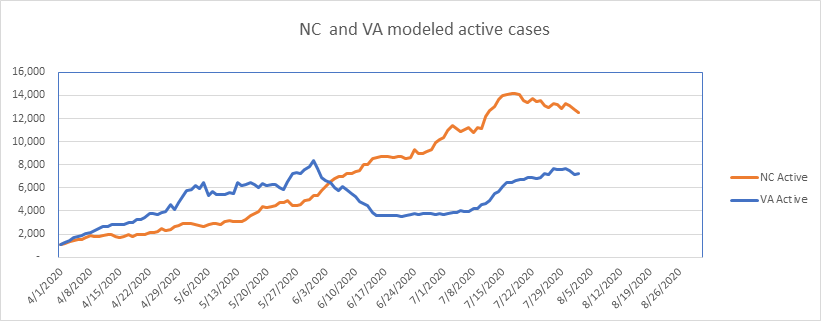
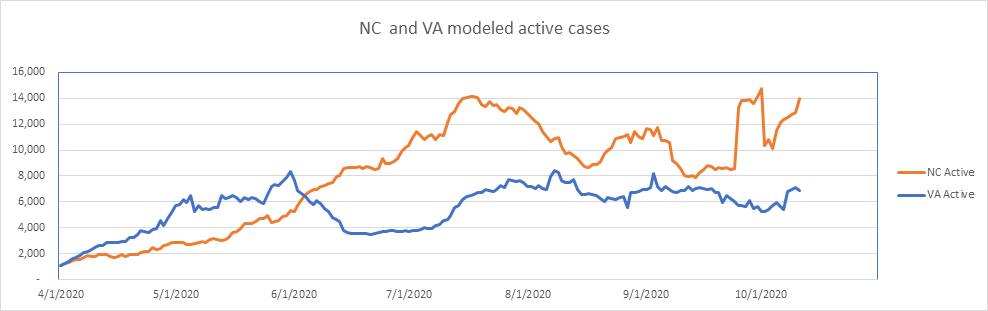
NC and VA tend to track each other, but NC reported an additional 4,563 “probable” cases on September 25th, which skews the results upward inappropriately.
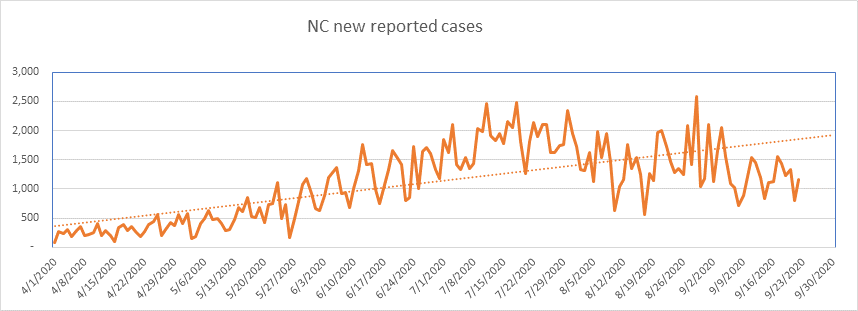
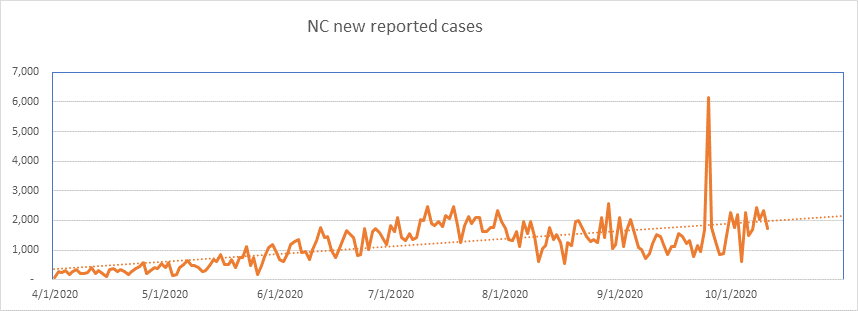
Here is the daily new case count for NC – you can see the anomaly. I should point out that this is not the fault of NC. They simply report the total each day, and the new totals are picked up by the reporting sites and catalogued as new.
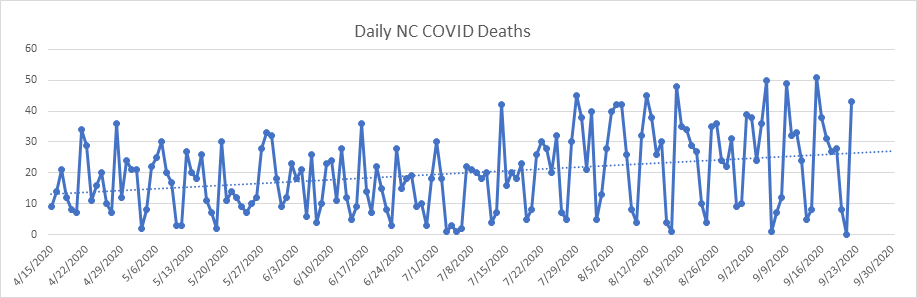
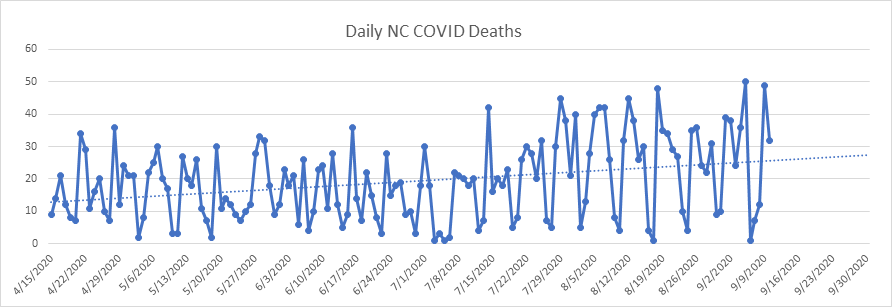
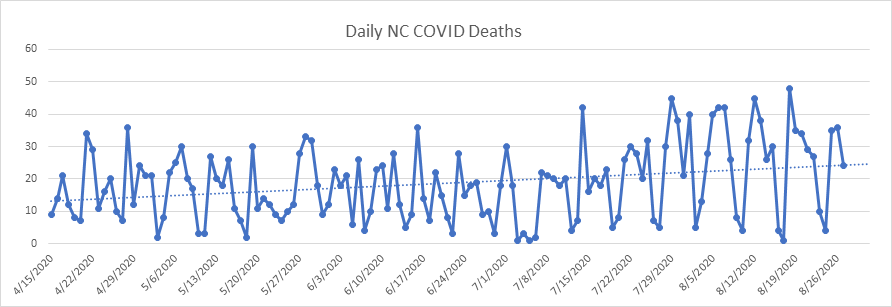
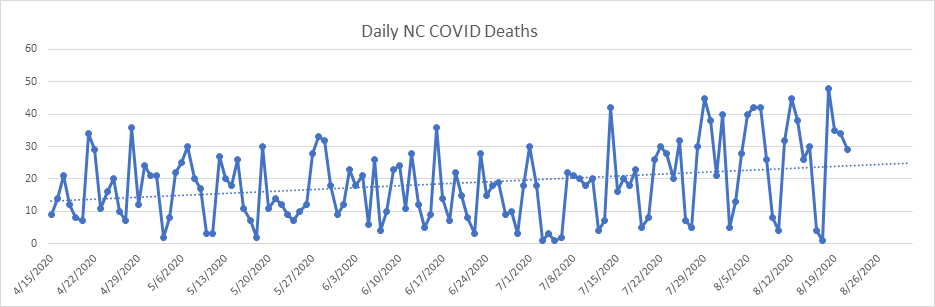
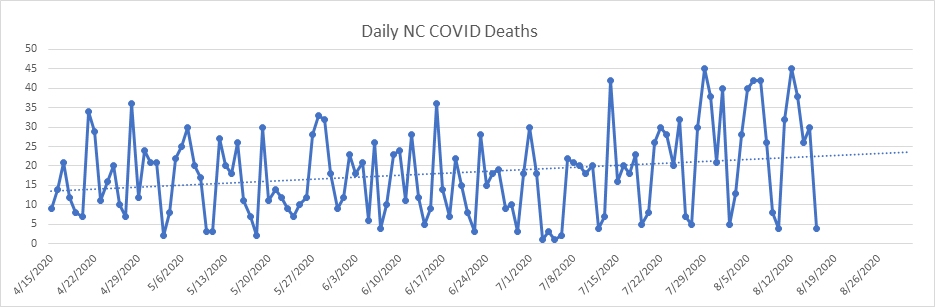
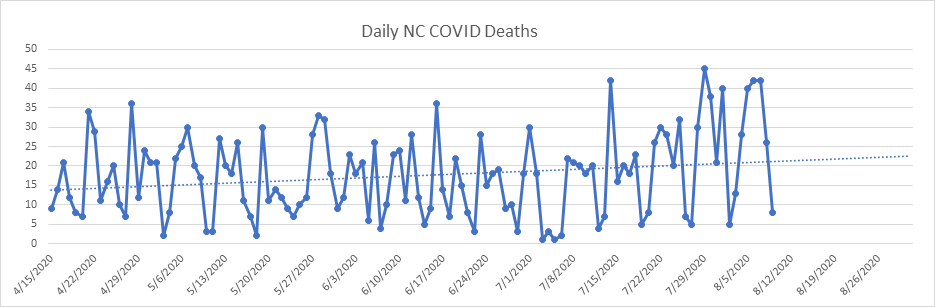
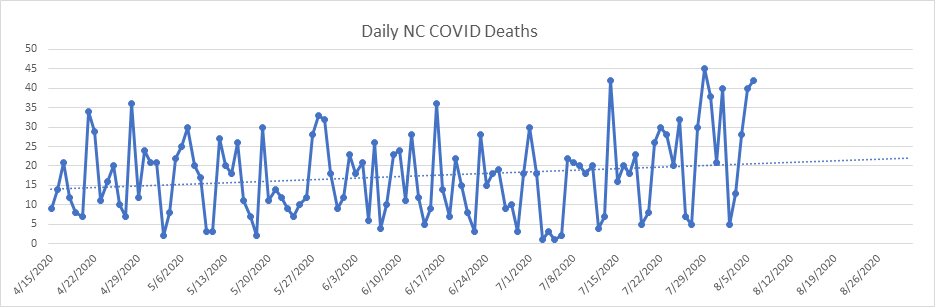
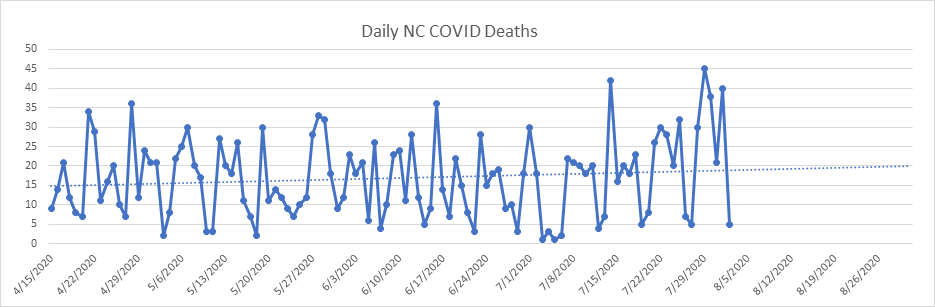
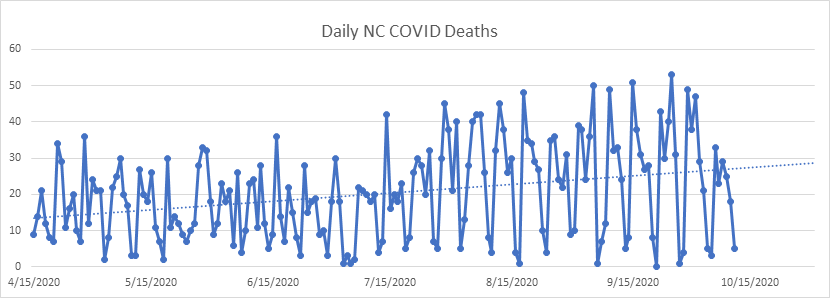
Here is the daily death report for NC, flat for months now.
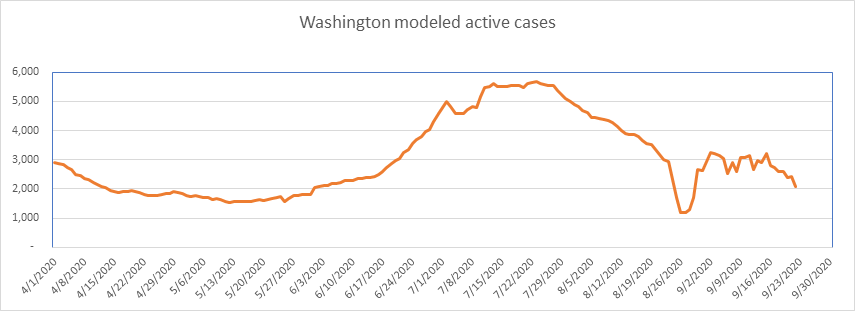
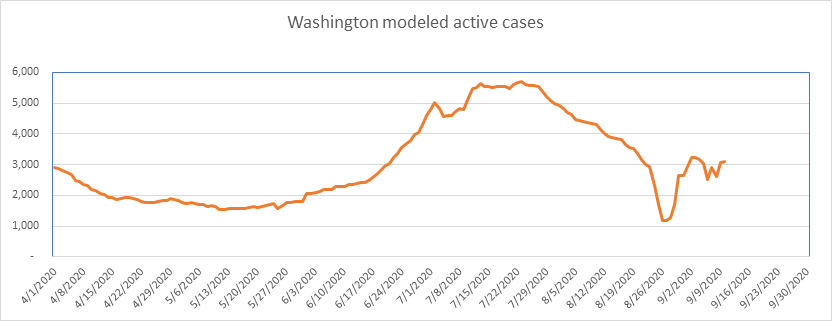
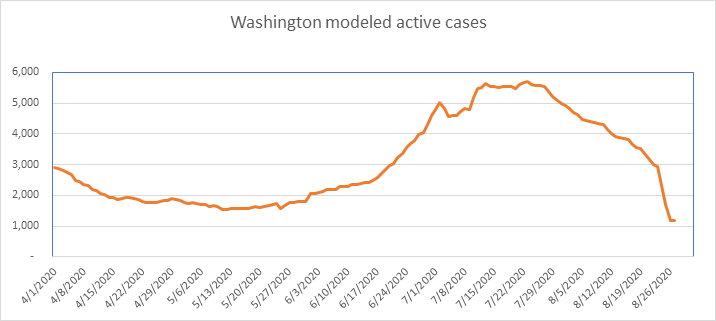
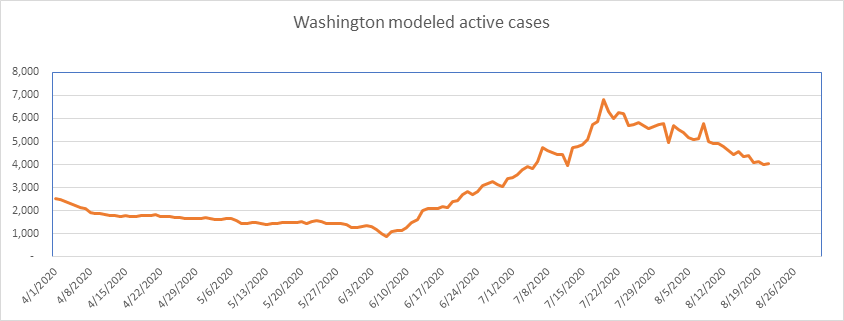
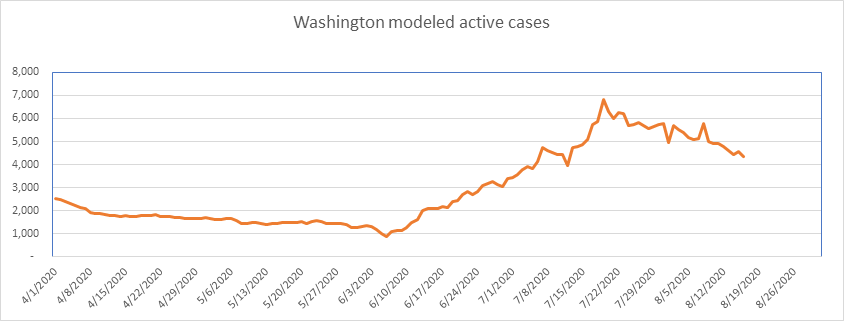
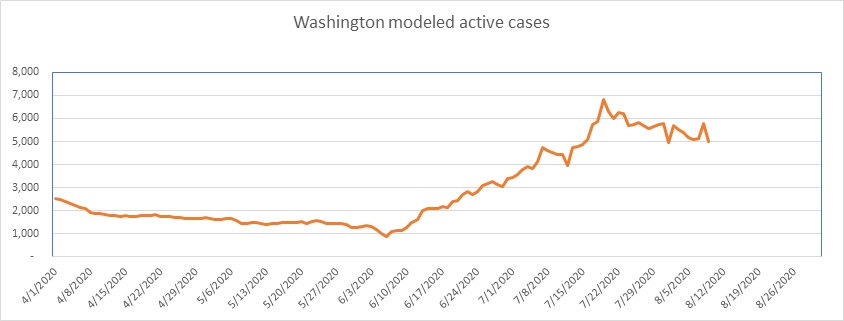
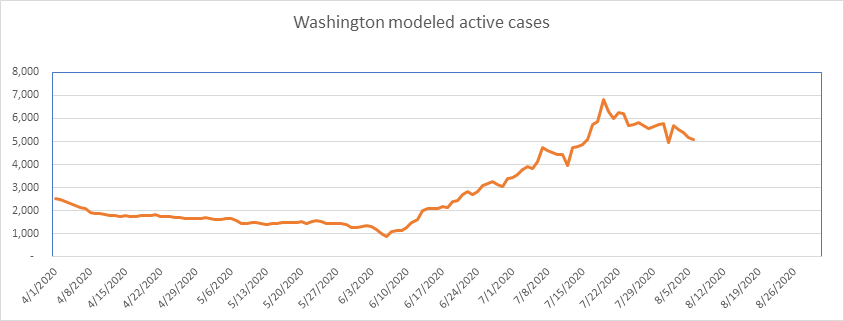
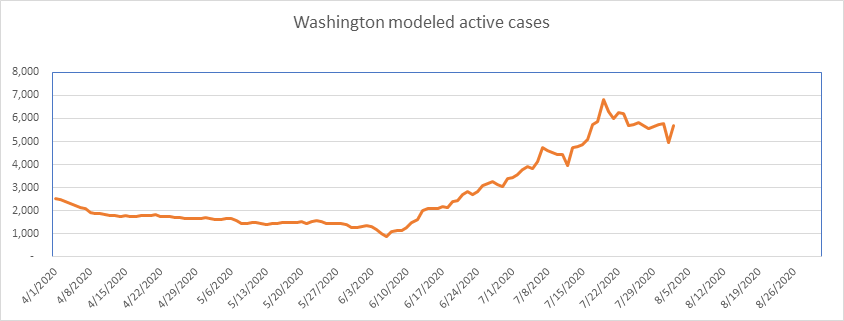
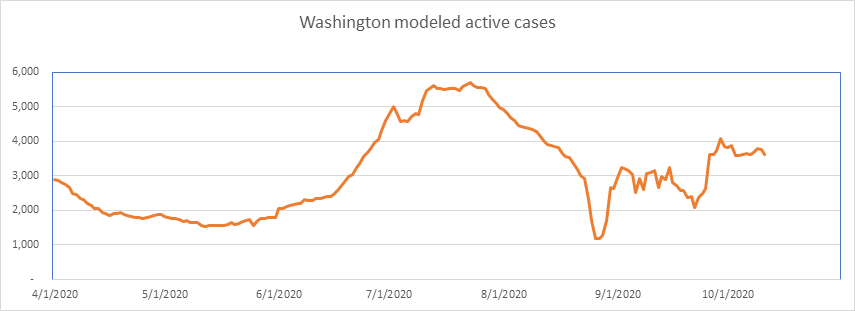
The COVID Tracking Project did a major revision of Washington data in late August, which created the sharp decline you see at the end of the month. It’s popped back up again, based on yet another change in the reporting protocol. These data aberrations have settled now, and we’re back seeing a bit of stability (until they change the protocol again!).
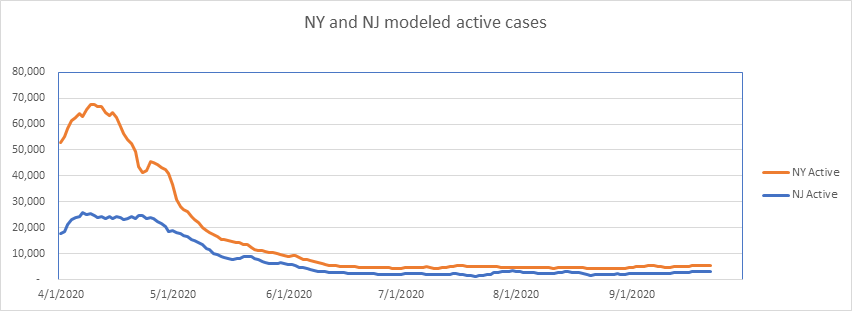
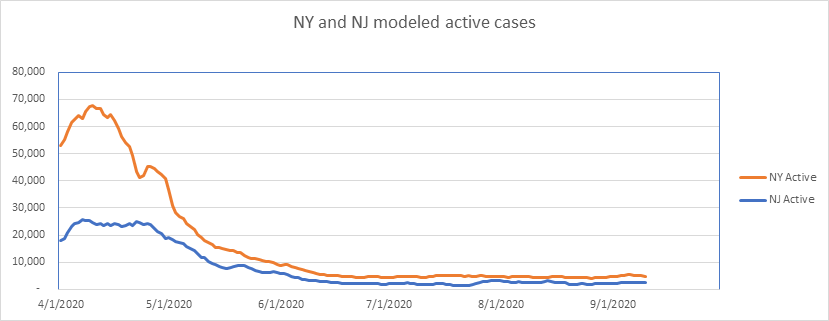
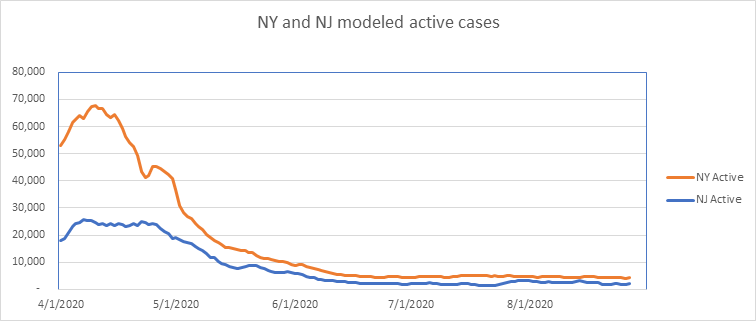
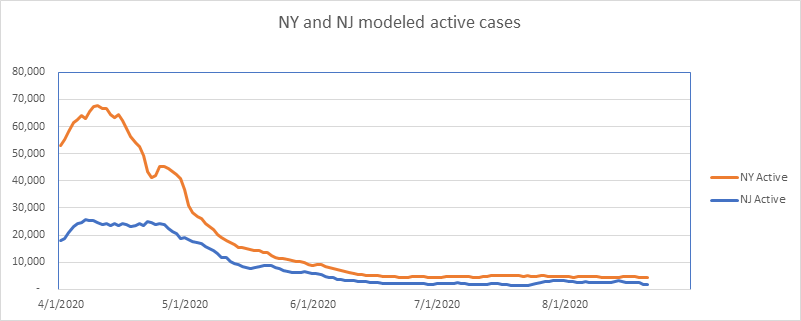
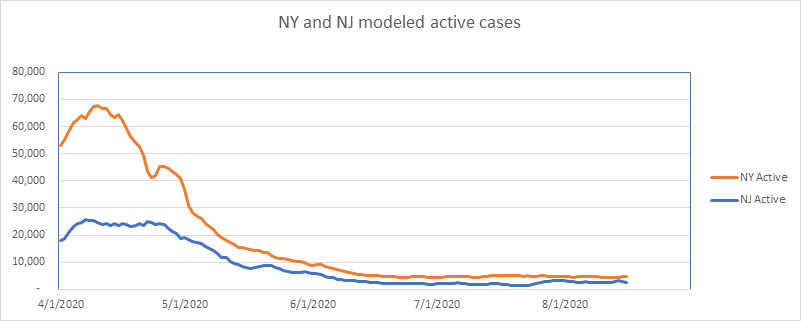
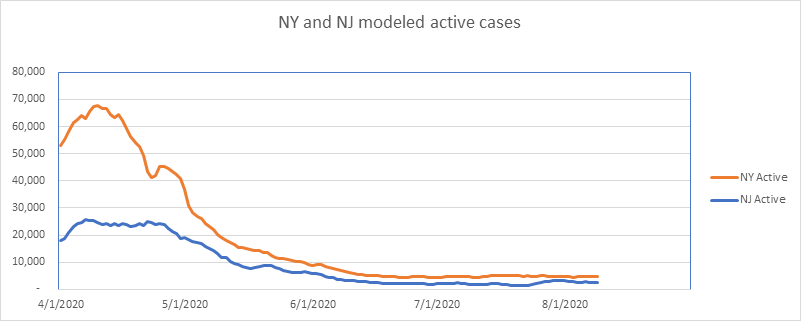
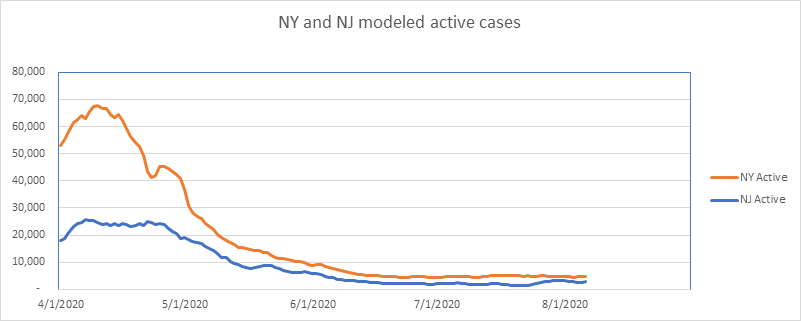
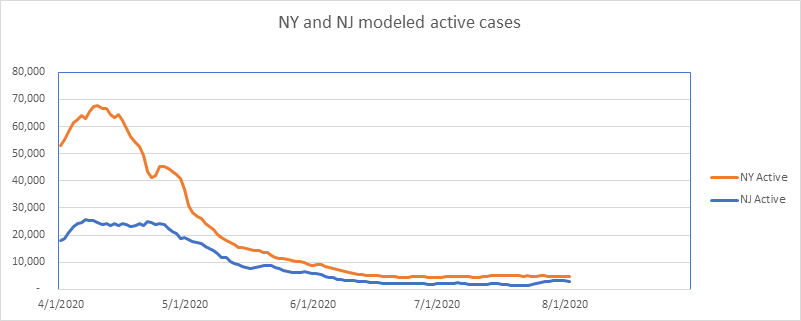
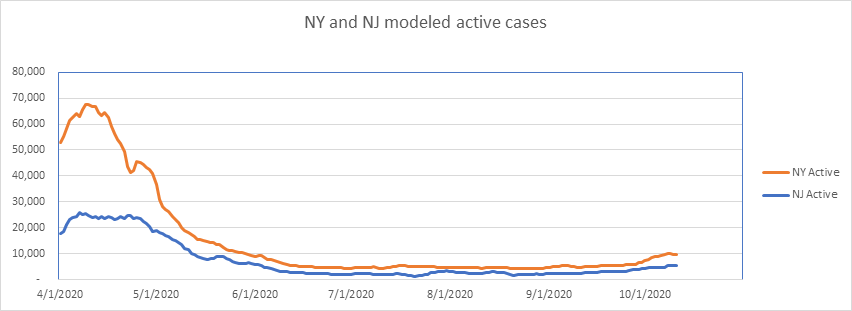
Here are NY and NJ – Significant percentage increases in both NY and NJ, albeit from small numbers.
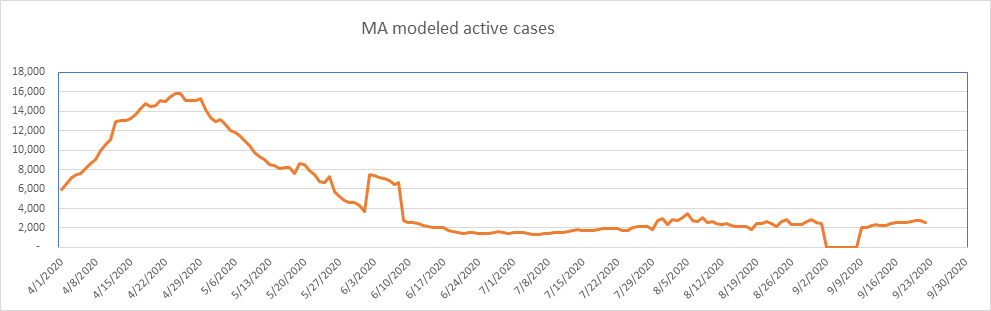
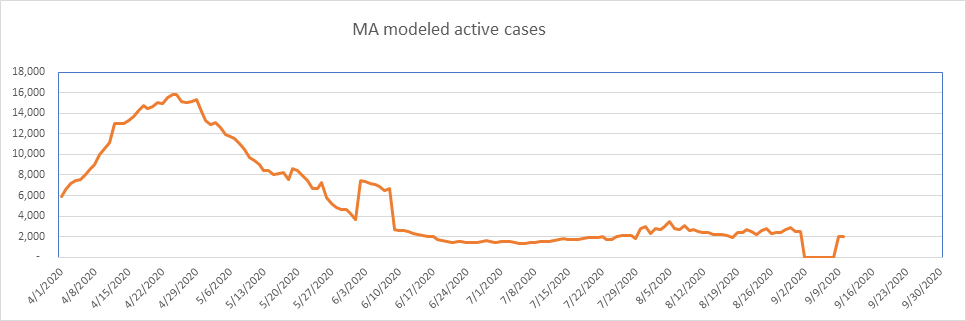
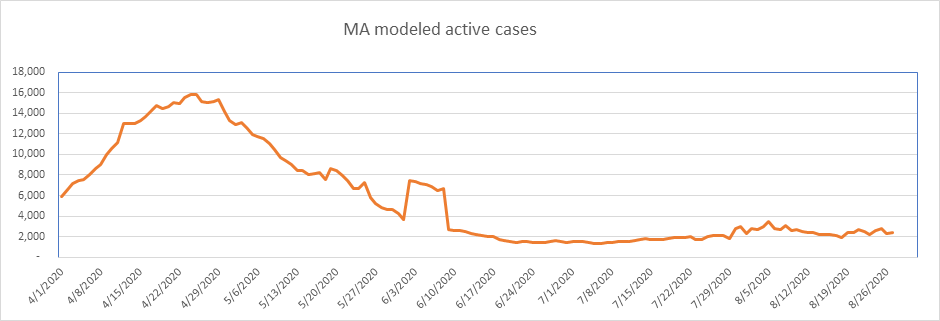
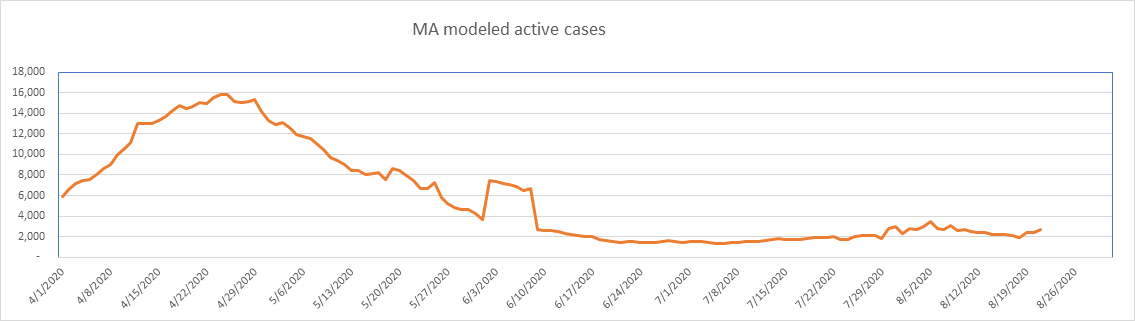
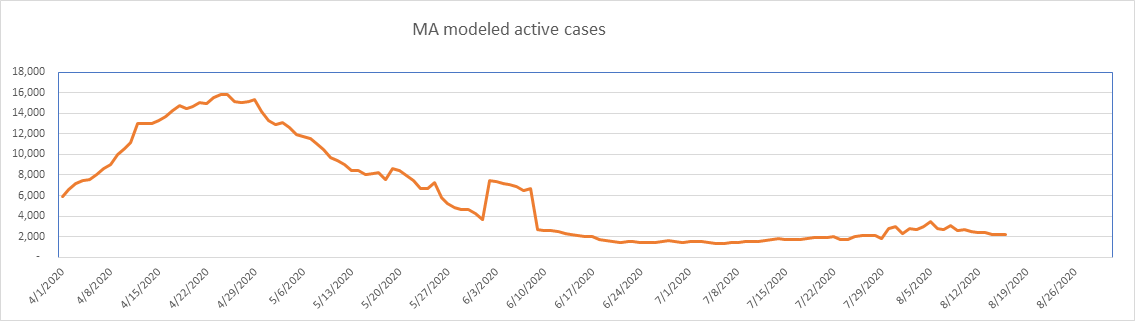
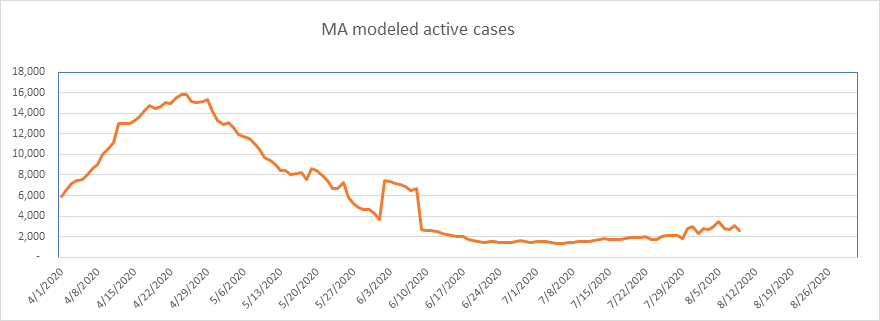
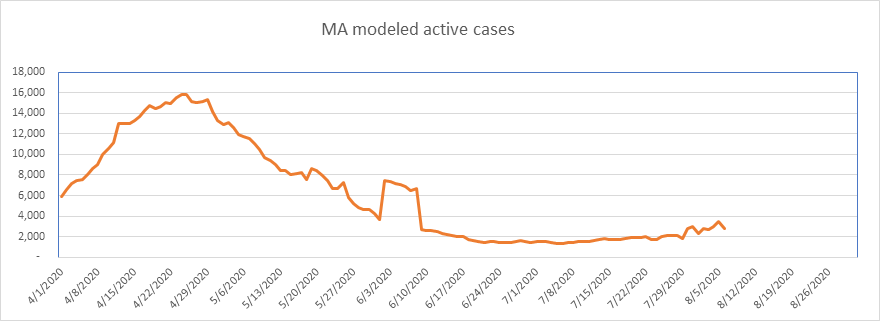
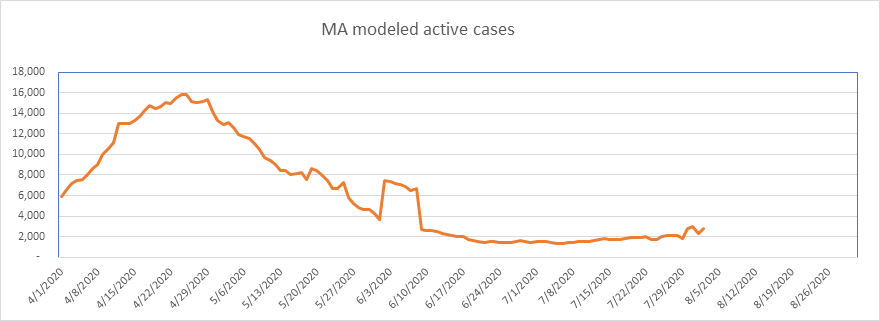
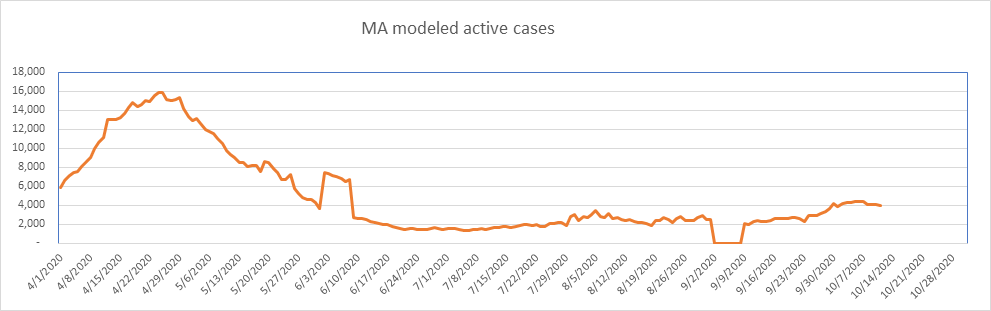
Here is Massachusetts. Like NY, they have a significant percentage increase in active cases, but again, on top of a small base.
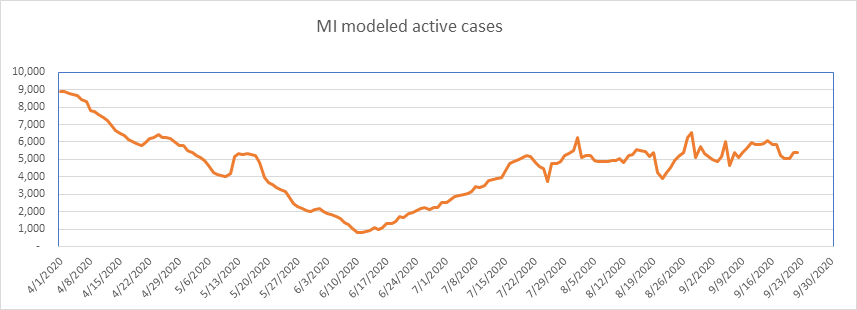
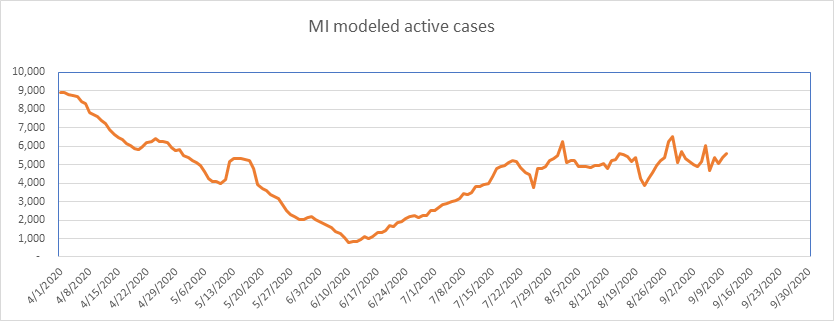
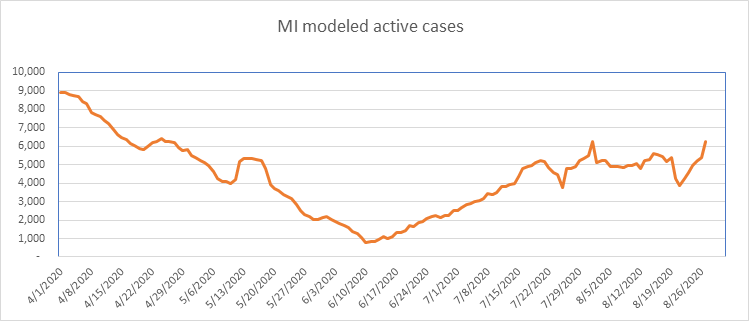
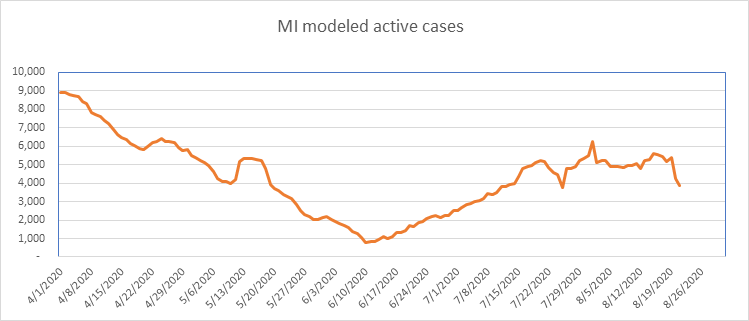
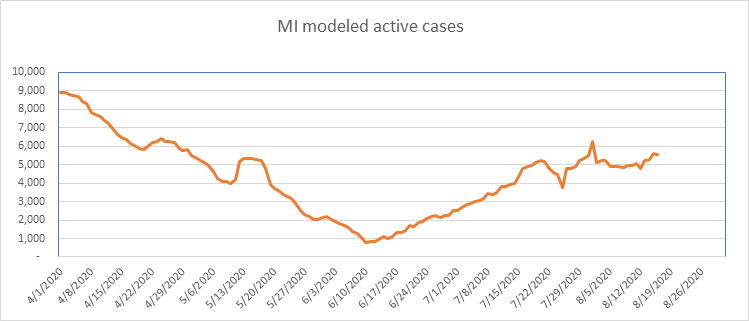
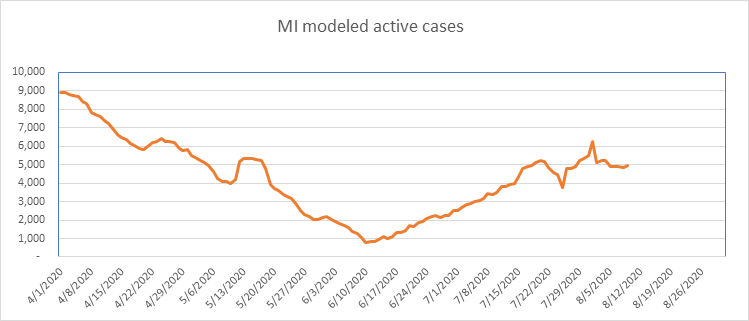
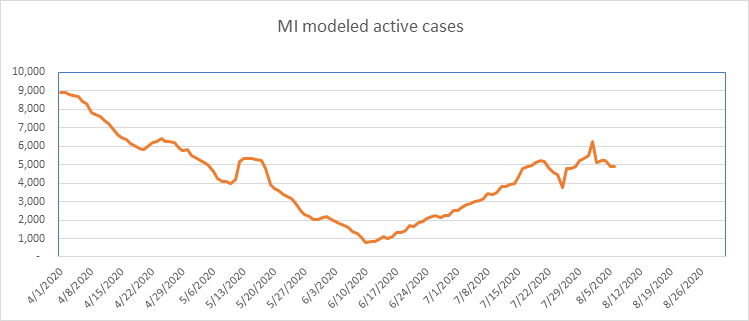
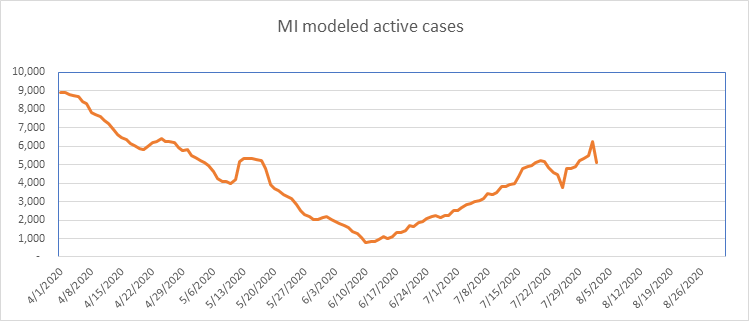
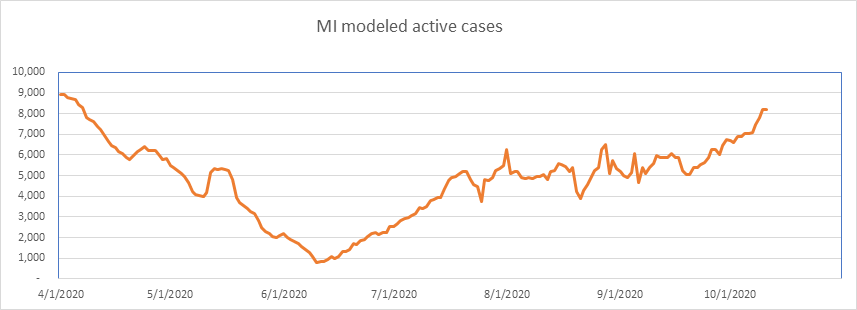
…And here is Michigan. As I expected, Michigan is growing again. They peaked at a very low 0.089% of the population, so have a way to go before hitting the population ceiling.
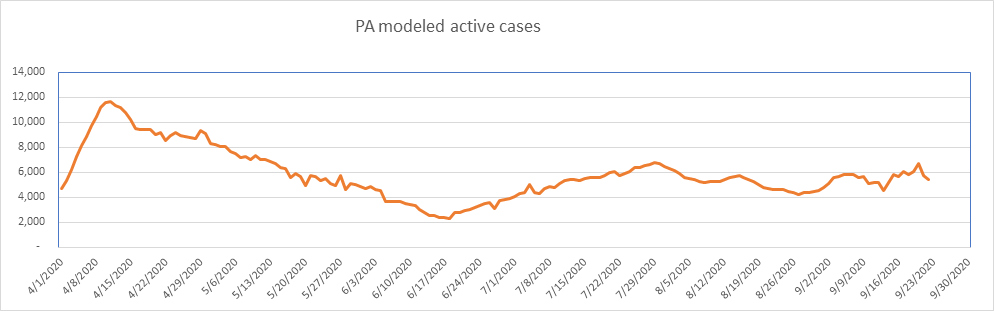
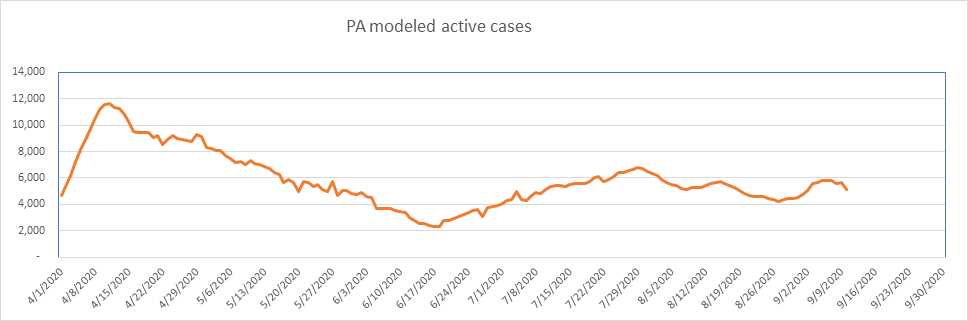
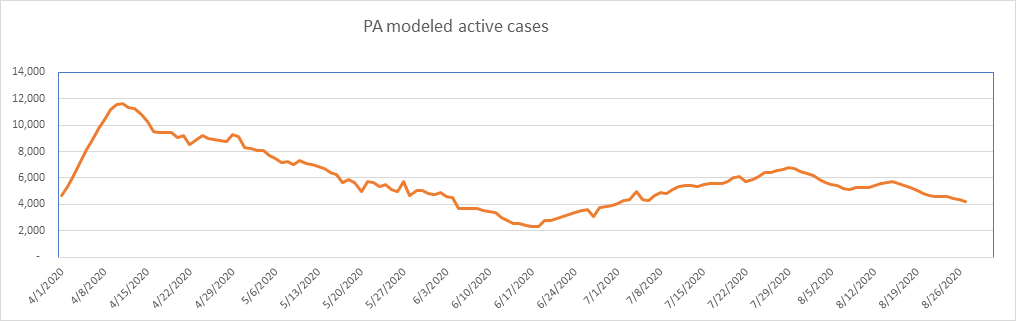
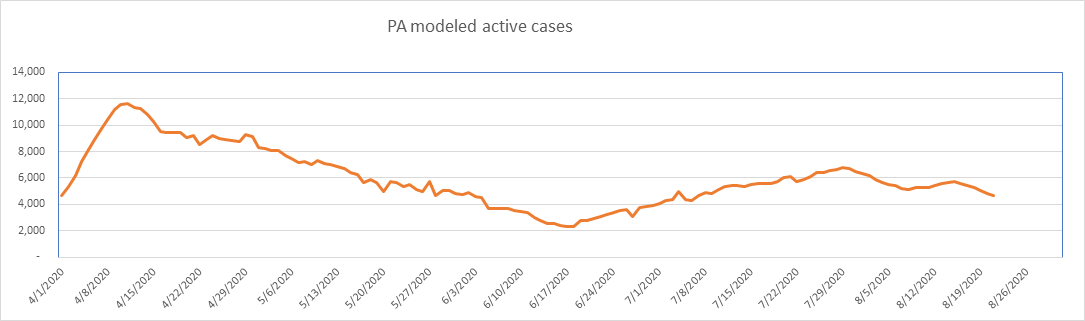
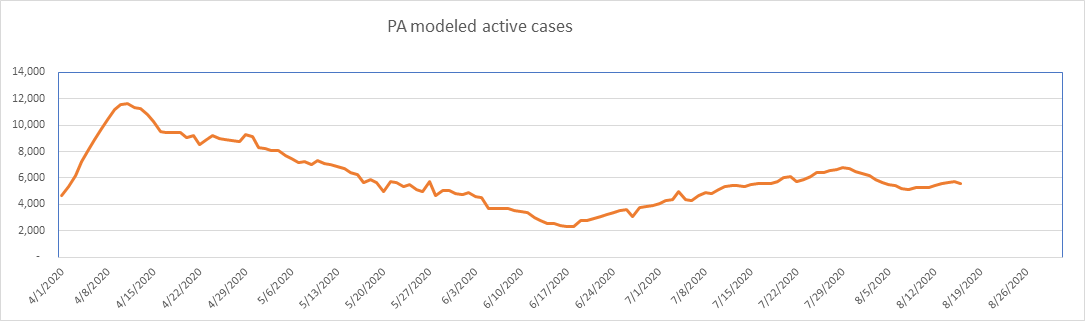
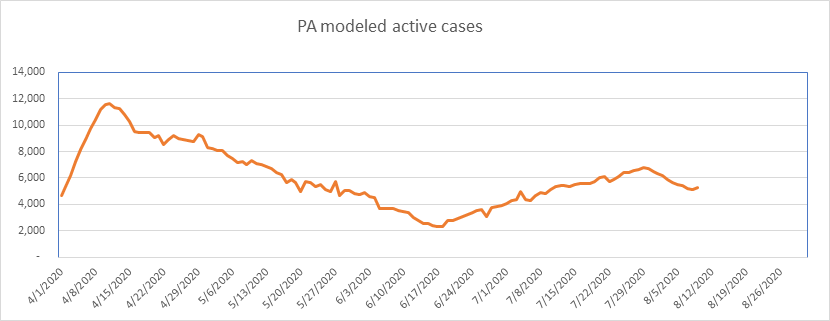
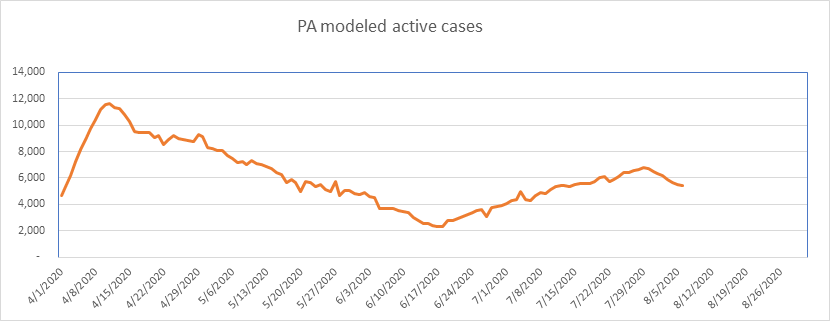
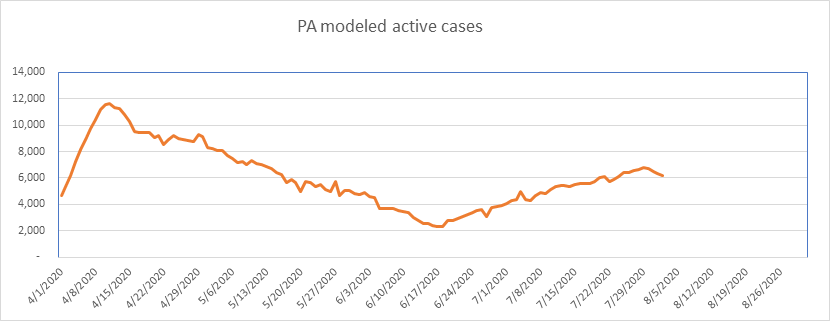
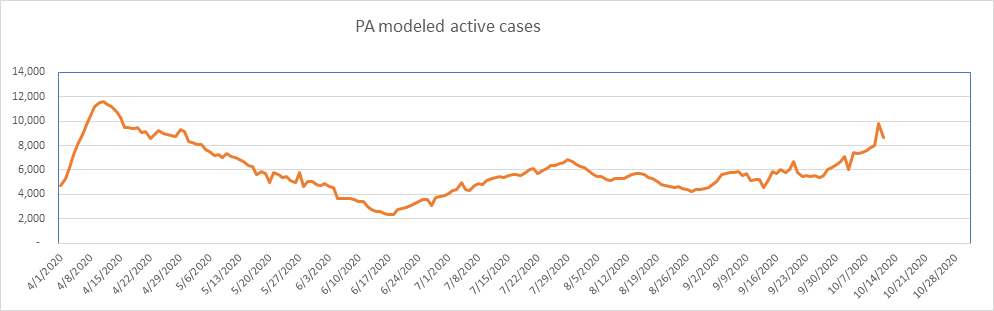
PA is also growing, as expected. The peak was very low (0.091% of the population), so I believe there is more to come.
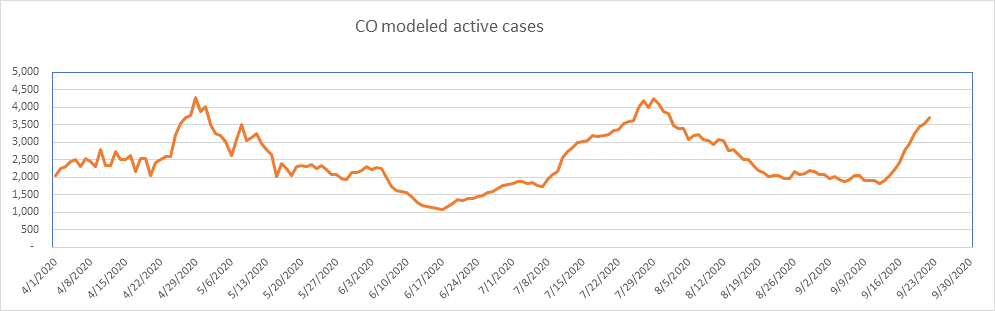
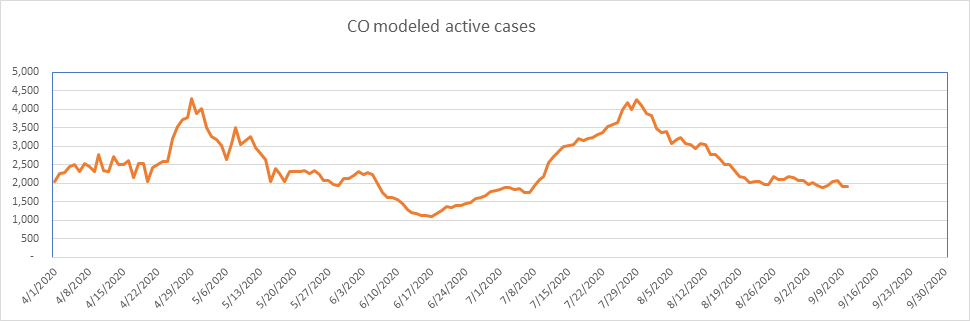
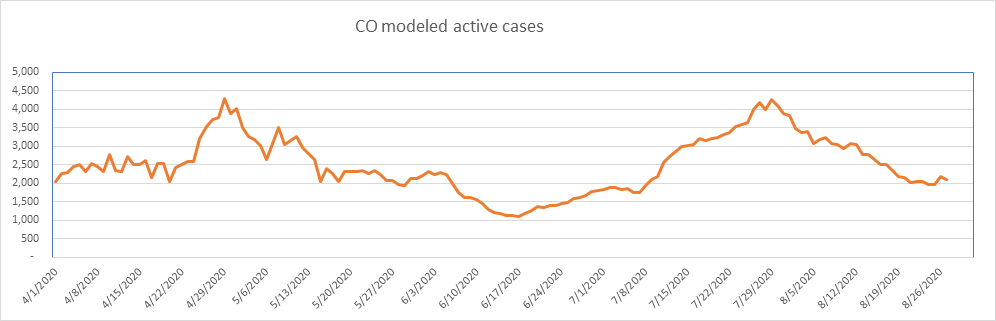
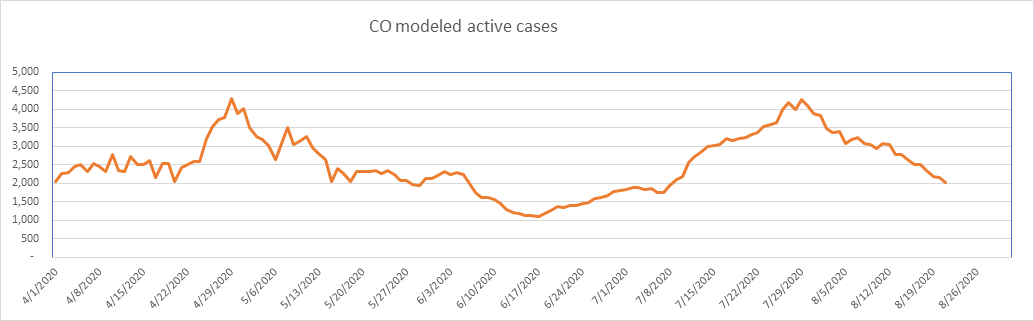
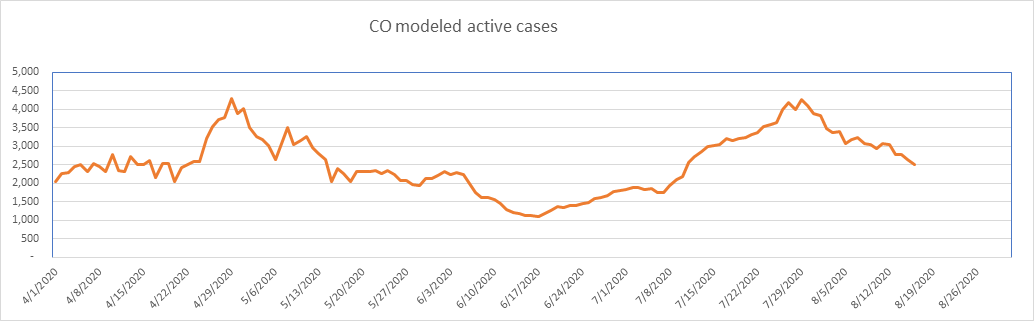
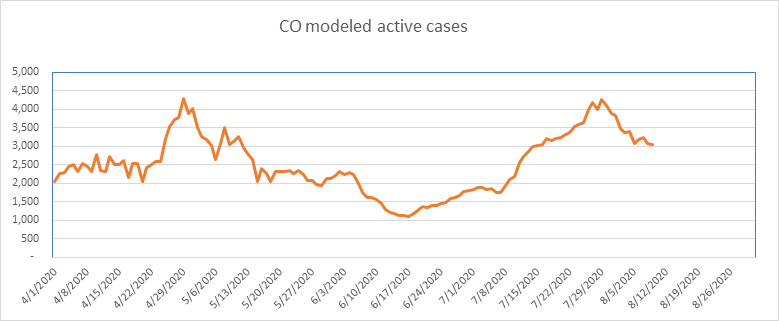
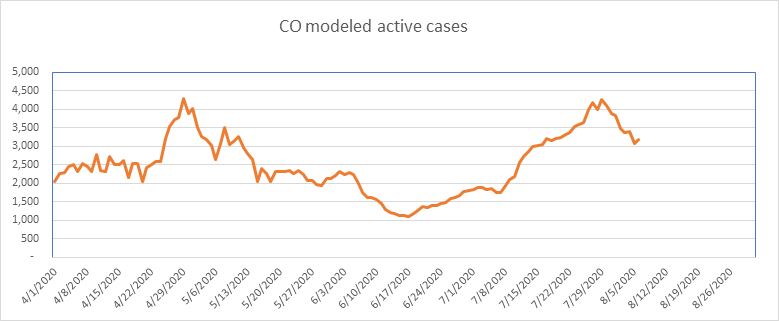
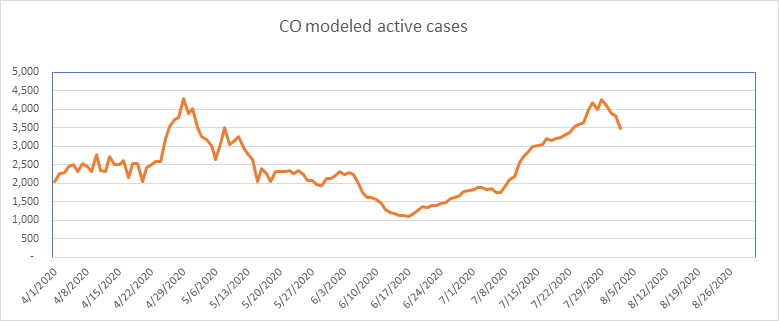
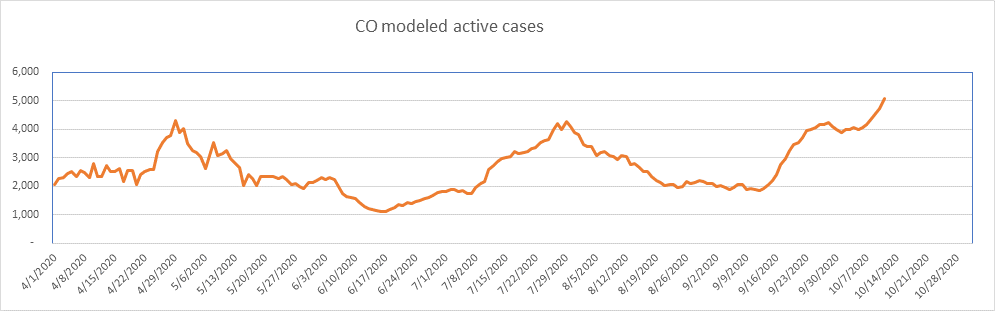
And finally, here is Colorado, at a new peak. It’s still only 0.087% of the population, so more to come I’m afraid.
So that’s it for today. I’ll report again in a week or so (longer if absolutely nothing changes).

The numbers are still very small as a percentage of the population. Unless you’re in a high density area, your chances of contracting COVID are very small. However, even though the probability is very small, you still don’t want to get it. Everyone please continue to be as cautious as you feel necessary.

–Shane Chalke, FSA
Categories
COVID Archives

No Real Surge in Cases

COVID continues to proceed at a crawl. Nationally, modeled active cases are up about 29,000. This could be the bump I was expecting from extensive university testing, but it’s occurring a couple of weeks later than I anticipated. You all probably saw the news reports of a surge in new cases over the past 2 days, but this is quite misleading. Over this time period, Texas increased their total case count by 27,673 cases. However, 21,967 of these are old cases newly reported. To Texas’s credit, they did not report these as new cases, however, Johns Hopkins and The COVID Tracking Project did. Of the 27,673 cases, Texas reported 1,742 on Monday as new, and 3,964 today as new. Johns Hopkins seems to make no attempt to correct this sort of data, but The COVID Tracking Project does a pretty good job of it (but it takes some time). I think they’ll revise the Texas numbers sometime over the next week or so, but in the meantime I’ve corrected for this in my numbers.

IHME has revised their model again on September 18. They are now projecting that daily deaths peak on December 21, 2020 at 3,620 per day. However, they also model “universal mask usage”, and under that model the April 16, 2020 daily peak holds. I have no idea how their model is built, but they have been overestimating daily deaths for the past two months. In reality, we’ve observed a slow, but steady decline in daily deaths for 7 weeks now.

Testing continues at a high rate, and we set a new record 3 days ago of just a hair under 1,000,000 tests. In total, the U.S. has recorded over 93 million tests. The New York Times ran an article at the end of August where they suggest that the tests are too sensitive. In case you didn’t see it, here it is:

https://www.nytimes.com/2020/08/29/health/coronavirus-testing.html

Here is the relevant quote: In three sets of testing data that include cycle thresholds, compiled by officials in Massachusetts, New York and Nevada, up to 90 percent of people testing positive carried barely any virus, a review by The Times found.

I expect we’ll see more about this as time progresses.

Feel free to send me your questions about my assumptions, methodology, or modeling in general.

  • Modeled known active cases in U.S. 279,198
  • Likely date of active case peak (Chalke modeling): July 23
  • Likely date of peak deaths (IHME): December 21 (last revision on September 18)
  • Total Test Results reported today: 719,578 (high)
  • Total Pending tests reported today: 7,999 (very low)
  • National reported case Growth Rate today: 0.51% (very low)

Shane Chalke Interviews

https://www.fredericksburg.com/opinion/editorial-unlock-demographically-not-geographically/article_a62e6e70-dccd-51cf-b7b2-16d77a90fd9c.html

Website

Groom Ventures has agreed to host a website that will archive my daily reports, and supplement with other commentary. John Groom worked at one of my companies back in the day, and is an excellent writer. The website is: www.howmuchrisk.com For those of you that post my daily report on Facebook, let me suggest you link to this site, as the direct Facebook posts don’t seem to copy the graphs.

Daily Analysis

Here is the national picture. We’ve added about 29,000 cases in the past 9 days. I suspect this is the widespread asymptomatic testing in university settings, but haven’t analyzed it yet. One thing that puzzles me lately is the phenomenon where geographical areas will reach a low level of COVID prevalence, and, rather than continuing the decline, it remains stationary. Will this ultimately be like the common cold (another Coronavirus), where a certain percentage of the population always has it?

Look at the daily new cases. We’re looking at a slow but steady decline since mid-July.


The daily death count is exhibiting a very slow decline for the better part of two months now. Here is the picture:

The decline is slow, and not particularly obvious on the above graph, but if we isolate the last 7 weeks, and show the regression line, it’s easier to see.

On to the states.

Here is Arizona. They reported a large increase in cases on Sep 17 and 18. This was a result of a change in reporting protocol, where they are now adding the results of antigen testing. As always with a change in protocol, this bump will flatten back down in a week or so.

SC has been relatively flat for nearly 3 weeks. Note that South Carolina double counts cases, as they treat each positive test as a new case (per The COVID Tracking Project).

Here is Florida – down dramatically from the top, but little progress in the past 2 weeks.

California has had a great recovery, but now flat for the past week. College testing? I think so, but don’t know for sure. As always, I need to report that California is one of the states that counts tests rather than people.

Georgia is also flat for a week now. Georgia hit a high of 0.25% of the population, so I’d be surprised to see any real increases here. GA is now down 55% from the peak. Note here again, the case numbers are exaggerated. Georgia counts each positive test as a case (according to The COVID Tracking Project).

Texas had a significant increase a week ago, but is already starting to decline. As I discussed above, Texas reported 21,967 historical cases over the past 2 days. I removed them for purposes of my analysis, but they will eventually show up in the historical data, increasing modeled active cases at some point in the past. Note that Texas also reports positive tests as cases, so is doing some level of double counting (per The COVID Tracking Project).

NC and VA tend to track each other. No real progress in the past week in either state, but I predict NC will fall further soon, based on day to day new case reports.

Here is the daily death report for NC, flat for 2 months.

And here is the daily new case count for NC. A noticeable drop from the peak in mid-July, and then 5 or 6 data points above the trend line in late August, then declining again. Based on this, we should see daily deaths in NC decline soon.

The COVID Tracking Project did a major revision of Washington data in late August, which created the sharp decline you see at the end of the month. It’s popped back up again, based on yet another change in the reporting protocol. These data aberrations have settled now, and we’re back seeing a decline.

Here are NY and NJ – I think the interesting observation here is that even though both states peaked very early and recovered rapidly, they don’t seem to make much progress once cases get to a low level. It seems asymptotic. It makes me wonder if the course of this disease is to simmer indefinitely at low levels.

Here is Massachusetts. On September 2, Massachusetts changed their case definition to the more restrictive August 6 definition released by the CTSE. As a result, they removed a whopping 7,000 cases in a single day. Since my model only showed about 2,500 cases at that time, this dislocation sent my model into negative territory. I zeroed it out, but this shows the problems with trying to model from continually shifting data definitions. This highlights the dire need for national standards on data collection and reporting. Where is the CDC? In any event, there is not much COVID in Massachusetts.

…And here is Michigan. Michigan peaked at a very low 0.089% of the population, so may continue to grow if my theory is correct. Nonetheless, MI has been relatively flat for 2 months now.

PA has been pretty flat for over 2 months. I believe PA has more growth to come, as the peak was very low (0.091% of the population).

And finally, here is Colorado. Modeled active cases have nearly doubled since my last report. I have no idea why, but have built up a healthy mistrust of Colorado data based on their many revisions and changes in protocol.

So that’s it for today. I’ll report again next week.

The numbers are still very small as a percentage of the population. Unless you’re in a high density area, your chances of contracting COVID are very small. However, even though the probability is very small, you still don’t want to get it. Everyone please continue to be as cautious as you feel necessary.

–Shane Chalke, FSA
Categories
COVID Archives

Known active cases fall over 40,000 since my last report

It’s been two weeks since I reported last, and overall, nearly everything has improved. WA, VA, and MI are flat, but all other states I track are in solid decline or have already reached very low numbers. Nationally, I’m modeling that we’ve shed over 40,000 known active cases since my last report. A surprise to me, there has been little impact from the flurry of campus testing as the school year begins. We’re seeing the slowest case growth in the history of the pandemic. With the continued relaxing of social and business restrictions, I find this continued decline encouraging.

On the negative side, the latest IHME model projects peak daily deaths on December 3, at about 2,880 per day. However, they did project steadily rising deaths over the past month, but in reality we’ve seen a slow decline. I’ll keep watching it and report changes to their model.

Feel free to send me your questions about my assumptions, methodology, or modeling in general.

  • Modeled known active cases in U.S. 249,082
  • Likely date of active case peak (Chalke modeling): July 23
  • Likely date of peak deaths (IHME): December 3 (last revision on September 3)
  • Total Test Results reported today: 614,042 (high)
  • Total Pending tests reported today: 10,530 (low)
  • National reported case Growth Rate today: 0.59% (very low)

Shane Chalke Interviews

https://www.fredericksburg.com/opinion/editorial-unlock-demographically-not-geographically/article_a62e6e70-dccd-51cf-b7b2-16d77a90fd9c.html

Website

Groom Ventures has agreed to host a website that will archive my daily reports, and supplement with other commentary. John Groom worked at one of my companies back in the day, and is an excellent writer. The website is: www.howmuchrisk.com For those of you that post my daily report on Facebook, let me suggest you link to this site, as the direct Facebook posts don’t seem to copy the graphs.

Daily Analysis

Here is the national picture. We’ve dropped over 219,000 known active cases since the peak of July 23rd, and over 40,000 since my last report. Overall, we’re down 53% since the peak. We’re not far off April levels. I think we’ll get there by the end of the month.

Look at the daily new cases. We’re looking at a steady linear decline since mid-July, and again, nearly at April levels.

The daily death count is exhibiting a very slow decline for a month now. Here is the picture:

On to the states.

Here is Arizona, now down 89% from the peak 2 months ago. I’m modeling that Arizona has only about 3,000 known active cases left.

SC is now down 64% from the peak. Note that South Carolina double counts cases, as they treat each positive test as a new case (per The COVID Tracking Project).

Here is Florida – now down an amazing 79% from the top. I’m guessing that bump beginning on September 1 and falling back down on September 8 is college testing.

Here is California – now down 63% from the peak, and back where they were in late June. I’m still not confident there won’t be more localized peaks here, with California maxing out at only 0.18% of the population. As always, I need to report that California is one of the states that counts tests rather than people.

Georgia continues to make strong progress. Georgia hit a high of 0.25% of the population, so I’m thinking that this is it. GA is now down 55% from the peak. Note here again, the case numbers are exaggerated. Georgia counts each positive test as a case (according to The COVID Tracking Project).

Texas is now down 64% from the peak on July 23. Note that Texas also reports positive tests as cases, so is doing some level of double counting (per The COVID Tracking Project).

NC and VA have tended to mirror each other since mid-June. However, NC is now down 40% from its high while VA is down 18%. Both VA and NC are about where they were a month ago. NC went into Phase 2.5 last Friday, which means gyms and some other businesses may now open.

Here is the daily death report for NC, flat for 6 weeks now. I expect a decline in daily deaths soon, as the active case count is declining.

And here is the daily new case count for NC. A noticeable drop from the peak in mid-July, and then 5 or 6 data points above the trend line in late August. I’m thinking that this could have been college testing, as NC schools start so early in the year, but I don’t know.

The COVID Tracking Project just did a major revision of Washington data in late August, which created the sharp decline you see at the end of the month. It’s popped back up again, based on yet another change in the reporting protocol. I’ll look into it if I have time, or maybe just wait until the COVID Tracking Project folks fix it.

Here are NY and NJ – I think the interesting observation here is that even though both states peaked very early and recovered rapidly, they don’t seem to make much progress once cases get to a low level. It seems asymptotic. It makes me wonder if the course of this disease is to simmer indefinitely at low levels.

Here is Massachusetts. On September 2, Massachusetts changed their case definition to the more restrictive August 6 definition released by the CTSE. As a result, they removed a whopping 7,000 cases in a single day. Since my model only showed about 2,500 cases at that time, this dislocation sent my model into negative territory. I zeroed it out, but this shows the problems with trying to model from continually shifting data definitions. This highlights the dire need for national standards on data collection and reporting. Where is the CDC? In any event, there is not much COVID in Massachusetts.

…And here is Michigan. Michigan peaked at a very low 0.089% of the population, so may continue to grow if my theory is correct. Nonetheless, MI has been relatively flat for a good 6 weeks now.

PA has been pretty flat for the past 2 months. I believe PA has more growth to come, as the peak was very low (0.091% of the population).

And finally, here is Colorado. A sharp drop over August, and then fairly flat since. Colorado is now down to about 1,900 known active cases. Very small numbers here.

So that’s it for today. I’ll report again next week.

The numbers are still very small as a percentage of the population. Unless you’re in a high density area, your chances of contracting COVID are very small. However, even though the probability is very small, you still don’t want to get it. Everyone please continue to be as cautious as you feel necessary.

–Shane Chalke, FSA
Categories
COVID Archives

Looks like minimal impact from college testing so far…

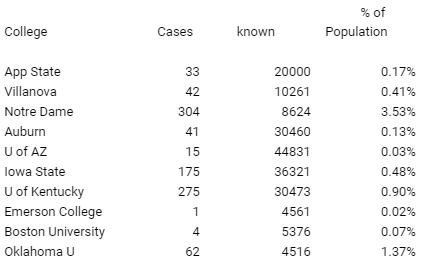
When I reported last week, I was expecting a bump in active cases this week from the ubiquitous testing at universities as the semester begins. So far, however, we’re not seeing it. Not only has the case count not risen, there is no spike in testing volume. Some schools are doing universal testing, some are testing all students moving into dorms, and some are only testing symptomatic students. Some schools are reporting tests and positives each day, and some (Like Arizona State University) aren’t reporting any data. I did a quick search earlier this week and found snippets of data – I combined this with reports sent to me by readers of this report, and have this:

This is VERY unscientific – just a few that come up on a quick google search – but the numbers are smaller than I was expecting. I’m modeling known active cases in the United States right now at 289,000, or about 0.09% of the population. If we hit that with a prevalence to known case ratio of 10, we get 0.9%. I was expecting college students to be higher than this, given their elevated socializing. However, the numbers in this admittedly ragtag data set is smaller than that. I wish I had 25 researchers – we could learn a great deal digging into the college testing. We’ll just have to watch and see what happens. In any event, if we have a positive rate of 0.5%, that would still be 100,000 extra cases across the 20 million college students in the U.S. Of course, I believe most universities are not testing the entire student body – they can’t be – we’re not seeing that kind of lift in total tests reported. In any event, an increase in college age cases will have a negligible impact on the daily death count, since people that age have a near zero mortality rate from the disease.

I’ve been writing about targeted, rather than blanket, restrictions on social mobility since I did my first mortality calculations in April. I’ve long thought that the correct public policy would be to protect those demographic groups with the highest COVID mortality rates, but let working age people continue to participate in the economy. I think this is likely what is happening naturally, and now it is making its way into the mainstream. Here is a good article from Monday’s Wall St. Journal: https://www.wsj.com/articles/covid-lockdowns-economy-pandemic-recession-business-shutdown-sweden-coronavirus-11598281419?mod=djemalertNEWS

Feel free to send me your questions about my assumptions, methodology, or modeling in general.

  • Likely date of active case peak (Chalke modeling): July 23
  • Likely date of peak deaths (IHME): April 16 (last revision on August 21)
  • Total Test Results reported today: 742,340 (very high)
  • Total Pending tests reported today: 11,168 (low)
  • National reported case Growth Rate today: 0.76% (very low)

Shane Chalke Interviews

https://www.fredericksburg.com/opinion/editorial-unlock-demographically-not-geographically/article_a62e6e70-dccd-51cf-b7b2-16d77a90fd9c.html

Website

Groom Ventures has agreed to host a website that will archive my daily reports, and supplement with other commentary. John Groom worked at one of my companies back in the day, and is an excellent writer. The website is: www.howmuchrisk.com For those of you that post my daily report on Facebook, let me suggest you link to this site, as the direct Facebook posts don’t seem to copy the graphs.

Daily Analysis

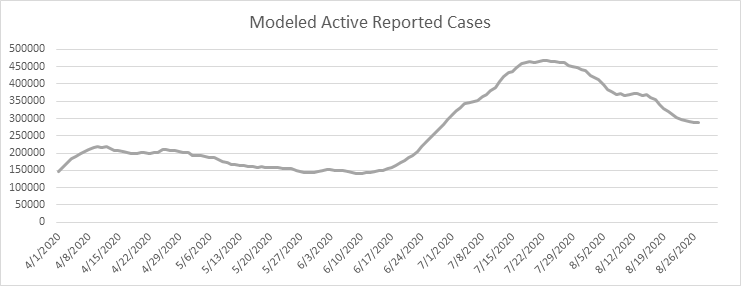
Here is the national picture. We’ve dropped over 179,000 known active cases since the peak of July 23rd. That’s a 38% decline, and puts us back where we were in late June. I was expecting a rise this week as the wave of college-based tests moves through the data, but we’re not seeing it yet. Perhaps over the next week as students in the northeast make their way back to campus, but so far, we don’t even have a bump in testing volume – that’s curious to me.

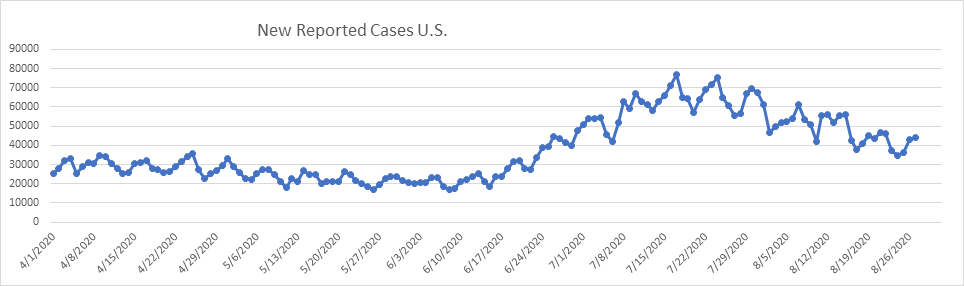
Look at the daily new cases. We’re looking at a steady and welcome decline since mid-July.

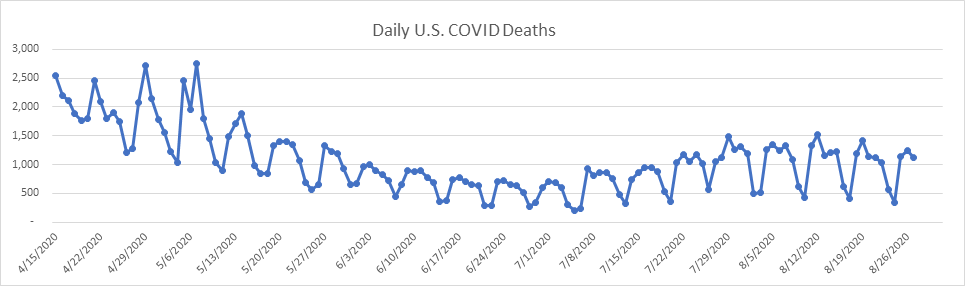
The daily death count is flat for about a month now, with an inkling of decline over the past two weeks. Here is the picture:

Here are the daily deaths per 1,000 known active cases. This disease is far less deadly than it was in April, when deaths per active case were far higher. The gradual rise is a result of daily deaths lagging the dropping case count by 2-3 weeks.

On to the states.

Here is Arizona, now down 86% from the peak just 7 weeks ago. I’m modeling that Arizona has less than 4,000 known active cases left.

SC is also looking far better than a month ago. SC is now down 61% from the peak. Note that South Carolina double counts cases, as they treat each positive test as a new case (per The COVID Tracking Project).

Here is Florida – another very rapid recovery. There is still a lot of COVID in Florida (I model over 23,000 known active cases), but far less than the 83,000 cases at the peak. Florida is now down an amazing 72% from the top.

Here is California – now down 44% from the peak, and back where they were in late June. I’m still not confident there won’t be more localized peaks here, with California maxing out at only 0.18% of the population. As always, I need to report that California is one of the states that counts tests rather than people.

Georgia continues to make progress. Georgia hit a high of 0.25% of the population, so I’m thinking that this is it. GA is now down 37% from the peak. Note here again, the case numbers are exaggerated. Georgia counts each positive test as a case (according to The COVID Tracking Project).

Texas is now down 49% from the peak about a month ago. Not as smooth or dramatic a recovery as Florida or Arizona. Note that Texas also reports positive tests as cases, so is doing some level of double counting (per The COVID Tracking Project).

NC has had a pronounced rise over the past week (over 2,000 cases), but it looks like we’re past that bubble now, as the daily case count has been falling for 6 days (except for today). Based on that, I expect this to turn around over the next few days. Virginia shows a sharp drop today, but that’s because they didn’t report numbers today (this happens once in a while in VA). VA will pop back up tomorrow.

Here is the daily death report for NC, flat for a month, and now showing early signs of decline.

And here is the daily new case count for NC. A noticeable drop from the peak in mid-July, and then 2 or 3 data points above the trend line over the past week. I’m thinking that this could be college testing, as NC schools start so early in the year, but I don’t know.

The COVID Tracking Project just did a major revision of Washington data, placing cases back on the proper dates. We now see a new picture of Washington which looks much better. This is a 79% decline from the peak. With the messy data last week, we showed a much smaller 41% decline. This is a great illustration of how newly discovered historical cases reported as new can skew the data, making things look much worse than they are.

Here are NY and NJ – I think the interesting observation here is that even though both states peaked very early and recovered rapidly, they don’t seem to make much progress once cases get to a low level. It seems asymptotic. It makes me wonder if the course of this disease is to simmer indefinitely at low levels.

Here is Massachusetts. Similar to NY and NJ, it continues to simmer along in a stationary fashion. There are few active cases, but as fast as they recover, an equal number of new cases are reported.

…And here is Michigan. Michigan peaked at a very low 0.089% of the population, so may continue to grow if my theory is correct. Nonetheless, MI has been relatively flat for a month now.

PA has been dropping steadily for 4 weeks not. However, I believe PA has more growth to come, as the peak was very low (0.091% of the population).

And finally, here is Colorado. A sharp drop over the past month. Colorado has declined about 50% over this time period, and is now down to about 2,000 known active cases. Very small numbers here.

So that’s it for today. I’ll report again on Monday or Tuesday.

The numbers are still very small as a percentage of the population. Unless you’re in a high density area, your chances of contracting COVID are very small. However, even though the probability is very small, that doesn’t help if you’re the one catching it. Everyone please continue to be as cautious as you feel necessary.

–Shane Chalke, FSA
Categories
COVID Archives

What will college testing do to the data?

Nationally, we’re still seeing a consistent and steady decline in known active cases. Over the last 6 days, we’ve dropped an average of just over 9,000 active cases per day. Florida, Arizona, Colorado, and South Carolina have been dropping particularly fast, but lately we’ve seen a lot of improvement in California as well. At this rate, I expect us to be down to April known active case levels by mid-September.

We have nearly 20 million college students returning to school from mid-August to Labor Day, and many schools are implementing universal testing for COVID. I don’t know what percentage of students will be tested, but I’m expecting to see a rise in cases over the next week as these tests are reported, and then a decline the week after. I’ve had reports from some schools in the sub 1% positivity rate – if any of you have information about various school stats please send them to me. We have very little data on entire sub-populations being tested, so this is a rare chance to learn more about total prevalence. In any event, the college populations being tested have a very low average age (even with faculty and staff in the mix), so these cases will have a negligible impact on the daily death count, since college age people have a near zero mortality rate.

I’ve been talking a lot about herd immunity, and how a significant population level of innate resistance to COVID would explain the data we’re seeing. I’m no expert in disease, but I’ve latched on to this idea because it’s the only explanation on the table for why this disease peaks at such low numbers. Here is a piece from Bloomberg news last week, which talks about scientists rethinking herd immunity based on T-Cell cross reactivity with the common cold. https://www.bloomberg.com/opinion/articles/2020-08-13/covid-spread-is-forcing-scientists-to-rethink-herd-immunity Yes, it IS an opinion piece, but it checks a lot of boxes for me and I thought you might find it interesting.

In other news, the IHME model updated today. They are projecting deaths along 3 scenarios out to December 1st: universal masks, current projection, and all mandates easing. You can see it here: https://covid19.healthdata.org/united-states-of-america

FYI, I pinned last Sunday’s discussion of Sweden’s results to the bottom of this report.

Feel free to send me your questions about my assumptions, methodology, or modeling in general.

  • Likely date of active case peak (Chalke modeling): July 23
  • Likely date of peak deaths (IHME): April 16 (last revision on August 21)
  • Total Test Results reported today: 756,105 (very high)
  • Total Pending tests reported today: 4,199 (extremely low)
  • National reported case Growth Rate today: 0.85% (very low)

Shane Chalke Interviews

https://www.fredericksburg.com/opinion/editorial-unlock-demographically-not-geographically/article_a62e6e70-dccd-51cf-b7b2-16d77a90fd9c.html

Website

Groom Ventures has agreed to host a website that will archive my daily reports, and supplement with other commentary. John Groom worked at one of my companies back in the day, and is an excellent writer. The website is: www.howmuchrisk.com For those of you that post my daily report on Facebook, let me suggest you link to this site, as the direct Facebook posts don’t seem to copy the graphs.

Daily Analysis

Here is the national picture. We’ve dropped about 155,000 known active cases since the peak of July 23rd. That’s a 33% decline, and puts us back where we were in early July. I expect to see a rise over the next week of perhaps 25,000 cases, as the wave of college-based tests moves through the data. However, I think that bubble is all over by the week after. I hope I’m wrong on the first part and right on the second.

Look at the daily new cases. We’re looking at a broad pattern of decline since mid-July.

The daily death count is flat for about a month now. I expect a gradual decline beginning this coming week. Here is the picture:

Here are the daily deaths per 1,000 known active cases. This disease is far less deadly than it was in April, when deaths per active case were 4 – 5 times higher. If we get a lot of college driven tests in the coming week, this number will decline.

On to the states.

Here is Arizona, now down 80% from the peak just 6 weeks ago. To put this in perspective, I model that Arizona now has less COVID than Virginia.

SC also continues to improve. SC is now down 59% from the peak. Note that South Carolina double counts cases, as they treat each positive test as a new case (per The COVID Tracking Project).

Here is Florida – another strong recovery story. Interestingly, I noticed Miami flattening first, but Miami is not declining as fast as the rest of the state. Florida is now down an amazing 64% from the top.

Now, California – what a difference a week makes. California has dropped 27% in 6 days! However, since California peaked at only 0.18% of the population, I’m thinking there is more to come here. On the other hand, Sweden peaked at a much lower percentage, as they had a quite high prevalence to reported ratio. That could be happening here. As always, I need to report that California is one of the states that counts tests rather than people.

Georgia’s recovery is accelerating lately. Georgia hit a high of 0.25% of the population, so I’m thinking that they did peak on July 24th. GA is now down 32% from the peak. Note here again, the case numbers are exaggerated. Georgia counts each positive test as a case (according to The COVID Tracking Project).

Texas is also a slower recovery than Florida or Arizona. Note that Texas also reports positive tests as cases, so is doing some level of double counting (per The COVID Tracking Project).

NC has been steadily declining for over a month, but now is up for the past 4 days. I’m hoping this is an anomaly, or perhaps a result of college testing, as NC schools start very early.

Here is the daily death report for NC, flat for nearly a month now. I’m expecting this to begin a definitive decline this week, based on the drop in daily new case count.

And here is the daily new case count for NC. A noticeable drop from the peak in mid-July.

Washington is now down 41% from the peak on July 19th. I’m skeptical about this, as the high water mark you see here is at just 0.087% of the population. However, that peak is now over a month old, so that’s hopeful.

Here are NY and NJ – hard to see since the numbers are small, but NJ has had quite a drop lately, down to about 1,600 cases.

Here is Massachusetts. That bump you see on August 19th is a result of a new procedure in Massachusetts for reporting “probable” cases. Here is the quote from The COVID Tracking Project:

“On August 12, MA began reporting probable cases weekly, not daily. This can lead to apparent spikes in the data when the weekly numbers are incorporated, as happened on August 19.”

So it looks like we’ll see a little spike of probably cases every Wednesday.

…And here is Michigan. Michigan peaked at a very low 0.089% of the population, so may continue to grow if my theory is correct. Nonetheless, MI has been relatively flat for a month now. Big drop in the past few days, though.

PA has been dropping for 3 weeks. However, I believe PA has more growth to come, as the peak was very low (0.091% of the population).

And finally, here is Colorado. A sharp drop over the past 3 weeks. Colorado has declined 53% over this time period, and is now down to 2,000 known active cases. Very small numbers here.

So that’s it for today. I’ll report again in a few days.

The numbers are still very small as a percentage of the population. Unless you’re in a high density area, your chances of contracting COVID are very small. However, even though the probability is very small, that doesn’t help if you’re the one catching it. Everyone please continue to be as cautious as you feel necessary.

–Shane Chalke, FSA
Categories
COVID Archives

Fear Sells Newspapers

The liberal media like the New York Times love to fan the flames of fear, so they produce a lot of articles like this “showing” how COVID is really killing more Americans than shown by the official statistics.
Here’s what our actuary has to say about articles like this:

These so-called “excess death studies” have serious limitations. They are looking at the average of 2017-2019 total deaths YTD, then comparing to 2020 total deaths YTD, and then assuming that any increase in 2020 over the prior 3-year average is the result of COVID. The problem is that total deaths vary year to year, and even more so when looking at a limited number of months. Variances occur based on the severity of the flu season, weather, the state of the economy, etc..

For example, the 2nd week of January 2018 had nearly 10,000 “excess” deaths. COVID? I doubt it. I don’t put much credence in these studies. We’ll also likely see a drop in deaths for 2021 and 2022, as many of the COVID deaths are among those with limited life expectancy. I doubt the New York Times – or any other mainstream media – will be writing an article on the “saved” lives next year.

Categories
COVID Archives

A look at Sweden, and new developments on herd immunity

It’s been a week since my last report, and a lot has happened. But first, Sweden. If you’ve followed COVID news at all, you know that Sweden’s approach to the pandemic has been wildly controversial. Rather than impose restrictions to slow the spread of the virus, Sweden pretty much let people behave as they liked. They did impose a few restrictions, but nothing close to the response of the rest of the world. I can show you countless articles declaring Sweden a success, and an equal number citing it as a disaster. I confess that until now I’ve not even looked at Sweden’s data, but I needed to satisfy my curiosity, so here goes…

I couldn’t find a single source modeling active cases in Sweden, so I ran Johns Hopkins’ data through my model, and see this:

This surprised me for a number of reasons. First, Sweden peaked later than I would have guessed, on June 29th. Also, the peak is relatively low, at 0.085% of the population. They didn’t have nearly the reported COVID numbers I would have expected. Here is where Sweden stacks up against the 15 states that I follow:

This is stunning to me. Sweden (SE) is the next to lowest on my list. Why so low? We find a clue in an antibody study from mid-May in Stockholm. 7.3% of those tested had COVID antibodies. At that time, there were 29,192 documented cases in Sweden, or 0.29% of the population. This implies that the total prevalence was something like 25 times larger than the documented cases. (Yes, I’m extrapolating Stockholm to the rest of Sweden, but I’m just trying to ballpark things here.) Sweden now has had 84,279 documented cases, so applying the 25x multiplier, we get a total of 2.1 million cases, or about 21% of the population. (Yes, I made another assumption – that the prevalence to known case ratio is static). OK, keep that 21% in mind for a moment.

I’ve been writing a lot recently about the latent immunity of a large swath of the population. The studies pointing to this are growing. The theory is that that T-Cell response is cross-reactive with other Corona viruses, including the common cold. I cited studies last week. Here is the important one:

https://science.sciencemag.org/content/early/2020/08/04/science.abd3871

A recent paper from Oxford University takes into account the variability in susceptibility to the disease, and calculated a Herd Immunity Threshold of between 10 and 20%!

https://www.medrxiv.org/content/10.1101/2020.07.23.20160762v1.full.pdf

Here is an important quote from the paper: “These findings have profound consequences for the governance of the current pandemic given that some populations may be close to achieving herd immunity despite being under more or less strict social distancing measures.” This is simply stunning.

What does this all mean? Simply put, if we have a significant percentage of the population with some resistance to the disease, the herd immunity threshold is much lower than the long thought 60-70%. Another way of saying this is that with a disease like this, with some level of societal resistance, we don’t need nearly as many cases as previously assumed to reach the turning point. This is what I’ve been seeing in the data, with a ceiling on known active cases (which are a fraction of actual prevalence) at a very low 1/3 of one percent of the population. I’m guessing this is where Sweden is now, having reached the Herd Immunity Threshold.

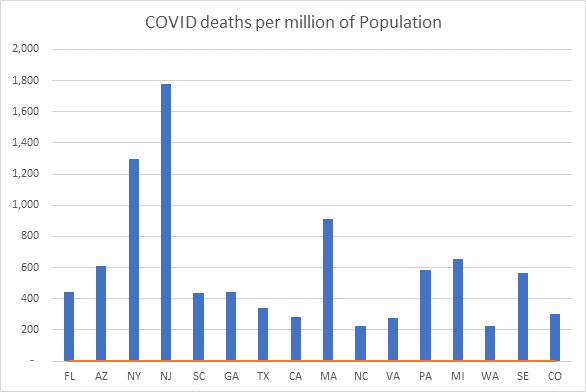
Let’s look at Sweden’s mortality results. As of today, Sweden has had 5,783 deaths. They are now down to low single digit deaths per day, so this number is incrementing very slowly. If we compare deaths to date with the 15 states I track we see that Sweden comes near the middle of the pack. AZ, NY, NJ, MA, PA, and MI fared worse, and the rest of the states have a better result so far. However, some of these states are still reporting significant daily death counts, while Sweden is not, so I’m thinking that Sweden’s ranking on this graph will even improve over time.

So what do we make of all this? It’s tempting to jump to the conclusion that social restrictions are not effective, but I’m not there yet. I do believe that social distancing, school, and business closures must have an effect, but I bet it’s not nearly as effective as we assume. It’s looking more and more like we can slow down the approach to herd immunity, but we can’t avoid it, hence the set of states that peaked early and low, but are increasing again. It will take years of research and statistical analysis to sort this out, but I think now the burden of proof has shifted to those favoring restrictions.

I do realize I’m treading on controversial territory here, but as always, I continue my pursuit of unraveling the mystery. Feel free to send me your questions about my assumptions, methodology, or modeling in general.

  • Likely date of active case peak (Chalke modeling): July 23
  • Likely date of peak deaths (IHME): April 16 (last revision on August 6)
  • Total Test Results reported today: 777,569 (very high)
  • Total Pending tests reported today: 4,302 (extremely low)
  • National reported case Growth Rate today: 0.81% (record low since the beginning of the Pandemic)

Shane Chalke Interviews

https://www.fredericksburg.com/opinion/editorial-unlock-demographically-not-geographically/article_a62e6e70-dccd-51cf-b7b2-16d77a90fd9c.html

Website

Groom Ventures has agreed to host a website that will archive my daily reports, and supplement with other commentary. John Groom worked at one of my companies back in the day, and is an excellent writer. The website is: www.howmuchrisk.com For those of you that post my daily report on Facebook, let me suggest you link to this site, as the direct Facebook posts don’t seem to copy the graphs.

Daily Analysis

Here is the national picture. We’ve dropped over 100,000 known active cases since the peak of July 23rd. That’s a 23% decline, and puts us back where we were in early July. That leveling you see is mostly driven by two very large states — California and Texas, which are not definitively declining yet (see below).

Look at the daily new cases. We’re looking at a broad pattern of decline since mid-July.

The daily death count is flat for nearly a month. I expect a gradual decline beginning next week. Here is the picture:

We’re still seeing the daily death count much smaller in relation to case count than we experienced in April. As predicted, daily deaths have flattened out over the past week, and I expect them to begin declining in another week.

Here are the daily deaths per 1,000 known active cases. This disease is far less deadly than it was in April, when deaths per active case were 4 – 5 times higher.

On to the states.

Her is Arizona, now down 74% from the peak just 40 days ago. This is wonderful to see. The news is finally talking about Arizona faring better, but you’d never know from the reporting that Arizona has just one fourth the COVID they had last month. This is positive news.

SC is also much improved. SC is now down 56% from the peak. Note that South Carolina double counts cases, as they treat each positive test as a new case (per The COVID Tracking Project).

Here is Florida – another strong recovery story. Interestingly, I noticed Miami flattening first, but Miami is not doing nearly as well as the rest of the state. With one out of every 19 residents documented to have had COVID, I’m surprised Miami isn’t falling fast. Florida is now down 51% from the top.

California has climbed steadily over the past week. As I pointed out in the past, California peaked at only 0.18% of the population, so I believe there is more to come. As always, I need to report that California is one of the states that counts tests rather than people.

Georgia’s recovery is not as pronounced as the other states hit hard in late June, but is looking better lately. Georgia hit a high of 0.25% of the population, so I’m thinking this could be the ceiling, but the pattern is just different enough that I have some skepticism. GA is down 22% from the peak. Note here again, the case numbers are exaggerated. Georgia counts each positive test as a case (according to The COVID Tracking Project).

Texas is looking like Georgia now. Down from the peak, but not definitively in decline. I’m suspicious there could be more to come here. Note that Texas also reports positive tests as cases, so is doing some level of double counting.

NC is down 38% from the peak, but the peak was at a very low level (0.14%). Nonetheless, NC new cases are in decline, so the pattern looks good. If this pattern continues, NC will definitely move to Phase 3 on September 11, if not sooner.

I won’t comment on this again (I know, it gets boring), but that recent bump in VA is a result of a backlog of testing data released on August 7th, and the various tracking sites, including The COVID Tracking Project, pick them up as new cases. Virginia is working to place the cases back on the correct dates on their website, and eventually the Tracking Project will catch up with this, but for now we’ll see this bump – it is NOT indicative of a surge in cases.

Here is the daily death report for NC, flat for 3 weeks now. We’ll start to see this decline soon, as the active case count has fallen fast.

Washington could have peaked, but I remain skeptical, as the high water mark you see here is at just 0.087% of the population. However, that peak is now a month old, so that’s hopeful.

Here are NY and NJ – both relatively steady at small percentages of the population.

Here is Massachusetts, just about through the bubble of new historical cases caused by reporting errors at the very end of July (https://www.wwlp.com/news/state-politics/reported-error-caused-spike-in-massachusetts-covid-19-numbers/).

…And here is Michigan. Looking beautiful until June 10th, then beginning a steady upward drift. Michigan peaked at a low percentage of population (0.089%), so may continue to grow if my theory is correct. It is just one of several states that peaked early and low, and doesn’t seem to be done with COVID yet. Nonetheless, MI has been flat for over 3 weeks now. I have no idea what is likely to happen here.

PA is about where they were 5 weeks ago. I believe PA has more growth to come, as the peak was very low (0.091% of the population).

And finally, here is Colorado. Colorado is one of the states that has had aberrations in their data. I still report it, but I’ve shied away from any conclusions in this state due to the data irregularities. Very small numbers here. Colorado peaked at a very small percentage, so could peak again as well.

So that’s it for today. I’ll report again on Thursday unless something notable happens between now and then.

The numbers are still very small as a percentage of the population. Unless you’re in a high density area, your chances of contracting COVID are very small. However, even though the probability is very small, that doesn’t help if you’re the one catching it. Everyone please continue to be as cautious as you feel necessary.

–Shane Chalke, FSA
Categories
COVID Archives

Arizona stages a remarkable recovery…

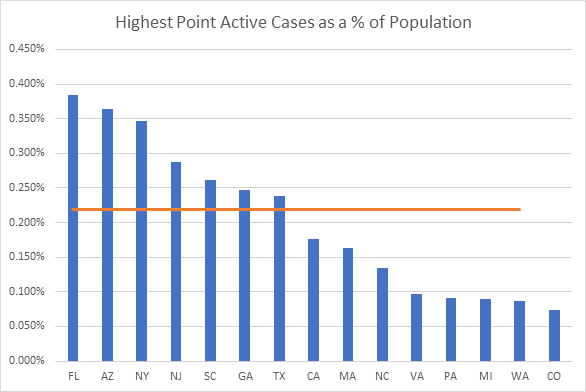
I’ve updated the graph of peak cases as a percentage of the population:

Here is what is remarkable. Every state on this list has peaked, some more definitively than others. In general, the closer the state is to the right side of the graph, the more tenuous the decline, and the more I’m likely to believe there may be more growth coming. But as of now, the only state showing a pattern of growth is VA, and even that’s hard to decipher as VA has had a data anomaly recently (see below).

Known active cases continue a steady decline nationally. In fact, we’re now down about 94,000 cases from the peak, about 20%.

The miraculous recovery story is Arizona, which was at the top of the news for being “out of control” a month ago, and is now down over 2/3 from the top!

As always, feel free to send me your questions about my assumptions, methodology, or modeling in general.

  • Likely date of active case peak (Chalke modeling): July 23
  • Likely date of peak deaths (IHME): April 16 (last revision on August 6)
  • Total Test Results reported today: 711,984 (very high)
  • Total Pending tests reported today: 3,871 (extremely low)
  • National reported case Growth Rate today: 1.03% (lowest growth rate since June 15)

Shane Chalke Interviews

https://www.fredericksburg.com/opinion/editorial-unlock-demographically-not-geographically/article_a62e6e70-dccd-51cf-b7b2-16d77a90fd9c.html

Website

Groom Ventures has agreed to host a website that will archive my daily reports, and supplement with other commentary. John Groom worked at one of my companies back in the day, and is an excellent writer. The website is: www.howmuchrisk.com For those of you that post my daily report on Facebook, let me suggest you link to this site, as the direct Facebook posts don’t seem to copy the graphs.

Daily Analysis

Here is the national picture. We’ve dropped about 94,000 known active cases since the peak of July 23rd. That’s a 20% decline. As during the first wave which peaked in April, the biggest declines are in the hardest hit states such as Arizona, Florida, and California.

Look at the daily new cases. We’re looking at a broad pattern of decline since mid-July. However, we haven’t seen any decline for a week now, so that has my antennae up.

The daily death count is flat for 3 weeks now. Here is the picture:

We’re still seeing the daily death count much smaller in relation to case count than we experienced in April. As predicted, daily deaths have flattened out over the past week, and I expect them to begin declining in about 2 weeks.

Here are the daily deaths per 1,000 known active cases. This disease is now far less deadly than it was in April, when deaths per active case were 4 – 5 times higher. This is very good news.

On to the states.

My goodness, look at Arizona. This is remarkable. I’m modeling known active cases in the state down an almost hard to believe 67% from their peak just one month ago. Sadly, you won’t see this in the news.

SC is also looking quite good. SC is now down 37% from the peak. Note that South Carolina double counts cases, as they treat each positive test as a new case (per The COVID Tracking Project).

Here is Florida – another strong recovery story. Interestingly, I noticed Miami flattening first, but Miami is recovering at a slower pace than the rest of the state. Florida peaked high, at 0.38% of the population, so I think this peak will hold. Florida is now down 45% from the top.

California looks good, down 36% from the peak. However, I’m less confident that California is over the worst, since the state peaked at only 0.18% of the population, and that’s a little low according to my theory. It could be that the lower population density results in a lower peak. Let’s hope so. As always, I need to report that California is one of the states that counts tests rather than people.

Georgia’s recovery is not as pronounced as the other states hit hard in late June. Georgia hit a high of 0.25% of the population, so I’m thinking this could be the ceiling, but the pattern is just different enough that I have some skepticism. Note here again, the case numbers are exaggerated. Georgia counts each positive test as a case (according to The COVID Tracking Project).

Texas is looking like Georgia now. Down from the peak, but not definitively in decline. I’m suspicious there could be more to come here. Note that Texas also reports positive tests as cases, so is doing some level of double counting.

NC is down 22% from the peak, but the peak was at a very low level (0.14%). Nonetheless, NC new cases are in decline, so the pattern looks good. Notice that spike in VA – they released a backlog of testing data on August 7th, and the various tracking sites, including The COVID Tracking Project, pick them up as new cases. Virginia is working to place the cases back on the correct dates on their website, and eventually the Tracking Project will catch up with this, but for now we’ll see this bump – it is NOT indicative of a surge in cases.

Here is the daily death report for NC. We’re seeing a mild upward slope in daily deaths, but I think this will reverse in the next week or two, as known active cases are steadily declining.

Washington could have peaked, but I remain skeptical, as the high water mark you see here is at just 0.087% of the population. That peak is now 21 days old, so that’s hopeful.

Here are NY and NJ – both continue their slow declines, and both are at small percentages of the population.

Here is Massachusetts, still working its way through the bubble of new historical cases caused by reporting errors at the very end of July (https://www.wwlp.com/news/state-politics/reported-error-caused-spike-in-massachusetts-covid-19-numbers/).

…And here is Michigan. Looking beautiful until June 10th, then beginning a steady upward drift. Michigan peaked at a low percentage of population (0.089%), so may continue to grow if my theory is correct. It is just one of several states that peaked early and low, and doesn’t seem to be done with COVID yet. Nonetheless, MI has been flat for nearly 3 weeks now. I have no idea what is likely to happen here.

PA’s decline is now 10 days old. Encouraging, but I believe PA has more growth to come, as the peak was very low (0.091% of the population).

And finally, here is Colorado. Colorado is one of the states that has had aberrations in their data. I still report it, but I’ve shied away from any conclusions in this state due to the data irregularities. Very small numbers here. Colorado peaked at a very small percentage, so could peak again as well.

So that’s it for today. I’ll report again on Thursday unless something notable happens between now and then.

The numbers are still very small as a percentage of the population. Unless you’re in a high density area, your chances of contracting COVID are very small. However, even though the probability is very small, that doesn’t help if you’re the one catching it. Everyone please continue to be as cautious as you feel necessary.

–Shane Chalke, FSA
Categories
COVID Archives

National active cases drop by 84,000 in the past two weeks…

Last report I talked about why the population ceiling for known active cases is so low. I’ve pinned that discussion to the bottom of this report in case you want to look at it again. In any event, it’s been a puzzle as to why more people don’t get COVID. It seems from the data that known active cases in any geographical area hit a hard ceiling of 0.25% to 0.50% of the population, then begin a downward path. I’ve come to the tentative conclusion that this is a result of a substantial percentage of the population with some resistance to the disease. I’m not a disease expert, but I’ve been seeing more academic research pointing in this direction. Here are two relevant articles:

https://www.cell.com/cell/pdf/S0092-8674(20)30610-3.pdf This one suggests that 40-60% of the unexposed population has some level of latent COVID resistance.

https://science.sciencemag.org/content/early/2020/08/04/science.abd3871.full This one suggests 20 to 50%.

Both articles suggest that COVID shares the same T-cell response with the common cold, although both caution that this is speculative at this point. However, this is where my belief stands until we find a better explanation of this diseases’ slow propagation. It was unusual that COVID broke from exponential growth as early as March. Here is a quote from my March 25th report:

“A day or two early to make any conclusions, but it’s clear break from the previous exponential curve. “

That was early on, when we had just over 50,000 cumulative reported cases. We all expected the propagation to follow an exponential path for much longer than that. However, this disease slowed much earlier than anyone forecast. I believe the cross-reactivity with other corona viruses is the only explanation currently on the table. Could this be wrong – sure. I’m completely willing to adopt a new theory when a better one comes along, or this one is proved or disposed of over time. I am happy to see research moving in this direction, so we’ll know in time.

As always, feel free to send me your questions about my assumptions, methodology, or modeling in general.

  • Likely date of active case peak (Chalke modeling): July 23
  • Likely date of peak deaths (IHME): April 16 (last revision on August 6)
  • Total Test Results reported today: 731,700 (very high)
  • Total Pending tests reported today: 3,903 (extremely low)
  • National reported case Growth Rate today: 1.13% (very low)

Shane Chalke Interviews

https://www.fredericksburg.com/opinion/editorial-unlock-demographically-not-geographically/article_a62e6e70-dccd-51cf-b7b2-16d77a90fd9c.html

Website

Groom Ventures has agreed to host a website that will archive my daily reports, and supplement with other commentary. John Groom worked at one of my companies back in the day, and is an excellent writer. The website is: www.howmuchrisk.com For those of you that post my daily report on Facebook, let me suggest you link to this site, as the direct Facebook posts don’t seem to copy the graphs.

Daily Analysis

Here is the national picture. We’ve dropped over 84,000 known active cases in just 2 weeks. We’re now down 18% from this last peak. 14 out of the 15 states that I track are down today – haven’t seen that kind of sweep in a long time. Could we have another wave? I don’t know, but I’m betting not. We’re running out of population centers that haven’t hit the population ceiling yet.

Look at the daily new cases. We’re looking at a pattern of decline for over 3 weeks now. Even the usual intra-week spike didn’t happen this week.

All the news now is about the daily death count, so let’s take a look at that. Here are the daily national deaths:

I expect daily deaths to lag active case count by 2-3 weeks, and the latest IHME model agrees. They expect daily deaths to level out in a few days, and begin declining again in 2 ½ weeks.

To help make sense of the daily death count, I’m going to continue to report my new statistic – daily deaths per 1,000 known active cases. Here it is.

It is obvious that this wave of COVID is far less deadly in relation to active case count. This stat will rise a bit because of the lag between case count and deaths, so should move back below 2 deaths per thousand in the next few weeks. I’ll say it again – this is nothing like April.

On to the states.

As I mentioned last week, Arizona is starting to look a lot like NY or MA, with a hard bounce off the population ceiling and a rapid decline from the peak. This state is down an amazing 52% from the peak of less than four weeks ago. This is a remarkable recovery. I wish the news would report some of this. The purely negative coverage does no one any service.

SC is now 20 days past peak. SC Peaked at 0.26% of the population, so I suspect this peak will hold. SC is now down 32% from the peak. Note that South Carolina double counts cases, as they treat each positive test as a new case (per The COVID Tracking Project).

Here is Florida – another strong recovery story. 21 days past peak active cases. Interestingly, I noticed Miami flattening first, but Miami was declining more slowly than the rest of the state. Florida peaked high, at 0.38% of the population, so I think this peak will hold. Florida is now down 41% from the top.

California continues to look better and better. I think it’s safe to say that California peaked 12 days ago (at least for now). California’s peak was only at 0.18% of the population, so I don’t know what to think here. It could be that the lower population density results in a lower peak. Let’s hope so. As always, I need to report that California is one of the states that counts tests rather than people.

Georgia is looking more and more like it peaked. Georgia hit a high of 0.25% of the population, so this could be the ceiling – just below the average for states that have peaked. Note here again, the case numbers are exaggerated. Georgia counts each positive test as a case (according to The COVID Tracking Project).

Texas is down from their high, but looking pretty flat for the past week. IF Texas peaked, it was 14 days ago at 0.23% of the population. I don’t know if this will hold. Texas also reports positive tests as cases, so is doing some level of double counting.

NC is looking pretty good for three weeks now, but if this is the peak, it’s at a very low level (0.14%). NC will stay in Phase 2 for 5 more weeks. I don’t think the numbers justify that, but the governor wants Phase 2 to overlap the start of the school year, so I suspect there was a fair bit of teacher’s union pressure. If it were me, I would have delayed Phase 3 by one week to let the decline solidify. IHME is now projecting peak daily deaths in NC now around August 20th. It’s interesting how NC and VA now move together since mid-June.

Here is the daily death report for NC. We’re seeing a mild upward slope in daily deaths, but I think this will reverse in the next 2 weeks, as known active cases are steadily declining.

Washington could have peaked, but I’m skeptical, as the high water mark you see here is at just 0.087% of the population. It’s been 18 days, though, so this is hopeful.

Nothing to say about NY and NJ – the picture says it all.

The rise in Massachusetts over the past 8 days is a result of the discovery of new historical cases (https://www.wwlp.com/news/state-politics/reported-error-caused-spike-in-massachusetts-covid-19-numbers/). Massachusetts, to their credit, has been carefully working to place the new cases on the appropriate historical dates, but the aggregation sites pick them up as new cases, as I’m showing here. It doesn’t mean growth – just the opposite. This will work its way through the numbers over the next week or so.

…And here is Michigan. Looking beautiful until June 10th, then beginning a steady upward drift. Michigan peaked at a low percentage of population (0.089%), so may continue to grow if my theory is correct. It is just one of several states that peaked early and low, and doesn’t seem to be done with COVID yet. Nonetheless, we see a nice drop over the past 5 days.

PA’s decline is now 7 days old. Encouraging, but I believe PA has more growth to come, as the peak was very low (0.091% of the population).

And finally, here is Colorado. Colorado is one of the states that has had aberrations in their data. I still report it, but I’ve shied away from any conclusions in this state due to the data irregularities. Very small numbers here. Colorado peaked at a very small percentage, so could peak again as well.

So that’s it for today. I’ll report again on Sunday or Monday.

The numbers are still very small as a percentage of the population. Unless you’re in a high density area, your chances of contracting COVID are very small. However, even though the probability is very small, that doesn’t help if you’re the one catching it. Everyone please continue to be as cautious as you feel necessary.

–Shane Chalke, FSA
Categories
COVID Archives

Why does COVID peak at such a low percentage of the population?

I’ve talked a lot over the past weeks about how COVID known active cases tend to peak in the range of 0.25% to 0.50% of the population in a given area, then decline. For the longest time it has puzzled me. However, I’ve been seeing more and more theories about full or partial immunity in a large swath of the population. Although I know little about medicine, this is quite congruent with the data, so I tend to believe it has some validity. Here is an article published today on CNN by Dr. Sanjay Gupta, postulating that as much as 50% of the population carries some level of built in resistance to COVID: https://www.cnn.com/2020/08/02/health/gupta-coronavirus-t-cell-cross-reactivity-immunity-wellness/index.html

This may be the missing piece of the puzzle. I’m seeing a ceiling in known active cases of, let’s say 1/3 of one percent. Now bear with me for a little arithmetic — When a location reaches this threshold, roughly 5 times the active case count has confirmed positive, so that means something over 1.5% of the population has been confirmed to have had COVID. However, we know that the actual prevalence of the disease is a large multiple of known cases. There is quite a range here based on the various antibody studies, but the average consensus seems to be about 10x. Assuming that, when a locality reaches the ceiling, perhaps 15% of the population has had COVID in total. If we add this 15% to the 50% of the population that has some level of innate immunity, we have 65%, which is right in the range of herd immunity.

It’s puzzled me for quite some time why so few people contract this disease. Even with a prevalence multiplier of 10x, we’re just now (after 5 months) seeing numbers of cases that match the flu each year. If it’s so contagious (I also remain skeptical about that), and it doesn’t attenuate in the summer, why so few cases? I know there are a lot of assumptions in my arithmetic exercise above, but it’s the only theory that matches the data so far, so I’m inclined to believe it until we have a better explanation.

As always, feel free to send me your questions about my assumptions, methodology, or modeling in general.

  • Likely date of active case peak (Chalke modeling): July 23
  • Likely date of peak deaths (IHME): April 16 (last revision on July 30)
  • Total Test Results reported today: 725,902 (very high)
  • Total Pending tests reported today: 3,888 (extremely low)
  • National reported case Growth Rate today: 1.06% (very low)

Shane Chalke Interviews

https://www.fredericksburg.com/opinion/editorial-unlock-demographically-not-geographically/article_a62e6e70-dccd-51cf-b7b2-16d77a90fd9c.html

Website

Groom Ventures has agreed to host a website that will archive my daily reports, and supplement with other commentary. John Groom worked at one of my companies back in the day, and is an excellent writer. The website is: www.howmuchrisk.com For those of you that post my daily report on Facebook, let me suggest you link to this site, as the direct Facebook posts don’t seem to copy the graphs.

Daily Analysis

This second wave of case growth, which began over 6 weeks ago, seems to have peaked about 10 days ago, and is in solid decline. Here is what it looks like today:

Every one of the 6 hot spots from the beginning of July is level or in decline.

Look at the daily new cases. We’re looking at a pattern of decline for about 2 ½ weeks now. The growth rate in cumulative cases has also declined – we hit just 1.06% today, a rate we haven’t seen since June 15th.

All the news now is about the daily death count, so let’s take a look at that. Here are the daily national deaths:

Deaths have risen from roughly 500 per day at the end of June to something over 1,000 a day over the past week. Some of this is reclassification of deaths (https://www.forbes.com/sites/karenrobinsonjacobs/2020/07/28/reporting-changes-for-covid-19-deaths-in-texas-florida-may-give-ammunition-to-hoax-believers/#55a29ad7547e) but not much of can be explained this way. We are seeing a rise in daily deaths for about 3 weeks now. I believe it will attenuate soon, as the active case count is falling pretty fast. To help make sense of the daily death count, I’m going to continue to report my new statistic – daily deaths per 1,000 known active cases. Here it is.

It is obvious that this wave of COVID is far less deadly in relation to active case count. It also looks to be fairly stable, at just over 2 deaths per thousand active cases. We are in a much better situation than we were in April.

On to the states.

As I mentioned last week, Arizona is starting to look a lot like NY or MA, with a hard bounce off the population ceiling and a rapid decline from the peak. This state is down an amazing 36% from the peak of less than four weeks ago.

SC is now 16 days past peak. SC Peaked at 0.26% of the population, so I suspect this peak will hold. Note that South Carolina double counts cases, as they treat each positive test as a new case (per The Covid Tracking Project).

Here is Florida – 16 days past peak active cases. Interestingly, I noticed Miami flattening first, but Miami remains flat – it hasn’t declined yet at all, differing from the state as a whole. Florida peaked high, at 0.38% of the population, so I think this peak will hold. Florida is now down 24% from the top.

California continues to look better and better. If California peaked, it was 8 days ago. California’s peak was only at 0.18% of the population, so I keep thinking there is more to come, but let’s hope not. As always, I need to report that California is one of the states that counts tests rather than people.

Georgia is now flat for 15 days. Is this the top for Georgia? I don’t know. Georgia hit a high of 0.25% of the population, so this could be the ceiling – just below the average for states that have peaked. Note here again, the case numbers are exaggerated. Georgia counts each positive test as a case (according to The COVID Tracking Project).

Texas is making good progress. IF Texas peaked, it was 10 days ago at 0.23% of the population. I don’t know if this will hold, but it’s looking promising, down 29% from the top – looking like another Massachusetts. Texas also reports positive tests as cases, so is doing some level of double counting.

NC is looking pretty good for two weeks now, but if this is the peak, it’s at a very low level (0.14%). We’re scheduled to remain in Phase 2 until August 7th, but I’m thinking the case and death numbers are such that we “could” move to Phase 3 then. IHME is projecting peak daily deaths in NC now around August 10th. It’s interesting how NC and VA now move together since mid-June.

Here is the daily death report for NC. We’re seeing a mild upward slope in daily deaths, but I think this will reverse in the next 2 weeks, as known active cases are declining.

Washington could have peaked, but I’m skeptical, as the high water mark you see here is at just 0.087% of the population. It’s been 14 days, though, so this is hopeful.

Nothing to say about NY and NJ – the picture says it all. Interesting that NJ is drifting upward lately, which NY continues to gradually fall. I don’t know what to make of this, but both numbers are small in relation to where they’ve been.

The rise in Massachusetts over the past 4 days is a result of the discovery of new historical cases (https://www.wwlp.com/news/state-politics/reported-error-caused-spike-in-massachusetts-covid-19-numbers/). Massachusetts, to their credit, has been carefully working to place the new cases on the appropriate historical dates, but the aggregation sites pick them up as new cases, as I’m showing here. It doesn’t mean growth – just the opposite.

…And here is Michigan. Looking beautiful until June 10th, then beginning a steady upward drift. Michigan peaked at a low percentage of population (0.089%), so may continue to grow if my theory is correct. It is just one of several states that peaked early and low, and doesn’t seem to be done with COVID yet. Nonetheless, we see a big drop today.

PA has seen a 3 day decline. Encouraging, but I believe PA has more growth to come, as the peak was very low (0.091% of the population).

And finally, here is Colorado. Colorado is one of the states that has had aberrations in their data. I still report it, but I’ve shied away from any conclusions in this state due to the data irregularities. Very small numbers here. Colorado peaked at a very small percentage, so could peak again as well.

So that’s it for today. I’ll report again on Thursday.

The numbers are still very small as a percentage of the population. Unless you’re in a high density area, your chances of contracting COVID are very small. However, even though the probability is very small, that doesn’t help if you’re the one catching it. Everyone please continue to be as cautious as you feel necessary.

–Shane Chalke, FSA
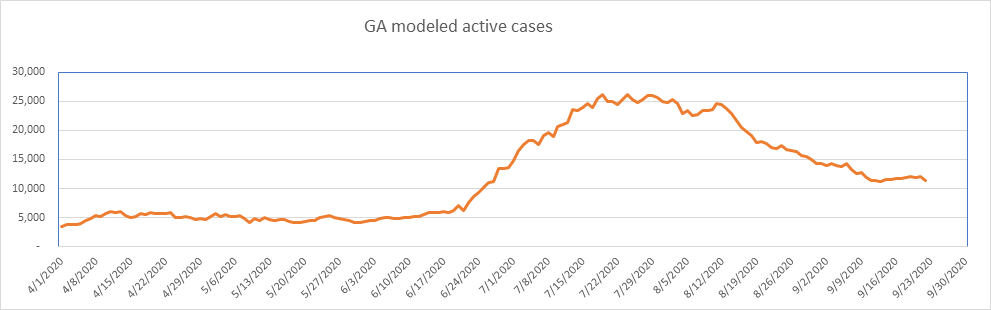
Site powered by   

Foundation for Sane Public Policy

Visit John F. Groom on Amazon and Groom Media Membership

Publicty